


AI is making intelligence cheaper. But that does not mean the whole system becomes cheaper.
April was the month when that idea stopped being theoretical for us.
It became a portfolio question.
Most of the market is still asking whether artificial intelligence will be inflationary or deflationary.
We think that question is too crude.
AI may be deflationary in the work it can replicate: drafting, coding, summarising, researching, analysing, automating.
But it may be inflationary in the bottlenecks it cannot replace: power, compute, data centres, memory, legal rights, trusted distribution, regulation, physical infrastructure, and institutional trust.
That was the thread running through everything we published inside VMF Research in April.
When intelligence gets cheaper, what becomes scarce?
That question shaped our asset allocation work.
It shaped our security selection.
And inside Alpha Tier, it led to actual Model Portfolio changes.
That is why we are launching this new monthly note.
Not to give you a simple archive of what we wrote.
But to show you how the VMF Research process works: how one idea moves from macro framework, to sector opportunity, to security-level thesis, to portfolio action.
That sequence is where the value is.
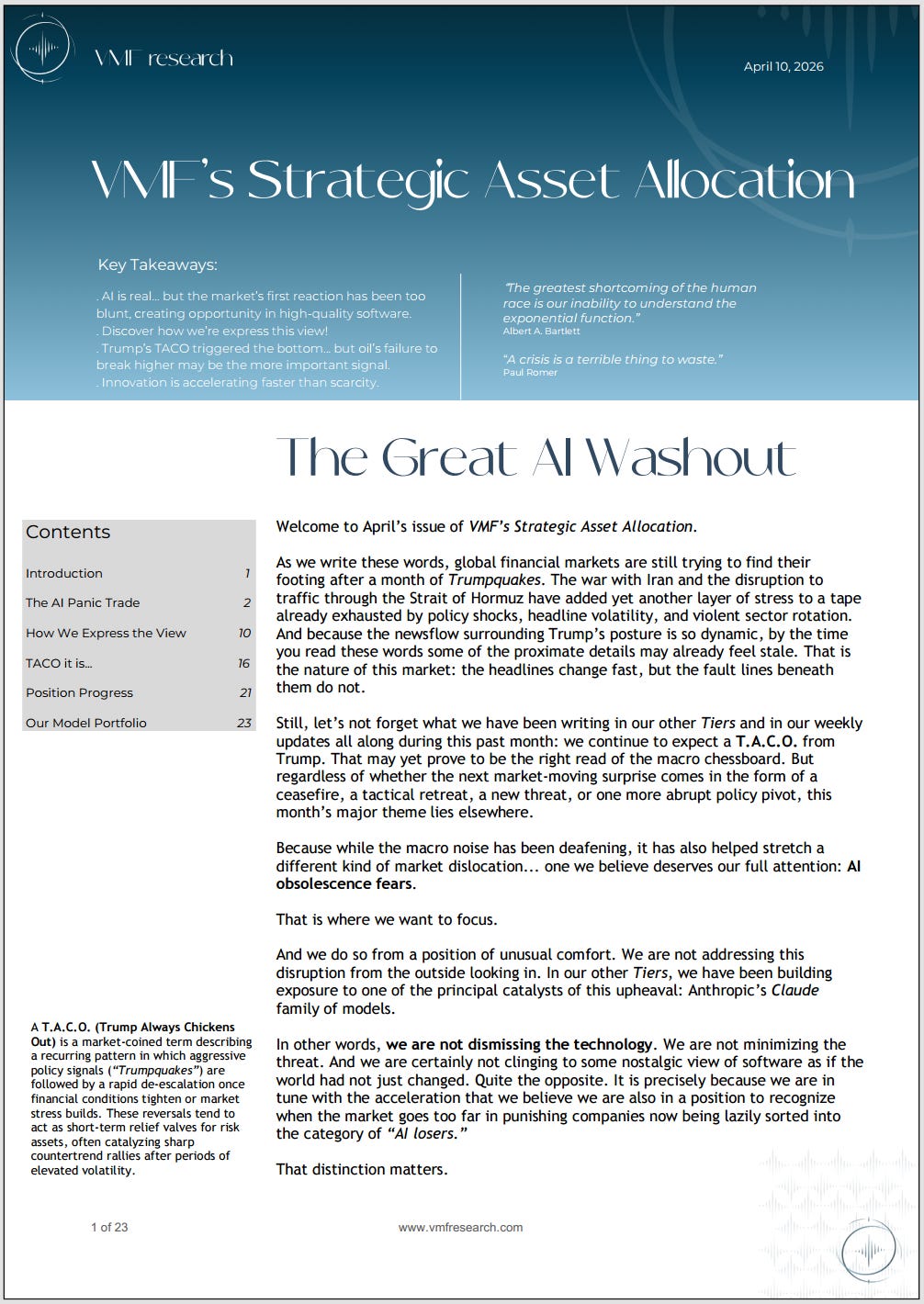
Strategic Asset Allocation: The Great AI Washout
In April’s issue of VMF’s Strategic Asset Allocation, we argued that the market’s first reaction to AI disruption had become too indiscriminate.
AI is real.
The threat is real.
But markets rarely price disruption with a scalpel.
They usually reach for a flamethrower.
That is what happened across software.
The market began selling companies exposed to AI obsolescence fears without carefully distinguishing between fragile point solutions and deeply embedded enterprise systems.
But enterprise software is not a weekend app.
It is often wired into approvals, compliance, client records, reporting systems, workflows, permissions, and years of operational muscle memory.
Replacing it is not like changing a browser plug-in.
It is more like replacing the plumbing in a skyscraper while the building is still occupied.
Our conclusion was simple:
The software panic had gone too far.
Inside the paid issue, subscribers saw how we expressed that view in the Model Portfolio, why we preferred a diversified sector vehicle over a single-stock bet, and how the position fit into our broader asset-allocation framework.
The public point is this:
AI disruption will create losers.
But when the market starts treating an entire sector as if the ending has already been written, investors should pay attention.
That is often where opportunity begins.
From this issue:

Security Selection: The Best Seat in the House
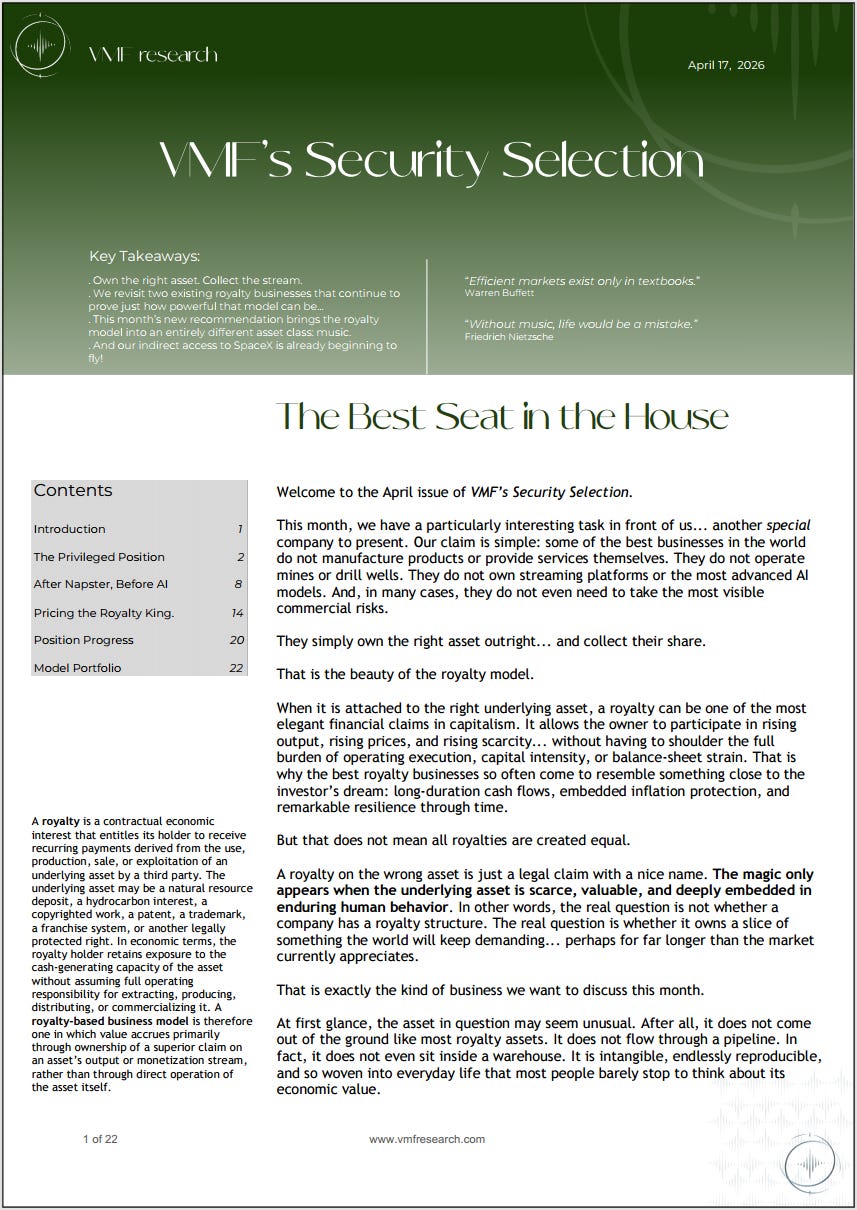
One week later, in VMF’s Security Selection, we moved from software to royalties.
The issue was called The Best Seat in the House.
The idea was simple:
Own the right asset. Collect the stream.
Some of the best businesses in capitalism are not the ones doing the hardest operating work.
They are the ones that own the superior claim.
That is the royalty model.
From this issue:

And in April, we applied that framework to music.
A great song does not deplete when it is consumed.
It can be streamed, licensed, covered, sampled, synchronised, rediscovered, used in advertising, used in games, and potentially licensed into new AI tools.
A mine depletes as it produces.
A great music catalogue can keep earning for decades.
That is why we became interested in Universal Music Group.
The bear case is obvious. Technology has disrupted music before, and AI could do it again.
But our view is different.
When content becomes infinite, authenticated cultural scarcity may become more valuable, not less.
That is what makes UMG interesting.
It is not merely a music company.
It is a rights platform.
And in a world where AI tools may need licensed creative inputs, premium rights may become a more important tollbooth, not a less important one.
Inside the paid issue, subscribers received the full UMG investment case: the sum-of-the-parts valuation, the royalty-like economics, the strategic value of the catalogue, and why Bill Ackman’s public proposal added a live special-situation catalyst to what we already considered a high-quality platform.
That combination matters.
The best investment ideas are rarely just thematic.
They are thematic ideas with a catalyst attached.
Also From this issue:

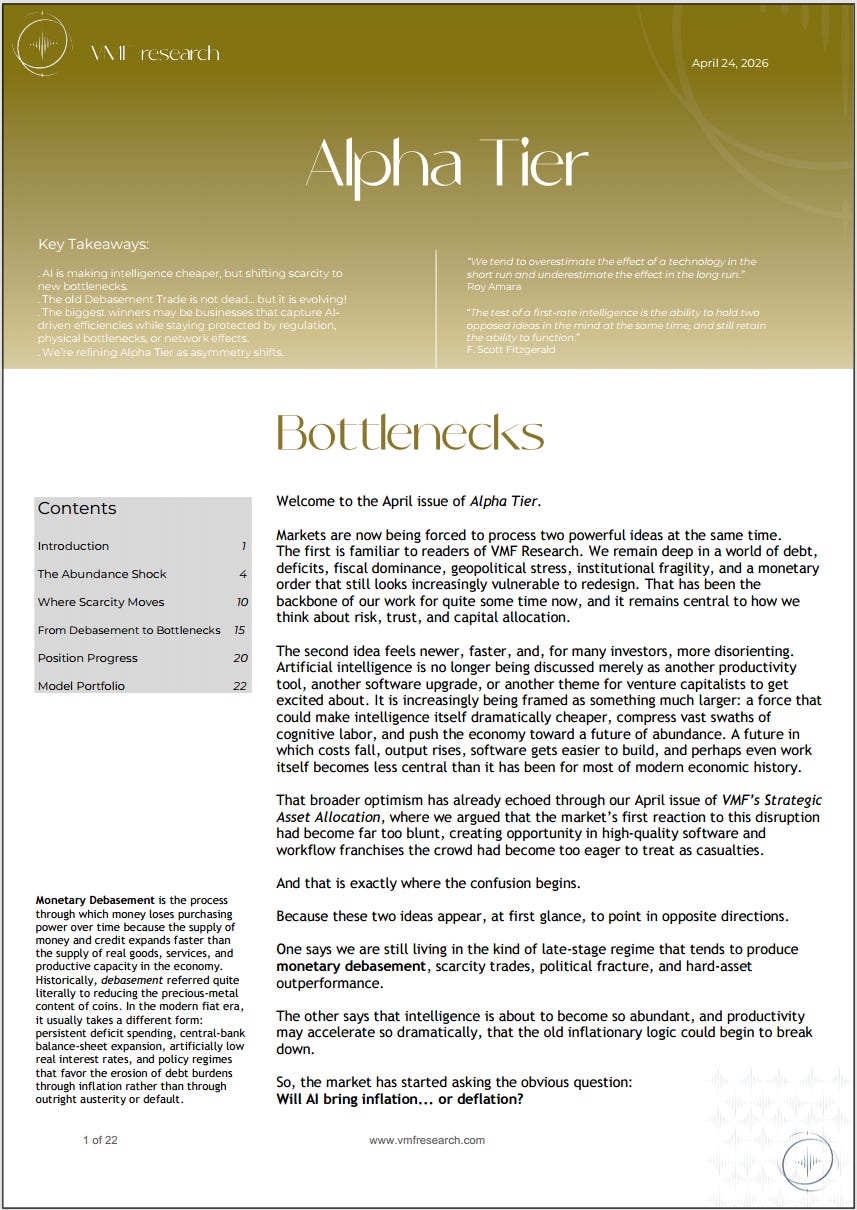
Alpha Tier: Bottlenecks
Then came Alpha Tier.
This is where April’s work became more aggressive.
The issue was called Bottlenecks.
The central claim was this:
AI is making intelligence cheaper, but shifting scarcity to new bottlenecks.
For a long time, Alpha Tier leaned into classic scarcity: gold, precious-metals miners, energy, metals and mining, and select commodity-sensitive markets.
That positioning worked.
But April forced us to refine the framework.
The old Debasement Trade is not dead.
It is evolving.

If the market has already recognised some of the obvious AI bottlenecks (power, uranium, semiconductors, memory, and data centres) then the more interesting opportunities may now sit one step away from the crowd.
Rights.
Rails.
Licensing.
Regulation.
Compliance.
Local physical assets.
Institutional trust.
That was the shift.
Inside Alpha Tier, we trimmed some broader scarcity exposures after strong gains and redirected capital toward more targeted bottleneck ideas.
One was Universal Music Group ($UMG.AS ), giving us exposure to licensed cultural scarcity.
The other remains reserved for paid subscribers.
But the high-level logic is worth sharing.
It is a company tied to the physical infrastructure beneath the AI buildout.
Because data centers do not build themselves out of software demos.
The intelligence layer may be digital.
But the infrastructure beneath it is stubbornly physical.
Electricity needs grids.
Compute needs buildings.
Buildings need materials.
Materials need logistics.
And local physical networks cannot be replicated as easily as code.
That is where the AI discussion becomes far more interesting.
Not in the obvious names everyone is already chasing.
But in the bottlenecks AI still needs in order to scale.
Inside the paid issue, subscribers received the full implementation: the name, position size, entry price, funding source, portfolio impact, and investment rationale.
That is the difference between reading a framework and following a process.
A framework tells you how to think.
A portfolio shows you what the thinking requires.
From this issue:


The One Idea From April
April’s message was simple:
AI does not eliminate scarcity. It moves it.
That idea connected all three publications.
In VMF’s Strategic Asset Allocation, it led us to the software washout.
In VMF’s Security Selection, it led us to premium music rights.
In Alpha Tier, it led us to refine the portfolio around more targeted bottlenecks.
That is the research architecture we are building at VMF Research.
Not isolated opinions.
Not fashionable themes.
A sequence.
A framework.
A portfolio process.
And a willingness to keep refining the thesis as the facts change.
Final Thought
The first phase of the AI trade was about owning intelligence.
The next phase may be about owning what intelligence still needs.
That means asking harder questions:
Who owns the rights?
Who owns the rails?
Who owns the infrastructure?
Who owns the regulated gateways?
Who owns the trusted data?
Who owns the bottlenecks?
That is where we spent April.
And that is where we believe some of the most interesting opportunities may still be hiding.
The free essays on VMF’s Market View will continue to share parts of our work. But the full research process (including model portfolios, position changes, entry prices, valuation work, security-level analysis, and new recommendations) remains reserved for paid subscribers.
To follow the full process as it unfolds, from framework to portfolio action, become a paid subscriber to VMF Research!
Good investing,
Vasco
By the way, have you check Leaderboard section? It tells the story better than any intro, showing our total returns since publication, including multiple triple-digit winners and a consistent record of beating the market while managing risk.