

The market does not reward you for finding something cheap. It rewards you when everyone else is forced to stop ignoring it.
That distinction has shaped our healthcare work from the beginning.
When we first made the case in October 2025, the opportunity was visible in valuation but absent from the tape. Healthcare companies were producing attractive returns on capital, yet many traded at unusually depressed multiples. Biotechnology looked even more extreme. The sector was strategically indispensable, financially neglected and deeply unpopular.
That was enough to establish asymmetry. It was not enough to establish timing.
UnitedHealth tested that distinction almost immediately. The position moved against us as medical costs rose, management turmoil intensified and political hostility towards managed care deepened. The headlines became worse. The valuation became more compelling. The easy response would have been to confuse discomfort with disproof.
We did not.
UnitedHealth has since delivered a total return above 20% from our reference price and outperformed the S&P 500 over the same period. The result matters. The sequence matters more.
We did not discover healthcare after it began working. We remained with the thesis long enough for the evidence to change.
That change is now spreading well beyond one company.
Recent articles on VMF’s Market View have followed the same development from several angles. The China AI Reset examined how rapidly falling intelligence costs could move the AI boom downstream.
The Intelligence Dividend argued that the greatest economic benefit may appear in industries where mistakes consume the most capital. Our latest public Leaderboard showed that healthcare and biotechnology were already contributing several of the strongest results in the VMF Research record.
The separate threads are beginning to converge.
Analysts are raising healthcare earnings expectations after a prolonged period of deterioration. Valuations remain subdued. Global healthcare equities are pressing towards new highs. Biotechnology has already broken out in both absolute and relative terms. Leadership is appearing across managed care, pharmaceuticals, diversified healthcare and individual drug-development platforms.
This no longer looks like one oversold stock catching a bid. It looks increasingly like capital beginning to rotate.
Artificial intelligence is not the only explanation. Patent expirations are forcing large pharmaceutical companies to replenish their pipelines. Biopharma acquisitions are accelerating. Financing conditions are improving. Clinical progress still matters more than any fashionable narrative.
But cheaper intelligence could make the entire system more productive.
Markets will not wait for that productivity to appear neatly in reported earnings. They will begin capitalising it when confidence improves that proprietary biological data, better target selection, more precise patient stratification and stronger trial design can alter the probability of success.
That repricing may already have started.
The section below was first published for paid subscribers in the July issue of VMF’s Security Selection on 17 July 2026 at 9:00 p.m. Eastern Daylight Time. It revisits the original healthcare valuation thesis, examines the improving fundamental and technical evidence, and explains why biotechnology may be moving from neglected optionality to emerging leadership.
The full issue then performs the work Tier Two was built to do. It moves from an attractive sector to the specific businesses we believe are best positioned to capture its changing economics, adding two complementary biotechnology companies to the Quality Model Portfolio.
One owns the discovery machine.
The other owns the tollbooth.
Before we get there, the sector itself must pass a more basic test.
Cheap has to start leading.
Here is the evidence.
Good reading.
Cheap is not a catalyst.
When we first laid out the healthcare opportunity in October 2025, we were explicit about its limitation: valuation revealed the asymmetry, not the timing. The sector already displayed the kind of dislocation that attracts us most: durable economics, high returns on capital and undeniable strategic relevance, obscured by weak sentiment, policy uncertainty and a market still directing the marginal dollar towards technology.
The evidence was unusually broad.
Most healthcare industries were trading at or below the broader market multiple, often near the lower end of valuation ranges extending back more than three decades. Biotechnology stood out. Its historical range was wider than that of almost any other healthcare industry, but the prevailing multiple sat near its lower boundary and well below the S&P 500.
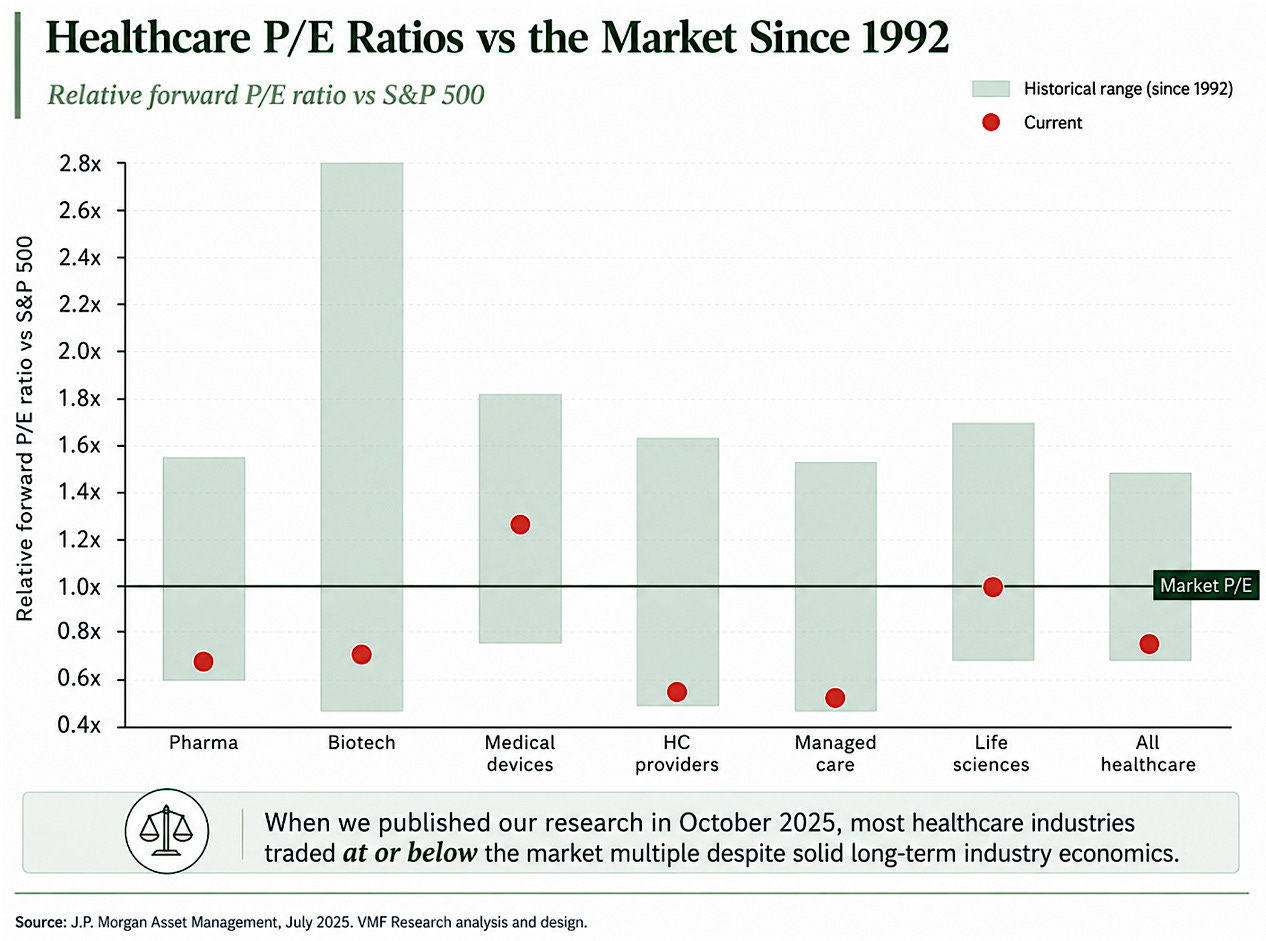
Low multiples alone did not explain the opportunity.
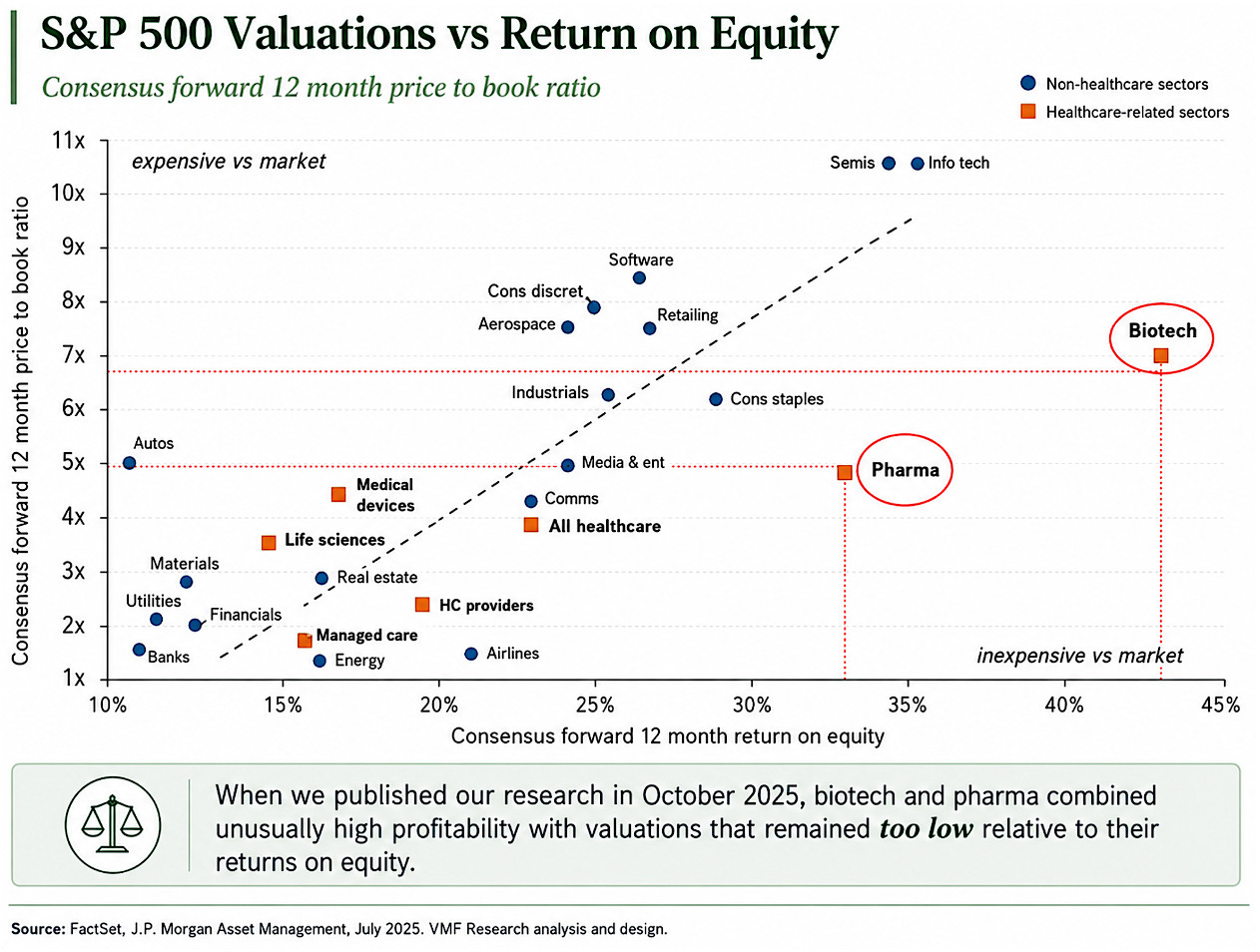
The more revealing comparison placed valuation beside profitability. Investors were paying the highest price-to-book multiples for semiconductors, information technology and software (industries whose strong returns on equity appeared to justify a premium).
Yet pharma and biotechnology were producing similarly attractive returns on shareholders’ capital while trading on the inexpensive side of the market relationship.
The sector was not cheap because its economics were uniformly poor.
It was cheap despite some unusually strong economics.
That work led directly to the addition of UnitedHealth Group ( UNH 0.00%↑ ) to the Quality Model Portfolio.
The timing was uncomfortable.
The position initially moved against us as medical-cost pressure, management upheaval, regulatory scrutiny and hostility towards the managed-care industry intensified. But a difficult entry does not invalidate a sound thesis. It tests whether the investor understands what is temporary, what is structural and what the price already discounts.
UnitedHealth has since produced a total return above 20% from our reference price and has outperformed the S&P 500 over the same period.
The result matters, but the more important point is what it illustrates. We did not arrive at healthcare after the charts improved. We identified the valuation opportunity while the sector was still being used as a source of funds. Today, the original valuation case remains largely intact, but the surrounding evidence is becoming more supportive.
The opportunity is beginning to acquire a catalyst.
Expectations Are Turning First...
The shift is also visible in Europe.
After more than fifteen months of deteriorating estimates, analysts have started upgrading healthcare earnings expectations. The forward earnings of the Stoxx 600 Health Care Index are now improving relative to those of the broader Stoxx 600, even as the sector’s relative price remains close to the depressed levels from which previous rotations began.
The two series do not need to turn simultaneously.
Earnings revisions often improve before price leadership becomes obvious.
The important development is that the fundamental line is beginning to rise while the relative-price line has stopped collapsing. The gap between them creates the possibility that price will eventually follow expectations higher.
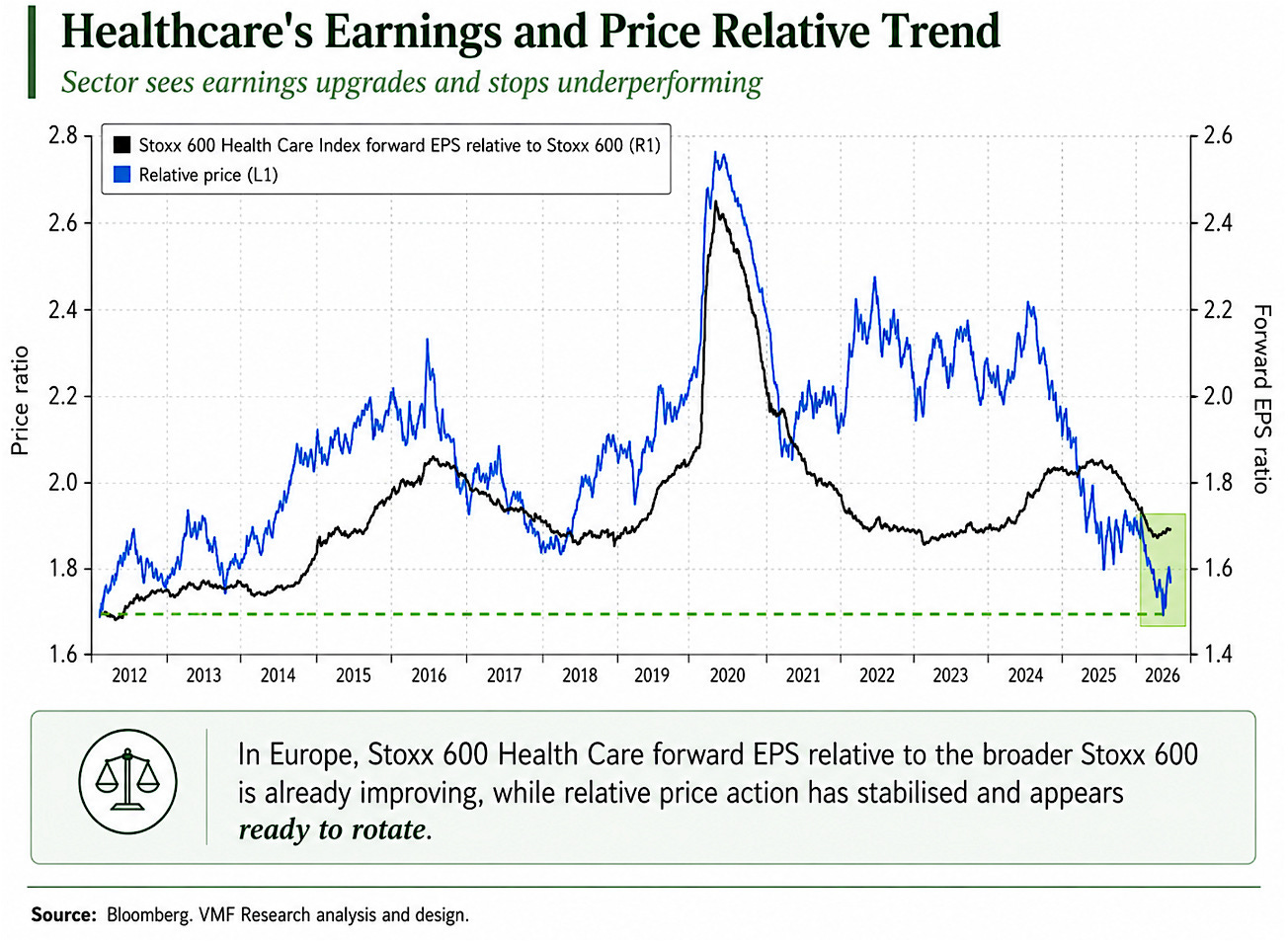
Our original valuation work focused primarily on the United States. Europe is now displaying the same sequence. The fundamental line divides the Stoxx 600 Health Care Index’s expected earnings by those of the broader Stoxx 600 (when it rises, analysts expect healthcare profits to grow faster than the market). The relative-price line divides the healthcare index by the broad index (when it rises, healthcare is outperforming). Fundamentals have turned first. Price has stopped deteriorating. The gap between them is the opportunity.
The sector is also beginning that repair from a favourable valuation base.
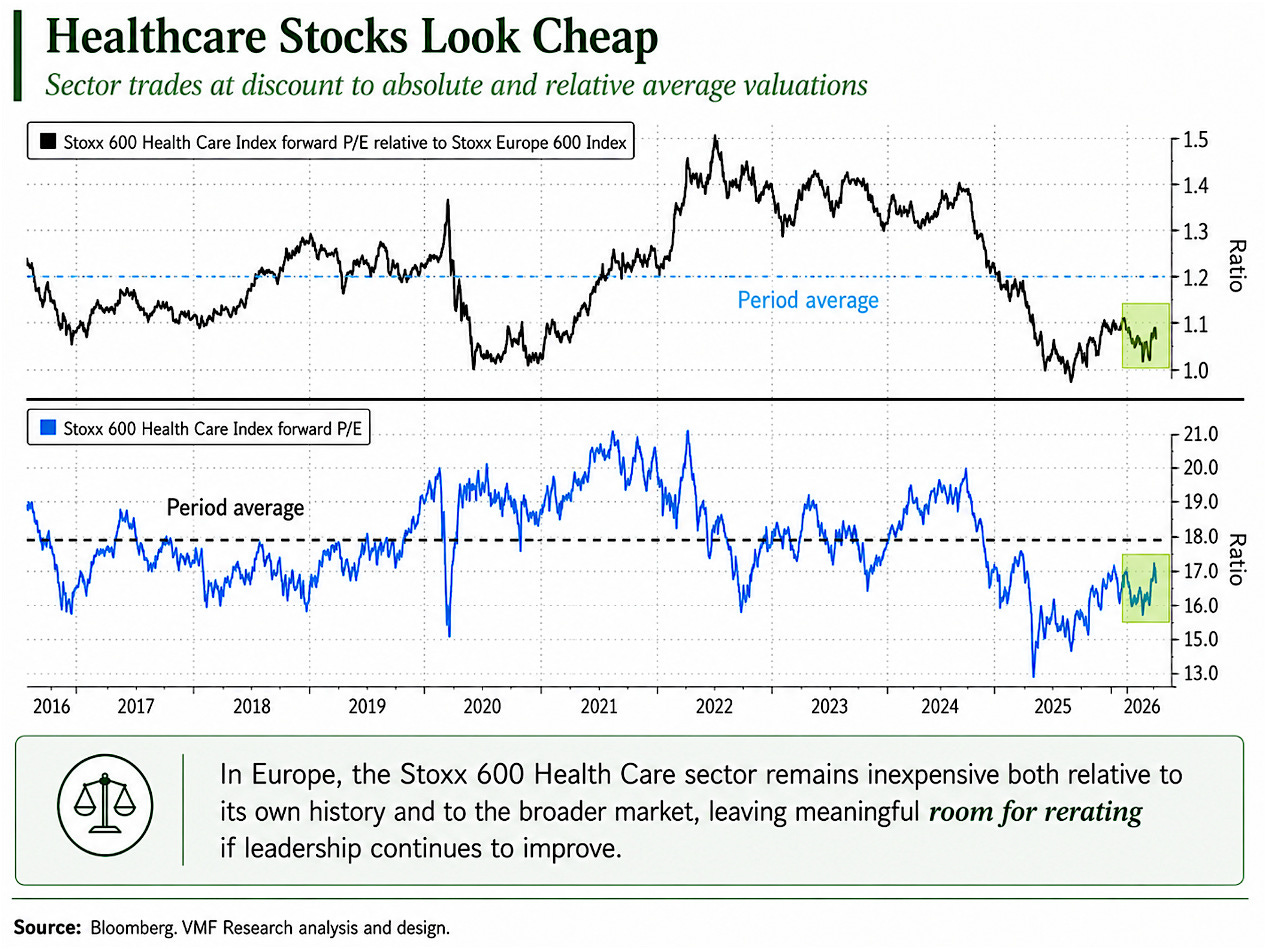
European healthcare remains below its historical average on both measures shown in the next exhibit. Its forward P/E is still inexpensive in absolute terms, while its relative P/E versus the wider European market remains deeply discounted. Recent price stabilisation has therefore not eliminated the valuation opportunity. It has merely reduced the probability that the market will continue ignoring it indefinitely.
This is where our interpretation begins to diverge from the emerging analyst consensus.
The analyst community is increasingly prepared to acknowledge that artificial intelligence may provide structural support to healthcare. Yet the prevailing assumption remains that any meaningful impact will be distant... that the technology may ultimately improve drug discovery, clinical development and operational efficiency, but will contribute little to the sector’s near-term investment case.
That conclusion may prove too conservative.
The full effect on revenues, margins and reported earnings will take time. Biological research cannot be reduced to a software-release cycle. Molecules still need to survive clinical trials. Regulators still need evidence. Manufacturing and commercialisation still matter.
But share prices do not wait for the full economic benefit to appear in the financial statements.
Markets capitalise changing expectations.
If investors become more confident that cheaper intelligence can improve target selection, molecular design, patient stratification, trial enrolment and the utilisation of proprietary biological data, the valuation of the companies controlling those assets can change long before the resulting medicines reach patients. The immediate catalyst does not need to be a visible AI revenue line. It can be a change in how the market values scientific productivity, data ownership and the probability of future success.
That repricing may already be beginning.
The Rotation Is Broadening
The Relative Rotation Graph below compares every major S&P 500 sector ETF against the broader market. We have also added the healthcare exposures most relevant to our own research: IXJ ( IXJ 0.00%↑ ) and SBIO ( SBIO 0.00%↑ ) , held through Tier One and Alpha Tier, together with Roivant Sciences, Novo Nordisk and UnitedHealth Group.
The result is unusually revealing.
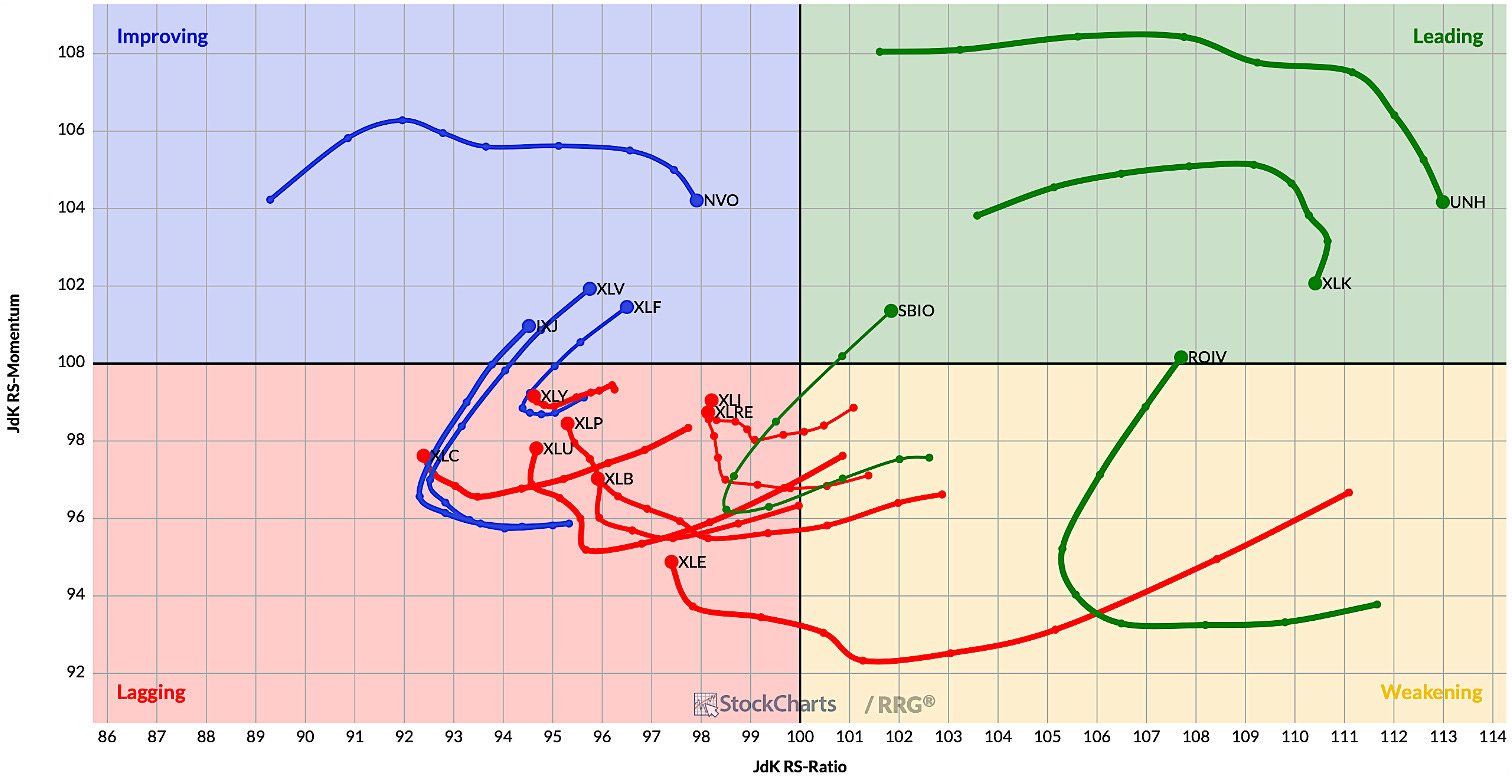
Roivant ( ROIV 0.00%↑ ), UnitedHealth ( UNH 0.00%↑ ) and SBIO all sit in the Leading quadrant.
That placement means they combine above-market relative strength with positive relative momentum. They are not merely rebounding from depressed levels. They are already behaving as leaders.
Each arrived there through a different route.
Roivant reflects the market’s growing recognition of a differentiated biotechnology platform and a record of disciplined asset monetisation. UnitedHealth reflects the recovery of a deeply impaired but highly valuable healthcare franchise. SBIO captures the improving appetite for smaller biotechnology companies with clinical, regulatory and strategic optionality.
Three distinct expressions of the same broad opportunity are now leading the market.
The Improving quadrant is equally important.
XLV, IXJ and Novo Nordisk sit there with strengthening relative momentum, even though their relative-strength ratios have not yet crossed into leadership. On a conventional price chart, that may look like incomplete confirmation. On an RRG, it is precisely the transition investors should watch.
Markets rotate.
Leadership rarely appears fully formed. Securities ordinarily move from Lagging into Improving before crossing into Leading. The direction and persistence of the tails therefore matter as much as the current quadrant. XLV, IXJ and Novo Nordisk are not guaranteed to complete that rotation, but the probability is rising as their relative momentum continues to strengthen.
The broader message is that healthcare leadership is no longer confined to one stock, one subsector or one investment style.
It is spreading across:
Managed care.
Large-cap pharmaceuticals.
Broad global healthcare.
Emerging biotechnology.
Individual drug-development platforms.
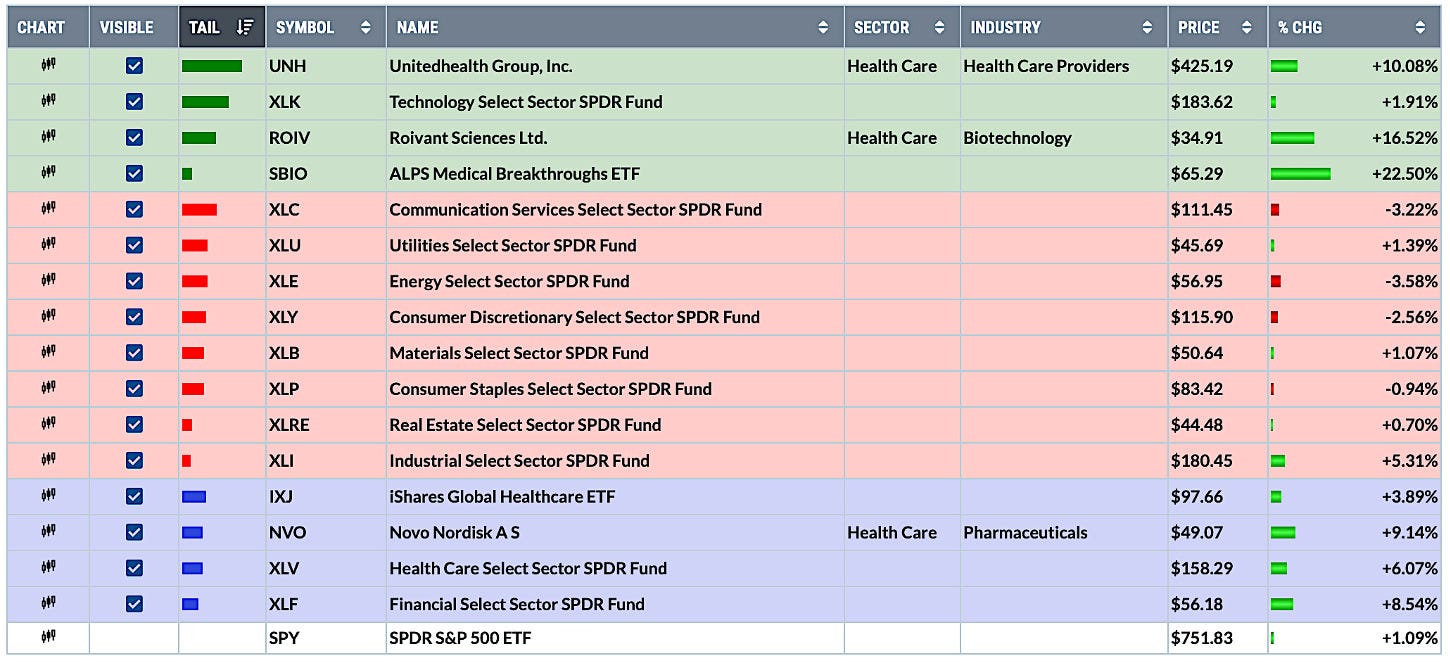
The accompanying table reinforces the distinction. UnitedHealth, Roivant and SBIO have produced particularly strong recent advances, but the improvement extends further. Novo Nordisk, XLV and IXJ are also moving higher, consistent with their progression through the Improving quadrant.
That breadth matters.
A single successful clinical trial can propel one biotechnology company. A relief rally can temporarily lift one damaged insurer. A genuine sector rotation looks different. It begins to appear across instruments with separate business models, market capitalisations and fundamental drivers.
We are increasingly seeing the latter.
Biotech Breaks First
The final chart in this section brings the argument into sharper focus.
SBIO has broken above a resistance area that had contained the ETF since the previous biotechnology cycle. Price is now comfortably above its rising medium- and long-term moving averages, while relative strength against the broader equity market has completed a prolonged base and is moving higher.
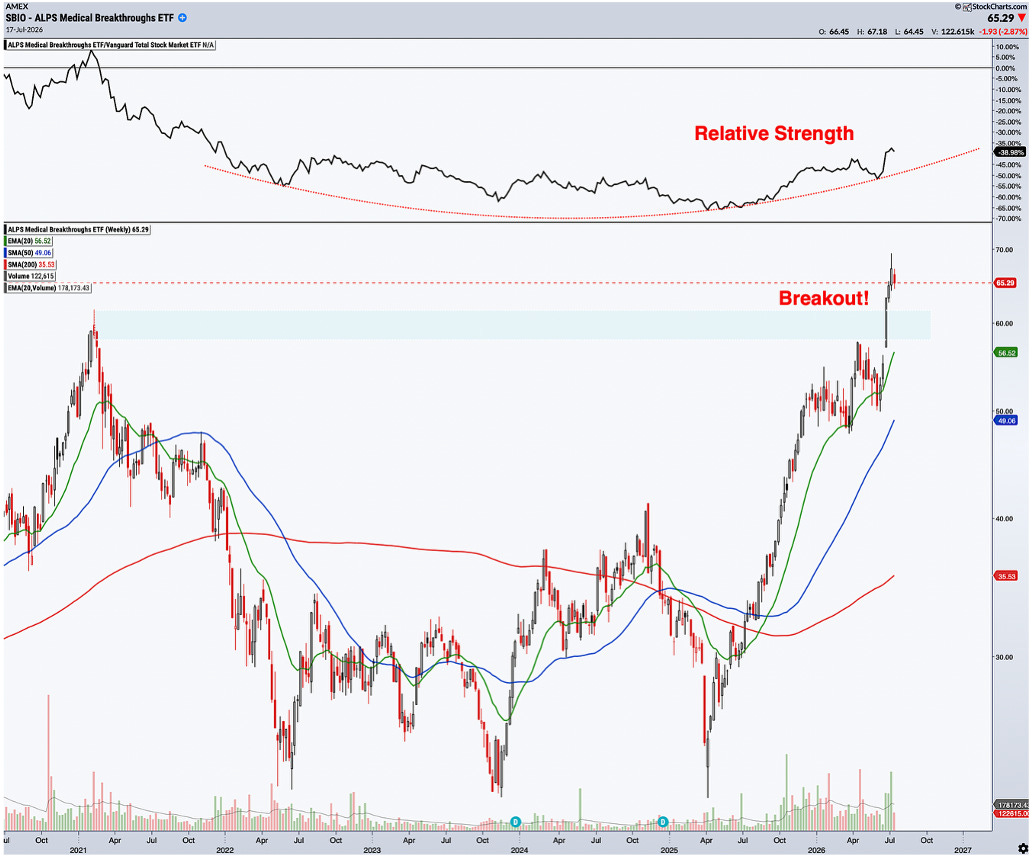
The technical structure is important for two reasons.
First, biotechnology often acts as the higher-beta expression of the broader healthcare complex. When investors become more willing to underwrite scientific, clinical and financing risk, biotechnology can begin outperforming before the more defensive parts of the sector achieve full leadership.
Second, the breakout suggests that the market is beginning to look beyond the sector’s familiar objections. Policy uncertainty, capital scarcity, clinical failure and long development timelines have not disappeared. What has changed is the price investors appear willing to pay for the opportunity on the other side of those risks.
When we first wrote about healthcare in October 2025, the thesis rested predominantly on valuation. The sector was cheap, profitable and strategically indispensable... but the tape was still hostile.
Today, the setup is more complete.
The valuation case remains intact, earnings expectations are improving, AI is introducing a potentially important new source of productivity, and the market is confirming the change through widening participation and outright biotechnology leadership.
The opportunity is there.
Increasingly, so is the timing.
That brings us to the work Tier Two is designed to perform: moving from an attractive sector to the specific businesses best positioned to capture its changing economics.
This month, we are adding two of them.
You might also like reading, The Intelligence Dividend - How cheaper AI cuts biopharma’s $300B failure risk and drives the next healthcare rotation:

A quick note on accountability.
We don’t publish these theses to be right on paper. We publish them to express edge in the real economy. Our Leaderboard shows the exact scorecard since inception, tracking every position, our compounding outperformance against the market, and the triple-digit winners we’ve captured along the way.
Important Disclosure
This article contains general investment research produced by Vasco Marques de Freitas, CFA, CMT, Founder and CEO of VMF Research, Lda. It reproduces an excerpt from the July 2026 issue of VMF’s Security Selection. The research, views and references to VMF Research’s Model Portfolios are stated as of 17 July 2026, 4:00 p.m. Eastern Daylight Time, unless another date is expressly identified. The original issue was first disseminated to paid subscribers on 17 July 2026 at 9:00 p.m. Eastern Daylight Time.
The publication contains information recommending or suggesting an investment strategy. It is not personalised investment advice and does not consider any reader’s individual objectives, financial circumstances, knowledge, experience, liquidity requirements or tolerance for risk. VMF Research’s Model Portfolios are illustrative research portfolios and do not represent client assets or transactions executed by VMF Research.
The analysis combines thematic, fundamental, valuation and market research within a medium- to long-term investment framework. Sources and the basis for material factual claims are identified throughout the article. Views, assumptions and portfolio conclusions may change as scientific, clinical, regulatory, corporate, macroeconomic or market evidence evolves. They are reviewed through VMF Research’s monthly publications and may be updated through weekly or ad hoc research.
Performance figures and relative-return comparisons use the reference prices and periods identified in the article. Returns on open positions have changed since the research cut-off. The figures relate to VMF Research recommendations or illustrative Model Portfolio allocations, do not represent returns earned by clients and should not be interpreted as a complete measure of the performance of VMF Research or any Model Portfolio.
Healthcare and biotechnology investments involve substantial risks, including clinical-trial failure, regulatory rejection, loss of intellectual-property protection, financing and dilution risk, adverse pricing or reimbursement decisions, political intervention, scientific uncertainty, product concentration, market volatility and the possible loss of capital. Artificial intelligence may improve research productivity without producing commercially successful medicines, higher corporate earnings or superior investment returns. Technical and relative-strength signals may also fail.
Disclosure of interests: as of the research cut-off, neither VMF Research, Lda. nor Vasco Marques de Freitas personally held a position in any financial instrument mentioned in this article. Legal entities controlled by Vasco Marques de Freitas held long positions in UnitedHealth Group Incorporated and Novo Nordisk A/S, both of which are discussed in the article. These holdings may benefit from increases in their respective market values and constitute financial interests and potential conflicts of interest. Readers should consider them when evaluating the analysis. Their existence does not validate any conclusion, reduce the risks described or imply that either investment is suitable for a particular reader.
Past performance is not indicative of future results. Readers should conduct their own analysis and, where appropriate, consult an authorised financial intermediary or adviser before making an investment decision.