

Intelligence is getting cheaper. Failure remains brutally expensive.
That gap may determine where the next fortunes in AI are made.
In The China AI Reset, we examined the supply shock now unfolding across artificial intelligence. Chinese laboratories are approaching the technological frontier while offering capable models at prices that could accelerate adoption across the global economy.
This article follows the money.
A cheaper model creates limited value where the underlying task was already inexpensive. The economics become far more powerful where a poor decision can waste years, destroy hundreds of millions of dollars or prevent a valuable product from ever reaching the market.
Healthcare lives inside that world.
Drug discovery is an enormous search problem conducted under punishing uncertainty. Researchers must select the right biological target, design the right molecule, identify toxicity early, choose the patients most likely to respond and construct a clinical trial capable of demonstrating the effect. A mistake at any stage can consume vast amounts of capital before the company learns that it followed the wrong path.
Better intelligence does not need to eliminate failure to transform those economics.
It only needs to improve the odds.
A slightly better target. An earlier warning. A more precise patient population. A weak programme abandoned before another expensive trial. Small improvements compound quickly when the existing failure rate is so high and the potential value of success is so large.
That is the Intelligence Dividend.
It will not accrue evenly across the economy. It should be largest where knowledge is scarce, proprietary data are valuable, experimentation is costly and better judgment changes the distribution of outcomes.
Biotechnology sits near the centre of that opportunity.
The theme is already appearing in our public record.
In the Leaderboard article, using market prices as of 2 July 2026, biotechnology occupied three places in VMF Research’s Top 10: Grail with a closed 272% gain, Roivant Sciences at 215% while still open, and SBIO at 79%. Returns on the open positions have moved since that snapshot, but the broader signal remains important: strength was no longer confined to one company or one corner of the sector.
It was spreading across diagnostics, an individual biotechnology business and a diversified sector vehicle.
That breadth is emerging alongside a powerful fundamental backdrop. Large pharmaceutical companies need to replenish ageing pipelines, biopharma M&A is accelerating, financing conditions are improving, and AI is becoming more useful across target selection, molecular design, clinical development and patient identification.
The pieces are beginning to connect.
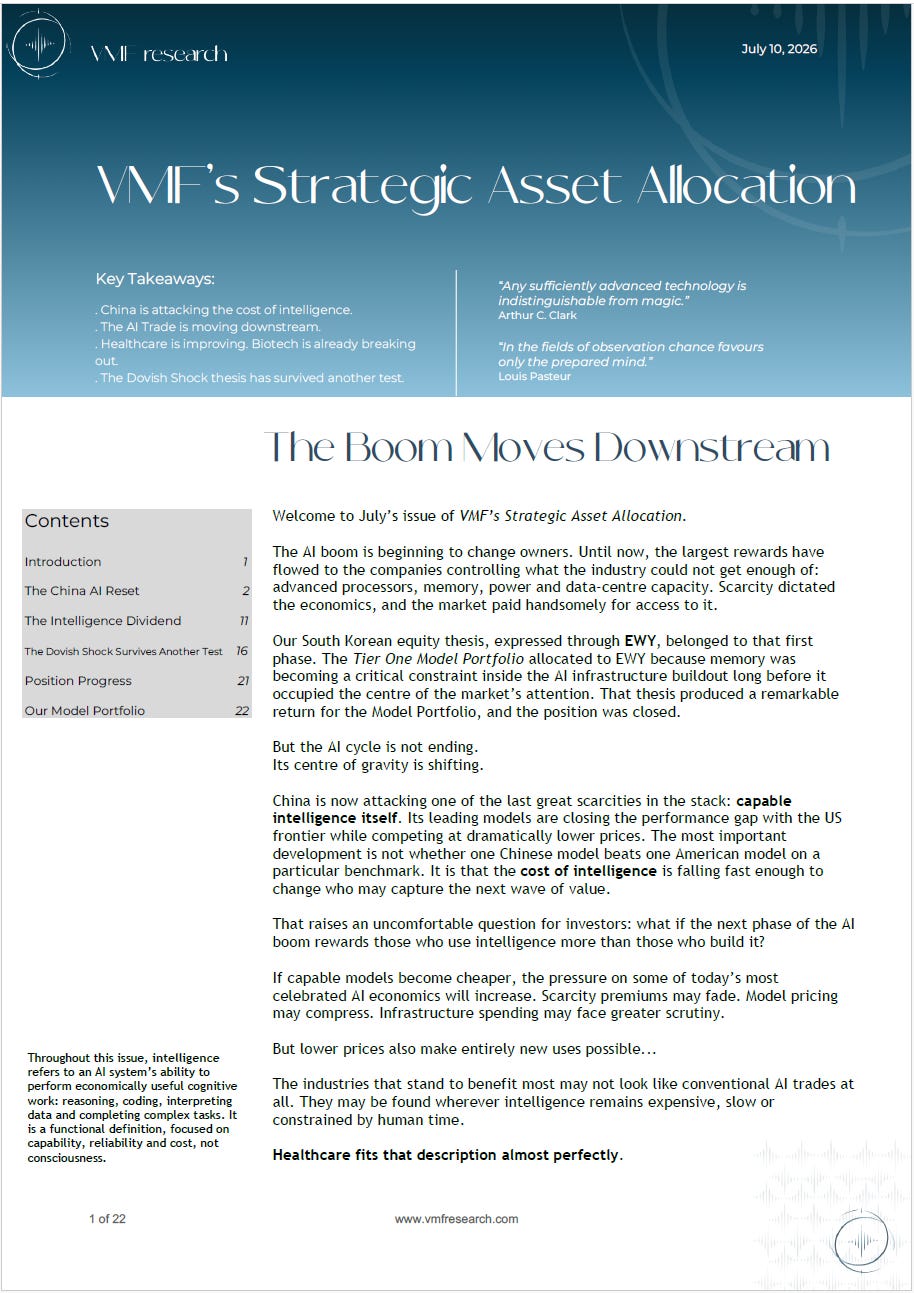
Our previous article examined why capable intelligence may become dramatically cheaper. The excerpt below turns to one of the sectors where that lower cost could create the greatest economic value.
Healthcare contains some of the world’s most expensive decisions.
Biotechnology contains some of its most expensive failures.
That is precisely why the Intelligence Dividend could be so large.
The excerpt below comes from July’s issue of VMF’s Strategic Asset Allocation. It examines why healthcare may be moving from defensive laggard to emerging market leader, why biotechnology is already further ahead in that rotation, and how AI, the pharmaceutical patent cliff and recovering M&A could reinforce one another.
The full July issue connects that sector rotation with China’s cost advantage, the evolving liquidity backdrop and the positioning of the Tier One Model Portfolio.
The first wave of AI spending built the machine.
The Intelligence Dividend will belong to those who use it to make better decisions where being wrong costs the most.
Here is the excerpt.
Good reading.

Healthcare is where the downstream AI thesis stops being abstract.
The sector contains some of the most valuable workflows in the economy. It also contains some of the most expensive mistakes. A failed drug programme can destroy hundreds of millions of dollars. A poorly designed clinical trial can waste years. A missed diagnosis can change a life. An inefficient hospital workflow can absorb labour, capital and time at enormous scale.
The opportunity is not that AI makes healthcare easy.
Nothing makes healthcare easy...
The opportunity is that better intelligence may begin to reduce the cost of failure in a system where failure is unusually expensive. That distinction is important for the Model Portfolio.
In China internet, the thesis is developing faster than the chart. KWEB ( KWEB 0.00%↑ ) may be stabilising. The relative-strength setup is improving. But the market has not yet delivered a clean confirmation.
Healthcare is different...
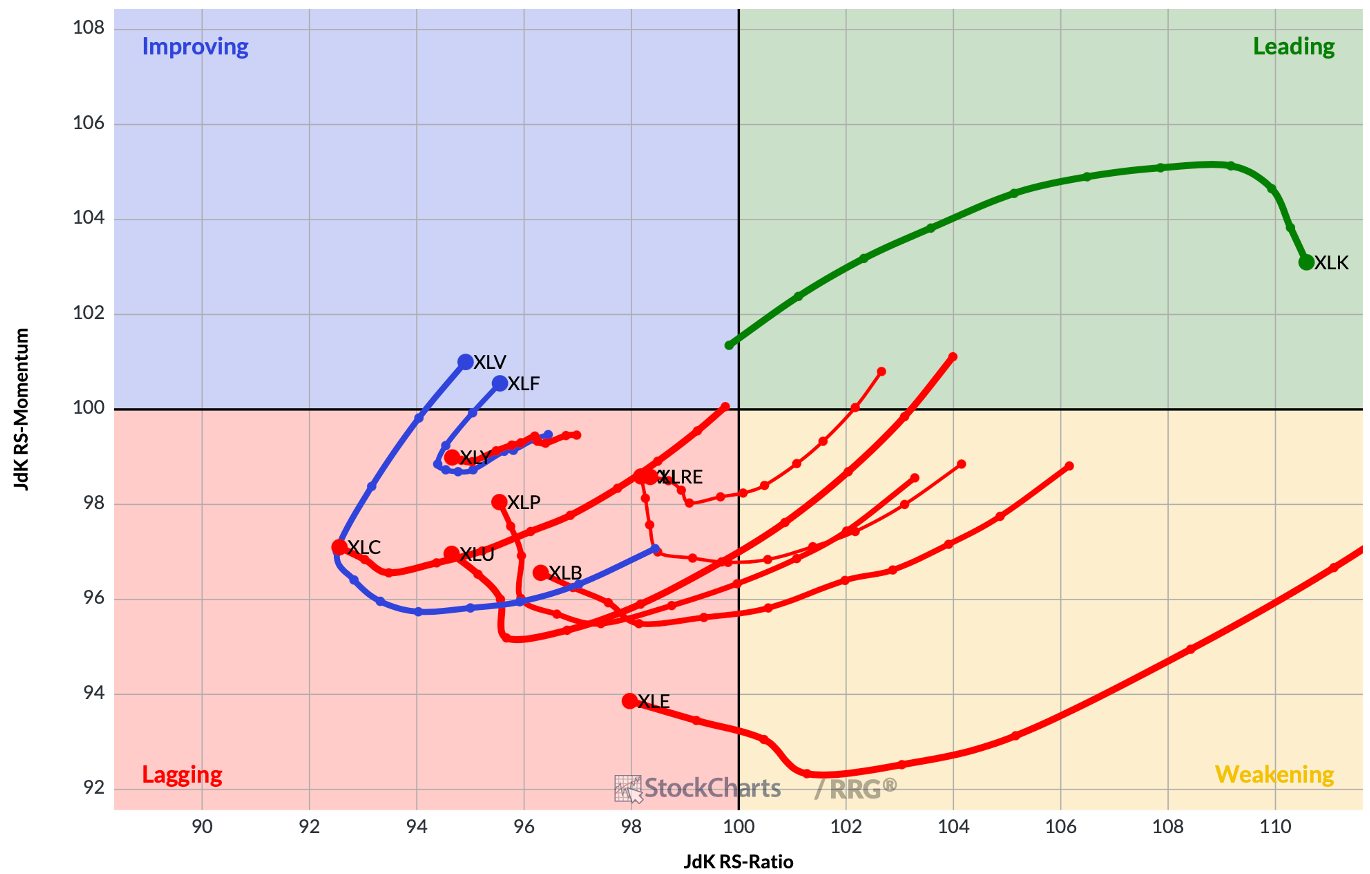
The Relative Rotation Graph 1 (RRG) for US sectors already shows healthcare (XLV) moving into the improving quadrant. That does not yet make the sector a dominant market leader, but it does show a change in character. Healthcare is no longer simply acting as a defensive place to hide. It is beginning to behave like a sector that investors may soon need to own.
Our global expression of that view is IXJ ( IXJ 0.00%↑ )
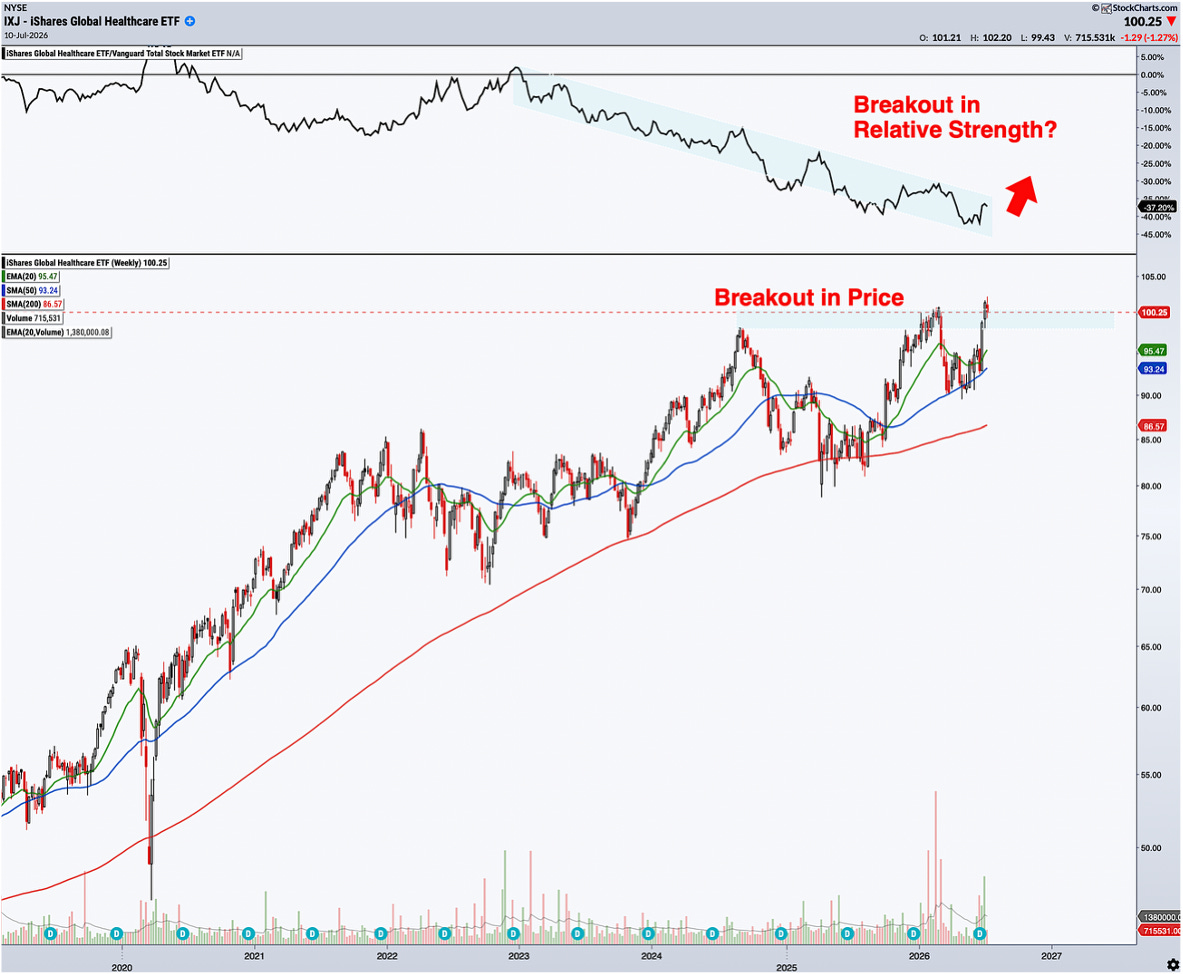
IXJ is already breaking out in price. The ETF is pushing to new highs, confirming that buyers are returning to global healthcare. The missing piece is relative strength versus the broader equity market. The relative-strength line in the upper panel has not yet broken out decisively, but it is now challenging a long downtrend.
That is exactly the sequence we want to see before a leadership transition becomes obvious.
First, the sector stops going down on a relative basis. Then it begins to stabilise. Then price confirms. Then relative strength catches up. The RRG evidence from XLV suggests the broad healthcare move is already forming. IXJ suggests the global healthcare allocation is beginning to participate.
Biotech is further ahead.
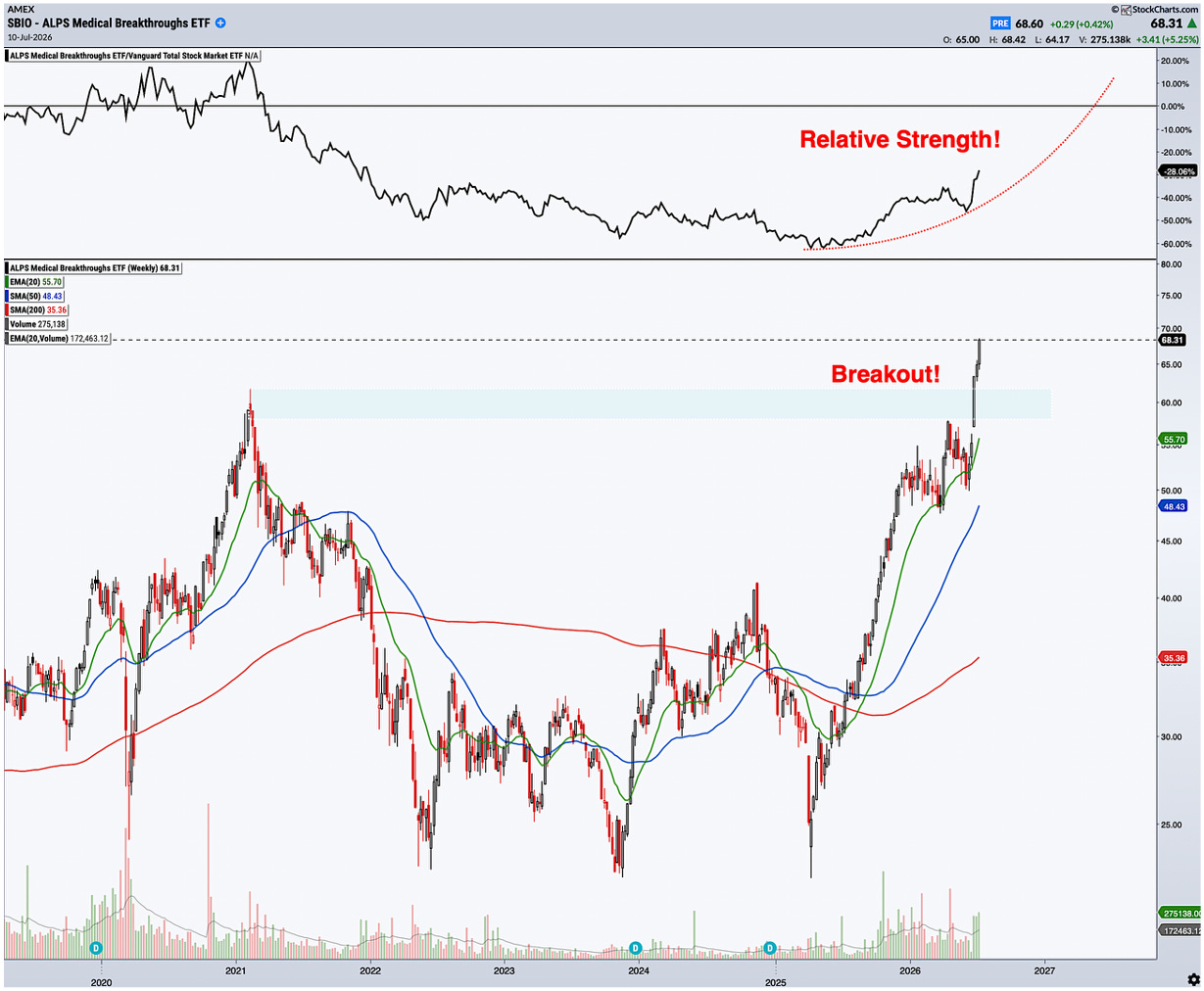
SBIO ( SBIO 0.00%↑ ) is not waiting for the broader healthcare complex to finish the rotation.
The price breakout is already visible. The relative-strength breakout is already visible. Therefore, this is the cleaner confirmation inside the sector. Biotech has moved from “potential recovery” to “emerging leadership.”
That is not accidental.
When the Model Portfolio added SBIO, the thesis was not simply that biotech was cheap. It was that biotech could become a quintessential AI trade.
Not because every biotech company suddenly becomes an AI company.
Not because clinical risk disappears.
Not because biology turns into software.
The thesis was that biotech sits inside one of the most attractive economic setups for artificial intelligence: a field with massive proprietary data, slow feedback loops, high failure rates, expensive experiments, difficult prediction problems and extraordinary upside from getting the answer right.
AI is valuable where intelligence is scarce.
In biotech, intelligence is scarce everywhere...
It is scarce when selecting targets. It is scarce when designing molecules. It is scarce when predicting toxicity. It is scarce when identifying patient subgroups. It is scarce when deciding which trial design gives a programme the best chance of showing a real effect. It is scarce when separating a beautiful scientific hypothesis from a commercially viable therapy.
The traditional biotech model is brutally inefficient because biology is brutally complex. Most programmes fail. Many failures arrive late. Capital is consumed before revenue appears. The market frequently discounts entire platforms because investors cannot confidently distinguish a temporary financing problem from a scientific dead end.
AI may not eliminate that uncertainty.
But it can change the distribution of outcomes.
The potential gain is not magic. It is better iteration. More hypotheses tested before expensive wet-lab work. Better prioritisation of targets. Earlier detection of failure modes. More intelligent trial design. More precise patient selection. Faster interpretation of biological signals. Better use of existing literature, internal datasets and experimental history.
In software, faster iteration improves products.
In biotech, faster iteration may improve the probability of survival.
A small improvement in success rates can be enormous when the starting point is so low. A slightly better clinical trial, a slightly better patient population, a slightly better molecule, or a slightly earlier decision to kill a weak programme can change the economics of a company and, in aggregate, the economics of a sector.
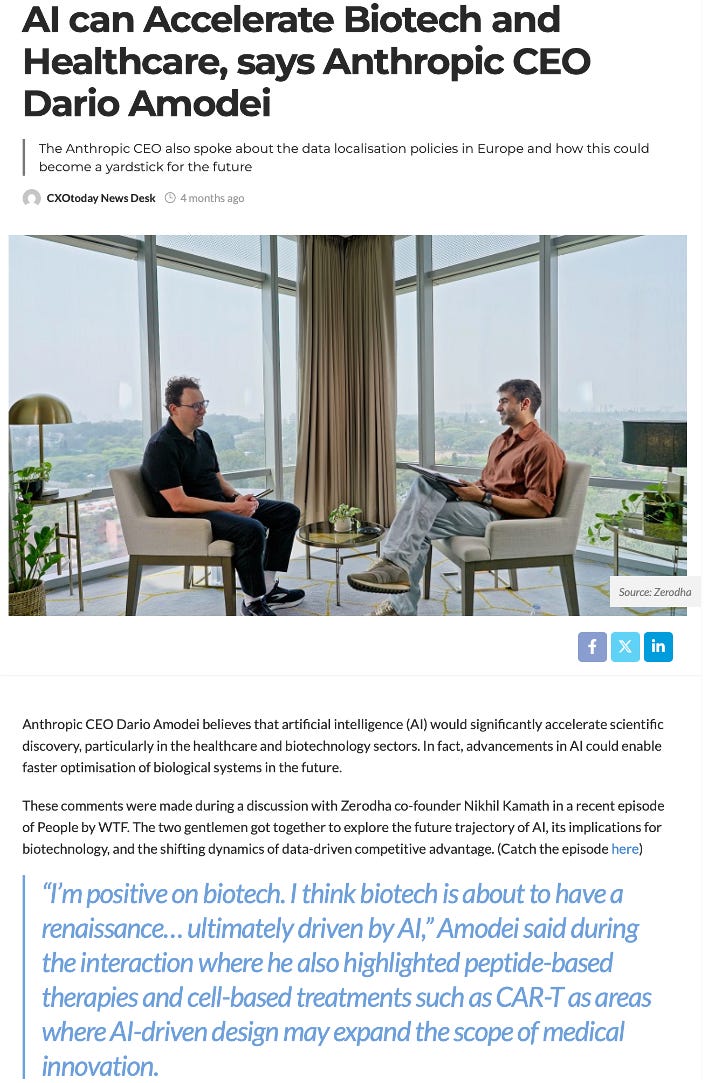
Dario Amodei is now making the same argument from the frontier of AI.
The Anthropic co-founder and CEO recently said he was positive on biotech and expected a renaissance ultimately driven by AI, highlighting peptide-based therapies and cell-based treatments such as CAR-T as areas where AI-assisted design could expand medical innovation.
That comment deserves more attention than a normal bullish soundbite.
Amodei is not merely saying AI will help doctors write notes faster. He is pointing to biology as one of the deepest design spaces in the economy. In his own essay, Machines of Loving Grace, he argued that AI-enabled biology and medicine could compress decades of biological progress into a much shorter period. His core idea is that powerful AI may allow researchers to search biological possibility far more efficiently than human-led trial and error alone.
That is the crucial insight for investors.
Biotech is not only a healthcare sector.
It is a search problem.
The industry is searching for targets, mechanisms, molecules, combinations, delivery systems, biomarkers, trial populations and commercial applications. The search space is vast. The cost of wrong turns is punishing. The payoff from better search is immense.
That makes biotech one of the most natural places for AI to create economic value. The timing also looks unusually favourable.
Large pharmaceutical companies need growth. Their existing franchises are ageing. The patent cliff is no longer a distant risk buried in sell-side slides. Evaluate estimates that more than $300 billion2 of prescription-drug revenue will lose exclusivity between 2025 and 2030.
A patent cliff changes corporate behaviour.
When a blockbuster loses exclusivity, management cannot replace the revenue with hope. It needs new assets. Internal research can help, but internal research is rarely enough. Large pharmaceutical companies have the balance sheets, commercial infrastructure and regulatory expertise. Smaller biotech companies often own the optionality: late-stage assets, novel platforms, targeted oncology programmes, rare-disease pipelines, immunology assets and emerging modalities.
That gap creates transactions.

Biopharma M&A is already accelerating. Reuters reported that if the current pace continues, 2026 biopharma M&A could exceed $250 billion, making it one of the strongest years since the 2019 megadeal cycle.
The deals themselves are telling.
Vertex agreed to acquire Crinetics for roughly $10 billion, adding rare endocrine-disease assets and paying a substantial premium to gain another growth vertical beyond its historical cystic fibrosis franchise. Novartis agreed to acquire Myricx Bio for up to $1,5 billion, strengthening its oncology pipeline through a next-generation antibody-drug-conjugate payload platform.
These transactions are not isolated events. They are symptoms of a broader pressure system. Big Pharma has revenue to defend. Biotech has science to monetise. The patent cliff creates urgency. AI increases the perceived value of better discovery platforms. Improving capital markets make deals easier to finance.
A sector that was starved of liquidity can re-rate quickly once acquirers, investors and strategics begin competing for credible assets again.
This is where IXJ and SBIO play different roles.
IXJ gives the Model Portfolio broad exposure to global healthcare. It captures the sector-level rotation without forcing the entire thesis into one scientific modality, one clinical programme or one financing window. It owns the more diversified expression: pharma, devices, diagnostics, healthcare services and life-sciences infrastructure.
SBIO is the asymmetric expression. It concentrates exposure in smaller biotechnology companies, where the upside from renewed M&A, better financing conditions, rising risk appetite and AI-assisted discovery can be much larger. It also carries more volatility. Clinical failures will continue. Regulatory risk will continue. Financing risk will continue. AI will not turn every experimental asset into a commercial product.
But markets do not need perfection to reprice a sector.
They need improving odds.
Biotech entered this period with depressed expectations, damaged investor psychology and years of capital scarcity behind it. Now the chart is breaking out, relative strength is improving, Big Pharma is buying, the patent cliff is approaching, and one of the most important figures in AI is explicitly framing biotech as a potential renaissance.
That is a rare combination.
The Model Portfolio owns IXJ because healthcare is beginning to improve. It owns SBIO because biotech may be where the improvement becomes explosive.
The distinction with KWEB is useful. In China internet, the thesis is compelling but relative strength is still early. In healthcare, relative improvement is becoming clearer. In biotech, the tape has already started to validate the argument.
The market is not waiting for every AI-driven breakthrough to arrive.
It is beginning to price the possibility that the cost of failure may fall.
That may sound subtle. It is not.
A lower cost of failure can reopen financing windows. It can make more assets worth funding. It can make more platforms strategically valuable. It can make acquirers more aggressive. It can make investors willing to pay for optionality again. And in biotech, optionality is the product.
The first part of this issue argued that the AI boom may be moving downstream. China showed us what happens when intelligence becomes cheaper. Healthcare and biotech show us where cheaper intelligence may change outcomes.
But there is one final constraint.
Biotech does not run on science alone. It runs on capital. Discount rates, liquidity, risk appetite and M&A confidence shape the sector almost as much as clinical data. A better molecule still needs a financing window. A better platform still needs buyers. A better probability distribution still needs investors willing to underwrite uncertainty. That brings the argument back to macro...
If the AI trade is moving downstream, liquidity will decide how far the market is willing to follow it.
The next section returns to the Dovish Shock.
You might also like reading:


A Relative Rotation Graph (RRG) compares the relative strength and momentum of several securities against a common benchmark. Moving right indicates stronger relative performance, while moving up indicates improving relative momentum. The four quadrants are Leading, Weakening, Lagging and Improving, and the direction of each tail often matters as much as its current position. In this chart, XLV represents the US healthcare sector and XLK the US technology sector.
The estimate comes from Evaluate’s October 2025 report, Portfolio Tactics to Scale the $300bn Patent Cliff*. It calculates that more than $300 billion of prescription-drug revenue will lose exclusivity between 2025 and 2030, increasing pressure on large pharmaceutical companies to replenish growth through internal development, partnerships and acquisitions.*
Important Disclosure
This article contains general investment research produced by Vasco Marques de Freitas, CFA, CMT, Founder and CEO of VMF Research, Lda. It reproduces an excerpt from the July 2026 issue of VMF’s Strategic Asset Allocation. The research, views and Tier One Model Portfolio information are stated as of 10 July 2026, 4:00 p.m. Eastern Time, unless another date is expressly identified.
The publication contains information recommending or suggesting an investment strategy. It is not personalised investment advice and does not consider any reader’s individual objectives, financial circumstances, knowledge, experience or tolerance for risk. The Tier One Model Portfolio is an illustrative research portfolio and does not represent client assets or transactions executed by VMF Research.
The analysis combines thematic, fundamental and market research within a medium- to long-term investment framework. Sources and the basis for material factual claims are identified throughout the article. Views, assumptions and portfolio conclusions may change as scientific, regulatory, corporate, macroeconomic or market evidence evolves. They are reviewed through VMF Research’s monthly publications and may be updated through weekly or ad hoc research.
The Leaderboard returns cited in the introduction were calculated using market prices as of 2 July 2026. Open-position returns have changed since that date. The figures relate to VMF Research recommendations or illustrative Model Portfolio allocations, do not represent returns earned by clients and should not be interpreted as a complete measure of investment performance. Healthcare and biotechnology investments, including IXJ, SBIO and individual biotechnology companies, involve substantial risks. These include clinical-trial failure, regulatory rejection, loss of intellectual-property protection, financing and dilution risk, political intervention, adverse reimbursement decisions, scientific uncertainty, market volatility and the possible loss of capital. Artificial intelligence may improve research productivity without producing commercially successful medicines or superior investment returns.
Disclosure of interests: as of the research cut-off, neither VMF Research, Lda., Vasco Marques de Freitas personally, nor any legal entity controlled by him held a position in any financial instrument mentioned in this article, including IXJ, SBIO, Grail or Roivant Sciences. Past performance is not indicative of future results. Readers should conduct their own analysis and, where appropriate, consult an authorised financial adviser before making an investment decision.