

The strongest thesis in the room can still be the wrong place for the next dollar.
That is one of the least intuitive lessons in investing.
New evidence arrives. Confidence rises. The temptation is obvious: buy more.
But portfolios are not conviction contests.
In The Boom Changes Owners, we argued that China’s rapidly improving AI ecosystem is making our broader thesis harder to dismiss. Capable intelligence is becoming cheaper. Competition is widening. And as models become more interchangeable, value should increasingly migrate towards the businesses controlling customers, proprietary data, distribution and commercial workflows.
The evidence has strengthened.
So has our conviction.
Yet Alpha Tier is not increasing its China weight.
Why?
Because a good portfolio decision cannot be made by asking whether a thesis looks better than it did yesterday. The relevant question is whether the next unit of capital offers better asymmetry there than anywhere else.
That distinction matters enormously.
Existing exposures can overlap. Diversified vehicles can conceal substantial company-level concentration. And a position that was attractive at one weight can become much less attractive when the portfolio already carries enough of the underlying economic bet.
There is another constraint too.
Price.
China’s technological progress is moving faster than the market’s willingness to reward it. Some of the fundamental evidence is increasingly persuasive. The broader technical confirmation remains incomplete.
That leaves us in an unusual position:
We are more confident in the thesis than we were before.
We are not yet more confident in adding capital to it.
This is where investment research becomes portfolio management.
Finding a good idea is only the beginning. The harder discipline is deciding how much of it deserves to be owned, what evidence should justify adding more, and when the next dollar belongs somewhere else.
Or, as we wrote in July’s Alpha Tier:
Fundamentals tell us what deserves to be owned.
Price tells us when conviction deserves more capital.
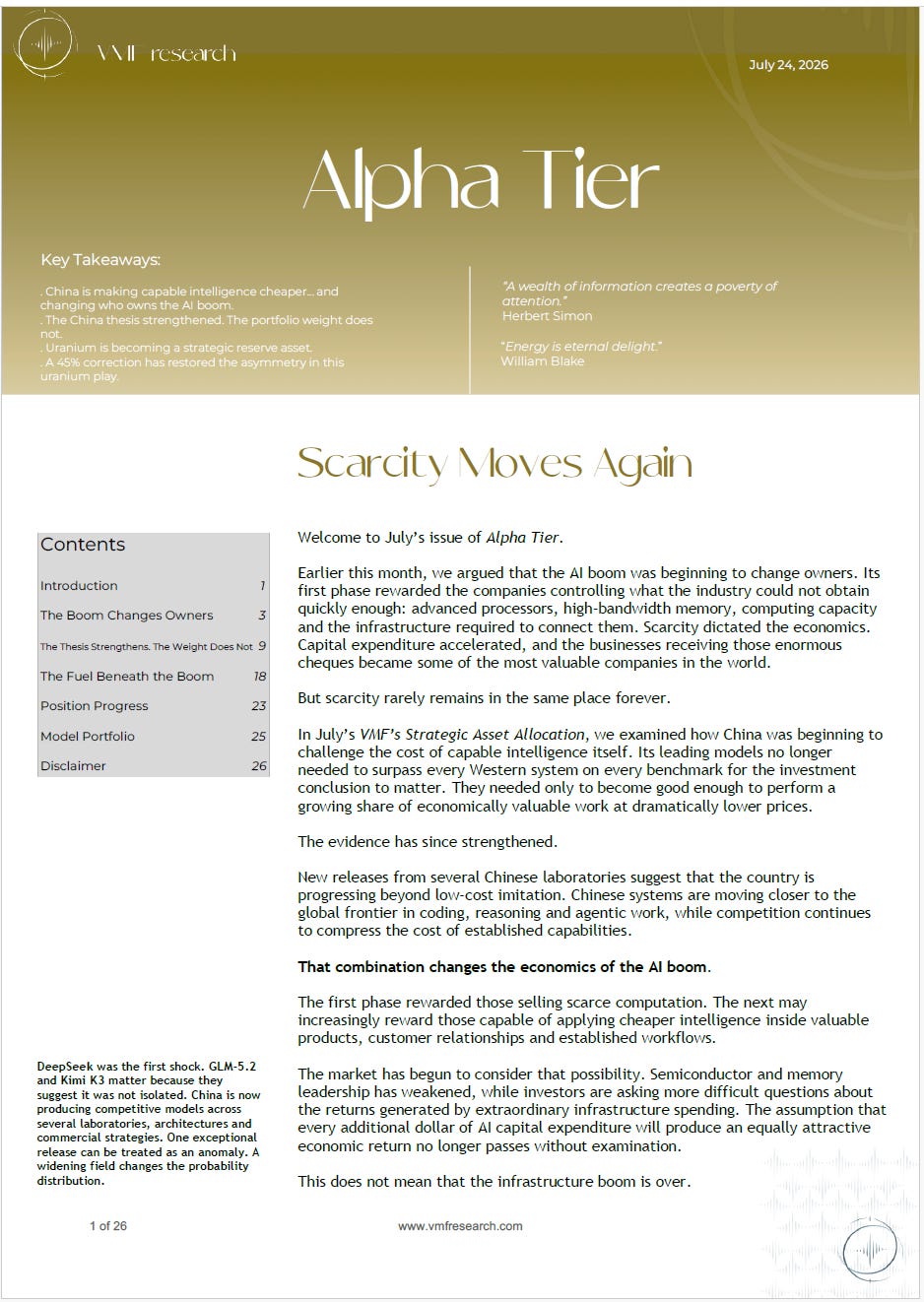
The excerpt below was first published for paid Alpha Tier Subscribers on 24 July 2026 at 9:00 p.m. Eastern Daylight Time. It explains why stronger evidence behind our China thesis led us to maintain, rather than increase, the existing allocation.
Sometimes conviction tells you to buy.
Sometimes it tells you to wait.
The difference is what separates an idea from a portfolio.
Good reading.

The obvious response to stronger evidence would be to buy more China.
We are not going to do that.
The Alpha Tier Model Portfolio already owns MCHI, KWEB, Alibaba and PDD. That headline understates the degree of concentration. Alibaba is also one of the two largest constituents in both MCHI and KWEB, meaning our economic exposure to the company is materially greater than the direct BABA allocation alone suggests.
That concentration is deliberate.
Alibaba is one of the few businesses capable of participating across almost the entire Chinese AI value chain. It develops the Qwen model family, operates one of the country’s leading cloud platforms and controls the commercial ecosystems through which cheaper intelligence can be deployed at scale. Its commerce, advertising, logistics and enterprise businesses provide customers, proprietary data and economically valuable workflows that independent model laboratories must still find elsewhere.
The latest evidence therefore strengthens an important conclusion.
Alibaba does not need Qwen to win every benchmark.
It needs the supply of capable intelligence to expand, the cost of deploying it to decline and Chinese enterprises to integrate it into a wider range of commercial activity. Alibaba can benefit by developing its own models, distributing third-party models, selling the computing capacity required to run them and applying AI throughout businesses that already serve hundreds of millions of users.
Few companies occupy so many favourable positions at once.
That is why our true exposure to Alibaba matters more than the direct position shown in the Model Portfolio table.
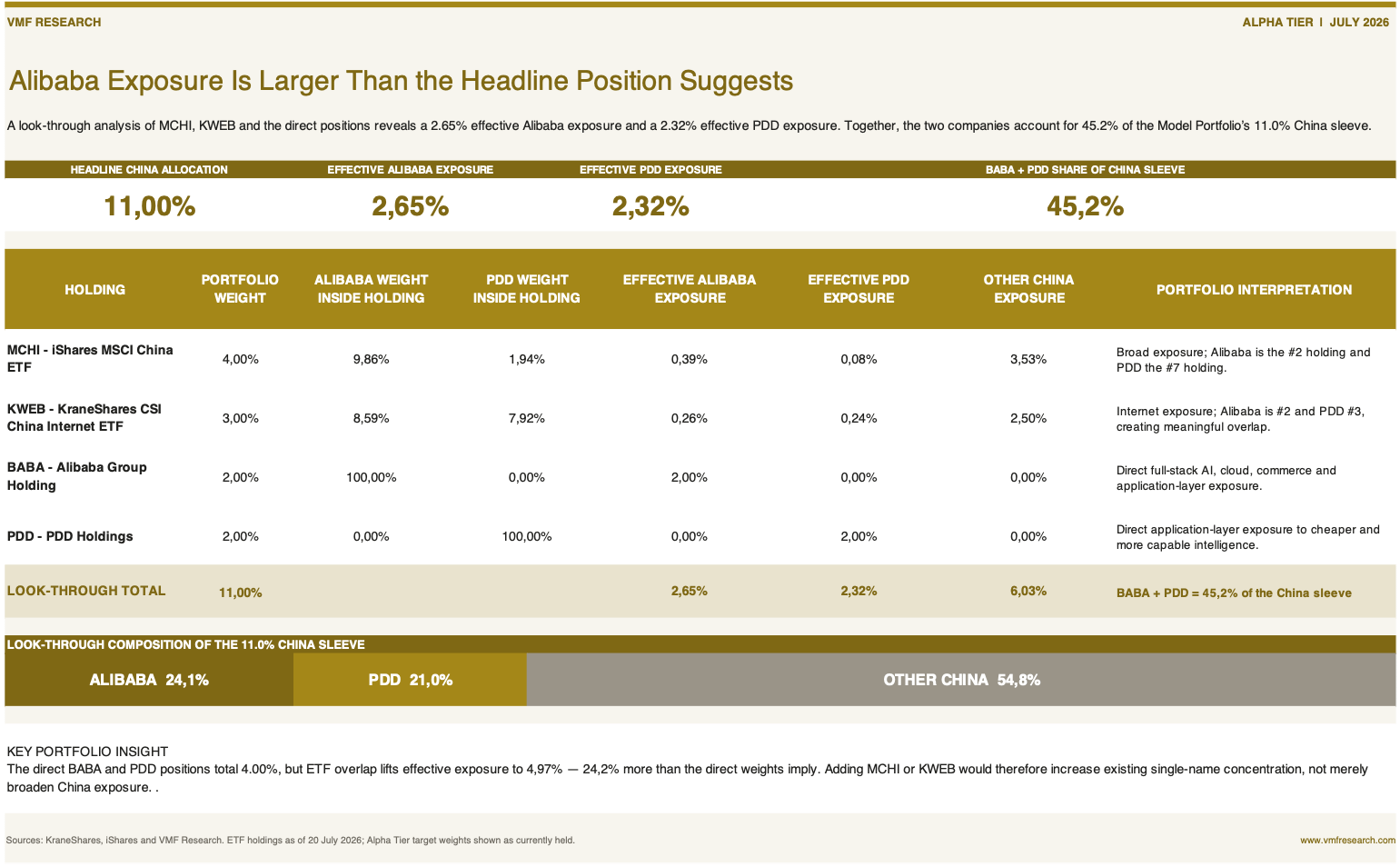
The look-through analysis will make two things clear.
First, Alibaba is already one of the Model Portfolio’s more consequential individual company exposures.
Second, any decision to increase MCHI or KWEB would also increase our effective Alibaba position, even if the trade were presented as an addition to diversified Chinese equities.
We must therefore distinguish between two separate questions.
Has the latest evidence increased our confidence in Alibaba and the wider Chinese application-layer thesis?
Yes.
Has it improved the asymmetry enough to justify greater concentration before the market confirms that interpretation?
Not yet.
The fundamental case nevertheless deserves to be understood because Alibaba’s position inside the Chinese AI ecosystem is unusually difficult to replicate. Independent laboratories may produce exceptional models. DeepSeek has established extraordinary cost efficiency. Kimi and GLM have pushed closer to the frontier in coding and agentic tasks. MiniMax has developed competitive multimodal capabilities. Tencent owns enormous distribution through Weixin and a substantial cloud and gaming ecosystem.
But most of these businesses occupy only part of the chain.
Alibaba is closer to a full-stack expression.
It owns models, cloud infrastructure, enterprise relationships, consumer distribution, transactional data and the applications capable of converting better intelligence into commercial output. It can participate when Chinese companies train more models, when they consume more inference, when enterprises move workloads into the cloud and when AI improves search, advertising, merchant productivity, customer service and logistics inside Alibaba’s own ecosystem.
The distinction is especially important in a market where model leadership may prove temporary.
A laboratory can lose its benchmark advantage with the next release. A model that appears differentiated today can face pricing pressure within months.
The competitive position of a platform controlling customers, data and distribution is more durable.
Alibaba does not need to forecast the permanent winner at the model layer. It can help distribute the winner.
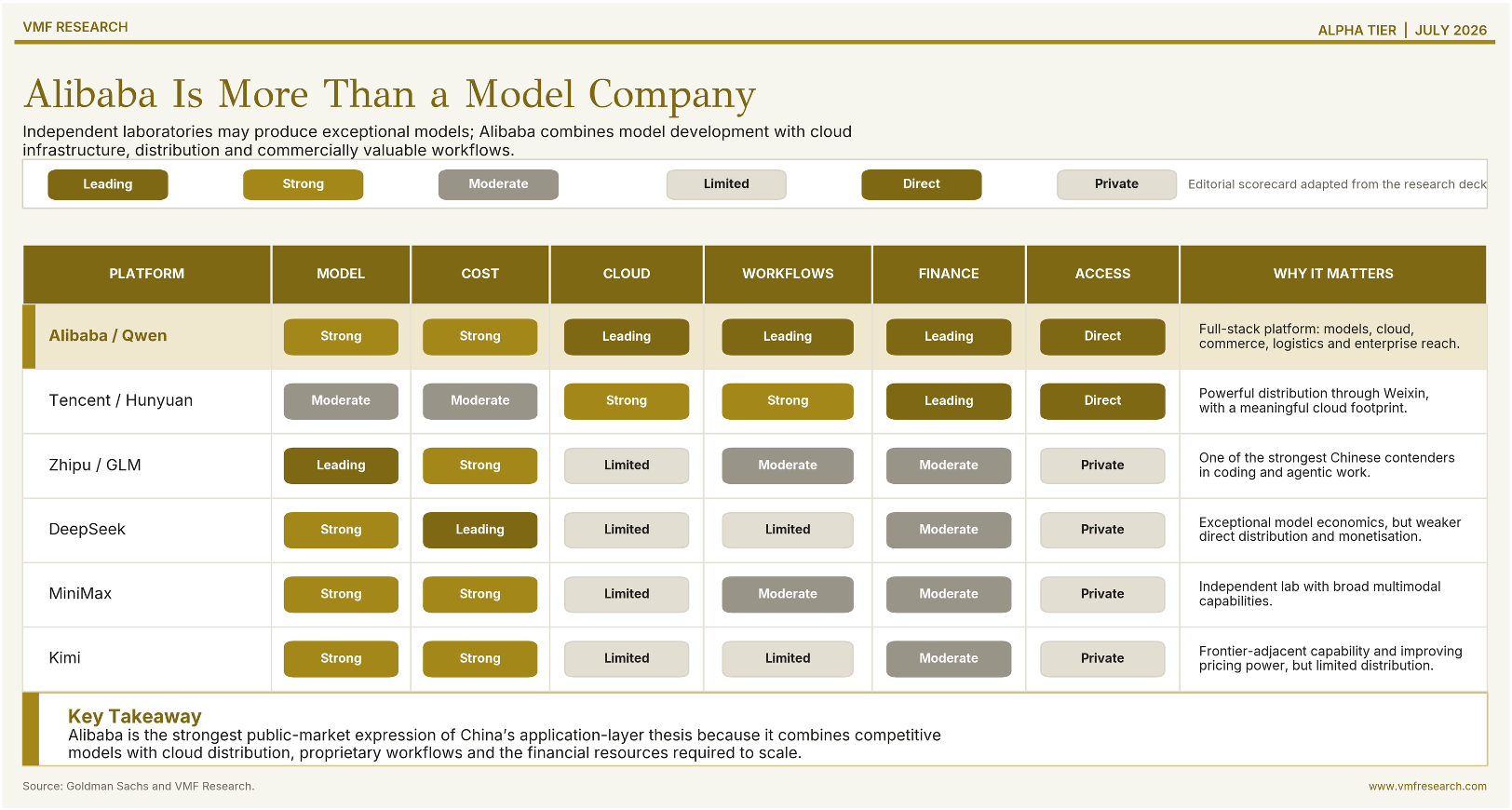
This does not mean Alibaba dominates every category.
DeepSeek may retain superior cost economics. GLM and Kimi may outperform Qwen on individual workloads. Tencent may possess stronger distribution in social media. Independent laboratories may innovate faster because they are less constrained by the priorities of a large organisation.
The investment case does not require otherwise.
It rests on Alibaba’s ability to monetise an expanding ecosystem rather than own every technical breakthrough within it. As intelligence becomes cheaper and model choice proliferates, the capacity to route workloads, serve enterprises and embed AI into established commercial systems may prove more valuable than temporarily controlling the highest score on one leaderboard.
The infrastructure data reinforce that opportunity.
China’s leading cloud platforms are still investing at a fraction of the scale of their American counterparts. Goldman Sachs estimates that capital expenditure by major US cloud providers rose from approximately $254 billion in 2024 to $443 billion in 2025 and could exceed $1 trillion in 2027. Equivalent spending by the principal Chinese platforms increased from approximately $36 billion to $57 billion and is projected to reach $123 billion over the same horizon.
The difference is enormous.
But it should not be interpreted simplistically.
China’s smaller capital programme partly reflects a less developed cloud market and constrained access to the most advanced computing hardware. Spending less is not automatically evidence of superior efficiency, particularly if the smaller investment base limits training capacity or slows the deployment of new infrastructure.
Yet the comparison also reveals how much runway remains.
Chinese model capability has advanced rapidly before domestic AI investment has approached anything resembling Western scale. If improving models stimulate cloud adoption, enterprise deployment and agentic workloads, Alibaba and its peers retain considerable room to expand their infrastructure.
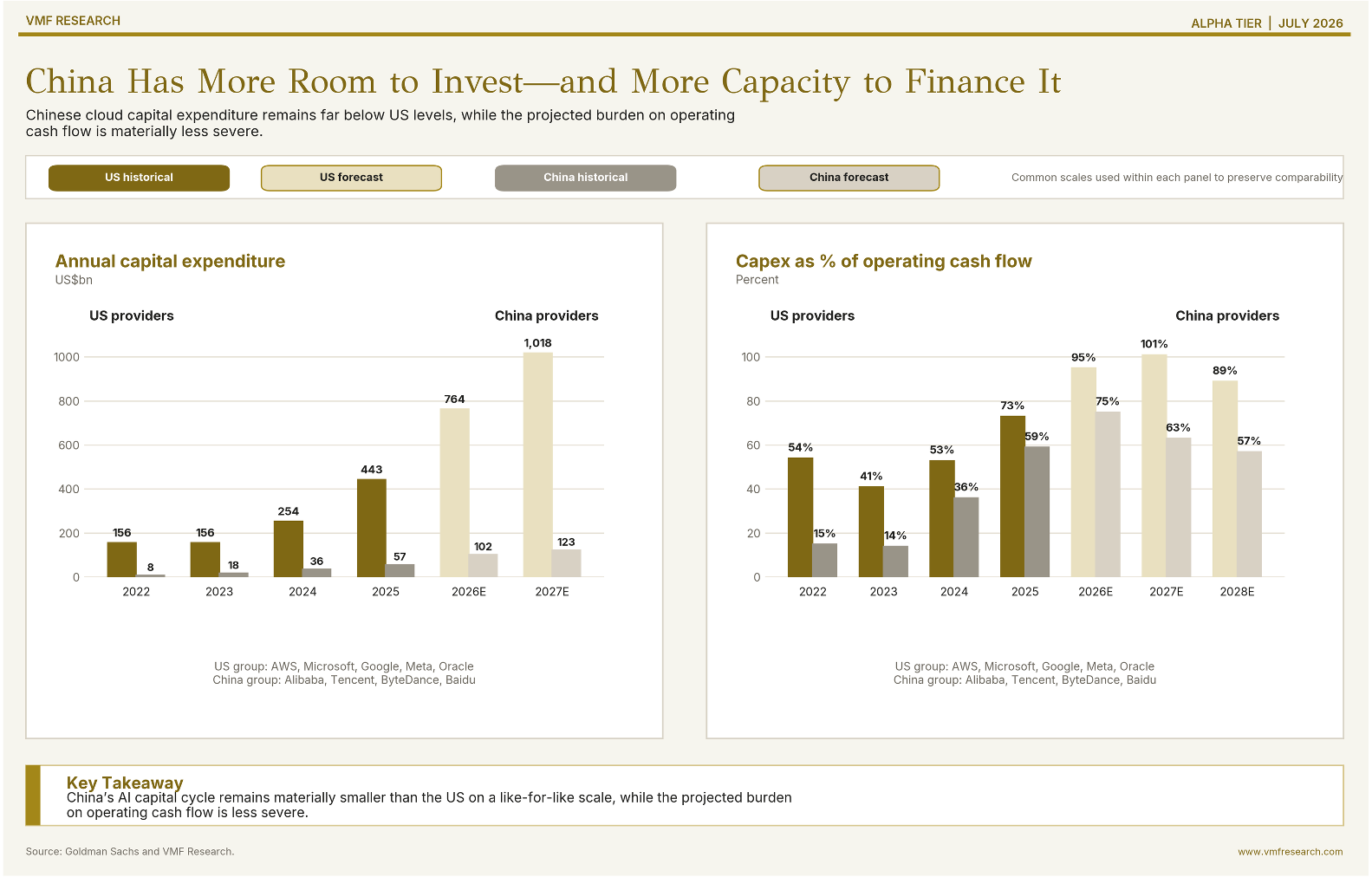
The financing comparison is as important as the absolute spending.
Capital expenditure by the principal US hyperscalers is estimated to approach or exceed their combined operating cash flow during the most intensive years of the buildout. The equivalent ratio for Chinese platforms is also rising, but from a much lower starting point and towards a less extreme peak.
That difference does not eliminate risk. Chinese companies can misallocate capital, invest too aggressively or fail to convert infrastructure into attractive returns. But it suggests that China’s leading platforms can increase AI investment without placing the same immediate pressure on cash generation as several US hyperscalers.
China therefore appears to possess both runway and financial capacity.
The harder question is whether Alibaba can transform that investment into revenue.
That is the real execution test.
Capital expenditure alone does not create shareholder value. It creates the capacity from which value may eventually emerge. Alibaba must demonstrate that additional infrastructure attracts enterprise workloads, supports greater model consumption and produces enough incremental cloud revenue to justify the investment.
The forecasts are encouraging.
Goldman Sachs expects Alibaba’s rolling incremental cloud revenue relative to lagged capital expenditure to improve steadily through 2027. By the end of the forecast period, the company’s conversion ratio could exceed the comparable estimates for Google and Amazon.
That would represent a material change. Alibaba’s cloud business has historically possessed the infrastructure, customer relationships and strategic relevance without consistently delivering the operating leverage investors expected. A sustained improvement in capital-to-revenue conversion would indicate that the AI cycle is beginning to translate technical progress into financial output.
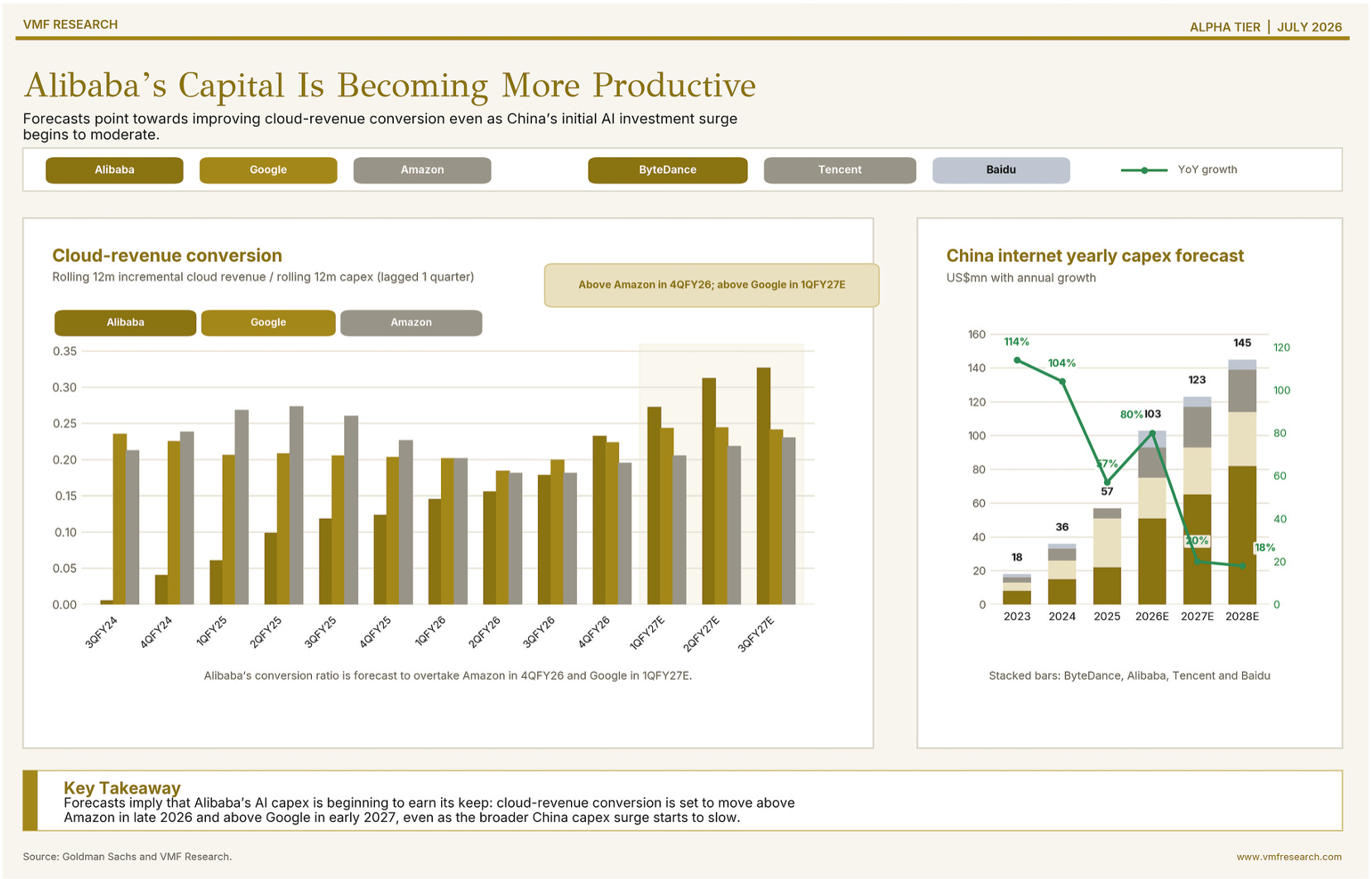
The wider capital-expenditure outlook suggests that this transition may extend beyond Alibaba.
Chinese internet investment is expected to continue rising through 2028, but at a progressively slower rate after the initial surge.
That is not a weakness in the thesis.
It is what the next phase should look like.
The industry is moving from building capacity towards proving what that capacity can earn.
Alibaba is the Model Portfolio’s most integrated expression of that transition. It develops models, owns cloud infrastructure and controls the commercial ecosystems through which cheaper intelligence can be converted into revenue. But it is not our only exposure to the application layer.
PDD Holdings offers a purer downstream expression. It does not need to train the leading Chinese foundation model or finance a hyperscale computing platform. It needs access to increasingly capable intelligence at a declining cost and the ability to deploy it across assets that remain scarce.
Those assets already exist. PDD controls merchant relationships, transaction data, consumer distribution and an expanding international network. Cheaper intelligence can improve product discovery, advertising conversion, fraud detection, translation, customer service, inventory management and logistics without requiring PDD to own the model producing every improvement.
The model may become commoditised. PDD’s network does not.
You might also like reading

KWEB provides the broader internet exposure. Its constituents span commerce, cloud computing, digital advertising, software, entertainment and online services, allowing the portfolio to participate if the benefits of cheaper intelligence diffuse across the Chinese platform economy. That breadth is useful, but it is not as diversifying as the ETF label initially suggests. KWEB contains several companies we also own directly (most importantly Alibaba).
MCHI serves a different purpose. It captures the possibility that technological progress contributes to a wider reassessment of Chinese assets through stronger investment, productivity and confidence. Yet it, too, adds to our effective Alibaba exposure.
The roles are therefore distinct. Alibaba is the integrated model, cloud and commercial-platform position. PDD is the downstream application. KWEB captures the wider internet ecosystem. MCHI expresses the possibility that technological progress contributes to a broader Chinese-equity recovery.
The latest evidence increases the expected value of all four.
It does not automatically increase their appropriate Model Portfolio weights.
That distinction is especially important because our direct positions understate the concentration already embedded in the portfolio. Alibaba is also one of the largest holdings inside MCHI and KWEB. Additional capital allocated to either ETF would therefore reinforce an existing company-level exposure rather than create an entirely new source of return.
A stronger thesis can make what we already own more valuable without making further concentration desirable. The next unit of capital must compete against every opportunity available to the Model Portfolio... not merely against an increasingly attractive China narrative.
Fundamentals tell us what deserves to be owned.
Price tells us when conviction deserves more capital.
The charts are not there yet.
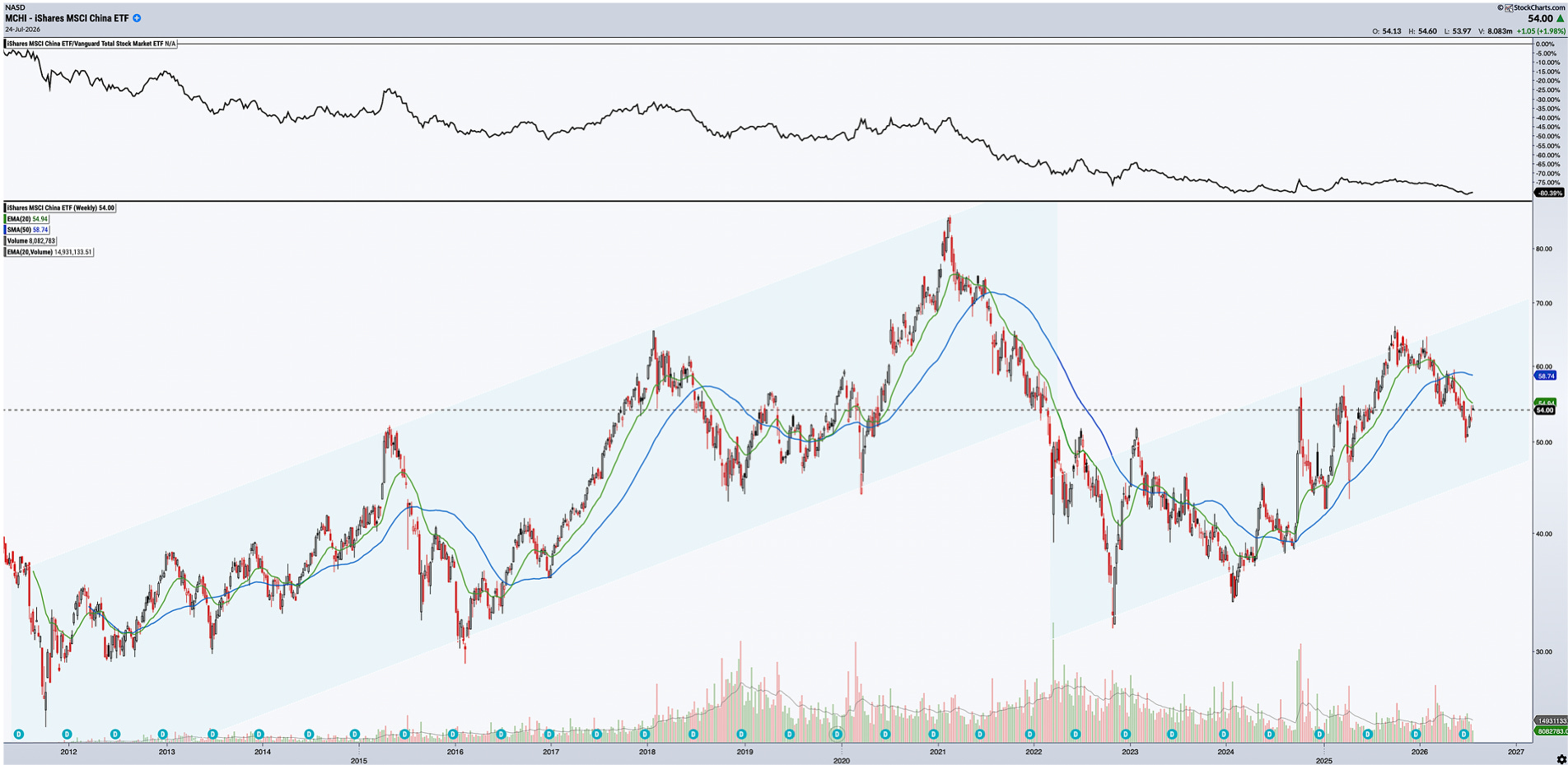
The MCHI chart on the previous page shows the scale of the damage that still needs to be repaired. Chinese equities have underperformed the broader US market dramatically for more than a decade, and the ETF remains only modestly above the levels reached in 2015.
Few charts provide a clearer record of the collapse in investor confidence. The decline from the 2021 peak to the 2022 low was particularly consequential. It broke the previous rising structure and reset the market onto a far lower trajectory. That collapse absorbed a remarkable concentration of negative forces: the consequences of prolonged Covid lockdowns, real-estate deflation, balance-sheet stress, regulatory intervention and the widening geopolitical conflict between China and the United States.
Investors have not lacked reasons to avoid the market. MCHI is the cumulative record of them. A new upward channel may now be developing from the 2022 low, but the recovery remains incomplete. The ETF has retreated towards the lower half of that structure and remains below its 50-week moving average.
The market has begun to stabilise. But it has not yet demonstrated that improving technology fundamentals can overcome the wider macroeconomic and geopolitical discount.
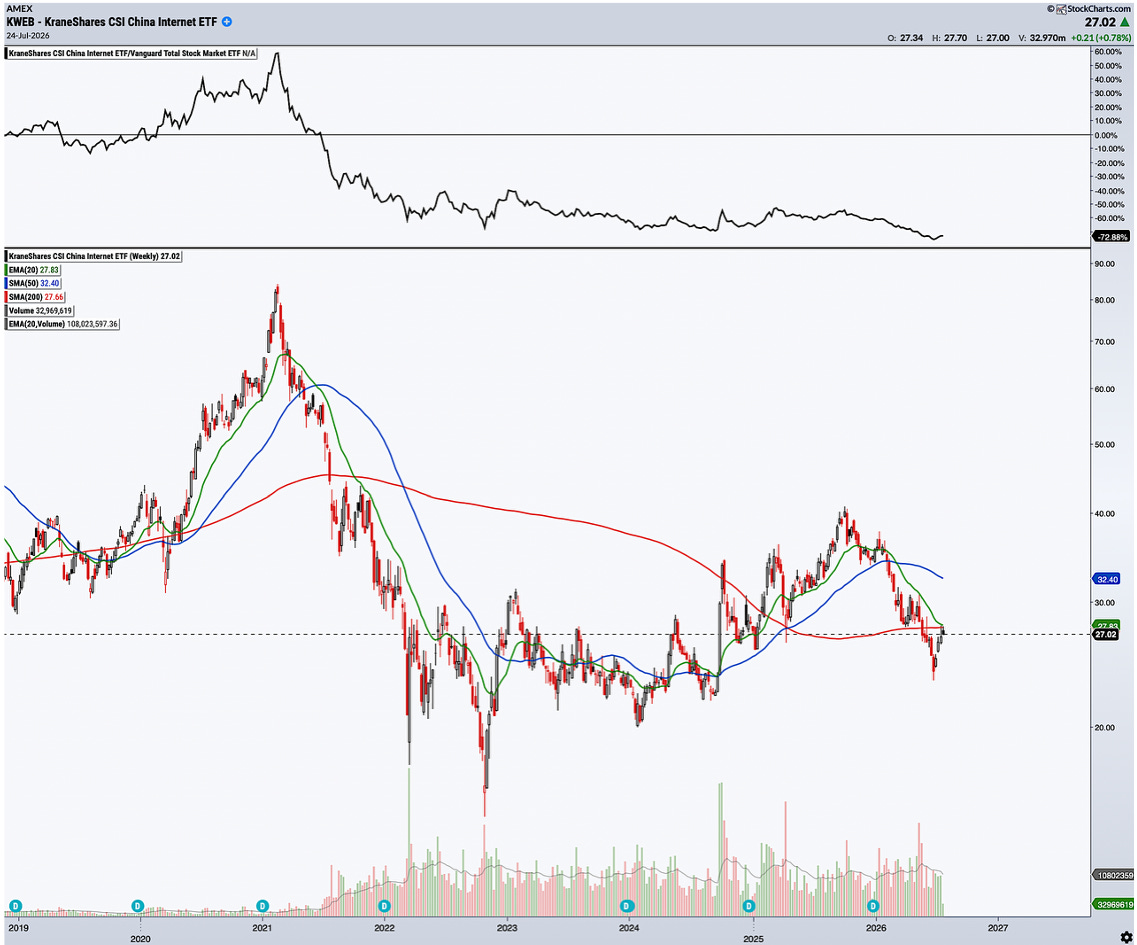
KWEB tells the same story in a more concentrated form.
Its collapse after 2021 represented far more than the unwinding of an expensive valuation. It reflected a wholesale reassessment of regulation, profitability, capital allocation, geopolitical risk and the investability of China’s digital economy.
The recovery remains uneven. KWEB is still far below its previous highs, beneath a declining 50-week moving average and close to its 200-week moving average. Its relative performance against the broader US equity market continues to weaken.
That is what makes the present divergence so compelling. Chinese model capability is improving. Intelligence costs are falling. Cloud platforms retain substantial room to invest. Yet the market continues to price much of the internet complex as though those developments will produce little durable value.
The mismatch is unusually large.
But valuation is not timing.
Markets can resist better fundamentals for far longer than expected when regulation, geopolitics and confidence remain unresolved. KWEB still requires evidence that buyers are prepared to move beyond isolated opportunities and reengage with the wider sector.
Alibaba is beginning to provide some of that evidence.
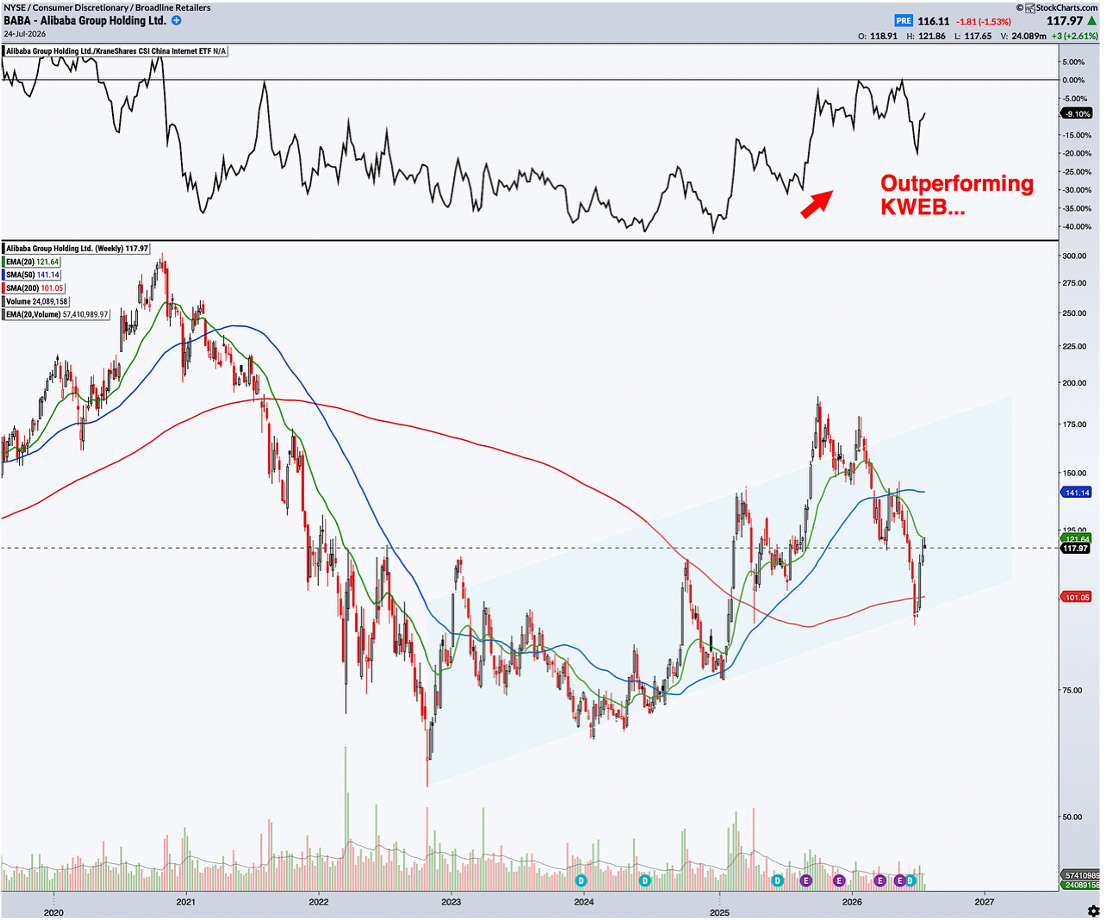
The stock has outperformed KWEB since 2024, helping validate our decision to own Alibaba directly rather than rely exclusively on the diversified ETF.
That relative strength is consistent with the analysis developed throughout this issue. Investors are beginning to distinguish Alibaba’s combination of models, cloud infrastructure, financial resources, distribution and commercially valuable workflows from the broader Chinese internet complex.
The chart is more constructive than KWEB’s, but it is not fully resolved.
Beat the old playbook.
Get institutional-grade research delivered to your inbox.
Alibaba remains inside its rising channel and above its 200-week moving average. The recent correction, however, has taken the stock below its shorter-term trend measures and interrupted the previous momentum.
The market is rewarding Alibaba’s superior positioning.
But it is not yet doing so decisively enough to justify increasing an exposure that is already substantial on a look-through basis.
PDD is approaching a different kind of decision.
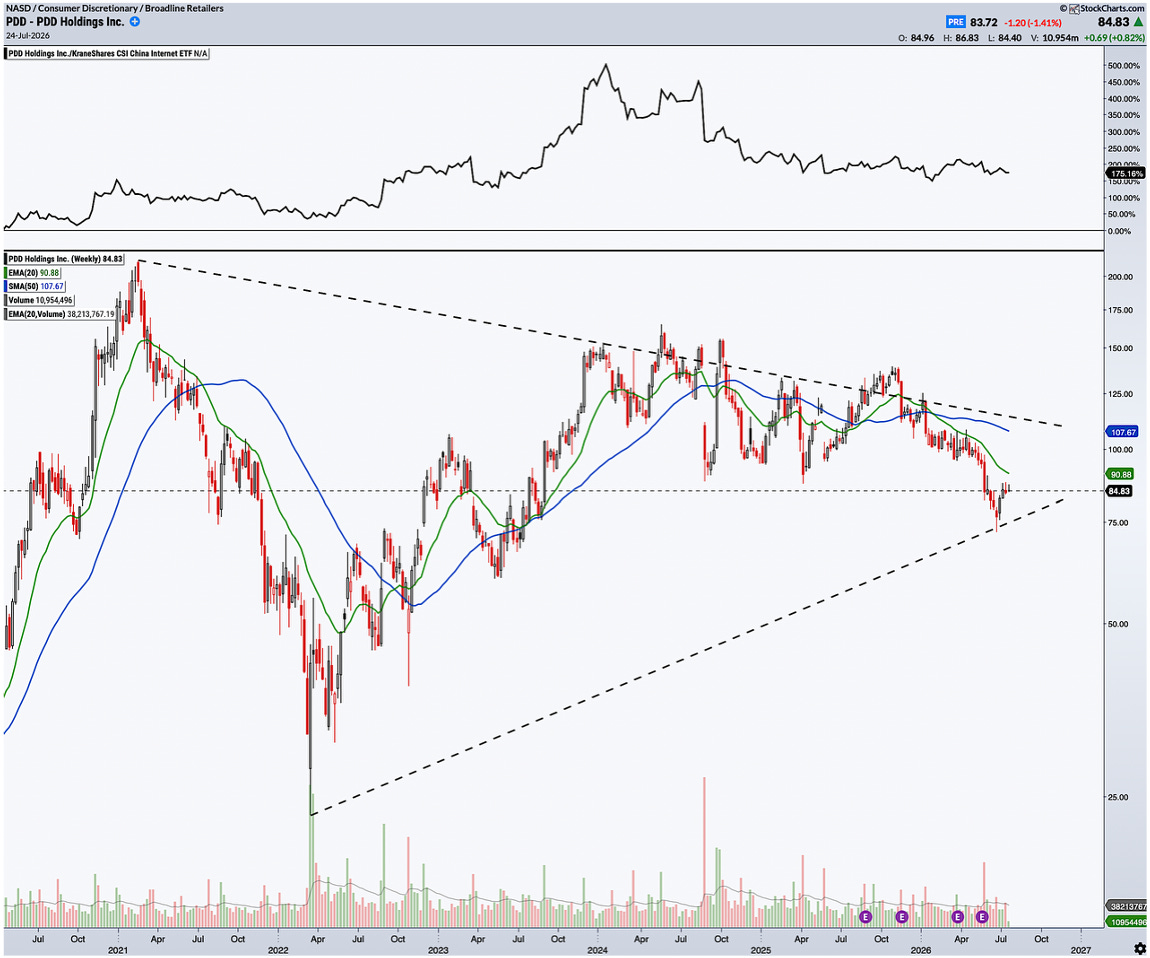
Its valuation may be even less demanding, but the chart will attract few momentum investors.
PDD remains below its 20- and 50-week moving averages and beneath the descending trendline extending from the all-time high. At the same time, it is approaching long-term support from the rising trendline drawn from the 2022 low.
Those two forces are converging. The result is a compressed technical structure between persistent overhead resistance and a rising long-term floor. An upside resolution would suggest that the market is beginning to recognise PDD’s ability to translate cheaper intelligence into better search, advertising, merchant services, localisation and logistics. A break of support would indicate that the fundamental case still lacks sufficient sponsorship.
We believe the setup can ultimately resolve higher as the wider Chinese equity complex is reassessed.
But the chart is approaching confirmation.
It has not delivered it.
That is the conclusion across the Model Portfolio’s four China positions. The fundamental evidence has strengthened, but price confirmation remains narrow and inconsistent. Alibaba is the strongest expression. MCHI is attempting to establish a new recovery. KWEB still reflects profound scepticism. PDD remains inside a consequential decision zone.
That is sufficient reason to maintain the overweight.
It is not sufficient reason to increase it.
We will therefore keep MCHI, KWEB, Alibaba and PDD at their current weights.
Additional capital should require evidence that the improvement is broadening beyond one company and becoming visible across the market itself.
At a minimum, we want renewed strength from either MCHI or KWEB, supported by confirmation from at least one direct holding. Until then, the Model Portfolio already owns enough of the upside... and enough of the risk.
The analysis does, however, point towards another opportunity.
If cheaper and more capable models lower the cost of useful automation, the number of tasks attempted across the economy should expand. Each individual task may require less computation, but the growth in models, agents and automated workflows could more than offset those efficiency gains.
More intelligence means more computation.
More computation means more data centres, networks and cooling.
Above all, it means more electricity.
We are therefore not allocating the next unit of capital to an existing China overweight before the market confirms the thesis. We are following the same economic transition into the physical system required to sustain it... towards a constraint that better software cannot remove and supply cannot expand quickly.
Intelligence is becoming more abundant.
Reliable power is not.
You might also like reading:

Important Disclosure
This article contains general investment research produced by Vasco Marques de Freitas, CFA, CMT, Founder and CEO of VMF Research, Lda. It reproduces an excerpt from the July 2026 issue of Alpha Tier. The research, views and Alpha Tier Model Portfolio information are stated as of 24 July 2026, 4:00 p.m. Eastern Daylight Time, unless another date is expressly identified. The original issue was first disseminated to paid subscribers on 24 July 2026 at 9:00 p.m. Eastern Daylight Time.
The publication contains information recommending or suggesting an investment strategy. It is not personalised investment advice and does not consider any reader’s individual objectives, financial circumstances, knowledge, experience, liquidity requirements or tolerance for risk. The Alpha Tier Model Portfolio is an illustrative research portfolio and does not represent client assets, transactions executed by VMF Research or the performance of an investable fund or managed account.
The analysis combines thematic, fundamental, technological, valuation, technical and portfolio-construction research within a medium- to long-term investment framework. Statements concerning Chinese artificial intelligence, declining intelligence costs, cloud investment, application-layer economics and future monetisation are analytical judgments rather than assurances. Model Portfolio weights also reflect concentration, overlapping exposures, diversification, price behaviour and relative opportunity. A strengthening investment thesis does not necessarily imply that a larger allocation is appropriate.
Investments in Chinese equities, emerging markets, internet and technology companies and China-focused exchange-traded funds involve substantial risks, including government intervention, regulatory change, geopolitical tensions, restrictions on technology or capital flows, governance concerns, currency movements, intense competition, technological disruption, valuation compression, liquidity constraints and the possible loss of capital. Improvements in AI capability or adoption may not translate into higher revenues, earnings or investment returns. Technical and valuation signals may also fail.
Disclosure of interests: as of the research cut-off, neither VMF Research, Lda. nor Vasco Marques de Freitas personally held any financial instrument included in the Alpha Tier Model Portfolio. A legal entity controlled by Vasco Marques de Freitas held a long position in the KraneShares CSI China Internet ETF (KWEB), which is discussed in this article. This interest may create an actual, potential or perceived conflict of interest and should be considered when evaluating the analysis. The existence of an interest does not validate a recommendation, diminish its risks or imply that it is suitable for any reader.
Neither VMF Research nor the author received compensation from any issuer covered in connection with the preparation of this research, and no issuer reviewed, approved or amended its conclusions before first dissemination.
Past performance is not indicative of future results. Readers should conduct their own analysis and, where appropriate, consult an authorised financial intermediary or adviser before making an investment decision.