

The market has mistaken an arms race for a monopoly.
For much of the past two years, artificial intelligence has been priced as though control of capable intelligence would remain concentrated inside a small group of Western laboratories and the companies supplying their infrastructure.
Capital followed that assumption.
Processors became strategic assets. Memory became a bottleneck. Data centres became factories for a new industrial revolution. The businesses receiving the cheques enjoyed immediate revenues, expanding margins and the comfort of visible demand.
China is now making that certainty dangerous.
DeepSeek opened the door. GLM-5.2 showed that the capability gap was narrowing. Kimi K3 has delivered a more unsettling message: Chinese models may be moving beyond cost leadership and beginning to compete for the economics attached to more valuable work.
Kimi is not the cheapest Chinese model.
That is what makes it important.
Customers appear willing to pay more when a system writes better code, completes longer workflows or produces a reliable result with fewer attempts. Yet Kimi remains less expensive than the leading Western frontier alternatives.
This is no longer a story about cheap imitation.
It is a market-structure story.
China is beginning to compete across both ends of the intelligence market: driving down the price of capabilities that are becoming common, while moving closer to the frontier where newly unlocked capabilities can still command a premium.
And it is no longer dependent on one exceptional laboratory.
DeepSeek, Kimi, GLM, Qwen and MiniMax now represent different organisations, architectures and commercial strategies. Individual leaders will change. Benchmarks will be overtaken. Some technically impressive model developers may still become terrible investments.
The broader signal is harder to dismiss.
China is building a competitive ecosystem capable of making useful intelligence better, cheaper and more widely available.
That gives new weight to a thesis we have been developing across VMF’s Market View.
In The Abundance Shock, we argued that falling intelligence costs would not eliminate scarcity. They would move it. The China AI Reset then examined the force accelerating that transition. The Intelligence Dividend followed cheaper intelligence into healthcare, where proprietary biological evidence remains difficult to reproduce. The Discovery Machine and The Royalty Engine showed how the same framework can ultimately reach individual businesses.
A common thread runs through all of them:
When intelligence becomes easier to obtain, the assets around it become more important.
Customers.
Distribution.
Proprietary data.
Embedded workflows.
Trusted relationships.
Physical infrastructure.
Those assets cannot be downloaded alongside a new model.
That is why the China technology thesis is gaining traction where a serious thesis should gain traction first: inside the mechanism.
The leading Chinese platforms do not need permanent control of the smartest model. They need a growing supply of capable intelligence, falling deployment costs and more businesses willing to integrate AI into commercial activity.
A platform controlling merchants, consumers, cloud infrastructure, transaction data and established workflows can benefit from a model it develops itself, a model supplied by a competitor or a model whose present benchmark advantage disappears six months later.
The model may become interchangeable.
The commercial ecosystem does not.
The market is still watching the leaderboards. We are watching who owns the customer when intelligence becomes cheap.
That distinction could reshape the AI profit pool. Infrastructure demand may remain enormous, particularly if lower costs generate an explosion in usage. But strong demand does not guarantee that every supplier preserves its scarcity premium, margins or valuation.
The companies financing the infrastructure may eventually capture more of the value it produces. Beyond them sit businesses capable of turning cheaper intelligence into better products, lower costs and deeper customer relationships.
That is how a boom changes owners.
The excerpt below was first published for paid Alpha Tier subscribers on 24 July 2026. It examines the latest Chinese model releases, the widening competitive ecosystem and why the application-layer thesis is becoming more credible even before the broader Chinese equity market has fully confirmed it.
The full issue then confronts the harder Alpha Tier question.
What should the next unit of capital own when the thesis is strengthening, but the portfolio already carries meaningful exposure to it?
This article begins with the evidence.
The boom is still growing.
The ownership of its profits may be changing.
Good reading.

The latest evidence arrived almost before the ink was dry.
When July’s VMF’s Strategic Asset Allocation was completed, GLM-5.2 provided some of the clearest evidence yet that China could perform a growing share of economically valuable work without reproducing the cost structure of the leading Western systems.
Days later, Kimi K3 moved the argument forward again.
The new open-weight model appears to compete near the global frontier in coding and selected agentic tasks. More importantly, it is priced materially above several leading Chinese alternatives while remaining cheaper than the principal Western frontier systems.
That combination matters more than another temporary position on a leaderboard.
DeepSeek showed that China could make intelligence cheaper. GLM-5.2 showed that the capability gap was narrowing. Kimi K3 may now be showing that the strongest Chinese models can command higher prices when they perform more valuable work.
China is therefore no longer competing only by offering yesterday’s intelligence at a discount. It is beginning to compete for the frontier itself... and for the economics attached to it.
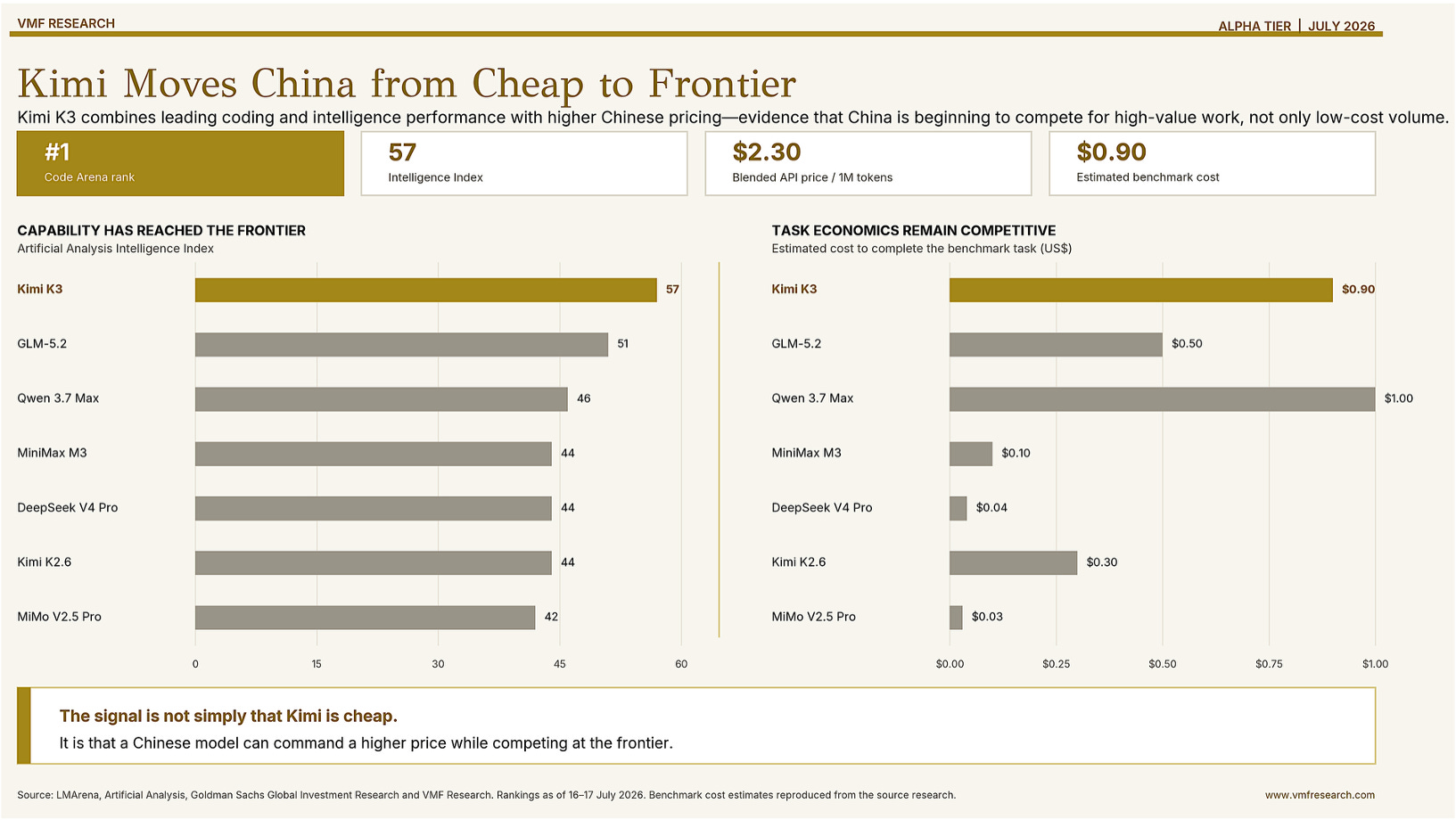
Kimi is not the cheapest model in the comparison.
That is precisely the point.
Once a capability becomes common, its price should fall. Routine summarisation, translation, content generation and basic coding assistance will become increasingly difficult to differentiate. Providers competing only on capabilities that are already widely available will eventually be forced to compete on cost.
But intelligence is not one uniform product.
A model capable of completing more difficult work, producing more reliable code or navigating a longer agentic workflow can still command a premium. Customers do not ultimately purchase tokens.
They purchase useful results.
A cheap model that fails repeatedly can prove expensive. A more capable model that completes an economically valuable task on the first attempt may justify a higher advertised price while still producing a lower total cost.
The likely outcome is therefore not the complete commoditisation of every model. It is a more competitive market in which established capabilities become cheaper, while temporary pricing power migrates towards newly unlocked and commercially valuable work.
China is beginning to compete at both ends of that market.
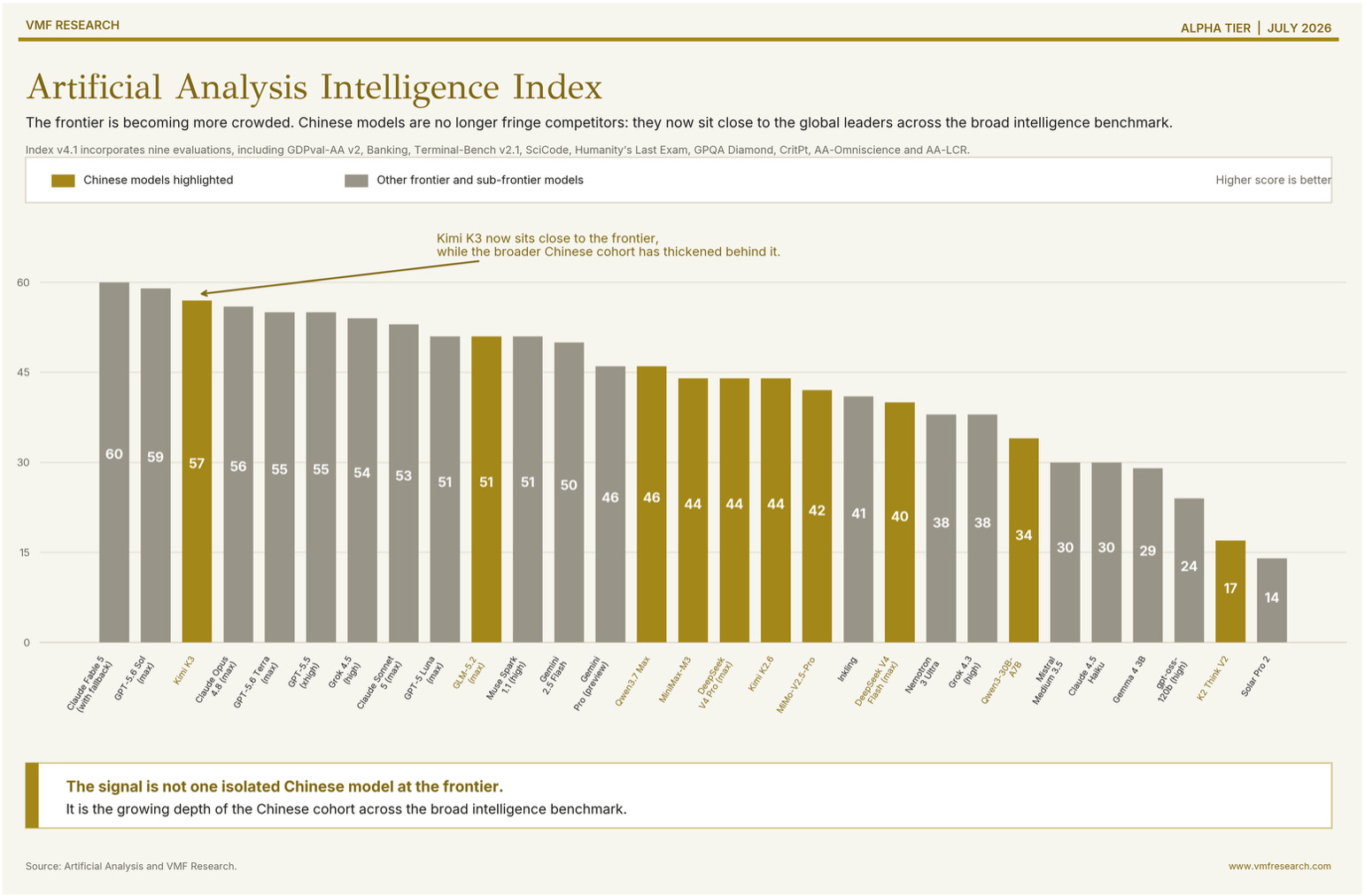
The broader intelligence rankings reinforce the conclusion.
Kimi is not sitting alone at the edge of an otherwise Western frontier. GLM, Qwen, DeepSeek, MiniMax and other Chinese model families increasingly occupy positions throughout the leading group.
One strong release can be dismissed as an anomaly. A growing cohort is more difficult to ignore.
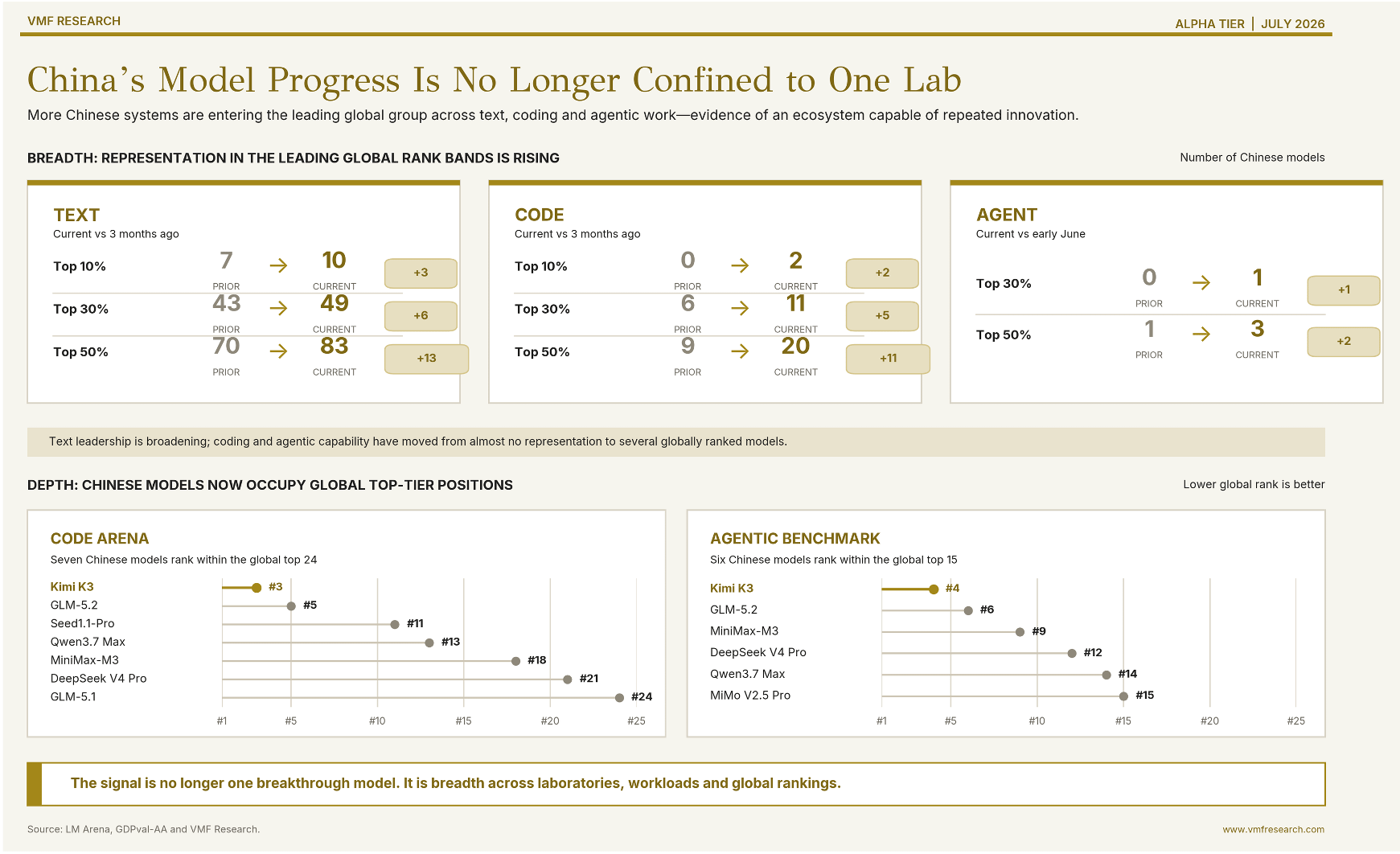
The significance of the chart above is not simply that China now has more models on global leaderboards. It is that the improvement extends across general text, coding and agentic workloads.
That breadth changes the probability distribution.
Individual laboratories will still rise and fall. Leadership can disappear with the next release, and competition may make many model developers poor investments even as their technology improves. Lower-end API pricing remains under pressure, training costs continue to rise and the capital required to remain near the frontier is substantial.
But the application-layer thesis does not require one permanent winner at the model layer. It requires competition to make capable intelligence better, cheaper and more widely available.
Deployment can reinforce that process. The research underlying this issue suggests that AI-generated code may already account for a very high proportion of output inside selected Chinese mega-cap technology companies. Those figures should not be treated as representative of the entire Chinese economy, but they illustrate the potential feedback loop: usage produces real-world successes, failures and corrections → that information improves post-training → better models then encourage more usage.
China may therefore be moving beyond the phase in which its laboratories learn principally from a frontier established elsewhere.
Increasingly, they can learn from their own users.
Its emerging domestic technology stack adds another layer of resilience.
Meituan’s LongCat 2.0 was reportedly trained and deployed on a large domestic computing cluster. This does not establish that Chinese accelerators have surpassed the leading American hardware. The more relevant point is that China appears increasingly capable of combining domestic silicon, sparse architectures, software optimisation and enormous engineering scale into a viable end-to-end system.
Export restrictions remain a constraint. But they are also influencing the form of Chinese progress, forcing laboratories to optimise models, hardware and deployment as an integrated system rather than rely indefinitely on access to one irreplaceable foreign component.
Constraints have not stopped progress.
They have shaped it.
That provides further evidence for a working hypothesis we have been developing for several months.
In The Abundance Shock, we argued that artificial intelligence would progressively reduce the cost of economically useful cognition. If that happened, value would begin moving away from the model itself and towards the assets required to apply it: proprietary data, distribution, trusted relationships, embedded workflows and physical infrastructure.
You might also like reading the Abundance Shock:

China’s latest advances do not prove that framework. They are, however, producing several of the outcomes it anticipated.
Models are improving faster than their prices are rising. Businesses can increasingly match different systems to different tasks instead of relying on one provider.
Attention is shifting away from the advertised cost of a token and towards the total cost of completing useful work. Capabilities previously limited to the largest and best-capitalised organisations are becoming accessible to a much broader market.
The economics should follow.
This transition also explains the progression of our own research.
During the first phase of the AI boom, value accrued to the bottlenecks that could not be expanded quickly enough. Advanced processors and high-bandwidth memory were scarce, and our South Korean equity exposure belonged to that phase.
EWY offered underappreciated exposure to an emerging memory shortage before the importance of memory to AI infrastructure became central to the market narrative.
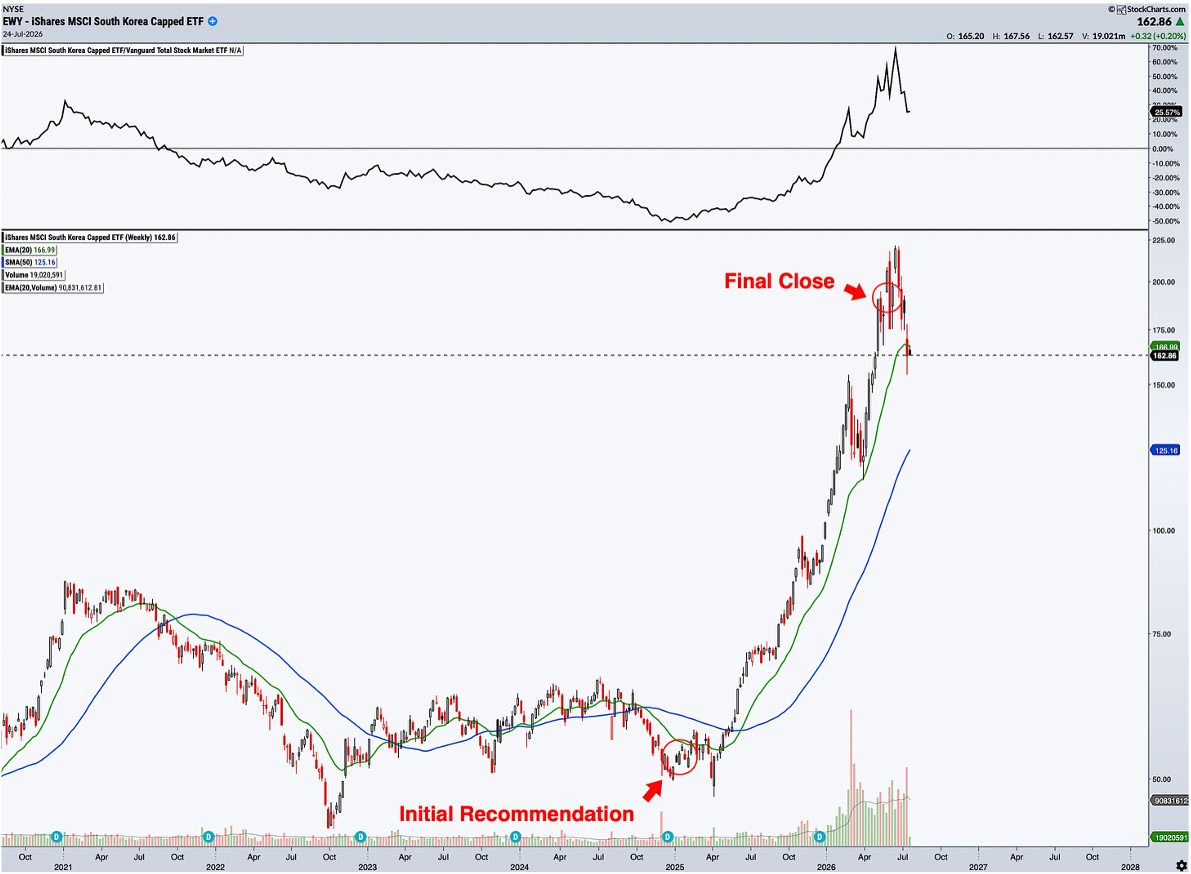
Recognition eventually arrived. Earnings accelerated, South Korean equities appreciated dramatically and an underappreciated expression of the AI buildout became a consensus winner. Tier One harvested the gains and ultimately closed the position... not because the AI opportunity had ended, but because recognition had changed the asymmetry.
We were already turning towards the application layer. Not because physical infrastructure had ceased to matter, but because the next phase of value creation was likely to emerge somewhere less visible.
The Forgotten Application Layer

The first and easiest money in this AI boom was already made... and it was in the obvious places.
The first phase possessed a direct earnings bridge. Hyperscalers increased capital expenditure → semiconductor, memory and infrastructure suppliers converted those cheques into revenue. The application layer depended on a different mechanism: lower intelligence costs had to stimulate enough new usage to transform the economics of the companies applying it.
That mechanism is becoming easier to see.
Goldman Sachs estimates that consumer and enterprise agents could drive global token consumption to more than 24 times today’s estimated capacity by 2030.
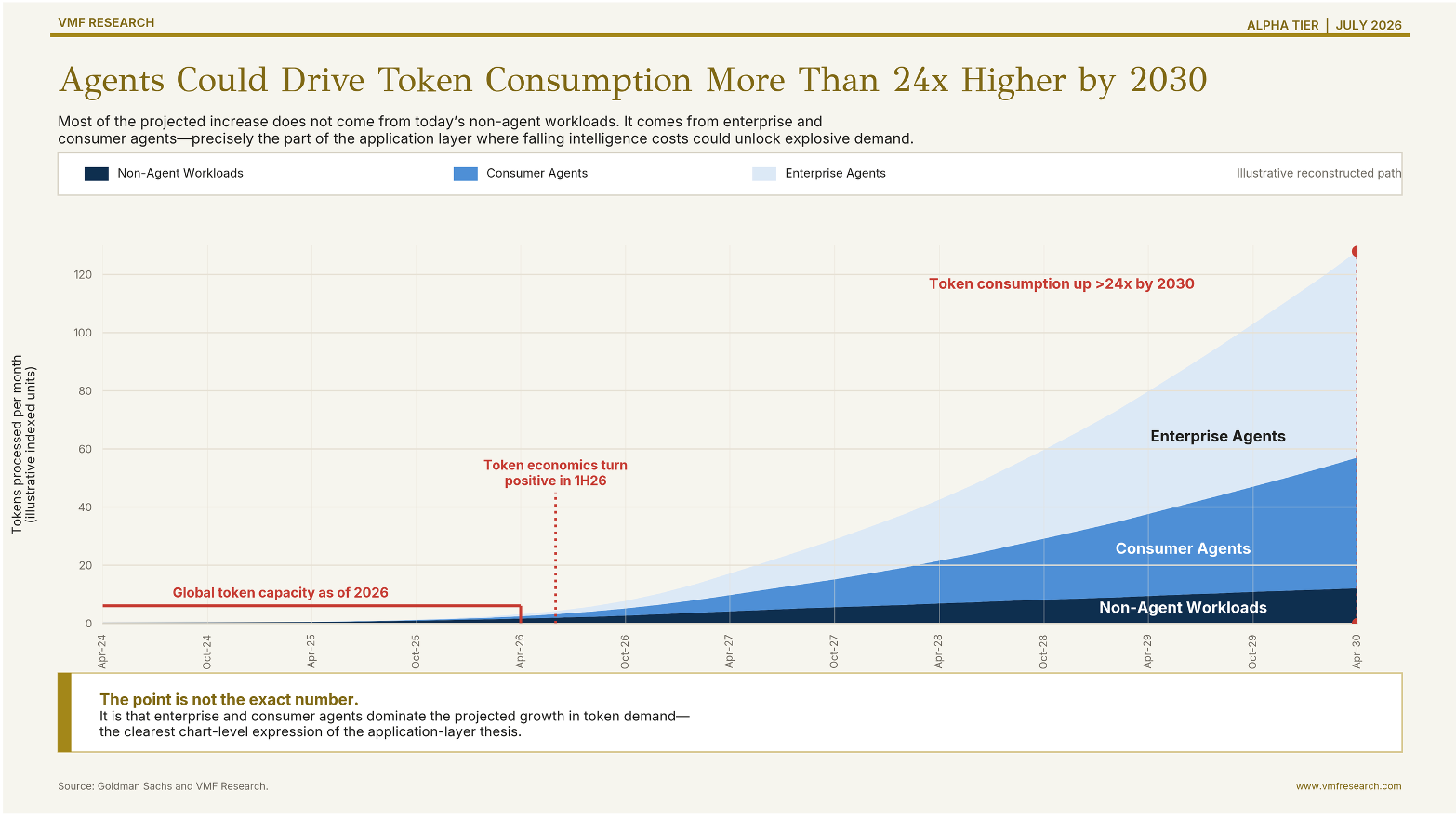
Most of the projected growth comes not from conventional AI workloads but from agents performing longer, more frequent and increasingly autonomous sequences of work. The exact magnitude is necessarily uncertain. Adoption could proceed more slowly, model efficiency could improve faster than expected and many proposed applications may never become economical.
The composition of the estimate is more important than the precise total.
Non-agent workloads contribute only a small share of the expected increase. Most of the growth comes from consumer and enterprise applications: agents searching, organising and transacting for individuals, and systems operating across software development, customer service, research, administration and commercial workflows.
That is the application-layer thesis in one chart.
As intelligence becomes cheaper, it can be deployed more frequently, across a wider range of problems and at progressively lower levels of economic value. The cost of each task may fall, yet the number of tasks attempted can rise much faster.
Abundance does not merely reduce expenditure.
It can create demand.
China’s latest advances strengthen that possibility. More capable open-weight models, lower task-completion costs and a broader competitive ecosystem should make agentic applications cheaper to build, easier to deploy and less dependent on any single provider.
The result could be an economy that consumes substantially more intelligence even as the cost of each individual unit declines.
That has important consequences for market leadership.
For most of the recent cycle, the companies receiving AI capital-expenditure cheques have materially outperformed those paying them. Hardware suppliers enjoyed immediate demand, expanding margins and visible order books. The platforms absorbed enormous expenditure while the return on that investment remained difficult to measure.
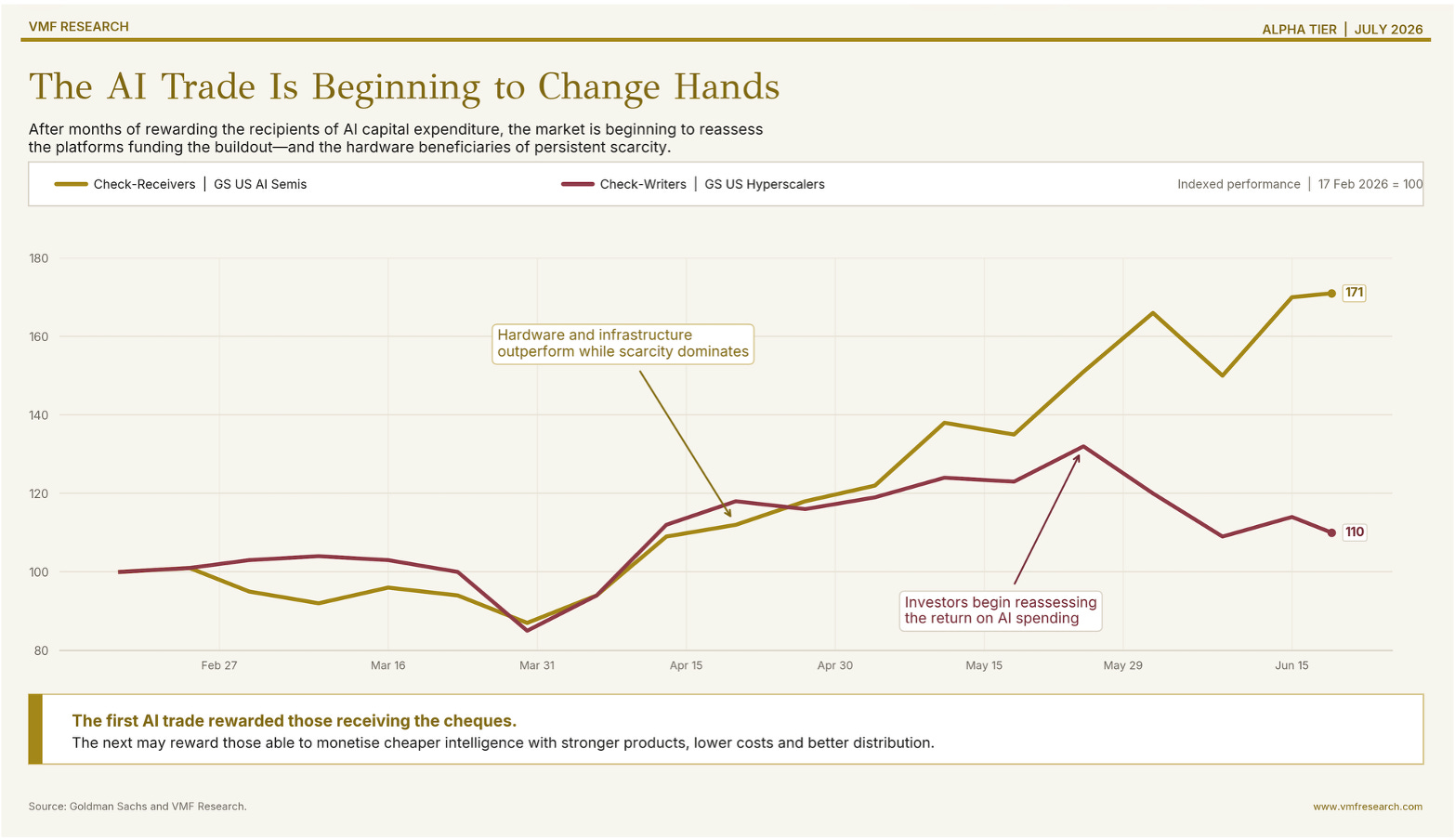
We do not believe that the hardware opportunity has disappeared. If token consumption develops remotely along the path Goldman Sachs envisages, the world will continue to require substantial investment in processors, memory, networking and data centres.
But the distribution of returns can still change.
China’s progress challenges the assumption that the economics of AI will remain concentrated around permanently scarce and increasingly expensive computation. If equivalent or superior output can be produced at a lower cost, the scarcity premium enjoyed by parts of the hardware stack becomes harder to sustain.
At the same time, the platforms financing that infrastructure gain access to cheaper models and a larger opportunity to monetise the capacity they have already built.
The first phase rewarded the recipients of AI spending.
The next may increasingly reward its payers... and, beyond them, the companies capable of converting cheaper intelligence into better products, lower costs and stronger customer relationships.
China’s latest breakthroughs could become an important catalyst for that rotation.
They provide further evidence that capable intelligence is becoming more abundant, that application economics are improving and that the beneficiaries of the AI boom may not remain the same as its earliest winners.
That expectation has significant implications for the Alpha Tier Model Portfolio. Several positions already sit on the favourable side of this transition. The latest evidence strengthens the case for them, although it does not necessarily mean that the next unit of capital should be allocated to the same theme.
That is where we turn next.
Important Disclosure
This article contains general investment research produced by Vasco Marques de Freitas, CFA, CMT, Founder and CEO of VMF Research, Lda. It reproduces an excerpt from the July 2026 issue of Alpha Tier. The research, views and Alpha Tier Model Portfolio information are stated as of 24 July 2026, 4:00 p.m. Eastern Daylight Time. The original issue was first disseminated to paid subscribers on 24 July 2026 at 9:00 p.m. Eastern Daylight Time.
The publication contains information recommending or suggesting an investment strategy. It is not personalised investment advice and does not consider any reader’s individual objectives, financial circumstances, knowledge, experience, liquidity requirements or tolerance for risk. The Alpha Tier Model Portfolio is an illustrative research portfolio and does not represent client assets, transactions executed by VMF Research or the performance of an investable fund or managed account.
The analysis combines thematic, fundamental, technological, portfolio-construction and market research within a medium- to long-term investment framework. Statements concerning the development of artificial intelligence, the economics of Chinese models, future token consumption and the possible migration of value towards the application layer are analytical judgments and conditional hypotheses, not assurances. Sources and the basis for material factual claims are identified throughout the article. Views and Model Portfolio conclusions may change as technological, competitive, regulatory, geopolitical, corporate or market evidence evolves and are reviewed through VMF Research’s monthly publications, with weekly or ad hoc updates where appropriate.
Investments in China, emerging markets, technology companies and AI-related financial instruments involve substantial risks, including regulatory intervention, geopolitical tension, restrictions on capital or technology flows, currency movements, governance concerns, market-access limitations, intense competition, pricing pressure, technological obsolescence, capital misallocation, valuation compression, liquidity constraints and the possible loss of capital. Improvements in model capability or lower intelligence costs may not produce higher corporate earnings, successful commercial adoption or superior investment returns. Technical and relative-strength signals may also fail.
Any references to historical recommendations or Model Portfolio performance relate to published reference prices and illustrative research portfolios. They do not represent returns earned by clients and should not be interpreted as a complete measure of investment performance.
Disclosure of interests: as of the research cut-off, neither VMF Research, Lda. nor Vasco Marques de Freitas personally held any financial instrument included in the Alpha Tier Model Portfolio. A legal entity controlled by Vasco Marques de Freitas held a long position in the KraneShares CSI China Internet ETF (KWEB), which provides exposure to several Chinese internet and application-layer companies relevant to the themes discussed in this article. This holding constitutes a financial interest and potential conflict of interest and should be considered when evaluating the analysis. Its existence does not validate the conclusions, reduce the risks described or imply that any financial instrument is suitable for a particular reader.
Neither VMF Research nor the author received compensation from any issuer discussed in connection with the preparation of this research, and no issuer reviewed, approved or amended its conclusions before first dissemination.
Past performance is not indicative of future results. Readers should conduct their own analysis and, where appropriate, consult an authorised financial intermediary or adviser before making an investment decision.