

Discovery captures the imagination.
Royalties capture the cash flow.
Our previous article, The Discovery Machine, introduced the first of two biotechnology companies added to the Quality Model Portfolio in July’s issue of VMF’s Security Selection.
Regeneron represented the scientific engine: proprietary human data, experimental infrastructure and the ability to turn biological evidence into medicine. Cheaper intelligence may make that system more productive, but the company must still identify the right target, develop the treatment and survive the clinical process.
The second company offers a very different route into the same opportunity.
Halozyme does not need to discover the next blockbuster.
It gets paid when somebody else already has.
Its core technology allows certain medicines that would ordinarily require intravenous infusion to be administered beneath the skin, often in a fraction of the time. Pharmaceutical partners remain responsible for development, regulatory approval and commercialisation. Halozyme provides the delivery layer and receives fees, enzyme sales and, most importantly, royalties linked to partner revenues.
The attraction lies in the separation between participation and responsibility.
Halozyme participates in the success of multiple medicines without financing the full cost of creating each one. Its partners carry most of the scientific, clinical and commercial burden. Halozyme collects a percentage when the products sell.
That economic architecture should be familiar to long-time VMF Research readers.
We admire royalty businesses, and several appear across our Model Portfolios. The best combine exposure to valuable assets with limited requirements for incremental capital. A mineral royalty company does not need to construct and operate every mine. A music-rights company can continue collecting from a successful catalogue without financing every new recording. A biotechnology royalty company does not need to discover and commercialise every medicine on which it earns.
The assets differ. The principle does not.
Allow somebody else to commit much of the capital and assume much of the execution risk, while retaining a contractual claim on the upside.
Halozyme’s financial statements are beginning to reveal the power of that model. Royalty revenue is growing faster than the wider business, cash conversion is unusually strong and each additional dollar of partner sales requires relatively little incremental expenditure. The company is not merely expanding. Its revenue mix is becoming more valuable as it grows.
The risks remain real. Halozyme depends on medicines and commercial decisions it does not control. Its intellectual property has finite lives, competing delivery technologies exist, and its balance sheet carries more leverage than we would ideally prefer.
Royalty economics reduce certain risks.
They do not eliminate them...
The July issue was first published for paid subscribers on 17 July 2026. At the time of writing on 29 July, both biotechnology additions were trading above their initial reference prices. That early response is encouraging, although a matter of days cannot validate a medium- to long-term thesis.
Together, the two setups express the same biotech opportunity through complementary business models.
Regeneron must improve the probability of discovery.
Halozyme participates after much of the hardest scientific work has already succeeded.
The previous article introduced the discovery machine.
This one introduces the tollbooth.
Good reading.

Regeneron must discover the next medicine.
Halozyme ( HALO 0.00%↑ ) gets paid when somebody else already has.
Its core ENHANZE technology uses a patented recombinant enzyme, rHuPH20, to temporarily break down hyaluronan beneath the skin. That creates space for large volume medicines that would otherwise require intravenous infusion to be administered subcutaneously, often more quickly, conveniently and potentially outside a hospital setting.
Halozyme licenses the technology to pharmaceutical partners, which remain responsible for developing, obtaining approval for and commercialising the resulting medicines. In return, Halozyme receives upfront fees, milestones, sales of the enzyme and, most importantly, royalties averaging a mid-single-digit percentage of partner sales.
The parallel with Altius Minerals is difficult to miss.
You might like also like reading

Altius does not need to build and operate every mine on which it owns a royalty. Its partners commit the capital, manage the assets and assume most of the operational risk. Altius participates when production succeeds.
Halozyme applies a similar economic architecture to biotechnology. Its partners bear most of the clinical, regulatory and commercial burden, while Halozyme collects a percentage of sales from medicines whose delivery its technology improves.
The underlying assets are different (mineral rights in one case, intellectual property and licensing agreements in the other) but the attraction is the same:
Participate in the upside of multiple assets without financing the full cost of creating each one.
That model is becoming increasingly visible in the financial statements.
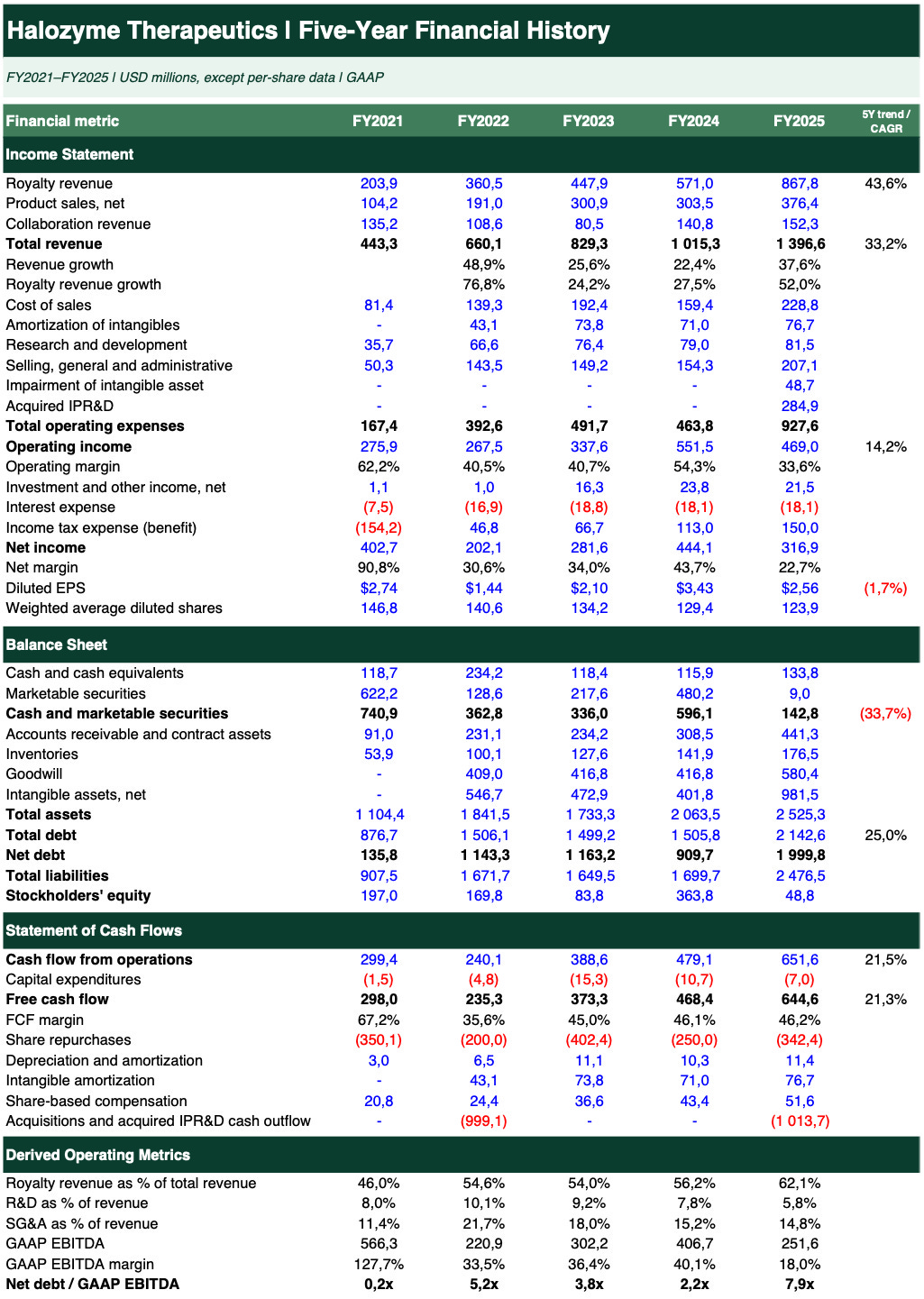
Between 2021 and 2025, Halozyme’s revenue rose from $443 million to almost $1.4 billion. Royalty revenue increased even faster, from $204 million to $868 million, expanding from 46% to more than 62% of the total. Free cash flow rose from approximately $298 million to $645 million, equivalent to 46% of 2025 revenue. First-quarter 2026 revenue increased 42% to $377 million, while royalty revenue rose 43% to $241 million.
These are unusually attractive economics.
As partner medicines grow, Halozyme collects additional royalties without carrying a proportionate increase in research, manufacturing or commercial expenditure. The principal current drivers include subcutaneous versions of DARZALEX, Phesgo and VYVGART, while recently signed agreements with GSK, Vertex and Oruka expand the opportunity across ENHANZE and the newer Hypercon platform.
Management expects 2026 revenue of $1.71–$1.81 billion, royalty revenue of $1.13– $1.17 billion and adjusted EBITDA of $1.13–$1.21 billion.
Halozyme is therefore not merely growing.
Its revenue mix is improving as it grows.
Royalties are replacing less valuable and less predictable sources of revenue, expanding cash conversion and reducing the amount of incremental capital required to support each additional dollar of sales. The company has used that cash aggressively on behalf of shareholders. Diluted shares declined from approximately 147 million in 2021 to 124 million in 2025.
Halozyme repurchased 19.1 million shares under its previous programme at an average price of $39.31, followed by approximately seven million additional shares during 2025 at an average price close to $52.
The board has now authorised another $1 billion of repurchases through 2028, with at least $400 million expected during 2026.
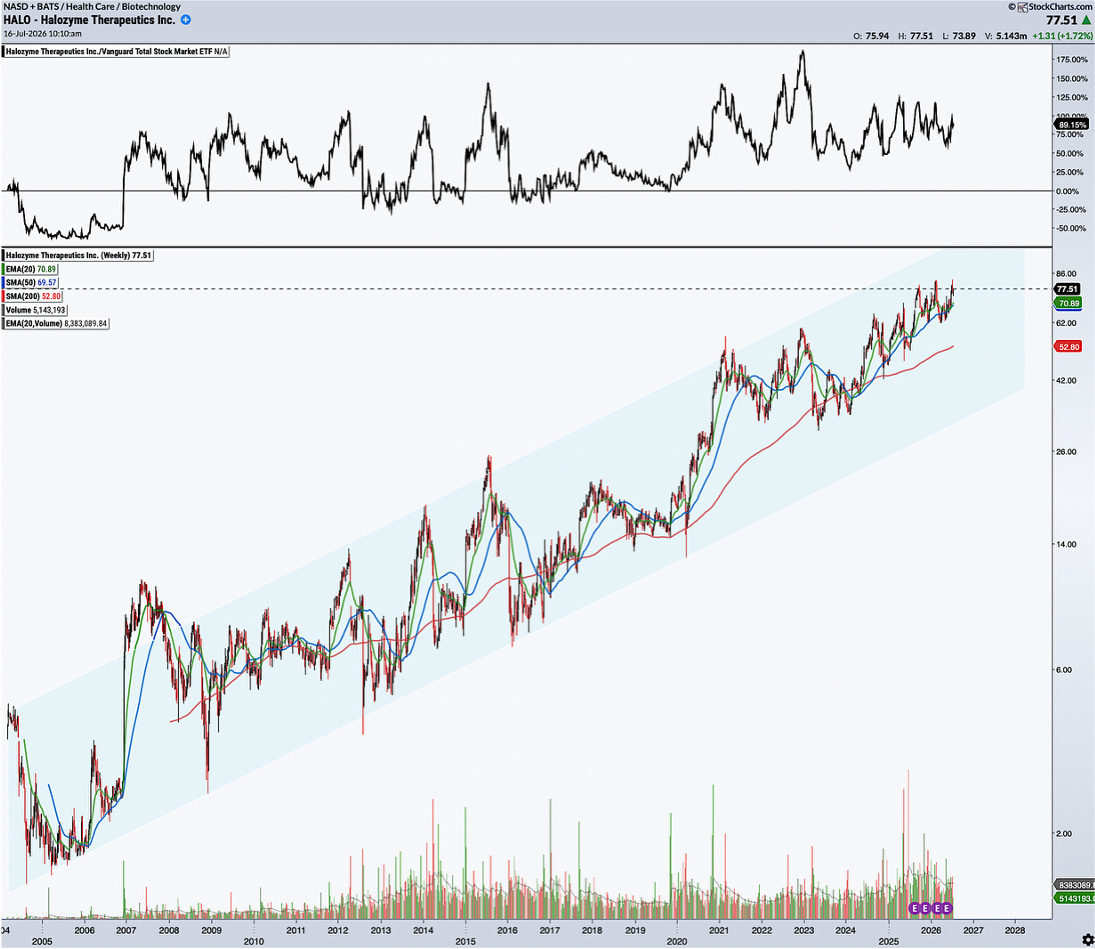
At the approximately $77.50 price shown in the chart above, the shares trade near ten times the midpoint of management’s 2026 non-GAAP earnings guidance. That is an undemanding valuation for a company growing royalty revenue above 30%, converting a large proportion of revenue into cash and reducing its share count materially.
But the model is not without vulnerabilities.
Halozyme still depends on the success of medicines it does not control.
Partners determine development priorities, clinical investment, pricing and commercial execution. A trial failure, weak launch or strategic decision to abandon a programme can eliminate an expected royalty stream without Halozyme being able to change the outcome.
Revenue also remains concentrated in several important partner products, while alternative subcutaneous-delivery technologies, including Alteogen’s competing hyaluronidase platform, could weaken Halozyme’s negotiating power or reduce future adoption. ENHANZE patent expirations and contractual royalty reductions must also be considered product by product and country by country.
The balance sheet is the element we like least.
At the end of March, Halozyme carried approximately $2.14 billion of debt, against only $319 million of cash and marketable securities, leaving net debt close to $1.83 billion.
Much of that debt consists of low-coupon convertible notes maturing in 2031 and 2032, and the company’s powerful cash generation makes the burden manageable.
At the midpoint of 2026 adjusted EBITDA guidance, net leverage would fall towards 1.6 times. Nevertheless, acquisitions, continued repurchases and financial leverage now compete for the same cash.
The company has less room for strategic error than the income statement alone might suggest.
The bear case is therefore straightforward.
Partner-product growth could slow, competition could erode the value of ENHANZE,
newer platforms may fail to reproduce its success, and management could continue deploying borrowed capital into acquisitions or repurchases at unattractive prices. Halozyme’s economic model substantially reduces individual drug-development risk; it does not eliminate partner concentration, intellectual-property risk or capital allocation risk.
We believe those risks are adequately compensated.
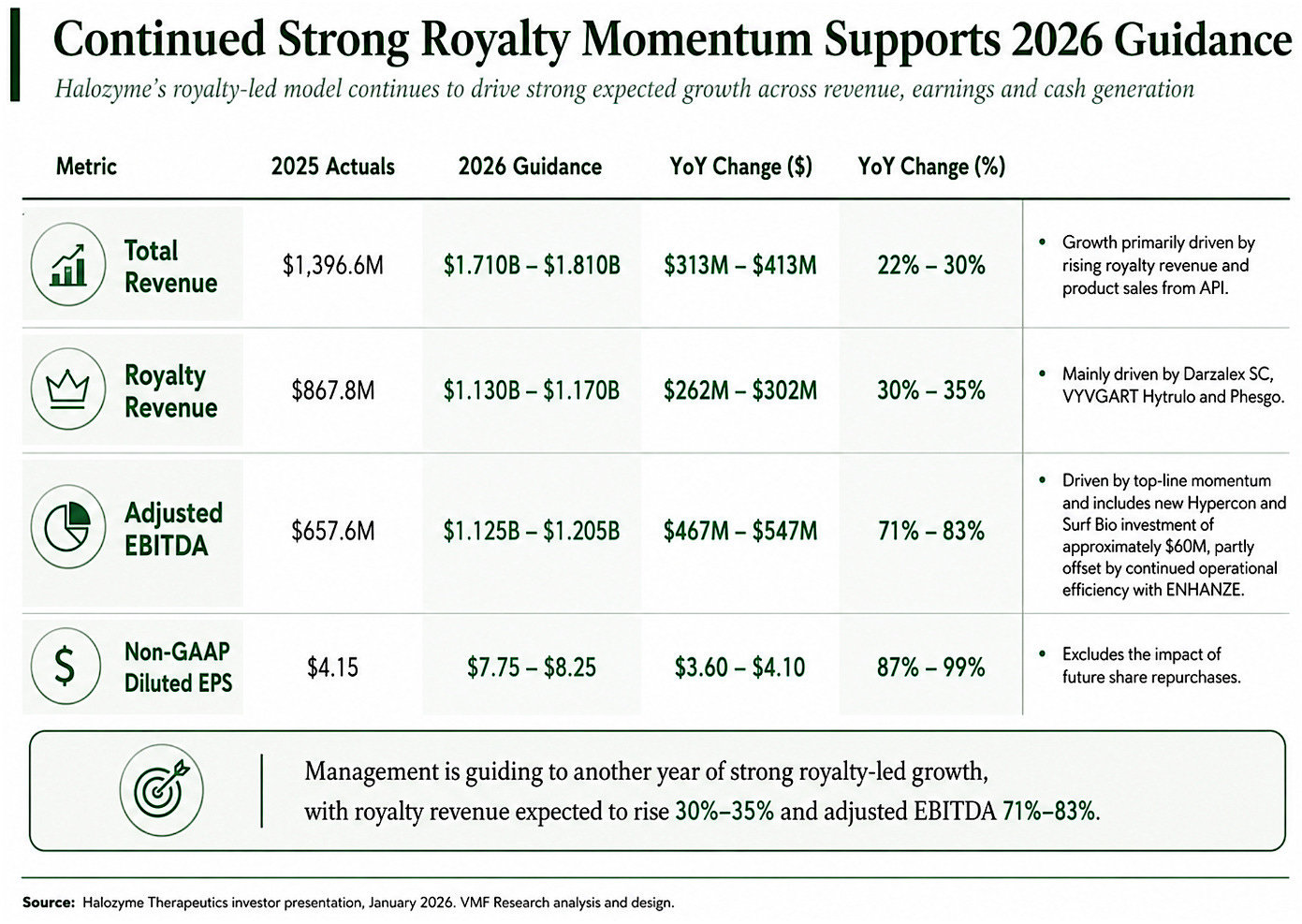
Management’s 2026 outlook makes the strength of the underlying model unusually clear. Total revenue is expected to reach $1.71–$1.81 billion, implying growth of 22%–30%, while royalty revenue is projected to increase 30%–35% to as much as $1.17 billion. More strikingly, adjusted EBITDA is guided to $1.13–$1.21 billion, an increase of 71%–83%, with non-GAAP diluted earnings per share expected to rise 87%–99%.
Those figures require careful interpretation. Management’s adjusted EBITDA excludes several items captured in the GAAP financials, including acquisition related charges and intangible amortisation, and is therefore not directly comparable with the GAAP EBITDA published before.
We prefer to underwrite the business using the more conservative measure and treat the company’s guidance as evidence of operating momentum rather than a substitute for our own valuation work.
Even on that basis, the outlook is powerful.
Halozyme’s highest-quality revenue stream is becoming a larger share of the business, partner medicines continue to expand, and the incremental economics remain exceptionally attractive. The company does not need to identify the next blockbuster itself. It needs a growing portfolio of established partners to keep selling medicines that physicians and patients already value, while Halozyme collects a royalty each time they do.
The long-term chart reflects that quality.
For more than two decades, the shares have advanced within a remarkable rising channel, repeatedly absorbing volatility without breaking the broader trend. Price remains above rising long-term moving averages, while relative strength against the wider equity market remains firmly positive. We see no reason to conclude that this pattern has reached its end.
Against the backdrop of the healthcare and biotechnology opportunity we have developed across VMF Research, Halozyme represents a compelling addition to our roster: a capital-light royalty engine, growing profitability, powerful cash conversion and exposure to multiple successful medicines without assuming the full clinical and commercial risk of creating each one.
Regeneron gives us ownership of the discovery machine.
Halozyme gives us the tollbooth.
You might also like reading, The Intelligence Dividend - How cheaper AI cuts biopharma’s $300B failure risk and drives the next healthcare rotation:

Important Disclosure
This article contains general investment research produced by Vasco Marques de Freitas, CFA, CMT, Founder and CEO of VMF Research, Lda. It reproduces an excerpt from the July 2026 issue of VMF’s Security Selection. The research, views, valuation analysis and Quality Model Portfolio information are stated as of 17 July 2026, 4:00 p.m. Eastern Daylight Time, unless another date is expressly identified. The original issue was first disseminated to paid subscribers on 17 July 2026 at 9:00 p.m. Eastern Daylight Time. Any reference to subsequent price performance is stated separately and does not amend the original analysis.
The publication contains information recommending or suggesting an investment strategy. It is not personalised investment advice and does not consider any reader’s individual objectives, financial circumstances, knowledge, experience, liquidity requirements or tolerance for risk. VMF Research’s Model Portfolios are illustrative research portfolios and do not represent client assets or transactions executed by VMF Research.
The analysis combines thematic, fundamental, scientific, valuation and market research within a medium- to long-term investment framework. Forecasts, valuation assessments and statements concerning future revenue, royalties, cash generation or operating leverage are analytical judgments rather than assurances. Sources and the basis for material factual claims are identified throughout the article. Views and conclusions may change as scientific, clinical, regulatory, competitive, corporate or market evidence evolves and are reviewed through VMF Research’s monthly publications, with weekly or ad hoc updates where appropriate.
Investments in Halozyme Therapeutics and other biotechnology companies involve substantial risks, including dependence on partner products and commercial decisions, clinical or regulatory setbacks affecting licensed medicines, product and customer concentration, loss or expiry of intellectual-property protection, competing drug-delivery technologies, pricing and reimbursement pressure, leverage, acquisition and capital-allocation risk, market volatility and the possible loss of capital. A royalty-based business model may reduce some development and commercial risks without eliminating them. Historical growth, cash conversion and technical trends may not persist, and valuation assumptions may fail.
Disclosure of interests: as of the research cut-off, neither VMF Research, Lda., Vasco Marques de Freitas personally, nor any legal entity controlled by him held a position in Halozyme Therapeutics or Regeneron Pharmaceuticals. A legal entity controlled by Vasco Marques de Freitas held a long position in Altius Minerals Corporation, which is referenced in the article as a comparative example of a royalty-based business model. This constitutes a financial interest and potential conflict of interest and should be considered when evaluating the comparison. Neither VMF Research nor the author received compensation from any issuer discussed in connection with the preparation of this research, and no issuer reviewed or approved its conclusions before first dissemination.
Past performance is not indicative of future results. Readers should conduct their own analysis and, where appropriate, consult an authorised financial intermediary or adviser before making an investment decision.