

Two weeks ago, the market was still asking how soon Kevin Warsh might raise rates.
We were asking a different question.
What if he did not have to?
On 7 August, when we published this section in VMF’s Strategic Asset Allocation, Warsh’s reputation was already doing much of the analytical work for investors. He had arrived at the Federal Reserve determined to restore credibility, repeatedly defended the 2% inflation target and deliberately reduced the forward guidance markets had grown accustomed to. Three FOMC members had just voted for an immediate rate increase.
The conclusion seemed straightforward: Warsh was a hawk, therefore the next meaningful move in policy was more likely to be tighter.
We thought that interpretation was too simple.
His rhetoric was uncompromising, but his behaviour was more nuanced. He had already supported holding rates through two meetings. More importantly, he had drawn a distinction between individual price shocks and a sustained broadening of underlying inflation. Tariffs, energy, geopolitical disruption and the enormous capital spending associated with AI could all lift particular prices without necessarily requiring the Federal Reserve to respond mechanically.
That distinction sat at the heart of our Dovish Shock thesis.
We were never forecasting an imminent cutting cycle. The more interesting possibility was much less dramatic: markets had become so conditioned to expect tighter policy that a transition from expected tightening to patience could be enough to change real yields, the dollar, liquidity conditions and cross-asset leadership.
Tier One had already been positioned with that possibility in mind. And over the past few days, the evidence has moved noticeably in our direction.
July consumer and producer inflation both came in softer than expected, while the labour data also weakened. By 14 August, Reuters was describing the new information as potentially setting the Fed up for an “extended do-nothing stance”, with traders abandoning much of their expectation for a September hike.
Then came weaker retail sales.
By 17 August, market pricing for a September increase had flipped towards a roughly 70% probability of no change. In Reuters’ latest economist poll, 90% expected the Fed to hold in September and nearly 80% expected no change through year-end. That is a meaningful shift from the environment in which this research was written.
It does not prove the Dovish Shock.
But the market is beginning to travel towards the scenario we described.
At the same time, another part of our August argument has become almost impossible to miss.
We called the area around 5.10–5.20% on the 30-year Treasury the TACO Zone because this was where an abstract argument about inflation and fiscal policy began imposing very real costs on mortgages, corporate financing, equity valuations and government borrowing. The level itself was never meant to be magical. The important point was the feedback mechanism: long-term yields could eventually constrain political choices in ways the White House could not simply talk away.
This week, the 30-year yield reached 5.34%, its highest level since 2007.
The Treasury responded by doubling its long-end bond buybacks to at least $4 billion per operation. Reuters noted that the move revealed the administration’s sensitivity to higher long-term borrowing costs and its willingness to intervene once those yields became sufficiently uncomfortable.
That is remarkably close to the mechanism we described on 7 August.
Warsh can control the overnight policy rate.
The administration can pressure the Fed.
Neither can casually ignore the long bond.
This is why the interaction between the hawk and the TACO Zone matters. Warsh’s credibility requires him to convince investors that 2% still means 2%. Yet the stronger that credibility becomes, the more freedom he may eventually have to respond to softer inflation and weaker activity without markets interpreting patience as surrender.
The recent data are beginning to test that possibility in real time.
There is still plenty that could reverse it. Inflation remains above target, oil remains elevated and several FOMC members continue to argue that tighter policy may ultimately be necessary. Markets still assign a meaningful probability to a rate increase later this year. Jackson Hole may move the debate again.
But that is precisely why revisiting this research now is useful.
What follows was first published to paid Tier One subscribers on 7 August 2026 at 9:00 p.m. Eastern Daylight Time, before the latest inflation releases, before the weaker retail data and before the Treasury was pushed into increasing its intervention at the long end.
We had been waiting for evidence that the market’s image of Warsh as a permanently hawkish Fed Chair was too rigid.
We are starting to get it.
And the bond market is simultaneously showing us why the cost of staying hawkish may be considerably higher than it looked only a few weeks ago.
Good reading.
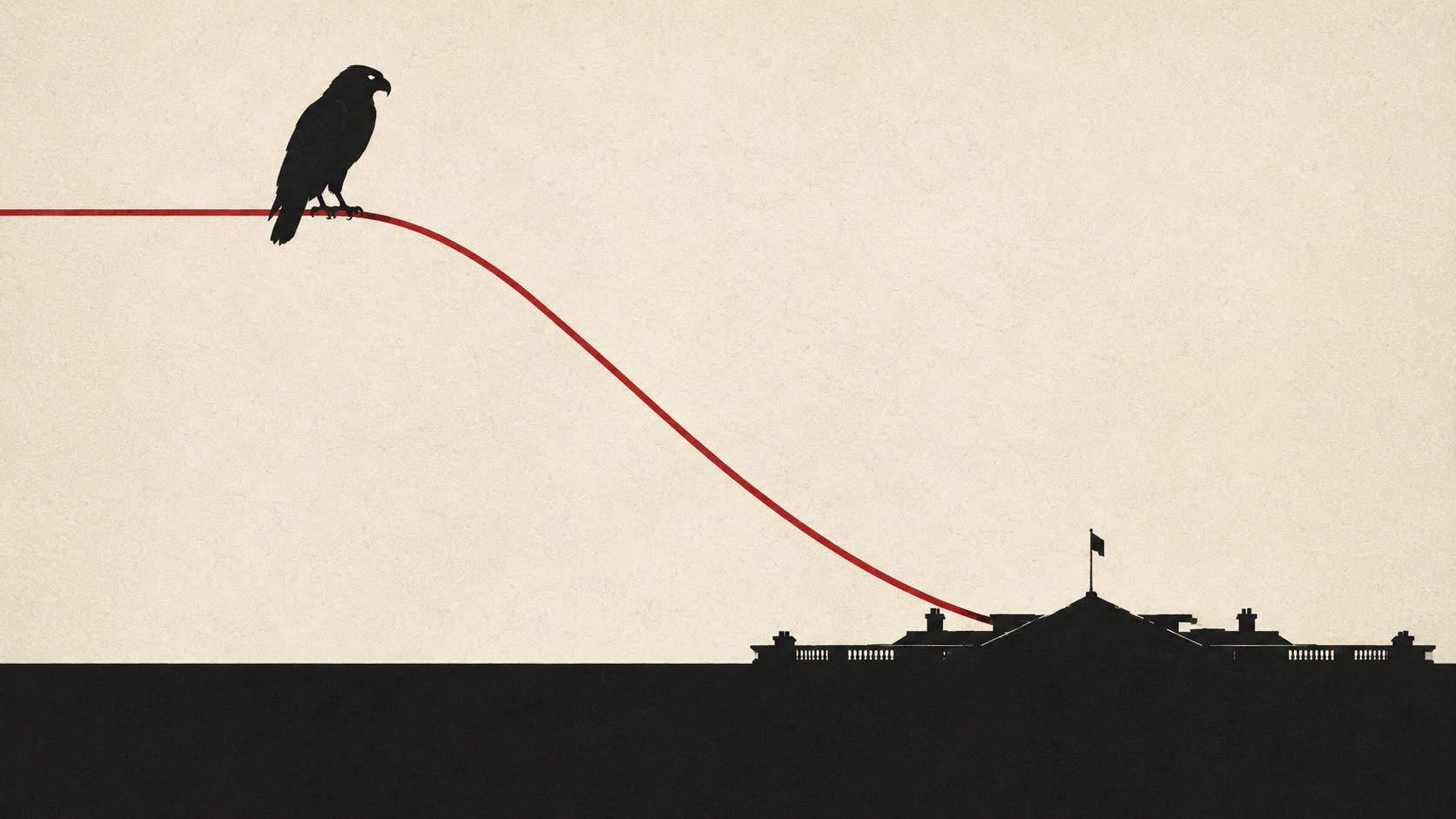
The inflationary lens has become so dominant that it now shapes the interpretation of policy before policy is even made.
Kevin Warsh is the clearest example. The market sees a central banker determined to restore the Federal Reserve’s credibility, unwilling to tolerate another period of above-target inflation and prepared to reconsider many of the institution’s established practices.
It sees a hawk.
Warsh has certainly given investors reasons to reach that conclusion. In his first testimony to Congress as Chair, he described price stability as a central obligation of the Federal Reserve and insisted that persistent inflation must ultimately be owned by monetary policy. There would be no quiet migration towards a higher target and no attempt to explain away a generalised rise in prices through an endless succession of external shocks. The Federal Reserve would return inflation to 2%.
The language has been deliberately uncompromising.
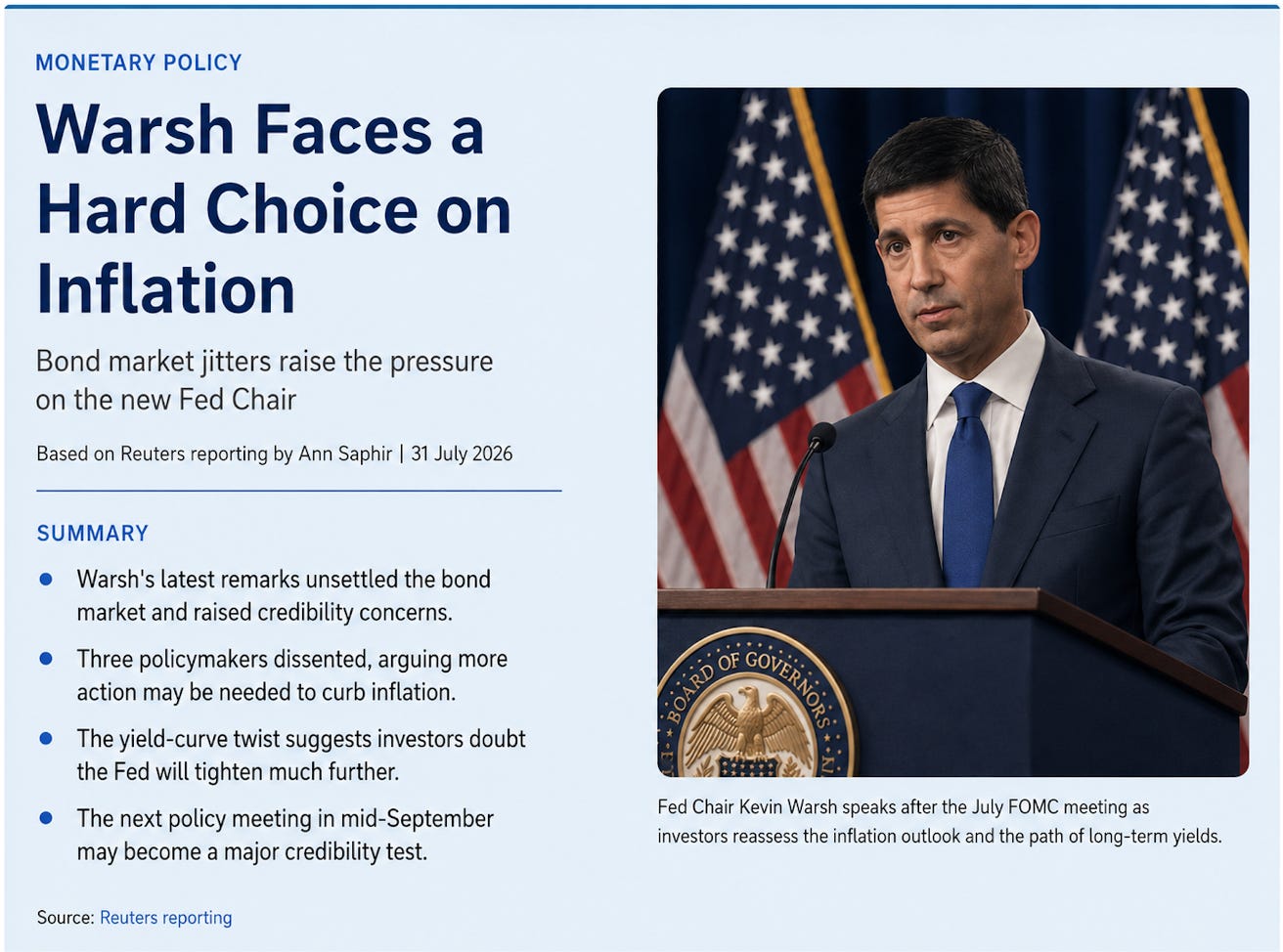
His actions have been more nuanced.
Warsh has chaired two FOMC meetings since taking office. In June, the Committee unanimously maintained the federal funds rate at 3.50–3.75%. In July, Warsh again supported holding rates even though three members preferred an immediate quarter-point increase. This is not the record of a Chair rushing to validate his hawkish reputation through higher policy rates.
Nor has Warsh described monetary policy as a mechanical response to every uncomfortable inflation release. He has distinguished between increases in individual prices and a broader movement in underlying inflation. Energy, tariffs, geopolitical conflict and AI-related investment may all raise costs in particular sectors. The policy question is whether those increases spread into unrelated categories, alter expectations and become embedded across the economy.
His reaction function is consequently more symmetric than the market narrative suggests. With the labour market close to equilibrium, rising underlying inflation would make him more inclined to tighten. Falling underlying inflation would make him more inclined to loosen.
The target is fixed.
The route is not.
Warsh’s most consequential change may therefore concern not the current level of the federal funds rate, but the way the Federal Reserve communicates. He has reduced the forward guidance through which central banks had become accustomed to preparing investors for almost every policy decision. Markets should respond more directly to economic information rather than continually attempting to anticipate the Fed’s next carefully rehearsed sentence.
That approach has merit. A central bank that manages every movement in financial markets risks replacing price discovery with a feedback loop in which investors merely repeat the Fed’s own forecasts back to it. Less guidance may eventually produce more informative market prices.
But it also means that those prices must be taken seriously.
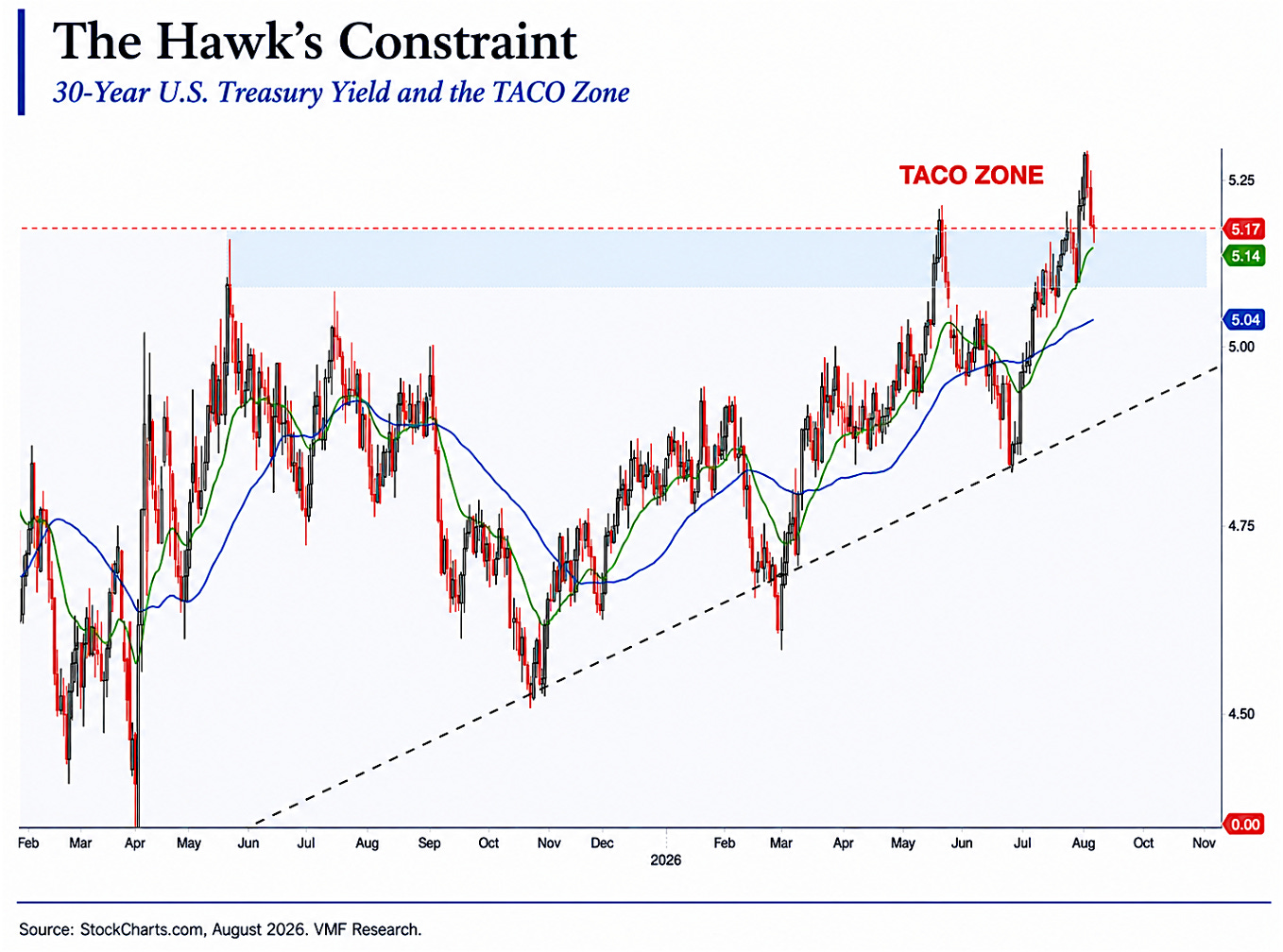
Long-term yields rose sharply after the July meeting even though the policy rate remained unchanged. The thirty-year Treasury yield moved above 5.20%, reaching its highest level since 2007, as investors questioned whether the Federal Reserve would act forcefully enough to restore inflation to its target. Reuters described the move as a test of Warsh’s credibility rather than a simple response to the FOMC decision itself.
Warsh wants the market to speak.
The long bond has taken him literally.
The chart above focuses on the part of the Treasury curve that increasingly matters for both monetary and political policy.
The thirty-year yield has established a sequence of higher lows and repeatedly tested the area between approximately 5.10% and 5.20%.
We have labelled that region the TACO Zone.
The name is intentionally irreverent.
The constraint is not.
A thirty-year yield above 5.20% raises long-term mortgage costs, increases the hurdle rate for corporate investment, weakens the valuation support provided by distant cash flows and raises the government’s prospective refinancing burden. It is where the abstract debate about inflation begins imposing an immediate cost on the economy and the political system.
The significance of that level has become especially visible during the war with Iran.
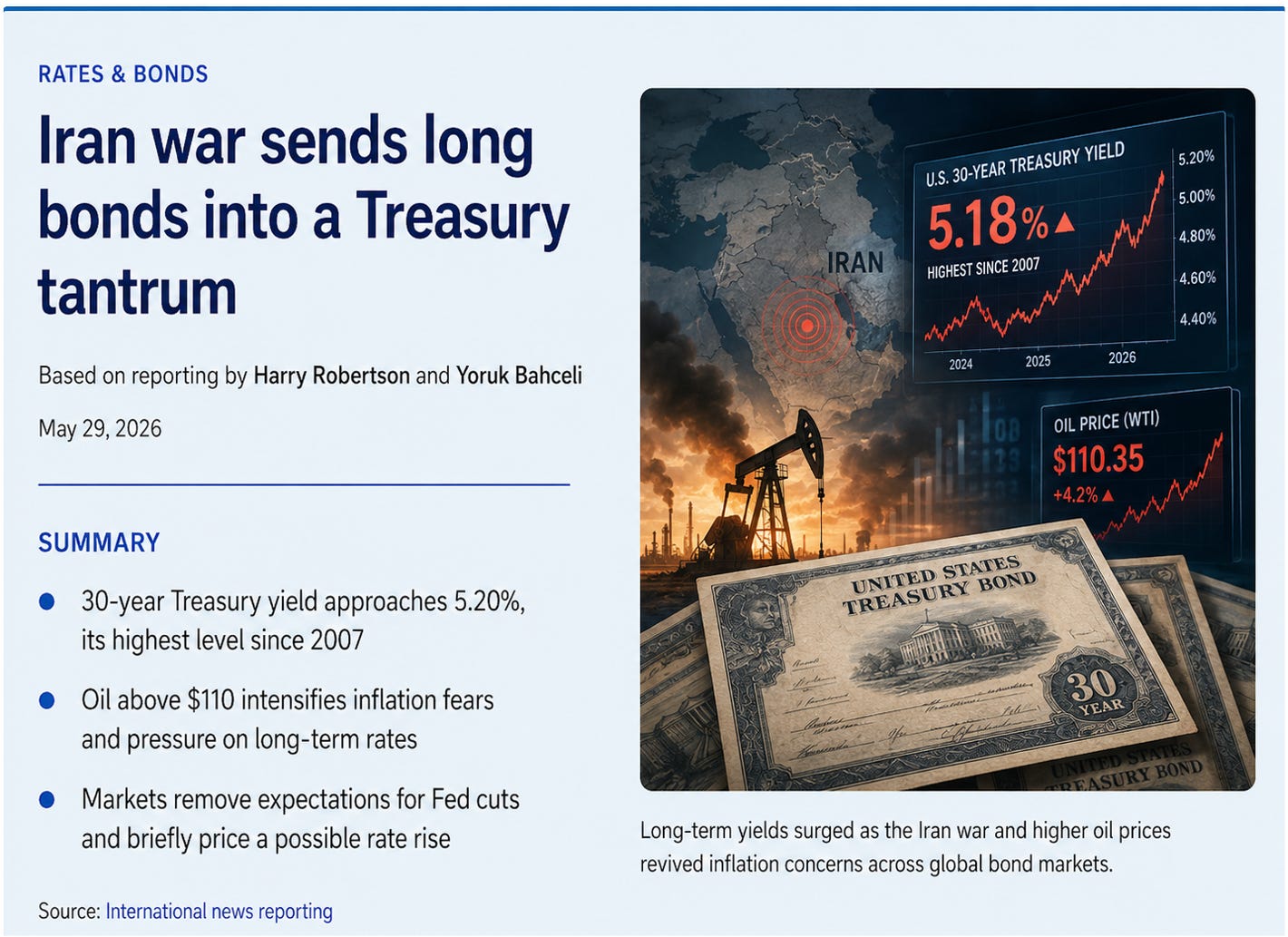
The conflict disrupted energy shipments through the Strait of Hormuz, lifted oil and petrol prices and forced investors to reassess the likelihood of further Federal Reserve tightening. As inflation risk rose, the long end sold off. In May, the thirty-year yield reached 5.20% for the first time since 2007, while markets moved from expecting several rate cuts before the war towards assigning a high probability to a rate increase.
At approximately the same time, President Trump began moderating his demands for immediate monetary easing. Having previously expressed disappointment at the prospect that Warsh might not cut rates quickly, he adopted a more patient tone and acknowledged that the Fed Chair would have to respond to the conditions confronting him. The timing does not prove that the bond market alone forced the rhetorical shift, but it showed how quickly political ambitions could collide with long-term borrowing costs.
The pattern subsequently repeated itself across the Iran conflict.
→ Trump would threaten military escalation.
→ Oil prices would rise as traders priced the risk of further disruption to Hormuz and regional energy infrastructure.
→ Inflation expectations and long-term yields would come under renewed pressure.
→ The administration would then postpone or cancel military action, claim progress towards negotiations or announce another tentative agreement.
→ Oil and yields would retreat.
In June, Trump cancelled planned strikes against Iran only hours after threatening to hit the country “very hard”. Brent and WTI fell by almost 3% after the announcement, even though Iran had not confirmed the agreement Trump suggested was advancing. Reuters noted that the President had repeatedly announced that a deal was imminent, only to return to military threats when Tehran refused his terms.
The same sequence became visible again in early August. Trump withheld further action and claimed talks were under way, while Iran denied that negotiations had been scheduled. Brent fell approximately 7%, Treasury yields declined and equities rallied as markets priced another possible de-escalation. The thirty-year yield retreated after having reached 5.28%, its highest level since 2007.
This is the geopolitical version of the TACO trade.
The threat creates the market shock.
The market shock increases the domestic political cost.
The threat is softened before that cost becomes intolerable.
The TACO Zone should therefore not be understood as one magical number on one chart. It is a broader pressure point connecting the Iran war, oil prices, inflation expectations and long-term borrowing costs.
When escalation threatens the Strait of Hormuz, oil rises.
When oil rises, the inflation problem confronting Warsh becomes more difficult.
When the expected policy path and inflation risk rise, the long bond approaches or breaks through the 5.10–5.20% zone.
And when those yields begin tightening mortgages, corporate finance, equity valuations and government funding simultaneously, Trump’s room for manoeuvre narrows.
Retail investors have increasingly recognised the pattern. Reuters reported that “TACO” has moved into everyday market language, with traders buying declines created by Trump’s most aggressive announcements on the expectation that economic or market pressure will eventually force another retreat. The long bond has become one of the clearest measures of that pain threshold.
None of this means every change in Trump’s Iran policy is caused by Treasury yields. Military capacity, domestic approval, petrol prices, diplomacy and the actions of Iran and America’s regional partners all matter. Nor does it mean 5.20% will remain the relevant threshold indefinitely.
But the repeated interaction is increasingly difficult to ignore.
Trump wants lower policy rates, stronger growth, greater defence production, more domestic manufacturing and enormous investment in energy and artificial intelligence. Each objective may be individually defensible. Collectively, they require capital and risk placing further upward pressure on long-term yields.
The President can pressure the Federal Reserve.
He cannot order the thirty-year Treasury yield lower.
This brings us to what we believe the market may be misreading about Warsh. He assumed office under unusually difficult circumstances. Inflation had remained above target for more than five years. The President who appointed him had repeatedly demanded easier monetary policy. Investors therefore had legitimate reasons to question whether the new Chair would defend the mandate independently of the White House.
A Chair entering under those conditions could not establish credibility by sounding dovish. He had to demonstrate that 2% still meant 2%, that the Federal Reserve would not automatically accommodate fiscal or political pressure and that he was willing to disappoint the President who appointed him.
Our interpretation is that Warsh’s hawkish language is partly an exercise in rebuilding that institutional credibility. This is an inference rather than something he has explicitly acknowledged, but it is consistent with his emphasis on accountability, independence and the need to put the recent period of high inflation behind the institution.
Credibility, however, is not the same thing as permanent hawkishness.
It is what preserves the freedom to respond when the evidence changes.
A Chair who convinces markets that he will defend the inflation target may eventually be able to loosen policy without appearing to have abandoned it. A Chair whose independence remains in doubt cannot.
This is the central asymmetry behind our Dovish Shock1 thesis.
You might also like reading, from June’s VMF’s Strategic Asset Allocation, Fighting the Wrong War:
The Setup for a Dovish Shock

How a 4% Productivity Surge and Changing Supply Dynamics Are Setting Up the Ultimate Fed Repricing for Active Investors.
The Invisible AI Rails

Crypto has spent the past few months doing what it does best when confidence breaks: punishing believers, rewarding cynics, and making every long-term thesis look foolish.
Warsh may need to sound more hawkish today precisely so that he can become more dovish later. Not because he changes the destination, but because the inflation confronting him changes.
The market has largely collapsed those two possibilities into one. It sees Warsh’s commitment to price stability and assumes a permanently restrictive policy path.
Yet his decisions, his treatment of supply shocks and his stated reaction function leave considerably more flexibility than that interpretation allows.
We are not arguing that rate cuts are imminent. We are arguing that the hurdle for a dovish repricing may be lower than investors believe.
The Federal Reserve does not need to cut aggressively for the Dovish Shock to matter. A shift from expected tightening towards an extended hold could be sufficient to alter real yields, the dollar, liquidity conditions and cross-asset leadership.
The most revealing evidence may be found outside the immediate rates debate. Warsh has established a dedicated task force to examine productivity and employment in an economy being transformed by general-purpose technologies, including artificial intelligence. The group is explicitly studying what those developments mean for productive capacity and for the Federal Reserve’s inflation and employment mandates. Marc Andreessen is one of its external leaders.
Warsh has also highlighted the extraordinary scale of AI-related capital expenditure. High-technology investment is growing rapidly, driven by data centres and the equipment and software required to operate them. But the Fed is not only examining the immediate demand for semiconductors, electricity and construction. It is asking what the technology could eventually mean for the supply side of the economy.
That question leads directly to the other side of this issue.
The market sees the power plants, data centres, semiconductors and financing required to construct artificial intelligence. Warsh is already asking what that investment may do to the economy’s future capacity. And if AI allows supply to expand faster, unit costs to fall and underlying inflation to moderate, his own reaction function tells us what follows.
The hawk becomes more inclined to loosen.
The market may believe Warsh’s credibility depends on remaining hawkish. We believe that credibility may eventually be what permits the dovish turn.
But for that thesis to work, the technology must deliver more than investment demand.
It must deliver productivity.
That is where we turn next.
We presented our Dovish Shock thesis in detail in June’s VMF’s Strategic Asset Allocation, Fighting the Wrong War. The argument was never that inflation had disappeared or that aggressive rate cuts were imminent. It was that markets had become so conditioned to a hawkish Federal Reserve that even a shift from expected tightening towards patience could trigger a meaningful repricing in real yields, liquidity conditions and cross-asset leadership.
Important Disclosure
This article contains general investment research produced by Vasco Marques de Freitas, CFA, CMT, Founder and CEO of VMF Research, Lda. It incorporates an excerpt from the August 2026 issue of VMF’s Strategic Asset Allocation, together with introductory commentary on developments that occurred after the original research cut-off. The underlying Tier One research and Model Portfolio information are stated as of 7 August 2026, 4:00 p.m. Eastern Daylight Time, unless another date is expressly identified. The original issue was first disseminated to paid subscribers on 7 August 2026 at 9:00 p.m. Eastern Daylight Time. Subsequent economic, policy and market developments referred to in the introduction are identified by their relevant dates.
The publication contains information recommending or suggesting an investment strategy. It is not personalised investment advice and does not consider any reader’s individual objectives, financial circumstances, knowledge, experience, liquidity requirements or tolerance for risk. The Tier One Model Portfolio is an illustrative research portfolio designed to communicate VMF Research’s strategic asset-allocation framework, Market View and investment conclusions. It does not represent client assets, transactions executed by VMF Research or the performance of an investable fund or managed account.
The analysis combines macroeconomic, monetary-policy, fixed-income, geopolitical and market research within a medium- to long-term framework. Statements concerning Kevin Warsh’s reaction function, the Dovish Shock thesis, inflation, Federal Reserve policy, Treasury yields, oil prices, geopolitical developments and the TACO Zone are analytical judgments and conditional interpretations rather than assurances. References to the TACO Zone describe an observed market pressure point and analytical framework; they should not be interpreted as implying that any particular Treasury yield constitutes a permanent threshold or will reliably produce a specific policy, political or market response.
Economic releases, market-implied probabilities and policy expectations can change rapidly and may be revised. A period of softer inflation or weaker activity may not lead to easier monetary policy, lower real yields or the cross-asset outcomes contemplated in the analysis. Inflation may remain persistent, energy or geopolitical shocks may intensify, Federal Reserve policy may prove more restrictive than expected and historical relationships between interest rates, financial conditions and asset prices may fail.
Neither VMF Research nor the author received compensation from any issuer, financial institution, public official or other entity covered in connection with the preparation of this research, and no covered entity reviewed, approved or amended its investment conclusions before first dissemination.
Past performance, historical market relationships, Model Portfolio performance and forward-looking scenarios are not reliable indicators of future results. Readers should conduct their own analysis and, where appropriate, consult an authorised financial intermediary or adviser before making an investment decision.