

Tether has a peculiar way of preparing for the future of money: it keeps buying gold.
The company behind USDT, the dollar-linked stablecoin, earns interest on a vast portfolio of US government securities. It also allocates capital to Bitcoin and physical bullion. For a business making substantial profits from interest-bearing reserves, choosing an asset that pays nothing deserves a closer look.
In The Only Assets That Owe You Nothing, we argued that gold and Bitcoin could perform complementary jobs within a portfolio. Tether offers a useful case through which to revisit that argument, especially for readers accustomed to hearing that the success of one must come at the expense of the other.
Much of our recent research has examined what happens when a useful investment rule becomes a substitute for judgement. The debate over money provides fertile ground. Investors can spend years defending a monetary allegiance without asking whether it serves the portfolio they actually need.
Tether’s choices invite that question. They also raise a less comfortable one: how much can we learn about an investment from the asset alone, without examining the structure surrounding it?
This excerpt was first published for paid Alpha Tier subscribers on 28 August 2026. The full issue follows the argument into our Dovish Shock thesis, Treasury policy and the market signals behind the decision to maintain the Model Portfolio’s positioning rather than chase the recovery.
Good reading.

The most interesting thing about Tether’s gold purchases is not that a crypto company likes gold.
It is that Tether apparently sees no reason to choose.
For years, one of finance’s strangest tribal disputes has pitted two assets with more in common than either camp often admits against each other. Gold advocates dismiss Bitcoin as speculative code with no history. Bitcoin maximalists describe gold as monetary technology whose best days disappeared with the telegraph.
The argument makes for excellent social media.
It makes considerably less sense as portfolio construction.
Tether offers an unusually useful test case because this is not an institution arriving reluctantly from traditional finance. It was built inside the crypto economy. It operates USDT, the dominant dollar-linked stablecoin, invests heavily in US government securities and has direct exposure to Bitcoin and blockchain infrastructure. If anyone should be predisposed to believe that digital scarcity has made physical monetary scarcity obsolete, Tether would be a reasonable candidate.
Instead, it has become one of the most aggressive private buyers of gold in the world.
Tether International purchased approximately 27 tonnes during the first half of 2026, taking its physical gold holdings to roughly 150 tonnes by June. The company has separately built Tether Gold, or XAU₮, whose tokens represent direct ownership of physical bullion held in Swiss vaults. At the end of Q2, that product was backed by another 22 tonnes of gold, although those bars belong economically to XAU₮ holders rather than to Tether itself.
That distinction is important.
So is the scale.
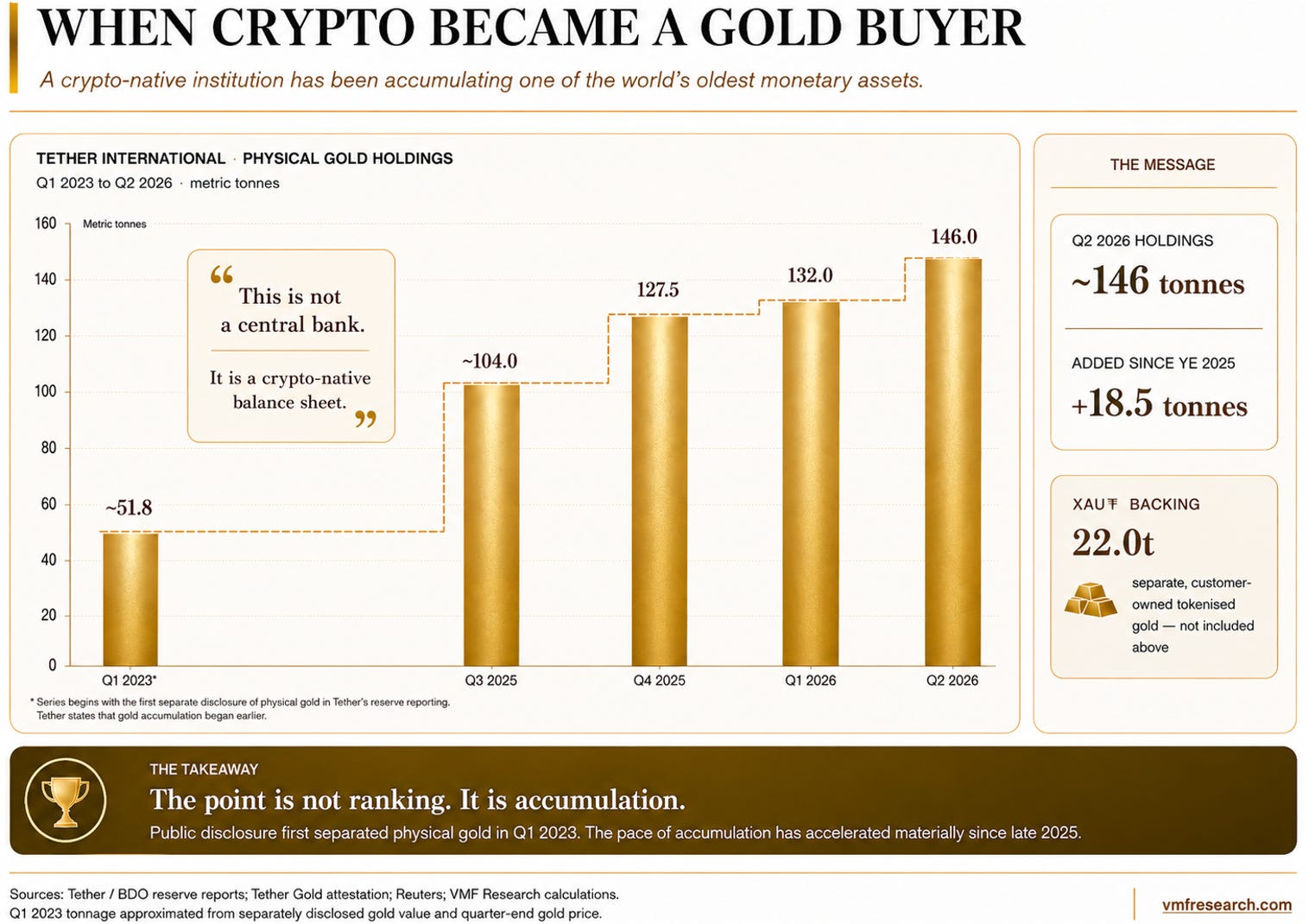
Tether is not buying a few bars to decorate a balance sheet.
At the beginning of the year, CEO Paolo Ardoino said the company considered it reasonable to hold roughly 10% of its investment portfolio in Bitcoin and 10–15% in physical gold. Tether had already been buying gold at a pace of around two tonnes per week.
Read those numbers again.
Bitcoin and gold.
Not Bitcoin instead of gold.
Not gold because Bitcoin failed.
Both.
That revealed preference is more useful than another thousand-page debate about which asset constitutes “real money”. A sophisticated allocator does not need assets to belong to the same philosophical camp. It needs them to perform useful economic functions.
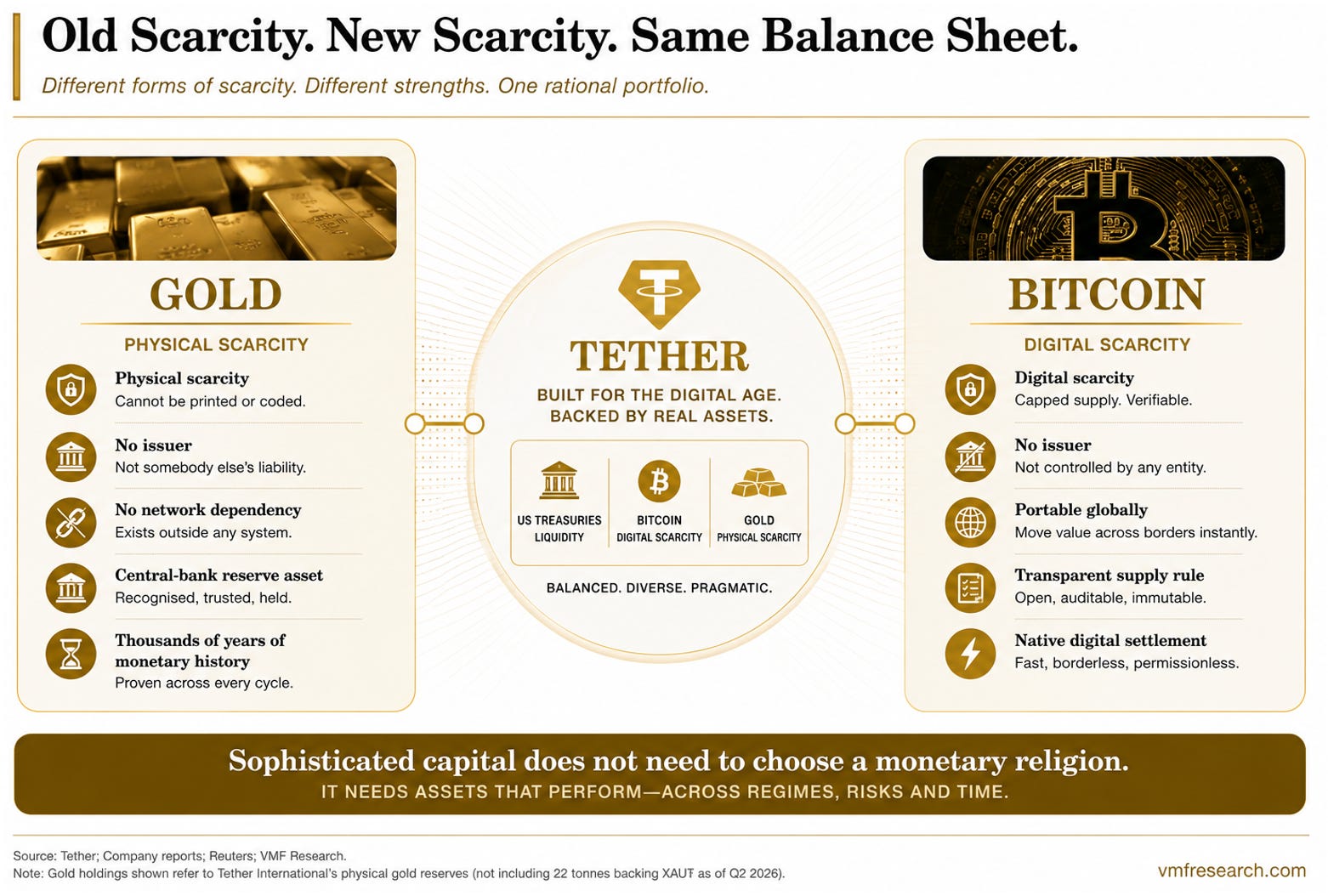
Gold and Bitcoin overlap in one very important respect. Neither is somebody else’s liability. That was the argument behind June’s The Only Assets That Owe You Nothing. But overlap is not equivalence. Gold has no technological obsolescence risk. Its monetary history is measured in millennia. Central banks already accept it as a reserve asset, its physical supply responds slowly to price and no network needs to remain operational for a bar in a vault to continue existing. Bitcoin offers something gold cannot: digitally verifiable scarcity that can move globally without moving a physical object. Its supply rules are transparent, settlement is native to the network and ownership can cross borders at a speed and cost that bullion cannot reproduce.
You might also like reading:

The strengths of one do not erase the strengths of the other.
They are different answers to a partially shared problem.
And that is precisely why owning both can be more rational than choosing a side.
There is another reason Tether’s behaviour deserves attention.
Its core business gives it access to something gold does not provide: yield.
USDT reserves are heavily invested in short-duration US government securities. As of the first quarter, Tether reported approximately $141 billion of direct and indirect Treasury exposure. Those securities pay interest. Gold does not.
That makes the decision to accumulate bullion more revealing, not less. A Treasury bill offers a contractual yield backed by the US government. A gold bar offers no coupon whatsoever.
For an institution earning billions from the spread generated by a vast pool of dollar reserves, allocating meaningful capital to an asset with no cash flow amounts to accepting an obvious opportunity cost.
Why do it?
Because carry is only one property of money.
Liquidity matters.
Credit quality matters.
Duration matters.
And in a world of rising sovereign indebtedness, geopolitical fragmentation and increasingly active monetary and fiscal authorities, independence from the issuer can matter too.
This does not make Treasury bills dangerous. Tether continues to own them in enormous size, and for good reason.
It makes the composition interesting.
The same institution can rationally want highly liquid US government paper for the operating demands of a stablecoin, Bitcoin for digital scarcity and gold for physical monetary scarcity.
Three assets. Three different jobs. One balance sheet.
That is a much more sophisticated way of thinking about portfolios than asking which one is destined to “win”.
And Tether is going further than simply accumulating bullion.
In February, it invested $150 million for roughly 12% of Gold.com, with plans to integrate XAU₮ into the platform and explore the purchase of physical bullion using digital dollars. XAU₮ has meanwhile expanded across blockchain infrastructure and received regulatory recognition as an accepted spot commodity within Abu Dhabi Global Market.
This is where the story becomes more interesting. Tether is not merely putting old money on a new balance sheet. It is attempting to put old money on new rails.
There is an important conceptual point here.
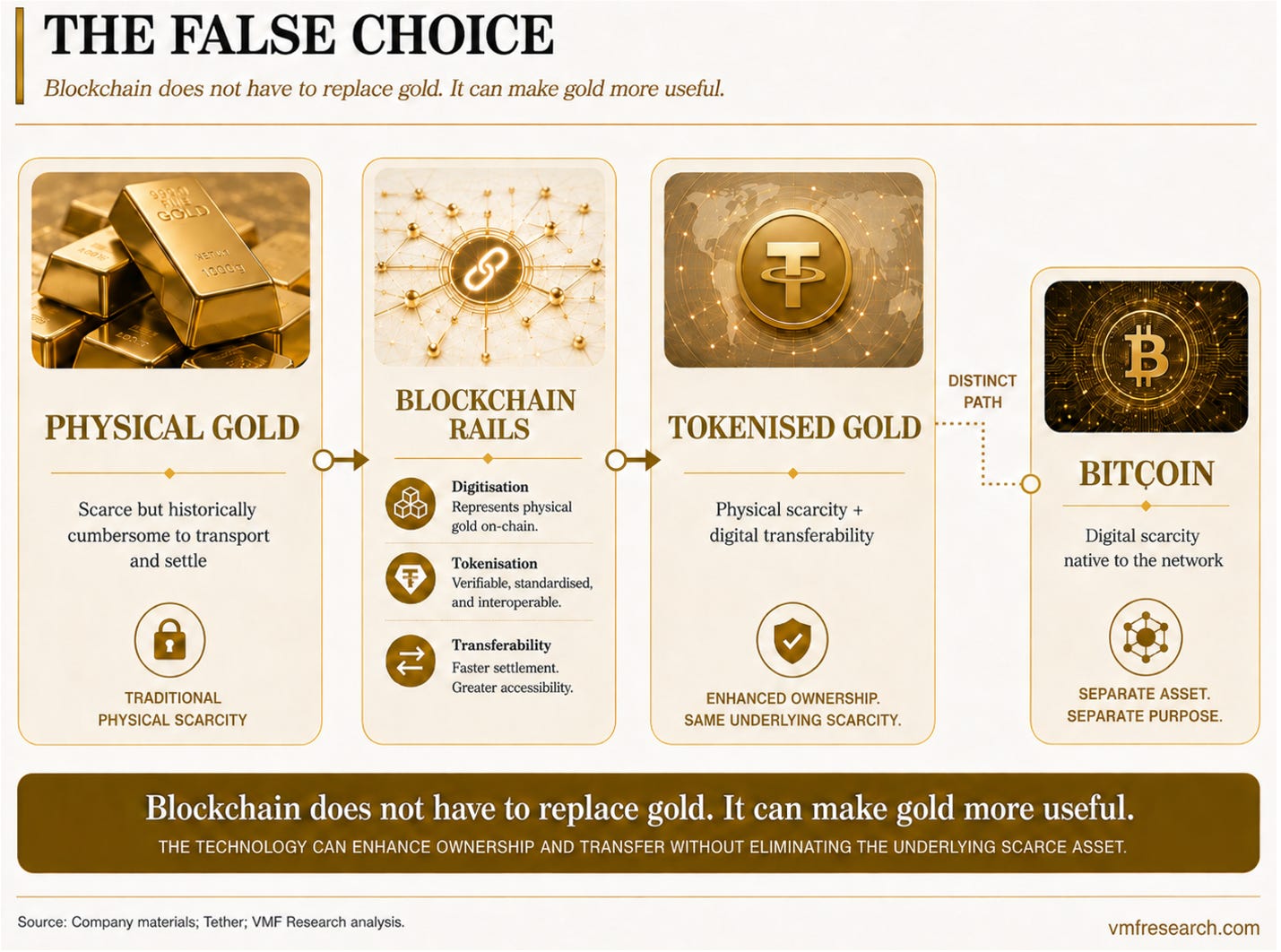
Technology usually does not eliminate scarce assets simply because it improves how claims on those assets can move. The internet did not eliminate warehouses because commerce became digital. Electronic trading did not eliminate securities because exchanges became faster. And blockchain need not eliminate gold merely because value can now settle digitally.
In some cases, technology can make the underlying scarce asset more monetisable.
Tether Gold is an early example. A London Good Delivery bar remains physical, costly to produce and impossible to replicate with software. Blockchain changes the ownership and settlement layer around it. One full XAU₮ represents one fine troy ounce of allocated physical gold, while the token can be transferred on-chain without physically moving the bar each time ownership changes.
That is not gold losing to crypto. It is crypto making gold more crypto-like. And it points towards a broader principle we have repeatedly encountered in our research.
Abundance does not necessarily destroy scarcity. It can increase the economic value of the scarce thing by making it easier to access.
This is why the Gold-versus-Bitcoin debate increasingly strikes us as the monetary equivalent of arguing whether investors should own software or electricity.
The assets perform different functions.
Their risks are different.
Their return distributions are different.
There will be environments in which one materially outperforms the other. That is exactly why a portfolio may want both.
Strategy’s ( MSTR 0.00%↑ recent Bitcoin sales provide a useful counterpoint. The company has not suddenly repudiated Bitcoin. It has built an increasingly complex corporate structure around it, complete with debt, preferred securities, distributions and liquidity requirements. When Strategy sold 1,638 Bitcoin recently, part of the proceeds went towards preferred-stock obligations and repurchases.
The lesson is not that Michael Saylor changed his mind. It is simpler...
Bitcoin owes nobody anything. Strategy does.
Place a scarce asset inside a financed wrapper and the behaviour of the wrapper can eventually dominate the behaviour of the asset. We encountered the same principle in Tier Two with Terry Smith. Fundsmith may hold businesses capable of recovering over the long term, but an open-ended fund faces redemption risk that Berkshire Hathaway does not. The liability structure determines how much time the asset owner actually possesses.
Tether is interesting from the opposite direction. Its balance sheet contains enormous liabilities in the form of redeemable dollar tokens, so liquidity remains essential. But once those obligations are supported by ample short-duration reserves, the company has increasingly directed its economic surplus towards assets whose supply cannot be expanded by a central bank.
Gold.
Bitcoin.
Not one against the other.
Both… against a different problem.
That is the part of Tether’s behaviour we think investors should pay attention to.
The old debate asks which form of scarcity will replace the other. The better question is why some of the most sophisticated capital inside digital finance increasingly sees value in owning more than one form of scarcity at the same time.
Because the market is now beginning to do the same thing. Gold, silver, Bitcoin and Ethereum have recently started moving with an unusual degree of sympathy. And the explanation may have less to do with a sudden outbreak of monetary philosophy than with something happening several steps upstream.
In the market that prices the world’s most important financial liability.
US Treasuries.
That is where we go next.
Important Disclosure
This article contains general investment research produced by Vasco Marques de Freitas, CFA, CMT, Founder and CEO of VMF Research, Lda. It reproduces “The End of Simple Frameworks” from the August 2026 issue of Alpha Tier. The underlying research, charts and Model Portfolio references are stated as of 28 August 2026, 4:00 p.m. Eastern Daylight Time, unless another date is expressly identified. The original issue was first disseminated to paid subscribers on 28 August 2026 at 9:00 p.m. Eastern Daylight Time.
The publication contains information recommending or suggesting an investment strategy. It is not personalised investment advice and does not consider any reader’s individual objectives, financial circumstances, knowledge, experience, liquidity requirements or tolerance for risk. The Alpha Tier Model Portfolio is an illustrative research portfolio and does not represent client assets, transactions executed by VMF Research or the performance of an investable fund or managed account.
The analysis combines monetary, fundamental, balance-sheet and portfolio-construction research within a medium- to long-term framework. Conclusions concerning monetary scarcity, the complementary roles of gold and Bitcoin, tokenisation and the effects of financing structures are analytical judgments rather than assurances. Corporate allocation decisions are examined as case studies, not as allocations suitable for every investor. Views may change and are reviewed through monthly publications, with weekly or ad hoc updates where appropriate. Precious metals, cryptoassets and related instruments carry differing market, liquidity, custody, counterparty, regulatory and technological risks. Stablecoins may lose their intended reference value. Tokenised bullion and exchange-traded products introduce legal, custody, operational and redemption dependencies that differ from direct ownership of the underlying asset. Corporate crypto exposure can introduce additional leverage, refinancing, distribution and dilution risks. Combining assets does not guarantee diversification or capital protection, and investors may lose some or all of their capital.
Disclosure of interests: as of the research cut-off, legal entities controlled by Vasco Marques de Freitas held long positions in listed exchange-traded products providing economic exposure to Bitcoin and Ether. These holdings may benefit from increases in the value of the assets discussed and constitute financial interests and potential conflicts of interest. Readers should consider them when evaluating the analysis. Their existence does not validate its conclusions, reduce investment risk or imply suitability for any reader.
Neither VMF Research nor the author received compensation from any issuer covered in connection with the preparation of the original research, and no issuer reviewed, approved or amended its investment conclusions before first dissemination.