

Terry Smith spent fifteen years telling investors that most of their activity was a tax on compounding.
Then, in 2026, he turned over more than half his portfolio in six months.
For a manager whose philosophy had been distilled into three instructions (buy good companies, don’t overpay and do nothing) that was not routine portfolio maintenance. Something in the calculus had changed.
When a great investor changes a rule that helped make him successful, the interesting part is rarely the trade itself. It is the world that forced the rethink.
That became our starting point for August’s VMF’s Security Selection.
Quality investing has always relied on patience. A strong franchise hits trouble, the market extrapolates the weakness and the patient investor gives management time to repair what others have already written off.
The trouble is that time may no longer be as generous as it once was.
AI is compressing development cycles, lowering the cost of experimentation and giving smaller competitors access to capabilities that previously required large teams, deep pockets and years of accumulated know-how. A company can still have a recognised brand, recurring revenue and attractive historical returns on capital while the economic ground beneath those numbers is moving faster than management can respond.
That is why we called the issue:
Quality Has a Half-Life.
The phrase is deliberately provocative. We are not suggesting that great businesses suddenly expire on schedule. We are asking whether the durability investors once inferred from yesterday’s economics now needs to be re-underwritten more frequently.
The question we kept coming back to was simple:
Would this company become more valuable or less valuable if intelligence became ten times cheaper?
Following that question took us into an industry where intelligence is extraordinarily valuable, but where intelligence alone is nowhere near enough.
Life sciences.
A new model can analyse data, draft documents and accelerate research. It cannot, by itself, make a clinical process compliant, maintain an audit trail, satisfy a regulator or turn a scientific insight into an approved medicine.
Between raw intelligence and a usable outcome sits an enormous layer of specialised workflows, permissions, data, trust and institutional knowledge.
That is where we went looking.
The business we ultimately recommended to Tier Two subscribers does not manufacture semiconductors, train foundation models or depend on discovering the next blockbuster drug. Its position is further downstream, inside the operating machinery of the pharmaceutical and biotechnology industry.
And the more capable AI becomes, the more interesting that position may become.
August’s paid issue contained the company, our full underwriting, valuation work, scenario analysis, risks and the initial Model Portfolio allocation.
We are keeping the recommendation behind the paywall this month.
What follows instead is the thinking that led us to it: why Terry Smith’s extraordinary change in behaviour caught our attention, why the old Quality playbook may need another test, and why time has quietly become one of the most important variables in security selection.
This section was first published to paid subscribers in VMF’s Security Selection on 21 August 2026.
Smith changed the rule.
We wanted to understand the reason.
The answer eventually led us to a business built for the place where cheap intelligence meets expensive consequences.
Good reading.

Changing a process that has failed is easy to explain.
Changing one that made you successful is something else entirely.
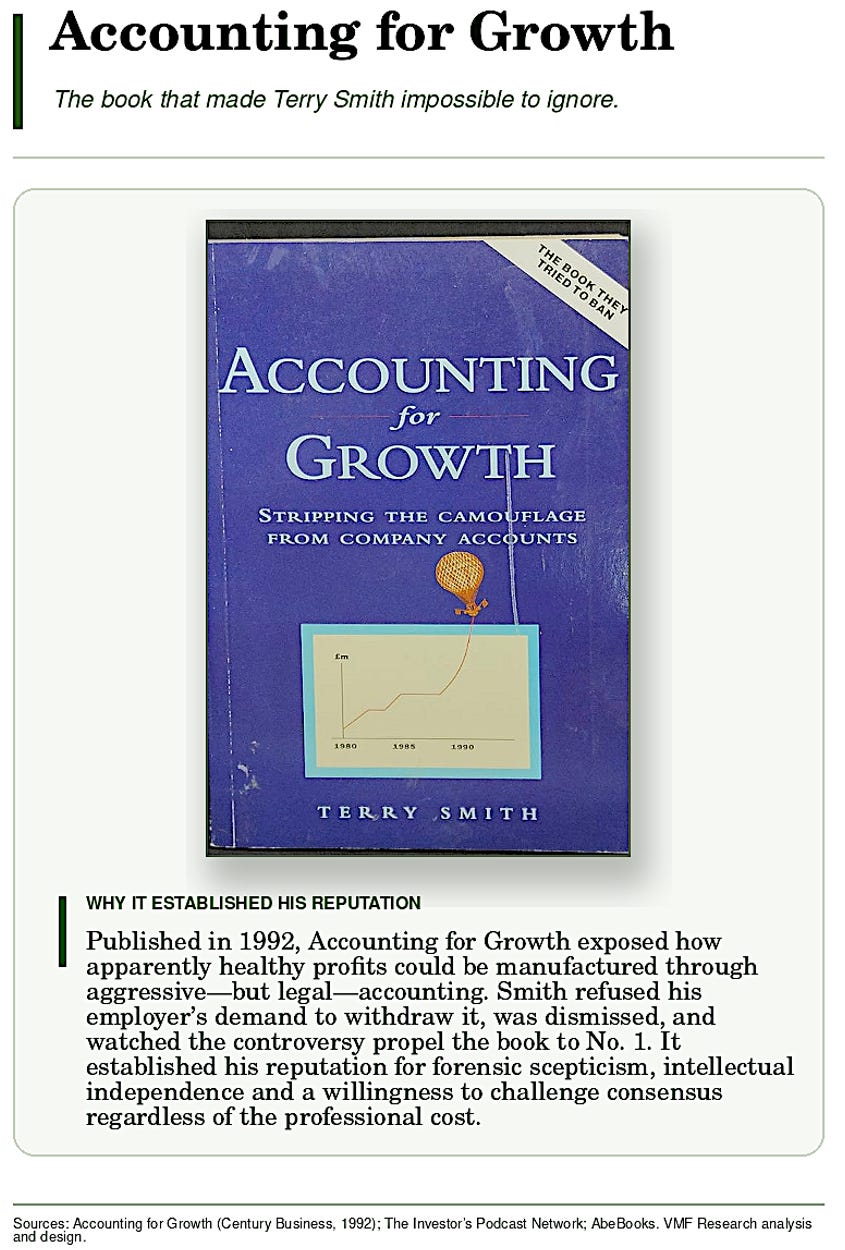
Terry Smith has spent much of his career reading what other investors ignored. He began at Barclays in the 1970s, became one of London’s leading bank analysts during the 1980s and later headed UK company research at UBS Phillips & Drew. In 1992, he published Accounting for Growth, a forensic examination of the accounting techniques companies used to make weak economics appear stronger.
The book became a bestseller. It also contributed to his dismissal.
That episode established the public character Smith would carry through the rest of his career: direct, sceptical, willing to challenge management and unusually alert to the difference between reported growth and genuine economic value creation.
More importantly, it established his willingness to defend an analytical conclusion even when the immediate professional cost was substantial.
Smith subsequently joined Collins Stewart, led its management buyout and
flotation, and helped build Tullett Prebon into one of the world’s largest interdealer brokers.
Then, in 2010, at an age when many successful executives begin preparing for retirement, he launched Fundsmith.
The investment proposition was deliberately narrow. Fundsmith would own a concentrated collection of companies capable of sustaining high returns on operating capital. Their competitive advantages would be difficult to replicate. They would not require substantial leverage to produce attractive returns. They would possess long and relatively predictable opportunities to reinvest their cash flows. They would also need to be resilient to change, particularly technological change.
The fund would then avoid the activity through which managers routinely dilute those advantages. There would be no market timing, no index hugging and no trading for the sake of appearing busy.
The philosophy was compressed into three instructions: buy good companies, do not overpay and do nothing.
The logic was that compounding requires inactivity.
A company that earns 25% on capital and can reinvest a meaningful proportion of its cash at the same rate does not need a constantly changing macroeconomic forecast to create value. Its internal economics perform the compounding. The investor’s principal task is to avoid interrupting it.
Low turnover reduces commissions, spreads and taxes. It avoids replacing a business the manager already understands with one that must be learned from the beginning. It also reduces the probability that emotion will transform temporary price volatility into a permanent loss of capital.
Most importantly, inactivity allows the holding period itself to become an advantage.
The market is generally efficient at discounting next year’s earnings. It is less comfortable underwriting what a high-return business may become after ten years of reinvestment. The further the investment horizon extends, the more difficult it becomes for conventional forecasts, quarterly benchmarks and career incentives to compete.
“Do nothing” was therefore not the absence of a process.
It was the final expression of the process.
That is what makes Smith’s latest change so important. But to appreciate its significance, Fundsmith’s track record must be divided into two very different periods.
During the first, Smith did not merely outperform. He established one of the most impressive records in European fund management. From the fund’s launch in November 2010 through the end of 2021, Fundsmith returned 570.7%, compared with 287.1% for the MSCI World Index in sterling. An initial investment of £100 became approximately £671 in Fundsmith and £387 in the index. On an annualised basis, the fund compounded at 18.6%, almost six percentage points faster than global equities.
That was not marginal outperformance. It was the record on which Smith’s reputation (and the commercial success of Fundsmith) was built.
Then the pattern broke...
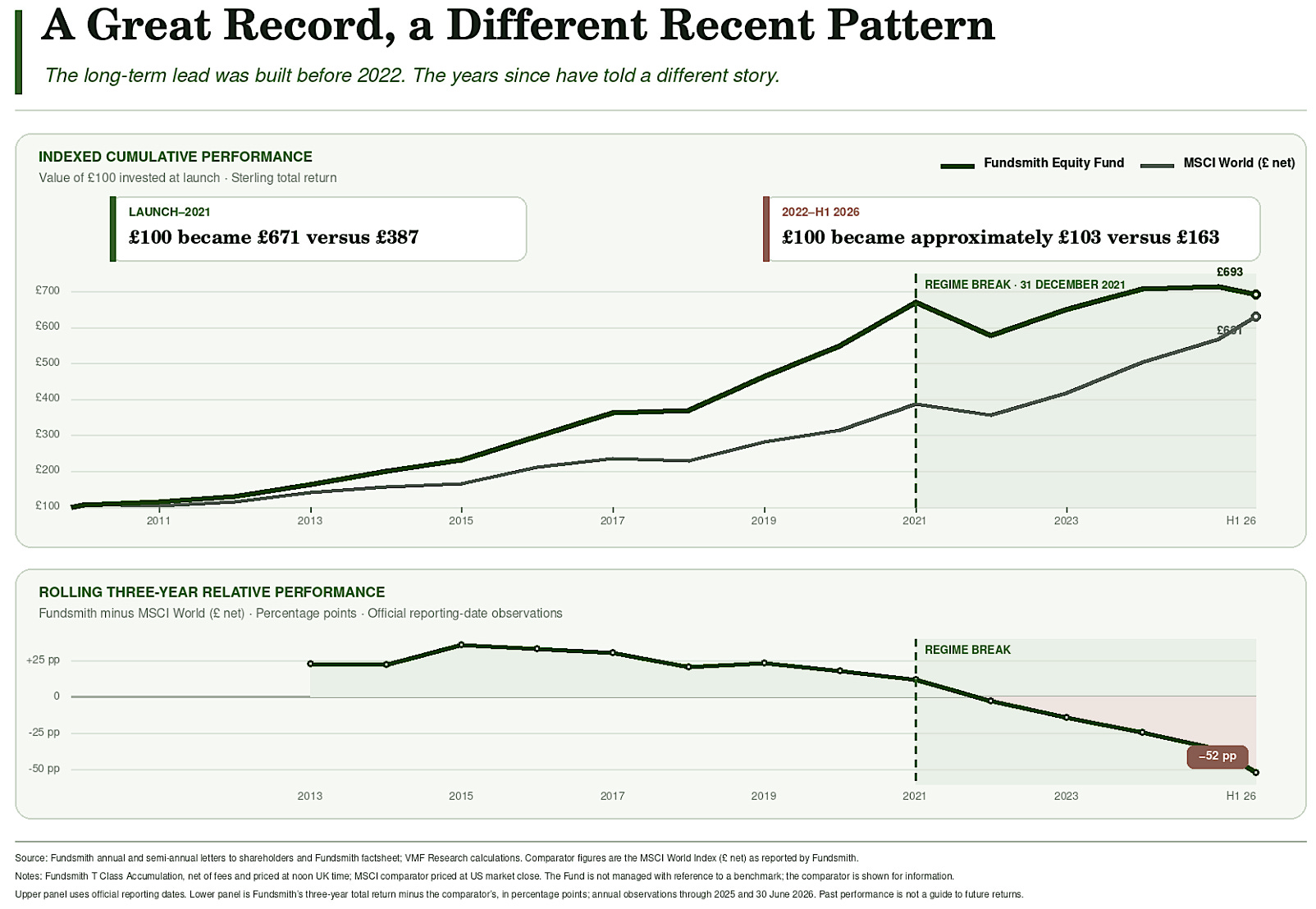
From the beginning of 2022 through June 2026, Fundsmith produced a return of only approximately 3.3%. Over the same period, the MSCI World Index in sterling advanced by roughly 63%.
The first period turned £100 into £671 while the index reached £387.
During the second, £100 invested in Fundsmith became approximately £103 while the same amount invested in the index became £163.
By June 2026, Fundsmith could still report an excellent since-inception record. The fund had returned 592.6% cumulatively and 13.1% annually, compared with 530.9% and 12.5% for the MSCI World. But those figures increasingly concealed the change beneath them. Almost all the relative wealth creation had occurred during the first part of the record. The subsequent four and a half years had consumed most of the lead.
The track record was no longer one continuous story.
It had become two.
This distinction matters because Smith did not alter his process after one disappointing quarter. Fundsmith had entered a sustained period of relative underperformance.
The concentration of index returns in a small group of large technology companies created an obvious headwind. A weaker US dollar reduced the sterling value of a portfolio with substantial American exposure. Several traditional Quality holdings also experienced company-specific disappointments that proved deeper or more persistent than expected.
The fund had marginally underperformed in 2021 and then fell progressively further behind through 2022, 2023, 2024 and 2025...
...then, the first half of 2026 brought the issue to a head.
Fundsmith declined by 2.9%, while the MSCI World Index in sterling gained 11.2%. A gap that had already persisted for several years widened by another 14.1 percentage points in six months.
Smith responded with activity on a scale the fund had never previously displayed.
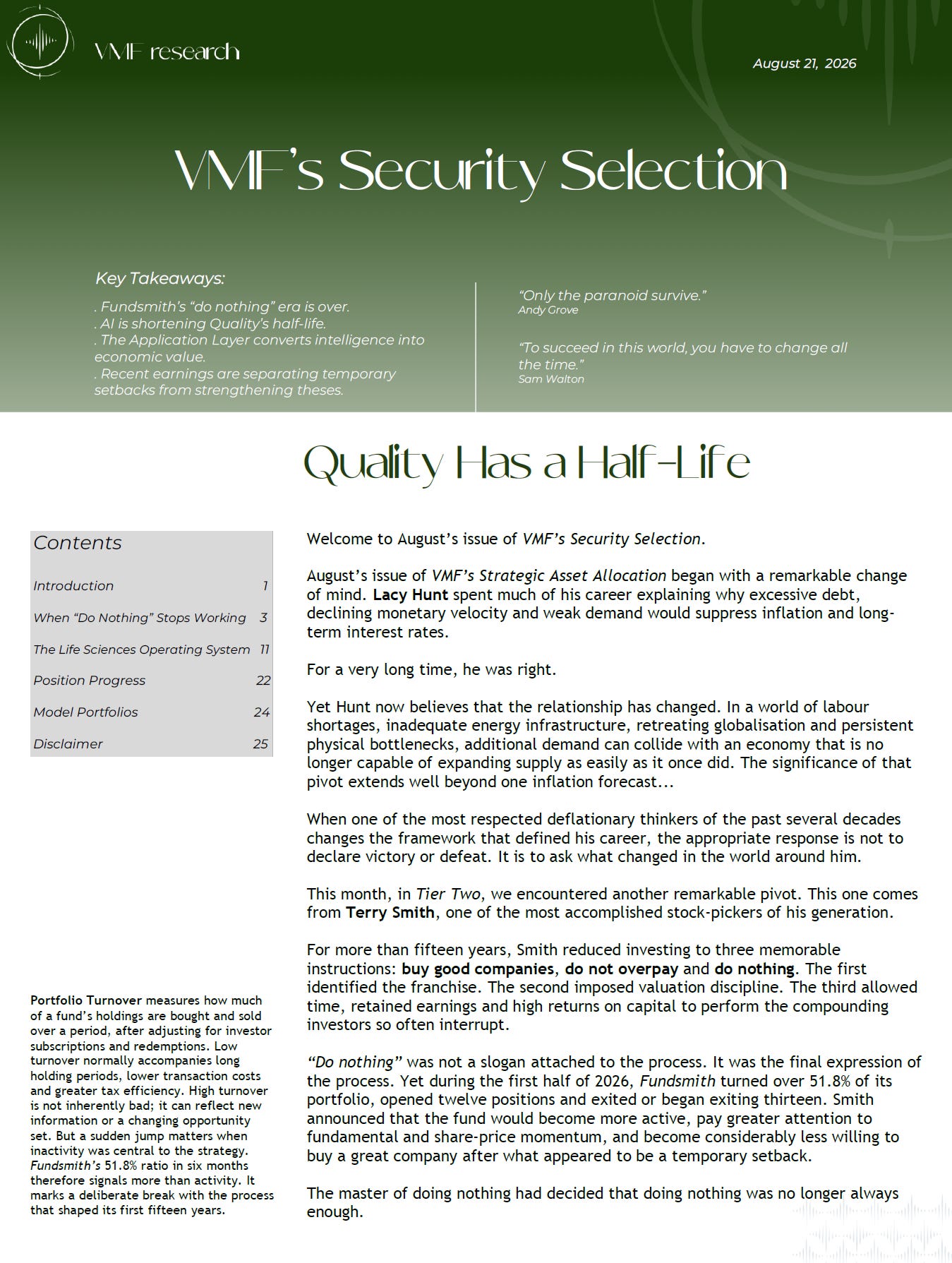
Portfolio turnover reached 51.8% during the half-year.
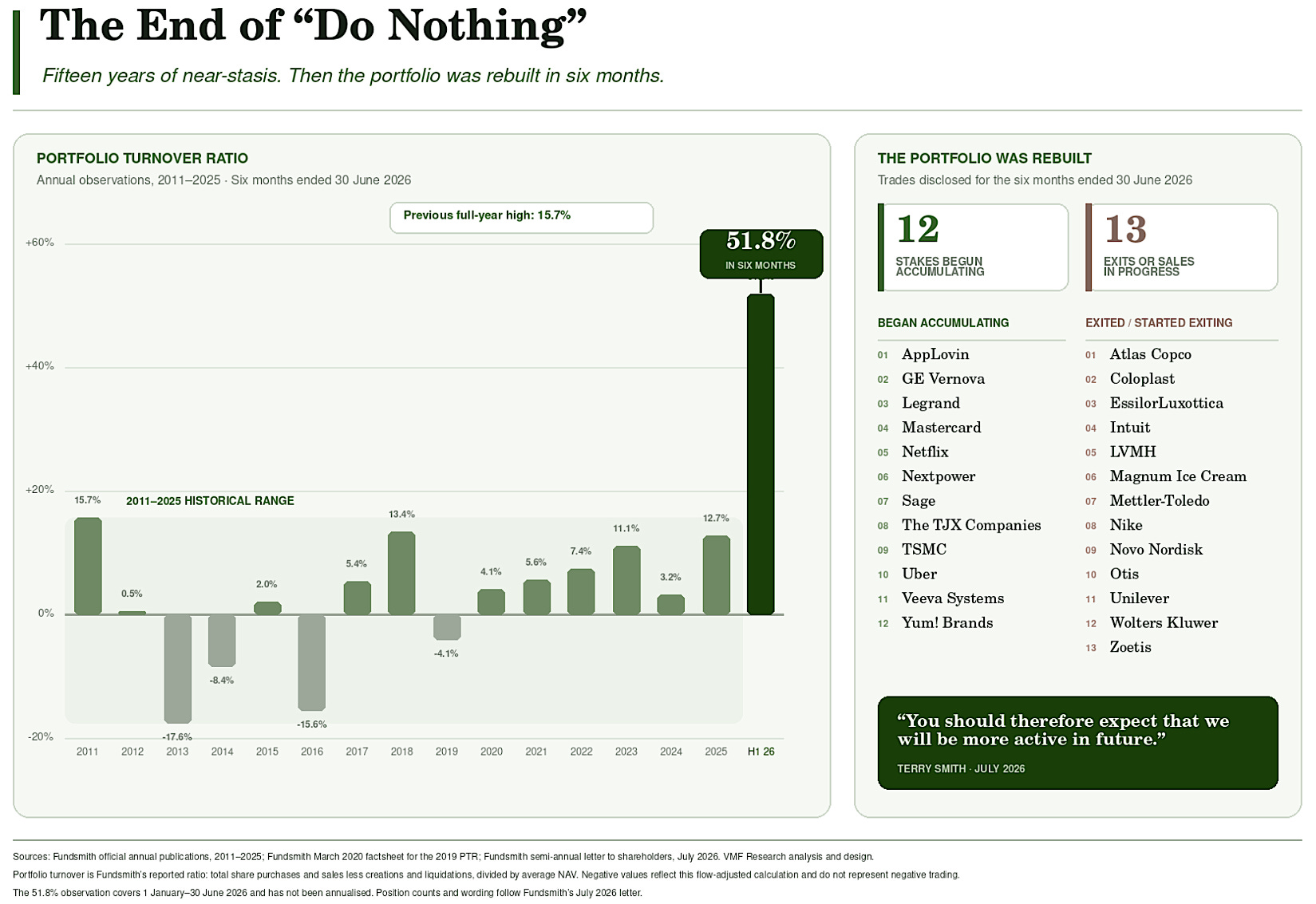
The fund opened twelve positions and exited, or began exiting, thirteen. Companies including Nike, Novo Nordisk, LVMH, Unilever, Zoetis, Coloplast and Wolters Kluwer were sold or placed in the process of being sold. New capital moved into businesses including AppLovin, GE Vernova, Legrand, Mastercard, Netflix, Nextpower, Sage, TJX, TSMC, Uber and Yum! Brands.
The composition of the portfolio changed.
So did its operating instructions.
Smith said Fundsmith would remain committed to owning good businesses at reasonable valuations. The first two rules survived. The third required modification...
The fund would become more active.
It would take greater account of both fundamental and share-price momentum. Most strikingly, it would become considerably less willing to use one of the established techniques of Quality investing: purchasing a great company after what appeared to be a temporary setback.
Smith compared that technique to catching a falling knife.
Fundsmith’s fingers had been cut too often.
Smith’s explanation focused heavily on the structure of the modern market. Passive vehicles now represent a large share of equity ownership, but their influence over marginal prices may be considerably larger than their share of assets suggests. Index flows purchase securities according to their weight rather than their valuation. Rising prices increase those weights. Strong performance attracts further flows. The process can become self-reinforcing, directing more capital towards the securities that have already appreciated while depriving neglected parts of the market of marginal demand.
That does not make index investing irrational...
For most investors, low cost, diversification and behavioural discipline remain formidable advantages. But it does mean that the resulting market is not passive in the ordinary meaning of the word. Somebody determines the index, and capital subsequently responds to that decision and to the price movements that follow.
An active manager can believe that this process has become detached from fundamentals and still lose assets while waiting for the detachment to reverse.
The overlooked issue therefore sits on the liability side of the portfolio.
An investment portfolio does not exist independently of the capital structure attached to it. Warren Buffett could purchase American Express during the salad-oil scandal because the structure surrounding his capital gave him the ability to wait. Berkshire Hathaway was not required to redeem nervous investors at the bottom.
An open-ended fund is different.
Its investors can withdraw capital precisely when the manager believes the opportunity is becoming most attractive.
That creates a dangerous mismatch. The investment thesis may require patience, while the funding base refuses to provide it.
Smith’s decision to incorporate momentum can therefore be interpreted as risk management at the fund level rather than the abandonment of fundamental investing. He is attempting to avoid a situation in which the portfolio is eventually proved right only after redemptions have made that vindication irrelevant.
This distinction matters for subscribers to VMF Research.
Our Model Portfolios do not face daily redemptions. They are not forced sellers. An investor with permanent capital can tolerate a period of unpopularity that an open-ended manager may not survive commercially. We should not surrender that advantage by importing a process designed to solve somebody else’s liability problem.
But neither should we dismiss Smith’s message.
It leaves us with an uncomfortable question: is this adaptation, or surrender?
If a manager purchases only after fundamental and price momentum improve, he risks selling near the bottom and returning after the recovery has become visible. If fund flows begin influencing security selection, the liabilities start dictating the assets rather than the other way around. And if a Quality investor responds to several years of underperformance by buying more of what the market already rewards, adaptation can quietly become style drift.
Some of Fundsmith’s new holdings make the question legitimate. TSMC, AppLovin and GE Vernova participate directly or indirectly in themes that Smith has also described in the recent past as dangerously momentum-driven. Purchasing them after substantial appreciation may ultimately prove prescient. It may also suggest that avoiding a popular trade became more difficult as the commercial cost of not owning it increased.
The evidence is not yet sufficient to decide...
Smith may be adapting rationally to a new market structure. He may be weakening a valuable discipline at precisely the wrong stage of the cycle. Those two interpretations can remain simultaneously plausible until performance and future portfolio behaviour separate them.
Our purpose is not to defend or prosecute him.
It is to extract the investment lesson.
Fundsmith’s recent performance cannot be explained exclusively by passive flows, index concentration or an unfavourable currency. Low-cost Quality indices have also outperformed the fund over several recent periods. Security selection, sector exposure, valuation and the specific companies Fundsmith chose to own all contributed. Any explanation that attributes every disappointing result to the structure of the market would be too convenient.
Smith appears to recognise this. Fundsmith sold companies for reasons including weak organic growth, management failure, excessive valuation and deteriorating competitive conditions. The revised process is not simply an instruction to buy whatever is rising. Fundamental momentum remains central.
The more revealing change is Smith’s reduced willingness to assume that a setback is temporary.
That is where his experience connects with a much broader problem confronting every Quality investor.
The classic Quality opportunity emerges when an excellent company encounters a recoverable problem. The market extrapolates the weakness. The patient investor looks through it. The business repairs the damage, its high returns reappear and the valuation normalises.
Warren Buffett’s investment in American Express during the salad-oil scandal remains the canonical example. Fundsmith’s purchase of Microsoft near the end of Steve Ballmer’s tenure offers a more recent one.
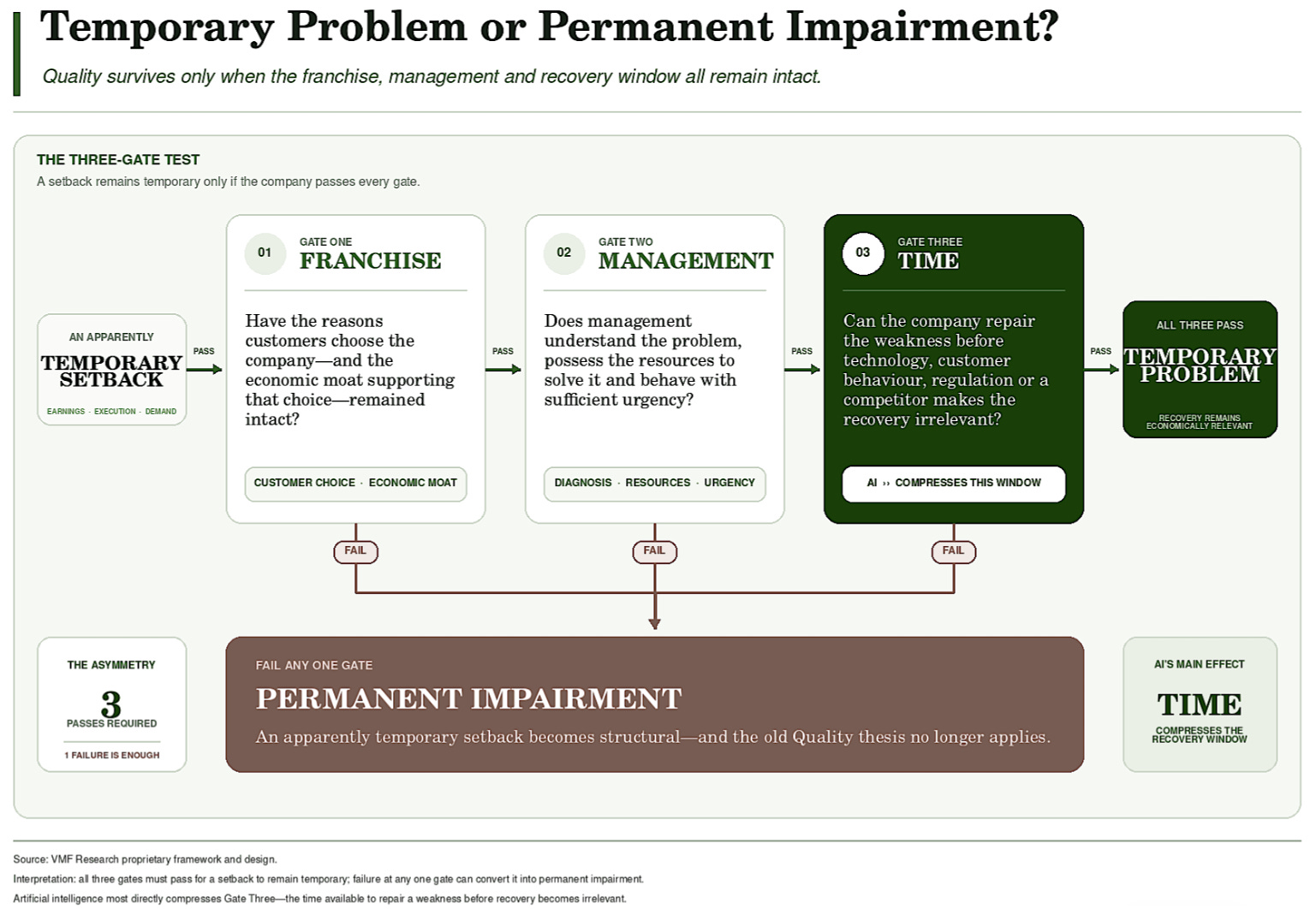
The method works only if three conditions hold.
The franchise must remain intact. Management must possess the capacity and determination to repair the problem. And the company must have enough time to do so.
Technology is placing unprecedented pressure on the third condition.
Artificial intelligence is reducing the cost of producing software, analysing information, designing products, generating content, serving customers and testing new commercial ideas. Competitors can move more quickly. Customers can evaluate alternatives more easily. Small organisations can assemble capabilities that previously required years of investment, large teams and substantial amounts of capital.
This is not merely a software problem.
Cheaper intelligence can alter research, manufacturing, distribution, marketing, customer service, financial analysis, product development and corporate decision-making across almost every industry. It can strengthen an incumbent by increasing its productivity. It can also give a competitor the tools required to attack an advantage that once appeared prohibitively expensive to replicate.
A management team that requires three years to complete a turnaround may discover that the market it planned to re-enter no longer exists in the same form. The weakness may still be repairable in theory while becoming irrelevant in practice.
This does not mean that every earnings disappointment has become permanent or that patient investing no longer works.
It means the cost of misclassification is rising.
The financial statements will often reveal the change late. Revenue can remain stable while customer engagement deteriorates. Margins can improve temporarily because a company is underinvesting in its product, distribution or people. Buybacks can support earnings per share while the strategic position weakens. A familiar brand can preserve yesterday’s cash flows even as tomorrow’s relevance migrates elsewhere.
A damaged share price can recover.
A damaged competitive position may not.
Quality investors must therefore look beyond historical returns on capital. They must determine whether the forces responsible for those returns are still strengthening... or whether the reported numbers are preserving the appearance of a franchise whose economic relevance has already begun to fade.
This framework changes what we should look for.
What is the customer really paying for and is that source of value becoming scarcer or easier to replicate?
Which part of the industry’s economics will control bargaining power as
technology changes?
Does the company own a brand, distribution network, cost advantage,
licence, patent portfolio, physical asset, proprietary dataset, installed base or customer relationship that becomes more valuable as capabilities spread?
Can it capture the productivity gains created by better technology, or will competition force it to pass those gains entirely to customers?
Does its balance sheet provide enough room to invest before the legacy business begins weakening?
Is management reallocating capital towards the next source of profit, or
protecting the economics of the previous one?
Would the company become more or less relevant if intelligence became
ten times cheaper?
These questions apply to a consumer brand as much as to a software platform; to an industrial manufacturer as much as to a pharmaceutical company; and to a financial exchange as much as to a retailer. The relevant source of control will differ. It may reside in intellectual property, physical infrastructure, distribution, regulation, scale, trust, data, customer access or an ecosystem that becomes more valuable with every additional participant.
What matters is whether the company controls something the next competitive regime will make more valuable... not merely something the previous regimerewarded.
These questions do not replace the traditional Quality Framework.
They make it harder to satisfy.
High returns on capital, recurring revenue, pricing power, strong balance sheets and long reinvestment runways remain essential. But historical excellence is no longer sufficient evidence of future durability. The investor must also understand how the source of that excellence behaves when intelligence becomes cheaper, competitive responses become faster and the time available to correct a strategic error contracts.
The best businesses in the next phase of the AI cycle may not be those most visibly associated with artificial intelligence. They may be companies that control the scarce assets, trusted relationships or essential processes through which cheaper intelligence must pass before it can create economic value.
That is why one of Fundsmith’s newest positions matters to us.
Not because Smith owns it.
And not because his process change provides our catalyst.
It matters because the company may offer an answer to the question his pivot has raised.
This company is not merely another Quality company caught in the software selloff. It represents what the next generation of Quality looks like…
The full single-stock thesis, valuation work, and Model Portfolio allocation were published to Tier Two subscribers in August’s VMF Security Selection. You can unlock the full research paper and company name by upgrading your subscription.
Important Disclosure
This article contains general investment research produced by Vasco Marques de Freitas, CFA, CMT, Founder and CEO of VMF Research, Lda. It reproduces an excerpt from the August 2026 issue of VMF’s Security Selection. The underlying research was completed on 21 August 2026 at 4:00 p.m. Eastern Daylight Time and first disseminated to paid subscribers on 21 August 2026 at 9:00 p.m. Eastern Daylight Time.
The article discusses investment philosophy, Quality investing, portfolio construction, market structure, technological disruption and the distinction between temporary operational setbacks and permanent competitive impairment. It is not personalised investment advice and does not consider any reader’s individual objectives, financial circumstances, knowledge, experience, liquidity requirements or tolerance for risk.
References to Terry Smith, Fundsmith and individual securities bought, sold or discussed in connection with Fundsmith’s portfolio are included for analytical and historical purposes. They describe Fundsmith’s investment process and its evolution and should not be interpreted as recommendations by VMF Research to buy, sell or hold those securities, nor as implying any affiliation with or endorsement by Terry Smith or Fundsmith.
The discussion of artificial intelligence, competitive advantage, Quality investing and the potential shortening of the time available for companies to respond to technological disruption reflects VMF Research’s analytical framework and judgment. Competitive positions may evolve differently from those contemplated, technological adoption may proceed faster or slower than expected, and businesses considered durable today may experience unforeseen changes in regulation, customer behaviour, technology or industry structure.
The article refers to a new Tier Two recommendation contained in the original August publication but does not identify or reproduce that recommendation, its valuation, Model Portfolio allocation or associated investment conclusions. Paid subscribers received the complete analysis, including the relevant assumptions, valuation scenarios, principal risks and portfolio implementation.
Neither VMF Research nor the author received compensation from any issuer, investment manager or other entity discussed in connection with the preparation of this research, and no covered entity reviewed, approved or amended its conclusions before first dissemination.
Past performance, historical investment records, Model Portfolio performance and examples of successful or unsuccessful investment strategies are not reliable indicators of future results. Readers should conduct their own analysis and, where appropriate, consult an authorised financial intermediary or adviser before making an investment decision.