

Two software companies lost nearly 60% of their value. Their customers kept paying.
That caught our attention.
For much of the AI boom, investors have been rewarding the companies building artificial intelligence while punishing businesses whose products it might eventually replace.
The logic sounds compelling. If AI can write software at a fraction of yesterday’s cost, why should established software companies command yesterday’s valuations?
It’s a powerful argument. And, in some cases, it will be devastatingly correct.
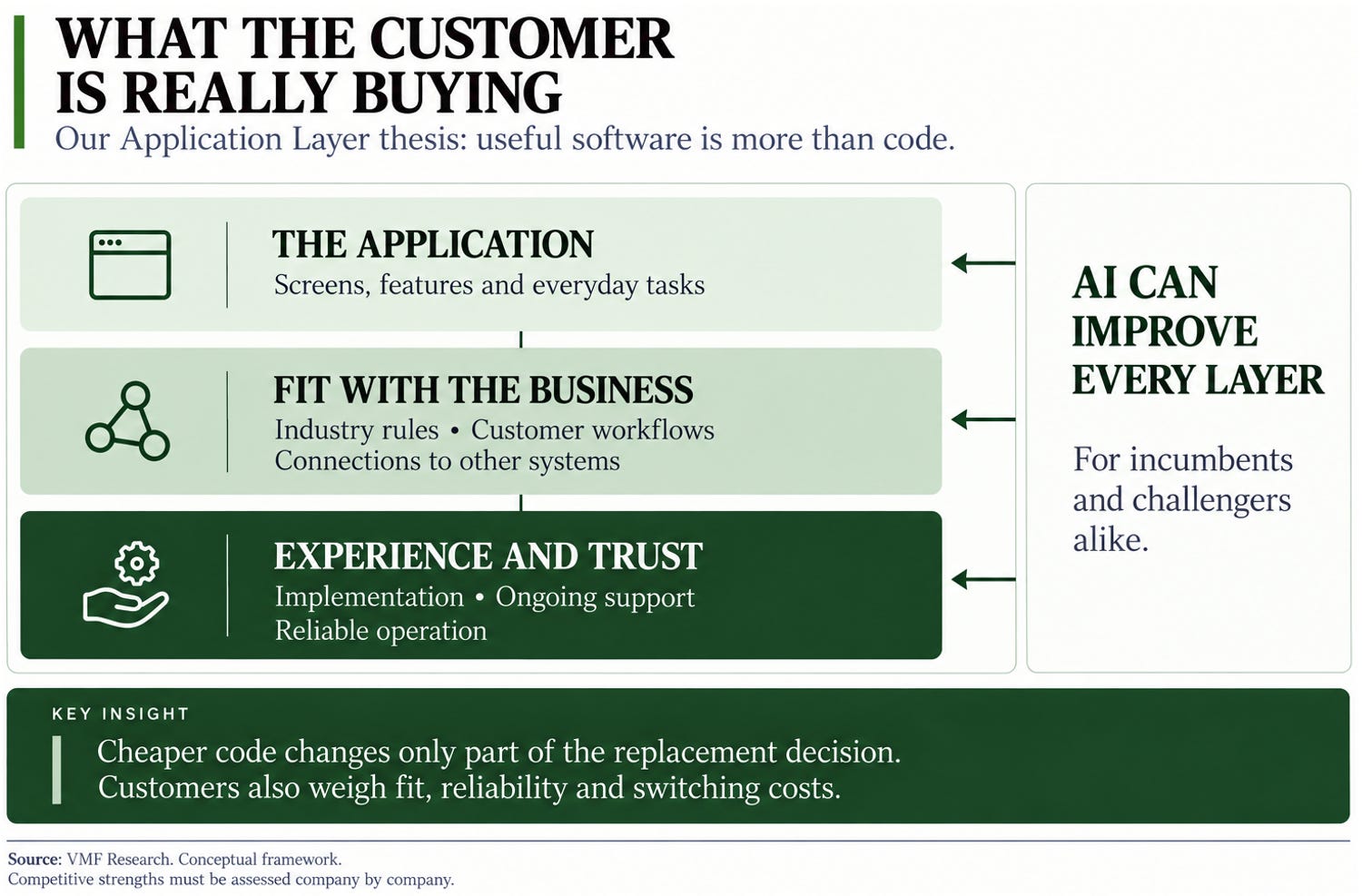
But we suspect Wall Street has made an expensive assumption: that making software cheaper to build also makes established software businesses equally cheap to replace.
The distinction is enormous.
A new AI model can reproduce an application’s features remarkably quickly. Convincing an organisation to entrust its operations to that application is another matter.
Consider the software that helps administer schools, coordinate healthcare, manage public transport or process financial transactions. Its value extends well beyond the code. It includes years of accumulated customer knowledge, regulatory requirements, integration with other systems and the experience needed to keep everything working when something goes wrong.
A cheaper competitor may eventually offer something better. But the customer must weigh the promised savings against the costs and risks of changing suppliers.
And that is where the economics become interesting.
As we explored in our recent The Fight to Own the Customer, increasingly abundant intelligence raises a much bigger commercial question: who retains control of the customer relationship, and who captures the value created by technology?

October’s VMF’s Security Selection takes that argument into an overlooked corner of the software industry.
We found two businesses that appeared to have been sentenced by the market before their economic fate had been decided.
Both had suffered extraordinary share-price declines. Both faced legitimate questions about disruption and leadership. Yet both continued generating cash from established software operations.
What made them particularly interesting was something else they had in common.
Neither depends on discovering the next revolutionary software product. Both have spent years learning how to buy valuable software businesses.
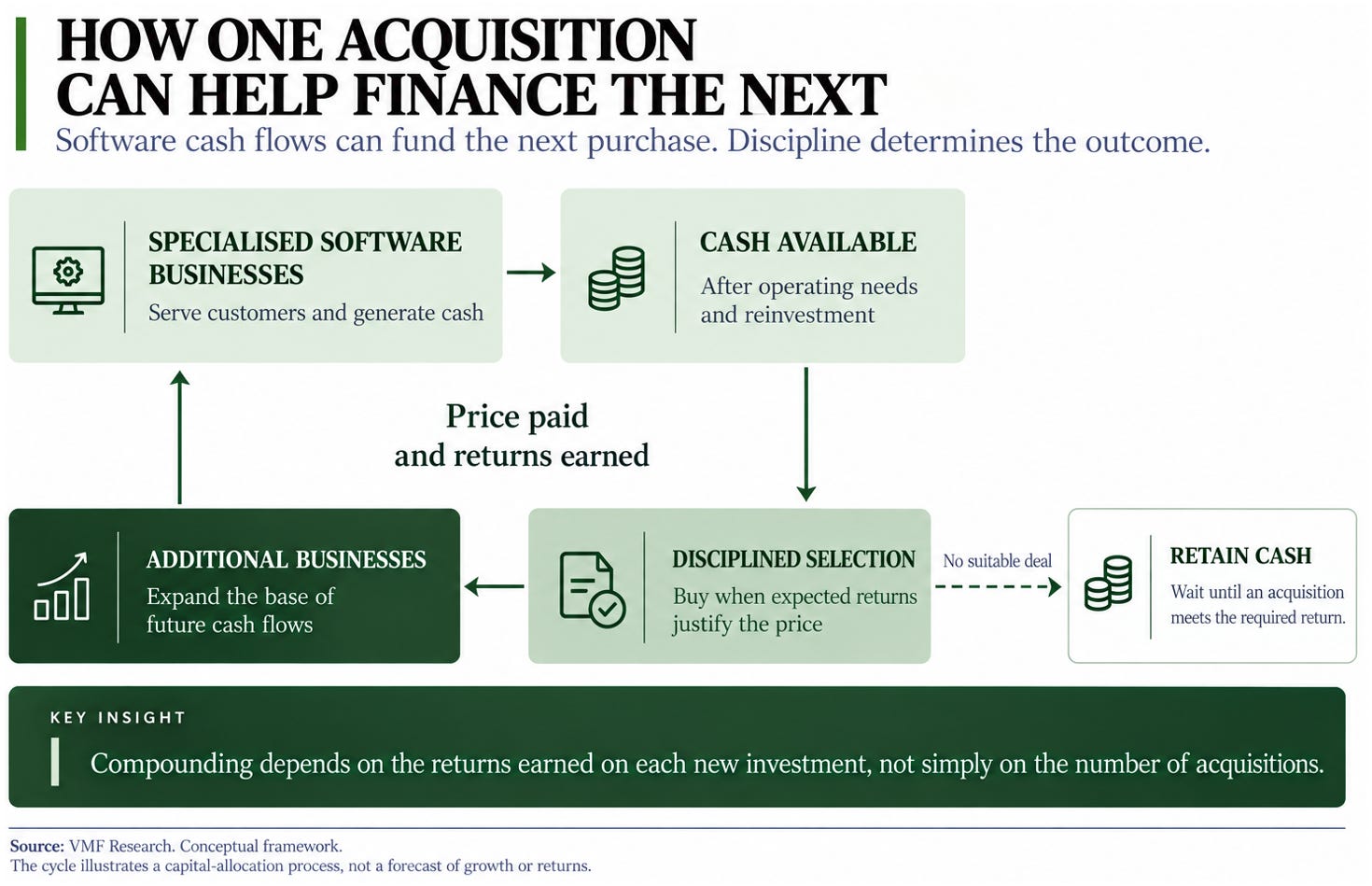
We have written before about the extraordinary potential of disciplined serial acquirers. Their ambition is deceptively simple: acquire businesses at sensible prices, preserve what makes them profitable and reinvest the cash into further acquisitions.
An obscure software company serving a small professional market may never attract headlines. It may also have loyal customers, recurring revenues and little need for enormous capital expenditure.
Own enough of those businesses, acquire them intelligently, and something powerful can happen.
The cash generated by yesterday’s acquisitions helps finance tomorrow’s. Those acquisitions, in turn, create additional earning power.
Eventually, the organisation responsible for allocating that capital can become as valuable as the businesses it owns.
Of course, the mathematics work in reverse too.
Overpay for acquisitions, underestimate technological disruption or allow growth to outrun investment discipline, and the compounding machine starts destroying shareholder value.
And as successful acquirers become larger, finding enough attractive opportunities becomes increasingly difficult.
That brings us to what we consider the most important lesson from October’s research.
There are two prices that matter. The price management pays to acquire a business. And the price investors pay to own the company making those acquisitions.
Even the world’s most disciplined acquirer can deliver disappointing returns to shareholders who pay too much.
But imagine what happens when investors become so frightened of technological disruption that they begin discounting the value of a proven acquisition organisation alongside the businesses it owns.
What if the price falls much faster than its ability to generate cash?
That is the opportunity we set out to investigate.
Our research went well beyond the share-price collapse. We examined the economics of the underlying businesses, the cash available for reinvestment, the prices paid for acquisitions and the assumptions required to justify current valuations.
We also turned the valuation exercise around, asking what one of these businesses would actually need to accomplish to support a demanding 20% annual shareholder return.
That was a test of the operating performance required, not a promise of what investors would earn.
The results gave us sufficient confidence to introduce two new recommendations in October’s VMF’s Security Selection
There is a broader connection to our recent research.
In September, we examined SpaceX ( SPCX 0.00%↑ ) and the extraordinary economics that might emerge from controlling infrastructure that competitors cannot easily replicate. In October, we turned our attention to a much less glamorous collection of businesses, whose value may reside in the accumulated knowledge and customer relationships that competitors cannot easily reproduce.
Different industries. Very different valuations. But the same question sits at the centre of our work:
Who ultimately captures the economic rewards of technological progress?
The Company That Builds the Frontier

SpaceX may be extraordinarily expensive. It may also be building one of the most powerful commercial flywheels we have ever studied.
And the timing has made this investigation particularly interesting.
Over recent weeks, a major rotation has been challenging the market’s established hierarchy. Some of the companies celebrated as AI winners have come under heavy selling pressure, while businesses previously treated as potential victims of the technology have begun attracting renewed interest.
Our two October selections belong to that second group.
The early reassessment is encouraging. It certainly does not settle the investment case. The real test will be whether their customer relationships endure, their acquisition discipline survives and their cash generation continues to grow.
But the market’s changing attitude illustrates why we devote so much attention to opportunities others have abandoned.
The greatest investment opportunities rarely arrive accompanied by universal enthusiasm. More often, they emerge when a compelling narrative has pushed prices further than the underlying economics justify.
We believe October may have presented us with two such opportunities.
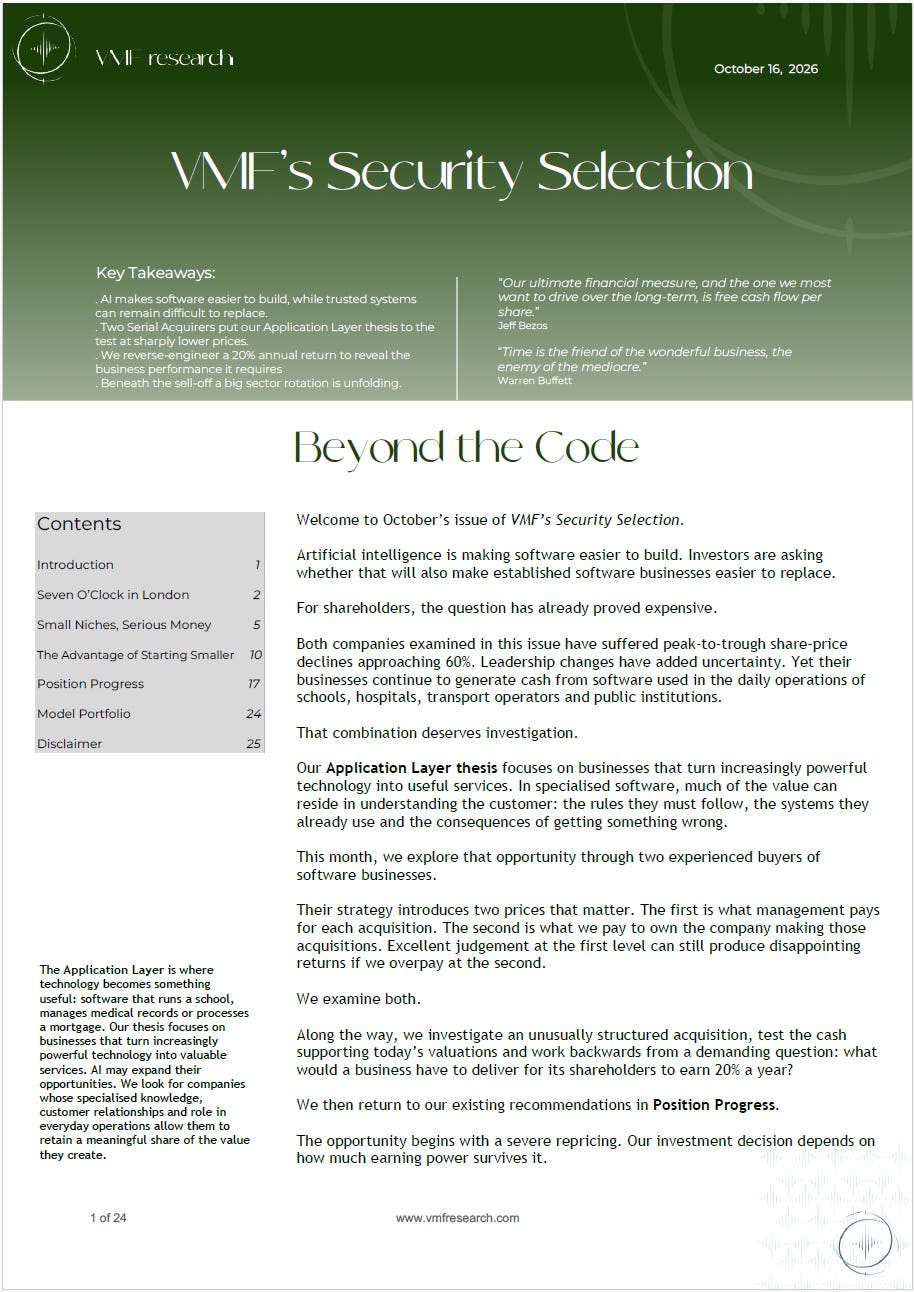
Paid subscribers received Beyond the Code, October’s VMF’s Security Selection, on 16 October 2026. It includes the identities of both companies, our fundamental research, valuation scenarios, principal risks and the initial allocations in our Quality Model Portfolio.
We are deliberately keeping those recommendations exclusive to subscribers this time.
Our previous public articles, including the SpaceX research, have shared detailed investment cases. This article offers the thinking behind our latest investigation. The conclusions, their implementation and our continuing reassessment remain part of the paid research.
Because recognising a compelling opportunity is only the beginning.
Knowing what it is worth, what could go wrong and how much capital it deserves is where the real investment work begins.
Discover the two recommendations in Beyond the Code, October’s issue of VMF’s Security Selection.
Important Disclosure
This article contains general investment research commentary produced by Vasco Marques de Freitas, CFA, CMT, Founder and Chief Executive Officer of VMF Research, Lda. It introduces investment themes and conclusions developed in Beyond the Code, the October 2026 issue of VMF’s Security Selection. The underlying research was completed on 16 October 2026 at 4:00 p.m. Eastern Daylight Time and first disseminated to paid subscribers on 16 October 2026 at 9:00 p.m. Eastern Daylight Time.
Unlike the public excerpts previously published on VMF’s Market View, this article is an original editorial summary intended to introduce and promote the full paid research. It does not reproduce the complete company analyses, identify the two new recommendations or disclose their valuation models and Model Portfolio allocations. References to subsequent market developments, including the ongoing rotation in equity-market leadership, are later observations and should be distinguished from the original research conclusions.
VMF Research produces investment research and recommendations under the applicable provisions of Regulation (EU) No 596/2014 on market abuse and Commission Delegated Regulation (EU) 2016/958, subject to supervision by Portugal’s Comissão do Mercado de Valores Mobiliários (CMVM). The underlying October publication contains investment recommendations within that regulatory framework. Withholding the identities of the recommended securities from this public article does not, by itself, determine whether the communication constitutes an investment recommendation under applicable law.
This material is not personalised investment advice and has not been prepared by reference to any reader’s investment objectives, financial circumstances, knowledge, experience, liquidity requirements or tolerance for risk. It does not constitute portfolio management, order execution, an offer to sell or a solicitation to purchase any financial instrument.
The analysis examines the potential effects of artificial intelligence on established software businesses, including development costs, competitive dynamics, customer retention, switching costs and long-term profitability. It also considers the economics of serial acquisition strategies, the reinvestment of cash flows and the relationship between acquisition prices, capital allocation and shareholder returns.
These assessments involve substantial uncertainty. AI may strengthen established software providers, enable competitors to displace them or allow customers to develop alternative solutions. Recurring revenues and established customer relationships do not guarantee future profitability. Acquisition strategies depend on management discipline, integration, access to suitable opportunities, financing conditions and the ability to reinvest capital at attractive returns. Historical acquisition success does not establish that comparable returns can be sustained.
Disclosure of Interests: The original October publication is accompanied by a dated Disclosure of Interests identifying relevant financial interests and potential conflicts involving VMF Research, the author and legal entities controlled by the author. Such interests may create actual, potential or perceived conflicts. The decision to withhold the two recommendations’ identities from this promotional article does not eliminate those conflicts or any applicable disclosure obligations. Readers should consult the complete underlying research and its accompanying interests disclosure when evaluating company-specific investment conclusions. Interests may have changed since the original research cut-off.
Neither VMF Research nor the author received compensation from any issuer covered in the original October publication in connection with its preparation. No covered issuer reviewed, approved or amended the investment conclusions before their first dissemination.
The VMF’s Security Selection Model Portfolios are illustrative research portfolios, designed to communicate VMF Research’s investment methodology and published recommendations. They do not represent actual client assets, transactions executed by VMF Research or the performance of an investable fund or managed account. Their allocations and reported returns are hypothetical research constructs based on the stated methodology and reference prices.
The research reflects the information and assumptions available at the stated cut-off and is intended within a medium- to long-term investment framework, subject to subsequent review. Information has been obtained from sources considered reliable, including company disclosures, regulatory filings and independent research, but its completeness, accuracy and continued relevance cannot be guaranteed.
Past performance, simulated performance, historical market relationships, valuation estimates and forward-looking scenarios are not reliable indicators of future results. All investments involve risk, including market volatility, liquidity risk, valuation changes and the possible loss of some or all invested capital. Readers remain responsible for conducting their own due diligence and determining whether any investment is appropriate for their circumstances.