

SpaceX may be extraordinarily expensive. It may also be building one of the most powerful commercial flywheels we have ever studied.
Those two statements are not mutually exclusive. In fact, the tension between them is exactly what makes the company interesting.
In What Tomorrow Could Become, we promised to reveal the business behind September’s new Tier Two investment thesis.
It is SpaceX...
Paid subscribers received our research on 18 September. Ten days later, Starship supplied an important new piece of evidence: it reached orbit for the first time and deployed 26 Starlink V3 satellites. An engine problem brought the mission to an early end, so the engineering challenge is far from finished. But Starship had moved one step closer from experimental vehicle towards something economically more consequential: a system capable of deploying infrastructure for SpaceX’s own commercial network.
That matters because our thesis has never rested on rockets alone.
Falcon helped build Starlink. Starlink created recurring demand for Falcon. Reuse improved launch economics and generated operating experience that fed back into the system. Starship is an attempt to push that mechanism much further: dramatically more capacity per launch, greater reuse and a lower cost of building whatever comes next.
And then comes the price...
Many investors look at SpaceX’s valuation and stop there. That is understandable. A wonderful company can still be a terrible investment if too much of the future is already embedded in the shares.
SpaceX makes that problem especially demanding because it is the quintessential long-duration equity. Much of what investors are paying for lies years ahead, precisely when rising long-term yields should make distant cash flows less valuable.
But long-duration equities are not bonds.
Their future cash flows can change.
A new capability can create a market that barely existed before. A lower launch cost can make another business viable. A network can generate demand for the infrastructure that expands the network. And an advantage built in one part of the organisation can become the starting point for the next. That is where SpaceX connects directly with our Abundance Shock work.
The investment case therefore turns on a harder question than whether Starship flies or whether another futuristic market eventually appears.
Can SpaceX keep converting difficult-to-replicate capabilities into businesses that make the next capability cheaper, more useful and more valuable?
And if it can, how much of that value ultimately survives for each shareholder after the enormous reinvestment, replacement costs and dilution required to build it?
That is the question the original research below tries to answer. The future may be enormous. SpaceX still has to earn the valuation investors have already placed on it.
Good reading.
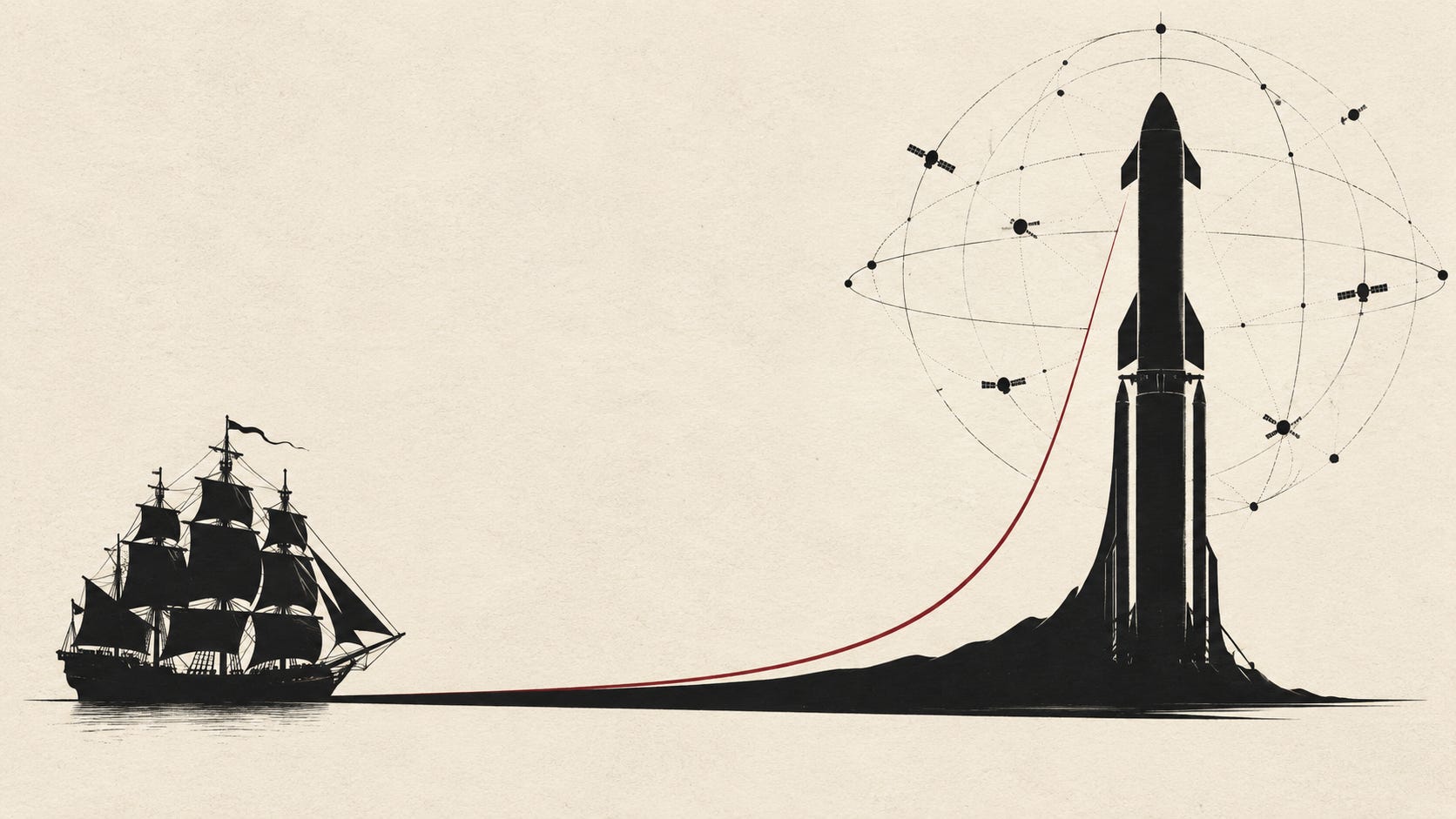
Some companies become large. A very small number become powerful enough that states have to reckon with them.
The Dutch VOC and the British East India Company belonged to that rarer category. At their height, they were not merely merchants moving cargo between continents. They fielded armies and navies, negotiated with governments, made war and peace, collected taxes and administered territory. By 1800, the British East India Company governed roughly one-fifth of the world’s population with a military force larger than England’s.
Contemporary scholars describe these organisations as company-states because the boundary between commercial enterprise and sovereign power had become extraordinarily difficult to draw.
Their dominance rested on privileges and practices that have no legitimate modern equivalent, including chartered monopolies, coercion and colonial rule. That distinction matters.
But the economic mechanism behind their rise still deserves attention.
Control access to a difficult frontier and you may eventually influence much of the commerce that develops beyond it.
That is precisely the parallel explored by Stefano Marcuzzi and Alessio Terzi in their June 2026 Cambridge working paper, Outsourcing the Final Frontier. The authors argue that today’s space economy is beginning to display some of the institutional dynamics of the Age of Sail: concentrated infrastructure, dependence on a dominant provider and an increasingly blurred boundary between private capability and strategic national interest. Cambridge summarised the comparison starkly: SpaceX’s grip on a critical transport technology is “almost without precedent” in the past four centuries.
Their concern is primarily about governance.
Ours is about economics.
What happens when the company that dominates access to a frontier can also build the infrastructure, networks and businesses that make that frontier valuable?
That question, of course, brings us to SpaceX. ( SPCX 0.00%↑ )
The company may ultimately prove valuable not simply because it can reach space more efficiently than its competitors, but because access itself can become the foundation from which entirely new businesses are built.
Its three reporting segments, Space, Connectivity and AI, describe different revenue streams. Our investment hypothesis concerns what connects them: the ability to turn one difficult-to-replicate capability into several mutually reinforcing businesses.
Launch supports satellite deployment. Satellite infrastructure supports connectivity.
The company is now attempting to extend those capabilities into computing and intelligence.
The opportunity is substantial. So is the difference between building the infrastructure of the future and earning an attractive return on the capital required.
The Advantage That Builds the Next One
A commanding market share is an outcome. The investment question is whether the forces behind it are strengthening.
Google accounted for 91.1% of worldwide search-engine referrals in Statcounter’s August 2026 data. That measures traffic referred to websites in its sample, not every search performed, but it illustrates the concentration of an important activity. A challenger needs more than a recognisable search box to displace the system surrounding it.
Meta offers the same lesson at a scale that is easier to visualise. During June, an estimated 3.60 billion people used at least one of Facebook, Instagram, Messenger or WhatsApp every day. Against a 2026 world population of roughly 8.3 billion, that is equivalent to about 43% of humanity, or roughly one person in every 2.3 alive. Meta then converted that reach into $59.4 billion of advertising revenue in a single quarter.
A competitor can reproduce a feed. It can copy Stories, short-form video, messaging or almost any individual feature. What it cannot reproduce overnight is the network of users, creators, advertisers, relationships and distribution already assembled around them.
That is when scale stops being merely an output and starts becoming part of the moat.
The businesses are very different, but the underlying mechanism is similar:
Can dominance in access to a market become the foundation of an even larger commercial system?
For SpaceX, that system begins with access to orbit.
Its roadshow reports that its share of global payload mass increased from 45% in 2021 to 65% in 2022 and more than 80% across 2023–2025. This includes its own satellites and development cargo, not just third-party payloads. It is therefore not an equivalent share of commercial launch revenue.
That qualification also reveals part of the advantage.
SpaceX builds a large part of its own launch demand. During the first half of 2026, 61 of its 78 launches were internal, principally supporting Starlink. The launch system helps build the network; the network supplies recurring reasons to use the launch system.
Reusability strengthens the relationship. Recovering expensive hardware allows additional missions without manufacturing an entirely new booster. More flights produce operating experience; inspections feed improvements into the next flight. The IPO roadshow presentation illustrates the result through 165 Falcon-family missions in 2025 alongside eight new boosters flown.
That does not mean eight boosters performed every mission. It demonstrates the importance of the existing reusable fleet.
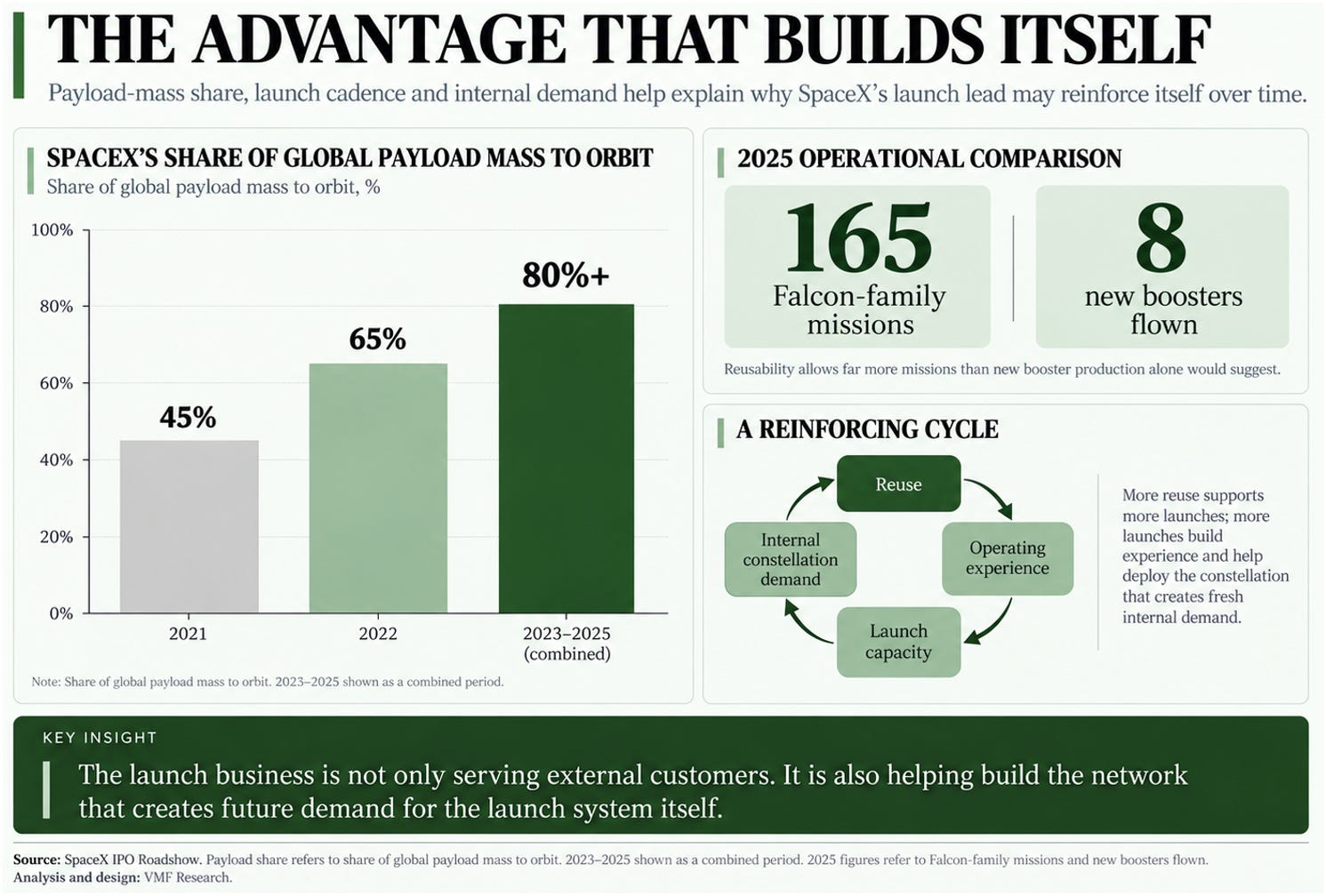
A rival must therefore assemble more than a rocket. Manufacturing, launch infrastructure, refurbishment, operating experience and downstream demand all matter.
The advantage is not guaranteed to widen every quarter. Second-quarter launches declined year on year (yoy) even as Space revenue increased through customer mix. Our thesis concerns the development of the system, not an uninterrupted rise in every operating statistic.
Starship could change that system’s economics considerably.
Falcon demonstrated the value of recovering and reflying the booster. Starship aims to extend that principle to the complete launch system: the Super Heavy booster beneath the Starship spacecraft, both designed for recovery and reuse. Returning the orbital ship, protecting it during atmospheric entry and preparing it for another mission are central to the programme, not incidental engineering details.
The difference is between spreading some hardware costs across repeated flights and attempting to spread the cost of the whole vehicle across them.
Size adds another dimension. The roadshow compares approximately 23 tonnes to low Earth orbit for an expendable Falcon 9 with an expected 100 tonnes for reusable Starship V3. These are theoretical capacities under specified conditions, not identical operating configurations or achieved Starship commercial performance.
Greater payload capacity and rapid reuse could work together: more infrastructure carried per departure, with less new launch hardware required for each one. Orbital propellant transfer would extend the architecture further, enabling missions beyond Earth orbit. Each capability must still become reliable and economical in practice.
This is why the most revealing comparison concerns the network Starship could deploy. The roadshow shows approximately 2,600 Gbps of satellite bandwidth per Falcon 9 launch, using V2 satellites, against an expected 61,000 Gbps per Starship launch using the developmental V3 configuration. That is more than twenty times the deployed bandwidth.
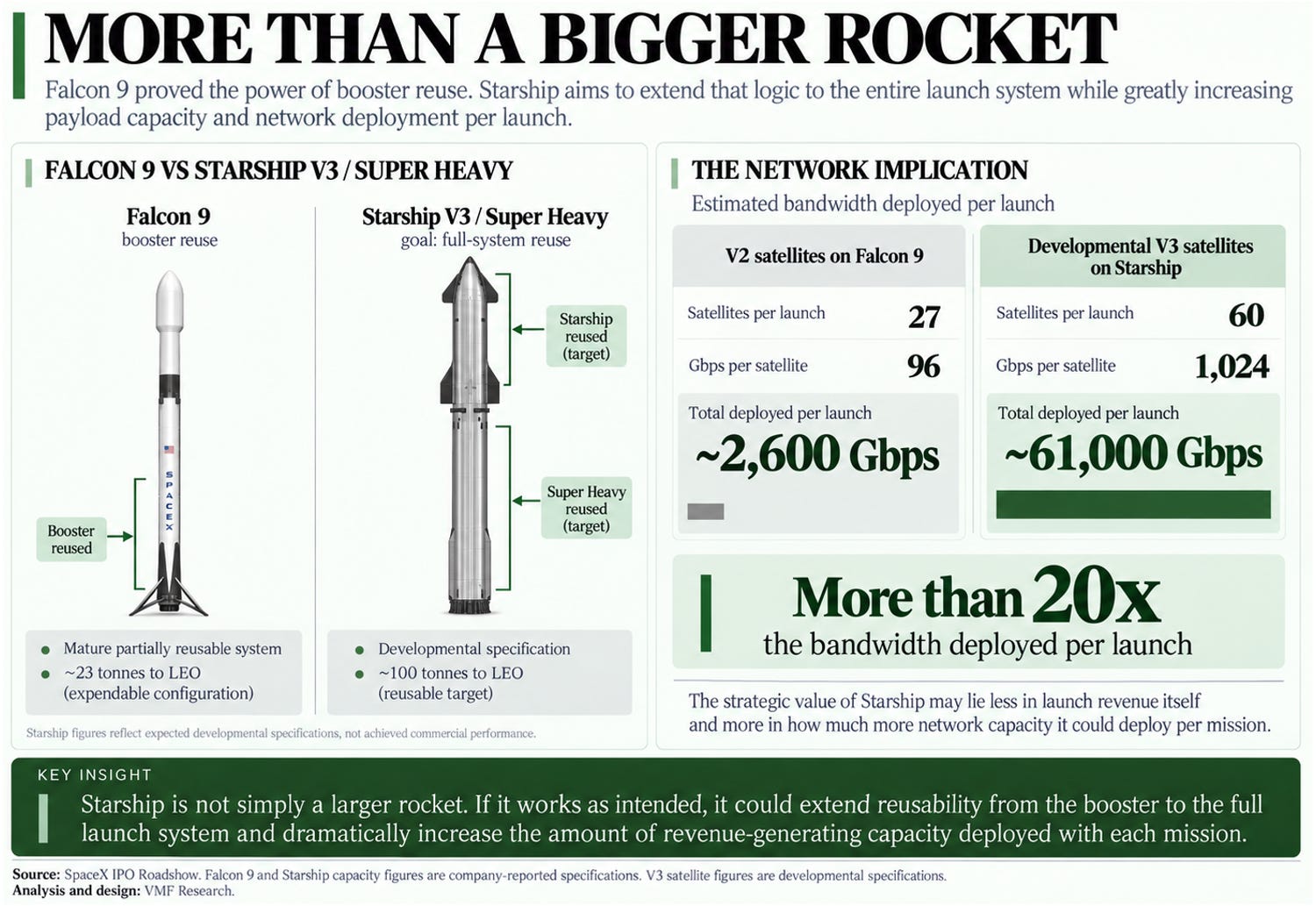
Installed bandwidth does not invoice a customer by itself. But cheaper, faster deployment of useful capacity could transform the economics of the businesses using it.
An infrastructure asset can become more valuable because it makes other valuable assets cheaper to build.
Some of that value would appear outside the Space segment. Internal satellite launches generate no intersegment revenue; their commercial benefit emerges through the network they help construct.
We should recognise the contribution without inventing internal sales and counting them twice.
Three Businesses, One Expanding System
The financial statements already show why viewing SpaceX solely as a launch provider misses much of the investment.
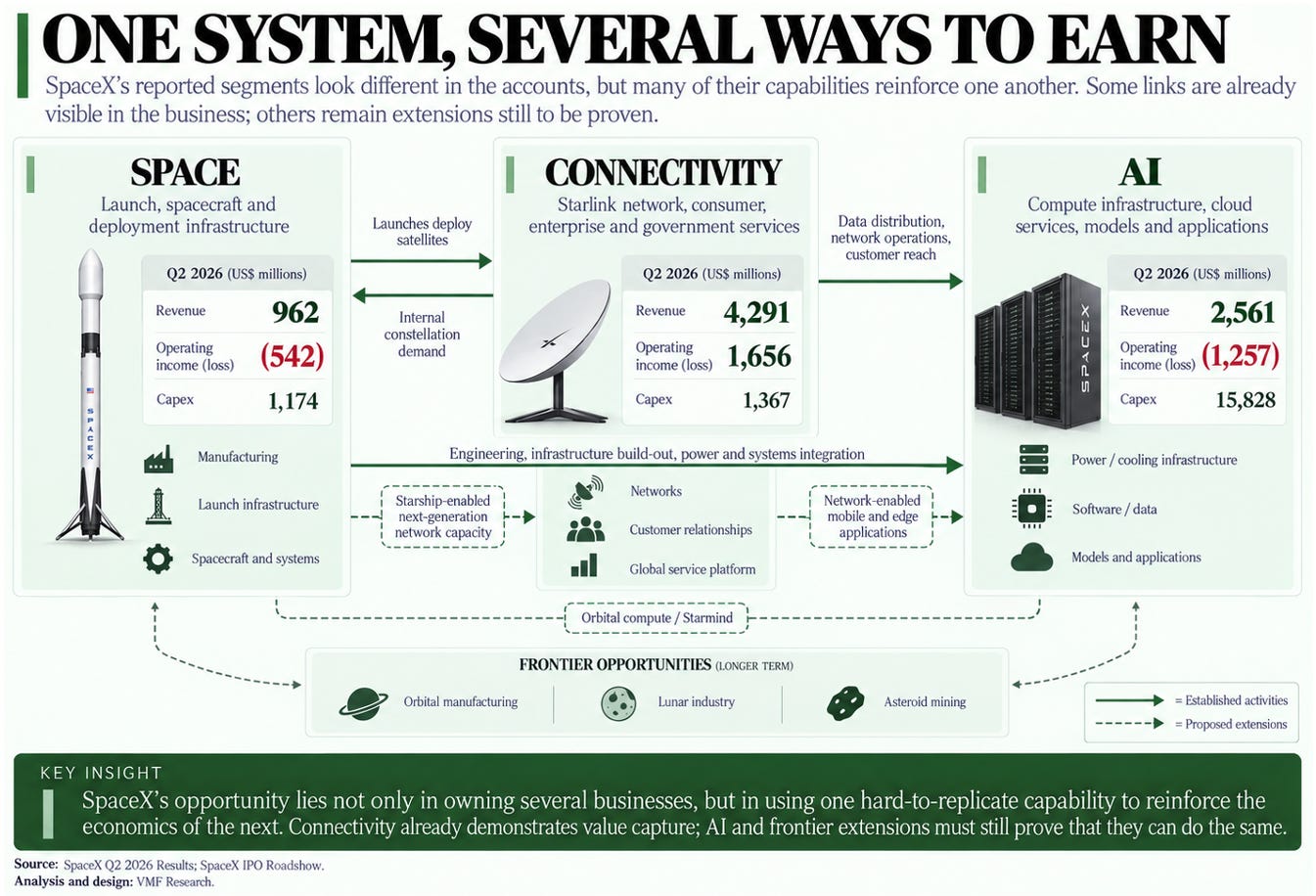
Second-quarter revenue reached $7.814 billion, up approximately 92% yoy. Connectivity contributed $4.291 billion, AI $2.561 billion and Space $962 million.
Space recorded a $542 million operating loss, alongside $1.076 billion of research and development expenditure as Starship investment accelerated. Its current earnings therefore reflect the cost of developing capabilities intended to support more than external launches.
Connectivity supplies the strongest evidence that the strategy can produce attractive operating economics.
Revenue increased approximately 66%, while operating income reached $1.656 billion, implying a 38.6% operating margin. That is profitability after reported depreciation and share-based compensation, not merely a favourable adjusted measure.
The customer base is also becoming more interesting.
Starlink ended June with 12 million subscriber service lines, twice the number a year earlier. Enterprise & Government revenue grew approximately 108% to $1.806 billion, representing around 42% of Connectivity sales. These calculations show that the business is becoming much more than household internet delivered by satellite.
Aircraft, ships, remote facilities and government operations require connectivity where conventional infrastructure can fall short. A common network can serve customers with very different requirements and willingness to pay. The company’s disclosed applications and recent airline partnerships illustrate that breadth.
However, expansion does not eliminate pricing pressure. Monthly subscriber ARPU was $66, stable sequentially but below $85 a year earlier. Management links geographic expansion to a changing customer mix and local pricing. Subscriber growth must therefore be judged alongside revenue, margins and the investment required to serve each market.
Mobile offers another extension, but management has not disclosed the complete capital requirements of its proposed terrestrial build-out.
Sharing infrastructure can improve economics without making expansion costless.
AI is growing faster, but its returns on capital are less established.
Quarterly revenue increased approximately 247% to $2.561 billion. Adjusted EBITDA turned positive at $1.146 billion, while the segment still reported an operating loss of $1.257 billion and $15.828 billion of capital expenditure. The commercial acceleration is significant. So is the investment burden.
The business pursues two opportunities: selling compute and selling intelligence.
Anthropic and Google are named compute customers in the roadshow, with Google’s disclosed arrangement scheduled to begin in October. Alongside that infrastructure activity sit the group’s own models and applications. SpaceX can earn revenue from other AI developers without requiring Grok to win every market, but it also bears the costs of competing in the model business itself.
The current group has been assembled through acquisitions as well as internal development. SpaceX acquired xAI in February and completed the acquisition of Cursor on 14 August. Integrating these capabilities is an opportunity to demonstrate better economics, not proof that the benefits have already arrived.
Cloud agreements drove most of the latest revenue acceleration. The release identifies $1.6 billion of incremental infrastructure revenue, accounting for most of the AI segment’s year-on-year increase. Its $14.1 billion contracted-sales disclosure includes already recognised revenue and covers enforceable, non-cancellable periods; it is not all additional future revenue.
The more ambitious proposition is to change where that computation takes place.
SpaceX is attempting to turn an energy constraint into a launch opportunity.
Its roadshow argues that orbital computing could benefit from lower-cost solar power, radiative cooling and data distribution through Starlink, provided launch and satellite-production costs fall sufficiently. These are management’s prospective economics, not results from an operating orbital data centre.
The energy logic is important. In suitable orbits, solar panels can receive near-continuous sunlight, avoiding weather and much of the day–night interruption experienced on Earth.
Google’s separate Project Suncatcher research examines precisely that configuration, including a reduced requirement for batteries. That could improve utilisation of solar equipment and reduce dependence on terrestrial electricity infrastructure.
Cooling offers a different potential advantage, but requires a precise explanation.
There is no surrounding air in space to carry heat away. Heat generated by processors must be transported to radiators and emitted as infrared radiation. Properly designed surfaces can reject heat towards space while limiting heat absorbed from sunlight. The process does not require evaporating water into the atmosphere, but it still requires thermal hardware, adequate radiator area and careful engineering.
SpaceX’s proposed design explicitly adds more solar generation and a larger radiator to capabilities retained from its satellite platform. The potential saving is therefore not “free cooling because space is cold”. It is a different power-and-heat-rejection architecture that management believes could lower operating costs.
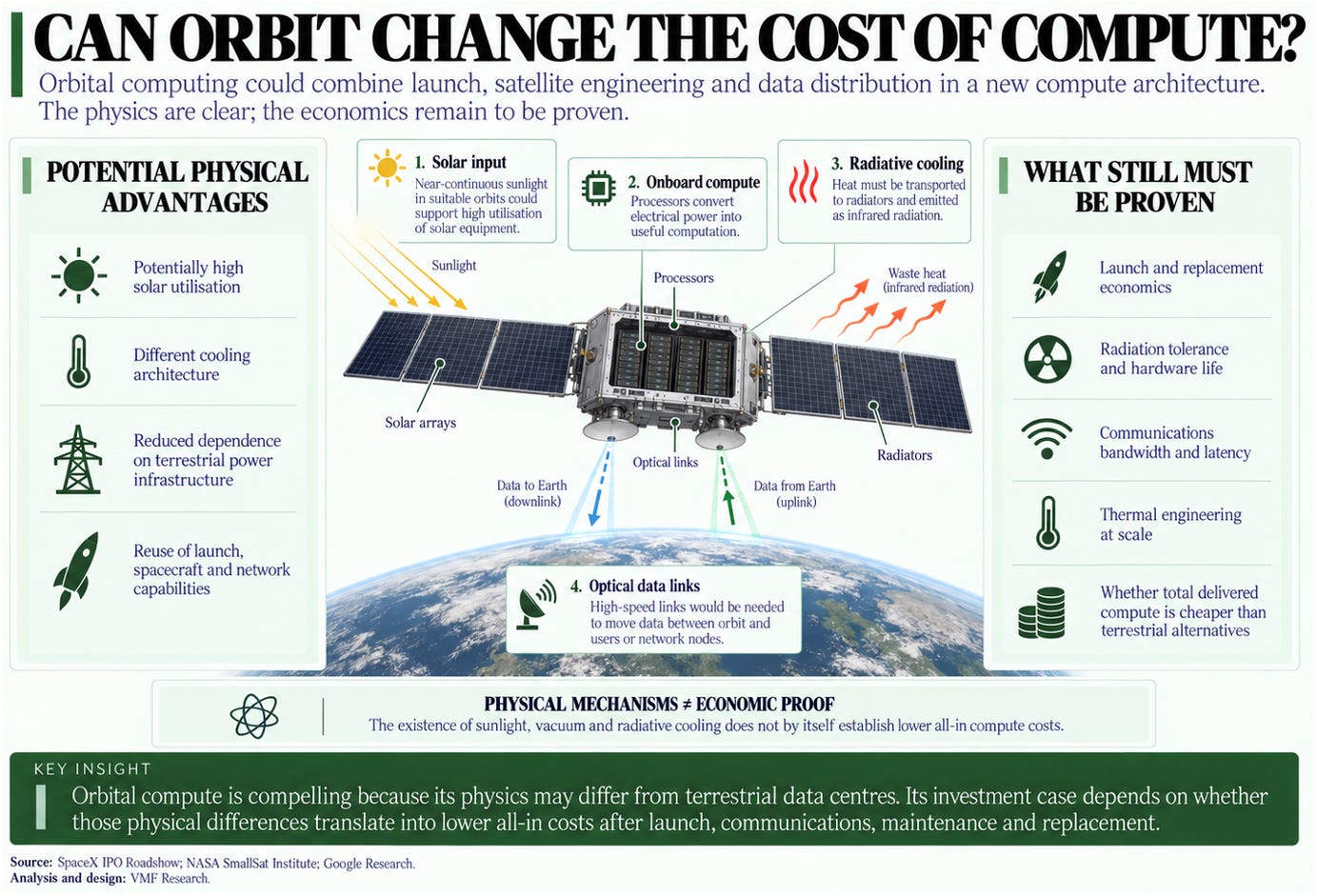
The complete system must still beat the alternatives after launch, deployment, communications, maintenance and equipment replacement. Google’s research itself identifies unresolved challenges, including high-bandwidth links, radiation and thermal management. Interest from another major technology company strengthens the relevance of the question; it also reminds us that sunlight is not an exclusive advantage.
SpaceX’s potential moat is the ability to assemble the system around it.
The company proposes retaining satellite propulsion, optical links and flight systems while adding compute and larger power-and-cooling equipment. In June, its AI satellite remained at the design stage; in August, Musk expected initial Starmind launches in 2027.
That is the optionality we find valuable: an advantaged starting position for the next business.
Scottish Mortgage’s managers have articulated a related investment interpretation. Tom Slater has emphasised the widening opportunities created by cheaper access to space. Lawrence Burns has highlighted the range of possible businesses rather than dependence on one technological outcome. Their perspective helps frame the question, without settling the answer.
Management’s market estimates illustrate the ambition: approximately $5.7 trillion across its nearer-term opportunities, expanding to $28.5 trillion when enterprise applications are included. The larger figure incorporates the smaller one. These are addressable-market estimates, not obtainable revenue. Beyond them, the roadshow contemplates orbital manufacturing, lunar industry and asteroid mining, whose timing and economics remain far less established.
We do not need to place a discounted-cash-flow value on an asteroid to recognise the potential importance of access.
If such industries develop, SpaceX could participate through transport, communications or infrastructure without becoming the successful operator of every downstream business.
The counterweight is that several opportunities share the same dependencies. Starship success could strengthen them together; persistent delays could weaken them together. They are not independent lottery tickets.
Nor does growing revenue ensure growing shareholder cash flow. Group capex reached $18.369 billion in the quarter. Adjusted EBITDA of $3.538 billion became a $143 million operating loss after depreciation, share-based compensation and restructuring charges. The next phase must demonstrate that additional capital creates more value than it consumes.
What Is the “Right to Build Next” Worth?
SpaceX is difficult to value because we must estimate not only the growth of existing businesses, but how their capabilities could change one another’s economics.
A valuation confined to current profits could miss much of the opportunity.
Capitalising every ambition could miss much of the risk.
The answer is not to abandon valuation. It is to identify the judgements doing the work.
Connectivity provides an operating anchor. Space combines essential infrastructure with substantial development expenditure. AI offers rapidly expanding revenue but much less established cash economics. They should not receive identical valuation multiples simply because they share a parent.
Management’s ambitions provide context, not our base case.
In August, the CFO described a path to a $100 billion annualised revenue run rate by December, including Cursor. That means expected December revenue multiplied by twelve, not annual recurring revenue or $100 billion of recognised 2026 sales.
Musk separately said internal projections for $1 trillion of annual revenue had moved forward to 2030. The public disclosures do not provide enough detail to reconstruct a complete numerical bridge to either outcome.
We can nevertheless reverse the question.
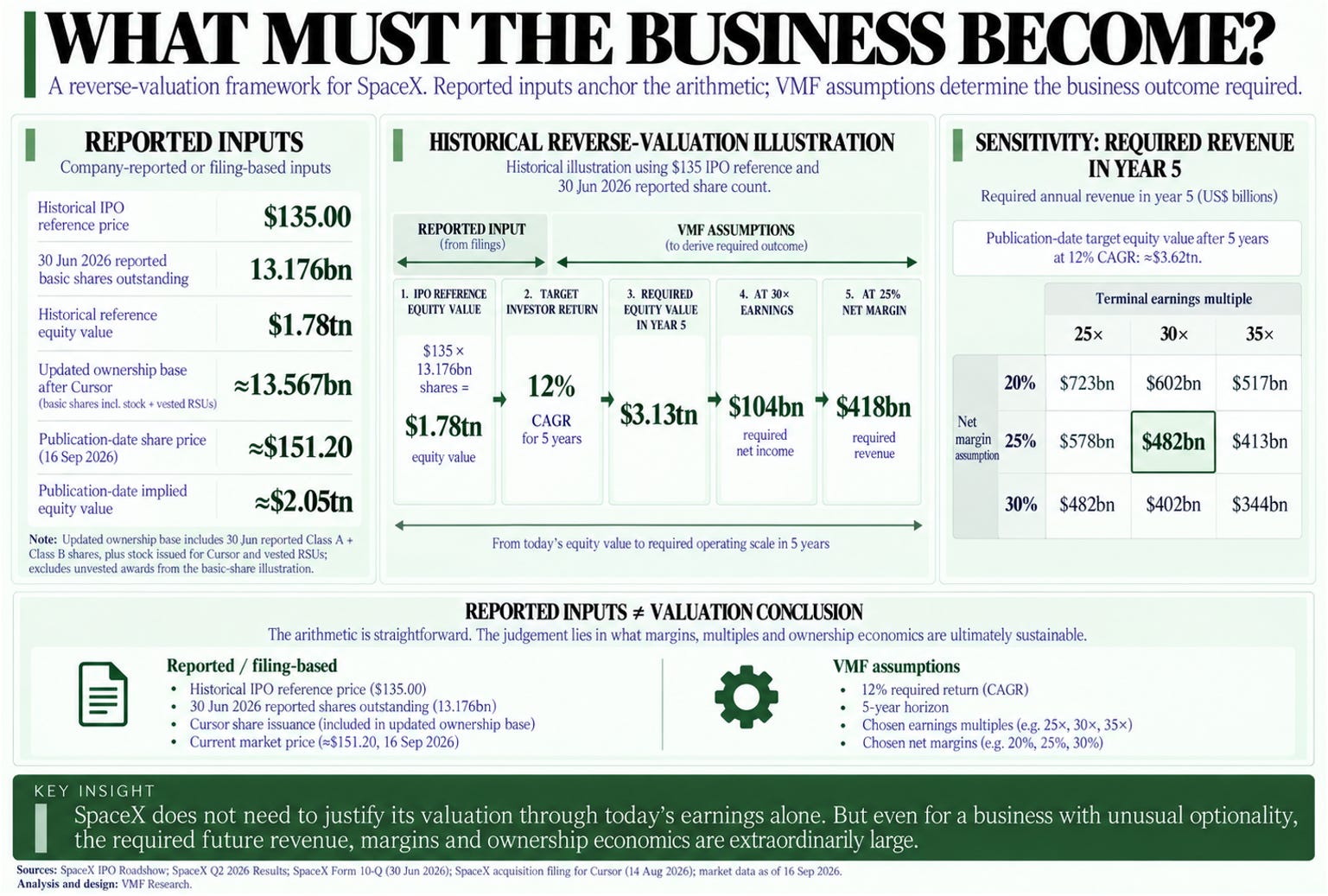
Consider the roadshow’s $135 offering-price reference and the 13.176 billion Class A and Class B shares reported at 30 June. Together, they imply approximately $1.78 trillion of equity value. This is a historical illustration, not the publication-date or fully diluted valuation.
Assume a 12% annual return over five years, no dividends and no subsequent dilution. Equity value would need to reach approximately $3.13 trillion. At 30 times earnings, that requires about $104 billion of annual net income. At a 25% net margin, it requires approximately $418 billion of annual revenue.
These are VMF Research assumptions and calculations, not forecasts. A lower eventual multiple, weaker margins or more shares would increase the required business outcome.
Cursor demonstrates why the ownership denominator matters. The completed transaction was principally share-financed at a $60 billion implied equity value, rather than a $60 billion cash payment. It expanded the shareholder base and brought additional equity awards, so June’s share count cannot simply be carried into September’s valuation unchanged.
This approach makes uncertainty visible without pretending that we know the company’s ultimate value to the nearest dollar.
The premium we are prepared to consider rests on established economics, difficult-to-replicate capabilities and credible opportunities to deploy them elsewhere. It does not rest on the difficulty of the calculation.
Likewise, unmodelled optionality is not automatically free. If the purchase price already requires several unproven businesses to succeed, we are paying for those outcomes whether or not the spreadsheet names them.
Capital allocation will determine how much survives for shareholders.
At 30 June, SpaceX held approximately $100 billion of cash and marketable securities, alongside $39.4 billion of debt and finance leases. That provides considerable execution capacity, but management indicated that each of the following two quarters could involve capex similar to the second quarter.
Liquidity is funding for the strategy, not an uncommitted surplus.
The CFO’s claim of a sub-one-year payback on new compute deployments is encouraging, but the public disclosures do not define the calculation well enough for us to reproduce it. We need the cash evidence.
The adverse outcome need not involve technological failure. SpaceX could remain strategically important while investment, replacement costs and dilution prevent shareholders from receiving the returns they expected.
But demanding that every uncertainty disappear before investing carries its own cost.
Facebook’s early stock-market history illustrates why...
Its shares were offered at $38 in May 2012 and subsequently traded as low as $17.55, approximately 54% below the offering price. By 16 September 2026, the shares stood at $673.31, approximately 38.4 times their post-IPO low, equivalent to roughly 30% annualised price appreciation over fourteen years, excluding dividends.
Knowing the ending makes the decline look easier to endure than it was.
What investors could observe was new operating evidence. By the second quarter of 2013, mobile represented approximately 41% of advertising revenue, while total revenue grew 53% year on year. By the fourth quarter of 2014, mobile’s advertising share had reached approximately 69%. The company was demonstrating how its changing audience behaviour could become a much larger commercial opportunity.
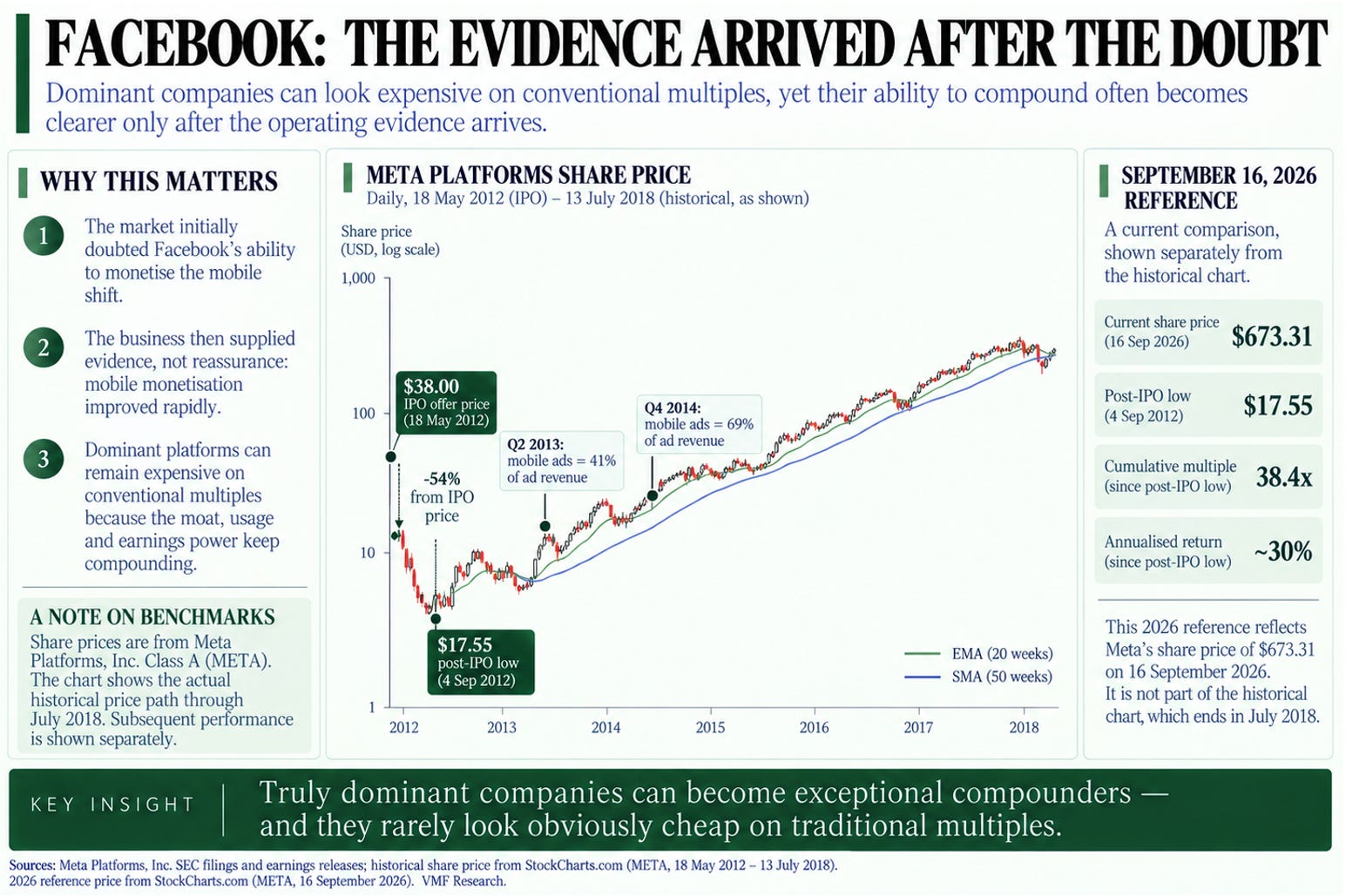
The useful lesson is not that celebrated IPOs recover. Many disappoint permanently. It is that investors can distinguish uncertainty that is gradually being resolved from a thesis that is deteriorating. Facebook supplies a case study, not a forecast for SpaceX.
Our tests are different. Starship must become a repeatable deployment system.
Connectivity must convert added capacity into profitable customer activity. AI contracts must produce attractive cash economics after operating and renewing the infrastructure. Across the group, progress must become visible in per-share value.
Those conditions allow patience to remain a discipline rather than an excuse.
We would reconsider the thesis if deployment delays became persistent, customer economics weakened, or investment and dilution repeatedly outpaced the growth of earning power. A lower quotation would not automatically justify buying more. A higher quotation would not automatically validate the business case.
We are therefore adding an initial 2% allocation to SpaceX ( SPCX 0.00%↑ ) in VMF’s Quality Model Portfolio, at the closing price used for publication.
The allocation reflects conviction in the competitive system, tempered by the unusually wide distribution of outcomes. We are not treating every segment as an established compounder. Connectivity supplies demonstrated profitability; the wider group offers the possibility of applying difficult-to-replicate capabilities across much larger markets. The position must earn additional capital through evidence.
The East India Company comparison brought us here because access can become the foundation of a much larger commercial system. Our thesis does not require SpaceX to own every resource or operate every business beyond Earth. It requires the company to keep turning capabilities that competitors struggle to reproduce into services customers will pay for, at returns that reward the capital committed.
That is the connection with our Abundance Shock thesis: a company that could help expand what becomes economically possible while retaining a valuable position in the infrastructure that makes it happen.
The opportunity is not simply to own a company that reaches the frontier. It is to own a company that can keep moving it.
Important Disclosure
This article contains general investment research produced by Vasco Marques de Freitas, CFA, CMT, Founder and CEO of VMF Research, Lda. It reproduces “The Company That Builds the Frontier” from the September 2026 issue of VMF’s Security Selection. The underlying research was completed on 18 September 2026 at 4:00 p.m. Eastern Daylight Time and first disseminated to paid subscribers on 18 September 2026 at 9:00 p.m. Eastern Daylight Time. Introductory commentary on subsequent Starship and market developments was added for republication and should be distinguished from the original analysis. Charts, prices and third-party information retain their individually stated reference dates.
The publication contains an investment recommendation concerning SpaceX. It is not personalised investment advice and does not consider any reader’s objectives, financial circumstances, knowledge, experience, liquidity requirements or tolerance for risk. The original recommendation introduced a 2% initial allocation to the Quality Model Portfolio at a published reference price of US$152.71. This is an illustrative research allocation, not a suggested weight for every reader. VMF Research’s Model Portfolios do not represent client assets, transactions executed by VMF Research or the performance of an investable fund or managed account.
The analysis combines thematic, fundamental, technological, financial and valuation research within a medium- to long-term framework. It examines the economics of SpaceX’s operating businesses, their potential interaction and the capital required to develop them. Management’s revenue ambitions, addressable-market estimates and prospective orbital-computing economics are not VMF Research forecasts. Sources, material assumptions and limitations are identified in the analysis. Views are reviewed through monthly publications, with weekly or ad hoc updates where material developments warrant reassessment.
The reverse valuation is an illustrative exercise, not a price target or return forecast. Its $135 offering-price reference and June share count are historical inputs, not the September recommendation price or a current fully diluted valuation. The assumed 12% annual return over five years is an analytical hurdle, not an expected or promised outcome. Different margins, valuation multiples, capital requirements or dilution could materially change the results. Historical comparisons, including Facebook’s post-IPO experience, do not predict SpaceX’s returns.
SpaceX involves substantial risks, including launch failures and deployment delays, unproven reuse or computing economics, intense competition, regulatory restrictions, high capital expenditure, infrastructure replacement costs, acquisition integration, financing needs, dilution and valuation compression. Its businesses share important dependencies, so their risks are not independent. As a long-duration equity, its valuation is particularly sensitive to required returns and the timing and scale of future cash flows. Technical progress, successful launches or revenue growth may not translate into attractive shareholder returns. Investors may lose some or all of their capital.
Disclosure of interests: as of the original research cut-off, legal entities controlled by Vasco Marques de Freitas held long positions in Scottish Mortgage Investment Trust PLC and Ark Innovation ETF, which both hold SpaceX and therefore provide those entities with indirect economic exposure to the company. This constitutes a financial interest and potential conflict of interest that readers should consider when evaluating the recommendation. Ownership of the Trust and the ETF is not equivalent to direct ownership of SpaceX. The interest does not validate the analysis, reduce investment risk or imply suitability for any reader.
Neither VMF Research nor the author received compensation from any issuer covered in connection with the preparation of the original research, and no issuer reviewed, approved or amended its investment conclusions before first dissemination.
Past performance, Model Portfolio performance and forward-looking scenarios are not reliable indicators of future results. Readers should conduct their own analysis and, where appropriate, consult an authorised financial intermediary or adviser before making an investment decision.