

Imagine being right about AI, right about economic growth, and still disappointed by the companies you bought.
Cheaper intelligence could open entire markets. It could also hand the savings to customers, invite new competition or leave shareholders financing an expansion whose rewards keep receding. September’s VMF’s Security Selection, “Who Owns Abundance?”, begins with that ownership problem.
We stopped September’s public Tier One series before sharing more of the conceptual work behind our main hypotheses about money, economic growth and market behaviour. That developing framework, and its portfolio implications, remain with subscribers.
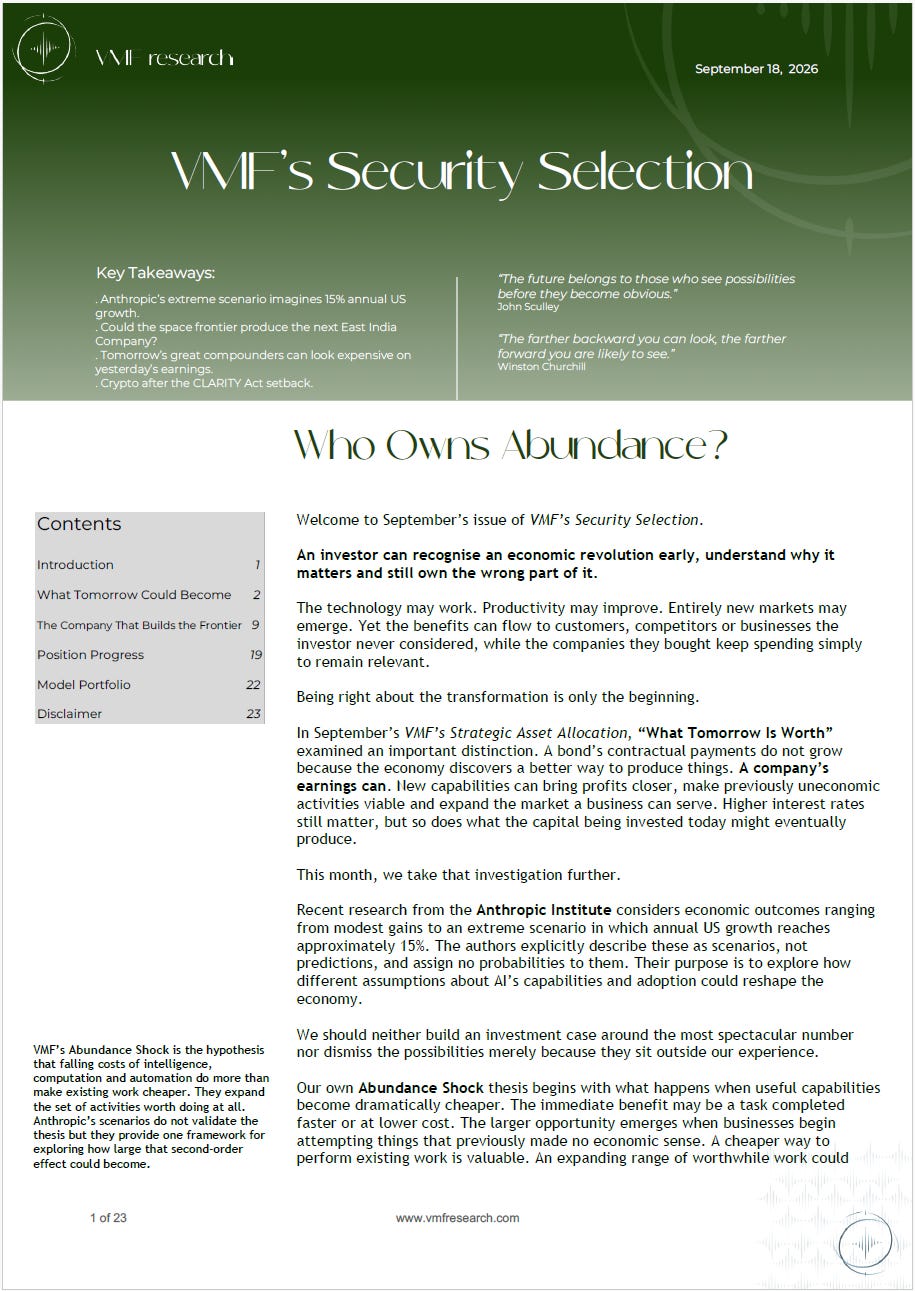
For Tier Two, we are taking a different route: we will reveal the company behind our latest investment thesis in the next article. But first, we need to explain the economic context that led us to it.
Anthropic’s scenario work gives this investigation an arresting starting point: an extreme case in which annual US growth eventually reaches approximately 15%. This is a scenario, not a forecast, and the authors assign no probabilities to the outcomes they explore. Our investment case does not require that number to be right.
What interests us is how businesses might respond when activities that were prohibitively expensive become affordable. The consequences could reach well beyond doing today’s work a little faster.
The excerpt below was first published for paid subscribers on 18 September 2026. It sets up the question we must answer before introducing the company:
When cheaper intelligence makes more of the economy possible, who gets to own the parts it still cannot reproduce?
Good reading.
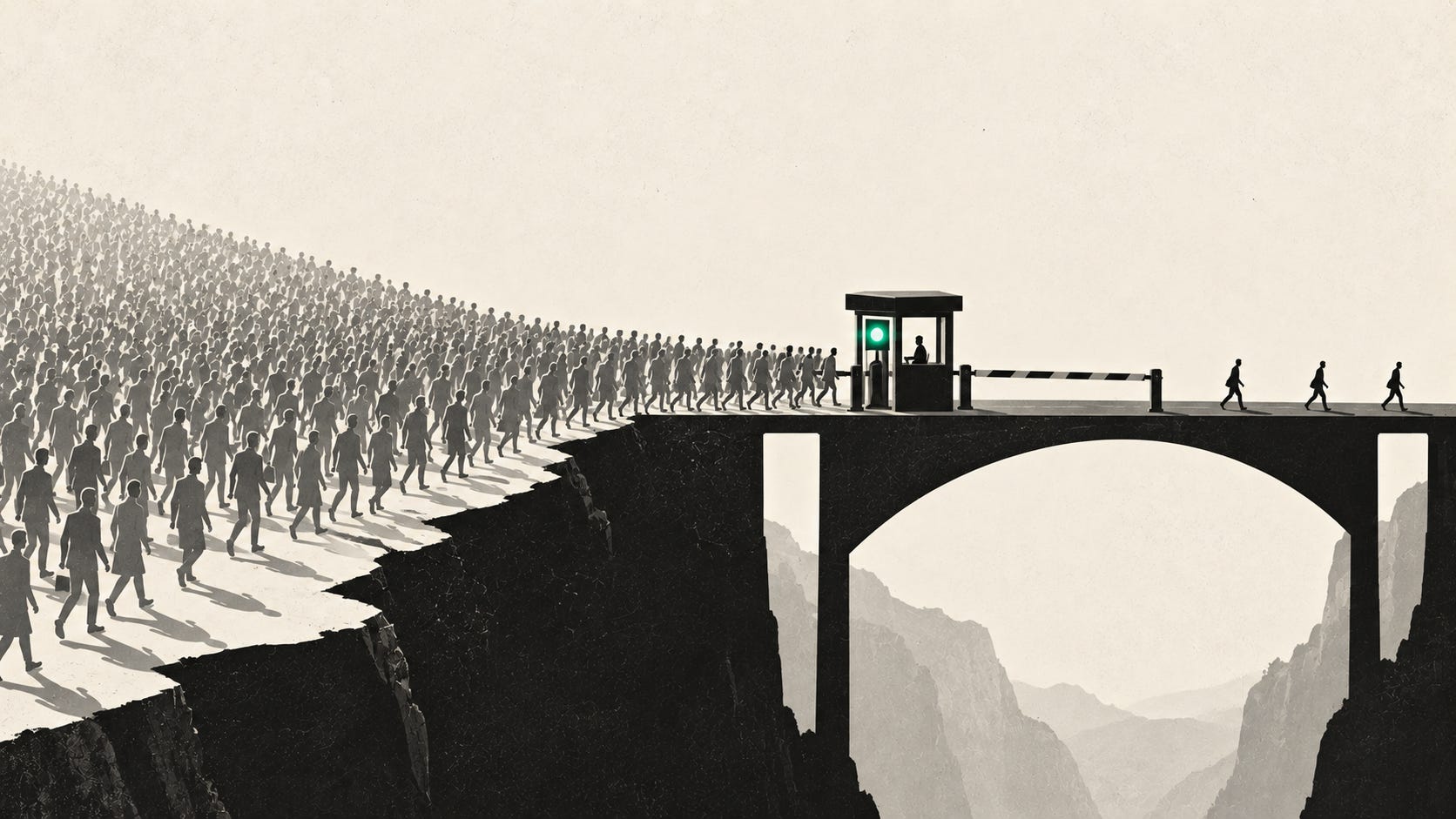
The future is usually discounted in basis points.
Anthropic is asking us to consider it in trillions. In the September issue of VMF’s Strategic Asset Allocation, we approached the problem from the perspective of valuation.
A fixed-rate bond cannot decide that the world has become more productive and increase its coupon. On the other hand, a company can develop a better product, discover a cheaper way to operate or enter a market that barely existed when the original investment was made. Higher interest rates make distant cash flows less valuable, all else equal. But everything else does not have to remain equal.
Future profits can become larger, arrive sooner or become considerably more probable.
Anthropic has now published an economic exercise that allows us to ask a more ambitious question.
What could tomorrow actually become?
The company’s new Economic Scenario Explorer models how advances in artificial intelligence could affect the US economy through 2030. It begins not with a forecast for the S&P 500 or another estimate of how many billions will be spent on data centres, but with something more fundamental: the work an economy actually performs.
Jobs are collections of tasks. Some tasks can be augmented by AI. Others can be automated. New ones can emerge. Productivity changes as people and machines divide that work differently. Adoption determines how much of the available technology actually reaches the economy.
Change those assumptions and the range of possible outcomes becomes enormous.
Anthropic highlights three.
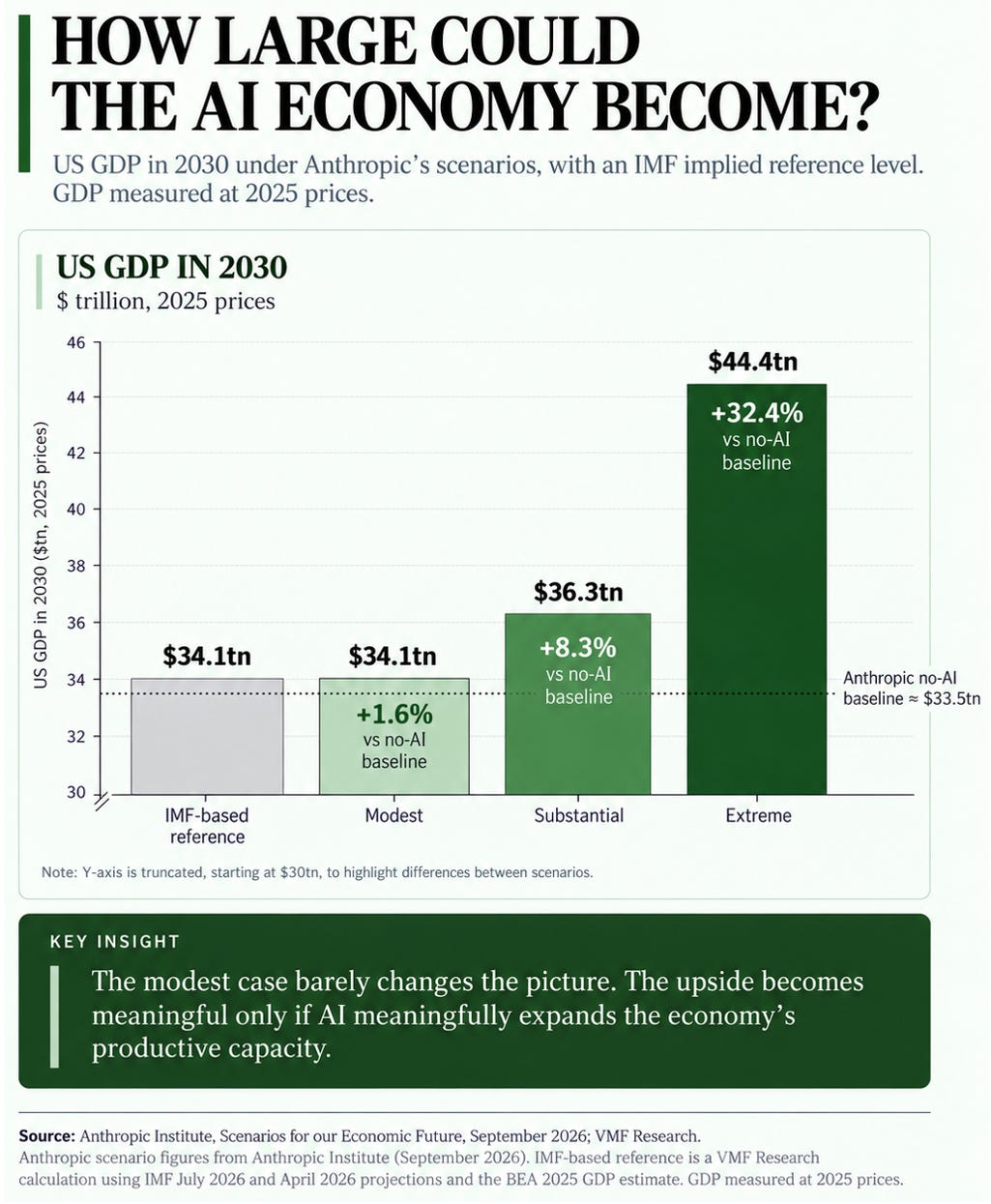
In its modest scenario, AI produces gains broadly comparable with those of an important previous technological revolution. US GDP reaches approximately $34.1 trillion in 2030, only 1.6% above the level generated by the same economy without AI.
The substantial scenario moves much further. AI becomes capable of performing a large proportion of knowledge work, although adoption remains incomplete. GDP reaches approximately $36.3 trillion, 8.3% above the no-AI baseline.
Then comes the extreme scenario.
Here, AI becomes more productive than humans across the great majority of knowledge work, operates with considerable autonomy and is adopted rapidly. US GDP reaches approximately $44.4 trillion in 2030, 32.4% above the counterfactual without AI. As adoption spreads, annual GDP growth eventually reaches approximately 15%, fast enough for the economy to double in size roughly every four and a half years.
Those numbers deserve two reactions.
The first is obvious. They are extraordinary.
The second is more important. They are not forecasts.
Anthropic explicitly assigns no probabilities to the scenarios. Its model is a deliberately simplified representation of a complicated economy and excludes forces that could materially alter the outcome, including policy responses, business cycles, aggregate-demand effects and financial disruptions. The most extreme case also relies on assumptions about recursive AI improvement and rapid adoption that may never materialise. Some of the economists who reviewed the framework considered that scenario closer to a thought experiment than a conventional forecast.
We should therefore resist the temptation to take the most exciting number and build an investment thesis around it.
We do not need to. What matters is that the range of economically serious outcomes may be widening.
Cathie Wood has been making a related argument from a very different starting point. ARK’s framework focuses on the convergence of artificial intelligence, robotics, energy storage, blockchain technology and other innovation platforms. In her latest In The Know, Wood notes that global real GDP growth has averaged roughly 3% over the past 125 years and argues that the rate could at least double. She goes further still, describing the 10% to 15% growth rates discussed by Elon Musk as within the conceivable range.
We made the necessary qualification in Tier One and will repeat it here.
Our investment case does not require any of those numbers to be right.
An economy growing at 4% rather than 3% can still produce extraordinary companies. A business can compound revenues at 20% while the wider economy grows at 2%. New markets, changes in market share and declining costs can produce exceptional corporate outcomes without anything resembling Anthropic’s extreme scenario.
The relevance of these possibilities lies somewhere else.
Conventional economic analysis spends considerable time worrying about the left tail of the distribution. Recession. Financial crisis. Inflation. Debt distress. Geopolitical shock.
Those risks remain.
But technological progress is forcing investors to take the right tail more seriously too.
What if tomorrow is not merely a little more productive than today?
What if entire categories of activity become cheap enough to perform for the first time?
What if falling costs do not simply allow companies to do the same work with fewer resources, but make previously uneconomic work worth doing?
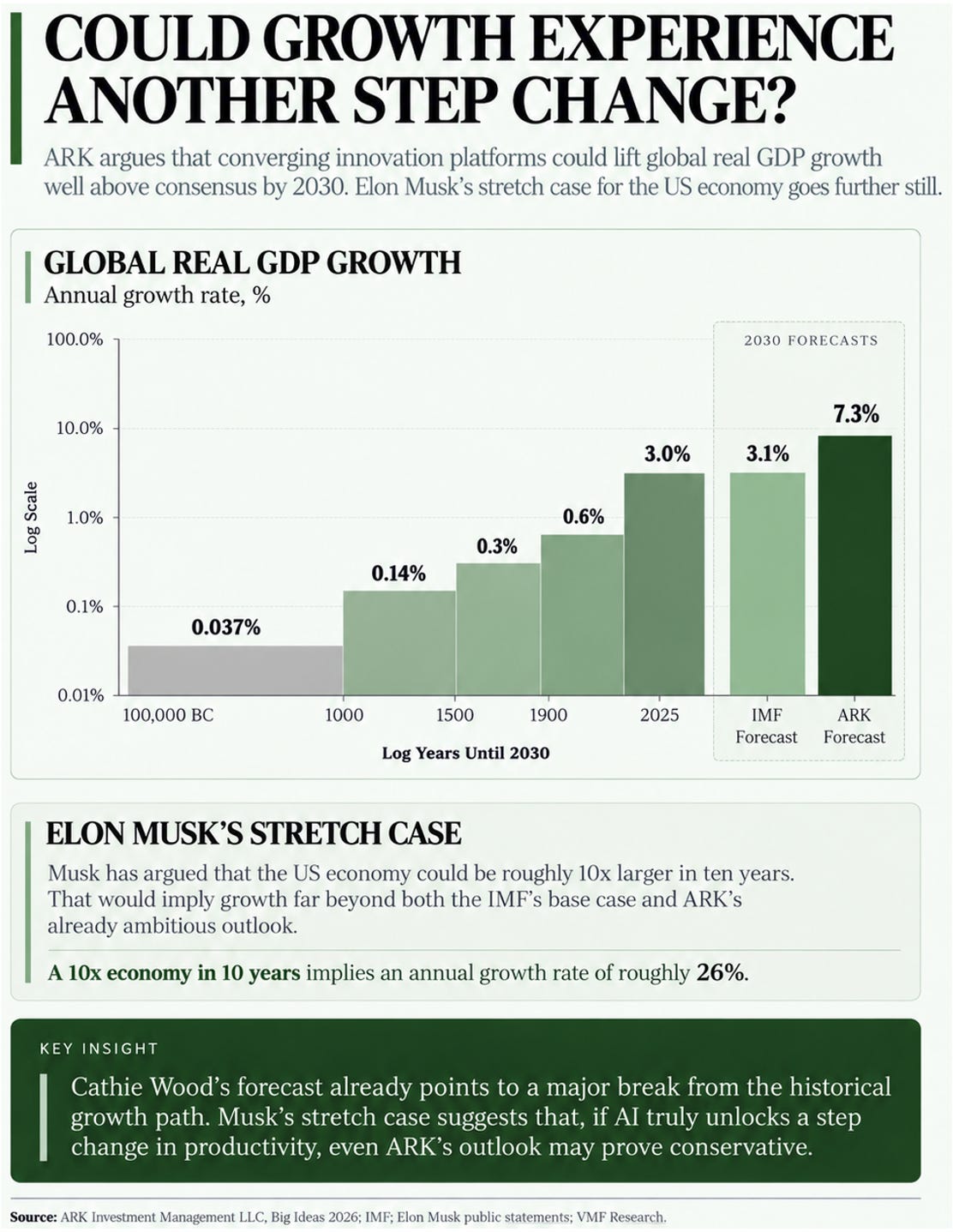
That is the possibility our Abundance Shock has been designed to investigate.
In Tier One, we described the mechanism in deliberately simple terms. As useful capabilities become dramatically cheaper, projects that previously failed an investment committee’s financial test can become viable. Smaller organisations gain access to tools that once required large teams and substantial amounts of capital. Existing businesses can attempt things that would previously have consumed too much money or too much time. The first effect is lower cost. The more powerful effect begins when behaviour changes because the lower cost makes more economic activity possible.
Anthropic’s scenarios take that logic and ask what happens when it spreads across an entire economy.
For investors, however, this is where the easy part ends.
A Bigger Pie Does Not Mean Equal Slices
A much richer economy does not tell us who becomes richer.
Anthropic’s model makes that distinction unusually visible. Today, approximately 60 cents of every dollar produced in the US economy goes to labour and 40 cents to capital. In Anthropic’s modest scenario, that relationship barely moves. Labour receives 59.4% of GDP and capital 40.6%.
The substantial scenario begins to look different. Labour’s share falls to 56.1%, while capital rises to 43.9%.
Under the extreme scenario, the change is profound. The economy is far larger, but only 45.2% of GDP accrues to labour. Capital receives 54.8%. Its share of the economic pie has increased by almost fifteen percentage points.
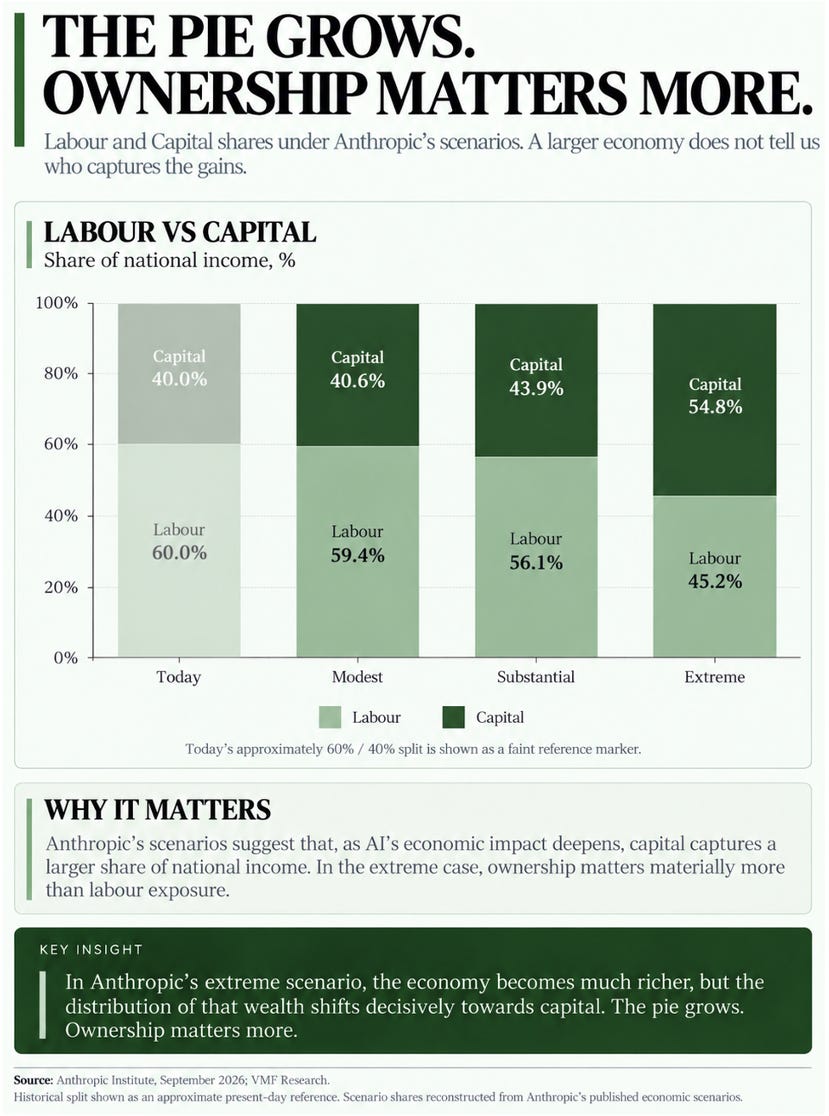
The social implications are substantial. Anthropic’s extreme scenario combines much greater aggregate prosperity with weaker outcomes for many knowledge workers. It is precisely why the company emphasises how the benefits of technological progress might eventually be distributed.
Our question in VMF’s Security Selection is narrower.
It is an ownership question.
And we need to be careful with the answer.
A larger share of income going to capital does not mean every owner of capital wins.
Far from it.
A technology revolution can create enormous economic surplus while destroying the economics of the companies that originally appeared best positioned to capture it. Competition can force productivity gains through to customers. New entrants can use lower costs to attack incumbent margins. Capital-intensive businesses can spend so aggressively to preserve leadership that shareholders wait years for the promised cash flows to arrive.
The economy can become vastly more productive while individual investments disappoint.
That distinction runs directly through the argument we developed in last month’s issue, “Quality Has a Half-Life”.
August asked a deliberately difficult question:
Would the company become more or less relevant if intelligence became ten times cheaper?
We were trying to identify the scarce assets, proprietary information, trusted relationships and essential processes whose economic importance could increase as intelligence itself became abundant.
September asks the complementary question.
If intelligence becomes ten times more productive, which scarce assets become more valuable?
That is where the distribution of future profits will be decided.
Some of the additional value may accrue to the companies producing intelligence itself. Some may accrue to semiconductor manufacturers and the owners of the equipment required to produce those chips. Some may flow towards electricity, transmission networks and the physical infrastructure supporting an increasingly computational economy.
Other businesses may capture value through intellectual property, proprietary data, distribution, customer relationships, network effects or regulatory permissions. And some will possess combinations of those advantages that reinforce one another.
The result will not be an even distribution of abundance.
It will be a competition to own the bottlenecks it creates.
Growth Is Not the Investment Thesis
This is where Anthropic, ARK and VMF Research arrive at related questions from different directions.
Anthropic begins with tasks. How capable does AI become? How autonomously can it work? How rapidly is it adopted? How much productivity does it create?
ARK begins with technological convergence. Artificial intelligence becomes more powerful as the cost of computation falls and interacts with advances elsewhere in the economy. Wood’s conclusion is that the combined productivity effect could move growth materially beyond the rate investors have come to regard as normal.
Our Abundance Shock begins with economics...
What changes when a useful capability becomes dramatically cheaper?
The three frameworks do not need to produce the same forecast to point towards the same possibility.
We may be approaching a period in which the productive frontier moves faster than conventional economic models, corporate planning cycles and financial markets are accustomed to handling.
But growth itself is not the investment thesis.
Between greater economic output and greater shareholder wealth sits a sequence of increasingly difficult tests.
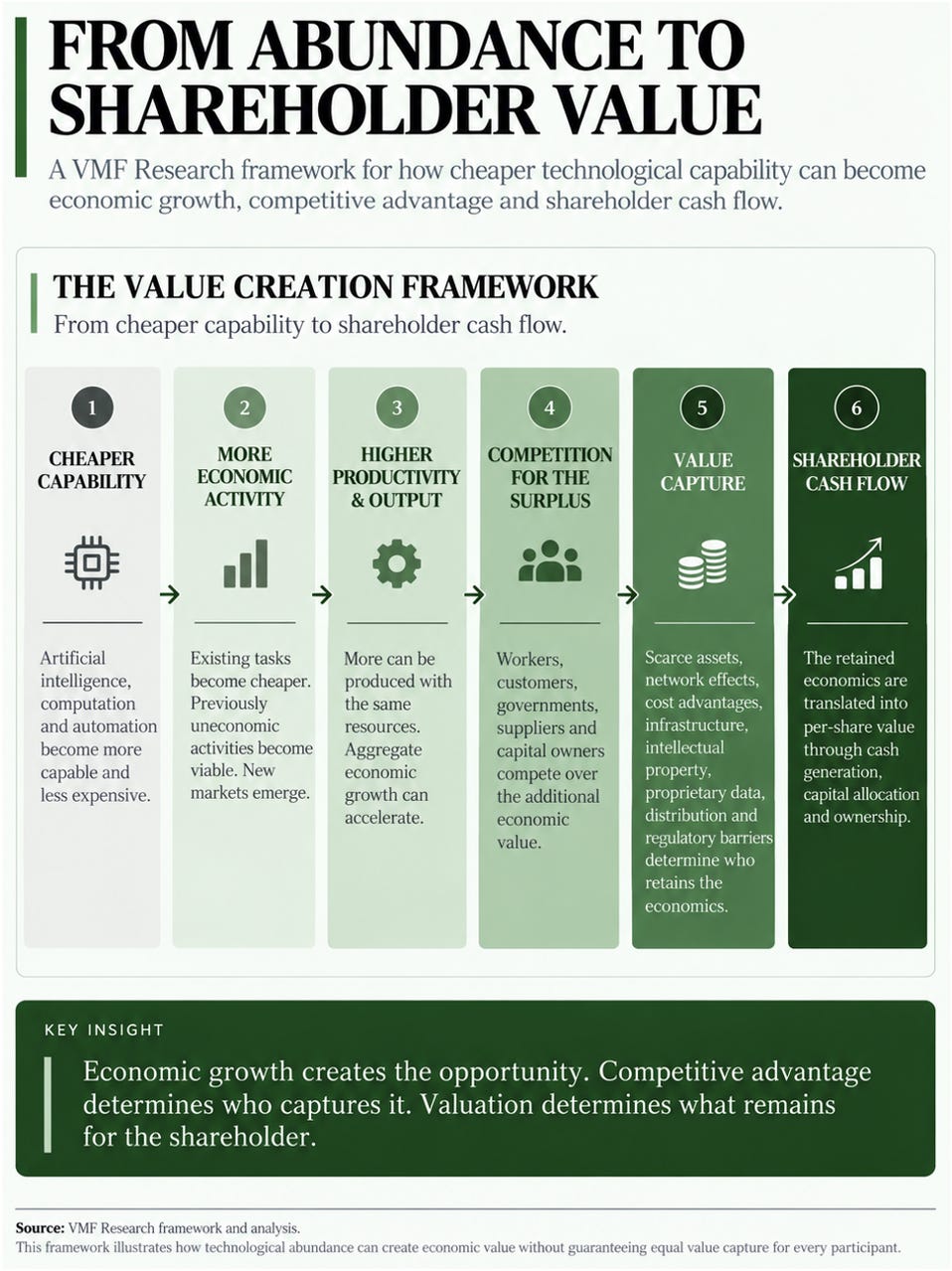
That last step is the one an investor cannot skip.
A wonderful technology does not guarantee a wonderful business. A wonderful business does not guarantee wonderful shareholder returns. And an economy capable of growing much faster than we expected does not remove the requirement to determine what we are paying for the claim on that future.
There is another implication, and it may prove even more important.
Abundance can make scarcity more valuable.
Cheaper scientific discovery can create more compounds worth testing, increasing demand for clinical trials, manufacturing capacity and regulatory infrastructure. Cheaper engineering can produce more viable physical projects, increasing demand for electricity, materials, construction and logistical capacity.
Cheaper intelligence can allow businesses to perform far more work, while increasing the value of the networks, permissions, physical assets and infrastructure through which that work must ultimately pass.
We saw an early version of this relationship in August. Veeva did not need to own the foundation model. Its opportunity came from controlling regulated workflows through which increasingly capable models must pass before they can create economic value in life sciences.
Generic intelligence may become cheaper. Completed, compliant work remains scarce.
The same principle can operate at much greater scale.
If the range of economically viable activity expands, the most valuable businesses may not simply be those creating the abundance. They may be the ones controlling what abundance cannot easily reproduce.
Physical infrastructure.
Distribution.
Networks.
Manufacturing capability.
Proprietary technology.
And, in the rarest cases, several of those advantages reinforcing one another inside the same organisation. That observation led us towards the company at the centre of this month’s recommendation.
Its ambition is enormous.
So is the uncertainty surrounding what it may ultimately become.
Our task is not to decide whether the future it imagines sounds exciting. It is to determine whether the advantages it is building can allow shareholders to capture enough of that future to justify the price they are being asked to pay today.
The future may become abundant.
The businesses capable of owning its bottlenecks will not be.
Important Disclosure
This article contains general investment research produced by Vasco Marques de Freitas, CFA, CMT, Founder and CEO of VMF Research, Lda. It reproduces “What Tomorrow Could Become” from the September 2026 issue of VMF’s Security Selection. The underlying research was completed on 18 September 2026 at 4:00 p.m. Eastern Daylight Time and first disseminated to paid subscribers on 18 September 2026 at 9:00 p.m. Eastern Daylight Time. Charts, economic estimates and third-party research retain their individually stated reference dates.
The publication contains information recommending or suggesting an investment strategy. It is not personalised investment advice and does not consider any reader’s objectives, financial circumstances, knowledge, experience, liquidity requirements or tolerance for risk. VMF Research’s Model Portfolios are illustrative research portfolios, not client assets, transactions executed by VMF Research or the performance of an investable fund or managed account.
The analysis combines macroeconomic, technological, fundamental and scenario-based research within a medium- to long-term framework. The Abundance Shock is a working hypothesis, not an assured economic outcome. Views are reviewed through monthly publications, with weekly or ad hoc updates where material developments warrant reassessment. References to Anthropic, ARK, Cathie Wood and other third parties do not imply their endorsement of, or participation in, VMF Research’s conclusions.
Anthropic’s economic scenarios are not forecasts and carry no assigned probabilities. The approximately 15% annual US growth rate belongs to its extreme scenario, which depends on demanding assumptions about AI capability, autonomy and adoption. Estimates of additional output in 2030 are comparisons with a modelled counterfactual, not annual growth rates. Anthropic’s scenarios, ARK’s projections and VMF Research’s analysis use different assumptions and should not be treated as interchangeable or as validation of one another.
Greater productivity or a larger share of income accruing to capital does not guarantee higher shareholder returns. Competition, implementation costs, capital expenditure, technological disruption, regulation, financing needs, dilution and excessive valuations can prevent investors from capturing the benefits of economic growth. Outcomes may differ materially from the scenarios discussed, and investments may lose some or all of their value.
Disclosure of interests: legal entities controlled by Vasco Marques de Freitas held a long position in Scottish Mortgage Investment Trust PLC at the 18 September research cut-off. The Trust provides indirect exposure to Anthropic, whose economic research is discussed in this article. Those entities also disclosed a long position in ARK Innovation ETF (ARKK) in the 11 September Tier One publication; this article discusses ARK’s economic framework. These interests may create potential conflicts and should be considered when evaluating the analysis. They do not validate its conclusions or imply suitability for any reader.
Neither VMF Research nor the author received compensation from any issuer covered in connection with the preparation of the original research, and no issuer reviewed, approved or amended its investment conclusions before first dissemination.
Past performance, Model Portfolio performance and forward-looking scenarios are not reliable indicators of future results. Readers should conduct their own analysis and, where appropriate, consult an authorised financial intermediary or adviser before making an investment decision.