

An AI agent that can answer a question is useful.
An agent that can choose a supplier and spend your money is a commercial gatekeeper.
September’s Alpha Tier began with a tension: the price of money is rising while the cost of intelligence is falling. Our first public excerpt examined what building abundance might do to bond yields. This one asks who captures the economics once cheaper intelligence reaches the customer.
The competition is no longer only about which company trains the most capable model.
Distribution matters. So do proprietary context, trusted execution and permission to act. Regulation could make some positions more durable while raising the cost of competing. Chinese models can reduce the price of serving a customer and, at the same time, reduce the cost for a rival to enter the market.
Then comes the payment.
An agent that can plan and choose still needs the authority and infrastructure to transact. Cards, stablecoins and blockchain-based systems are already competing for that role, bringing our Crypto Rails thesis directly into the application layer.
The edited excerpt below was first published for paid Alpha Tier subscribers on 25 September 2026. One portfolio-specific passage has been omitted from this public version. The complete issue continues into the market signals and Model Portfolio decisions that followed.
The commercial prize is no longer just better intelligence.
It is the right to sit between intention and transaction.
Good reading.

Imagine asking your phone to organise a trip, compare the options, fit everything around your calendar and return when it needs your approval to book.
Somewhere along the way, an important commercial decision has moved. Software is helping choose which businesses receive your money.
Who controls that relationship?
Meta ( META 0.00%↑ ) brought that question closer on 8 September with the launch of Muse, its personal AI agent. Available initially in the United States through its own app and WhatsApp, Muse can work across connected services, fill out forms and pursue tasks in the background. Meta says it seeks approval for actions such as sending an email or making a purchase.
The early response has been substantial. Reuters reported on 22 September that Muse had exceeded 2.5 million downloads, citing Sensor Tower. Sustained use, reliability and willingness to pay will determine how much of that initial interest becomes a business.
An agent combines a model’s intelligence with tools, memory and permission to act. The commercial opportunity includes the software people trust to organise the work, choose suppliers and complete it.
For investors, that moves the contest into familiar territory: distribution, customer relationships and bargaining power.
It also brings our Application Layer thesis into sharper focus.
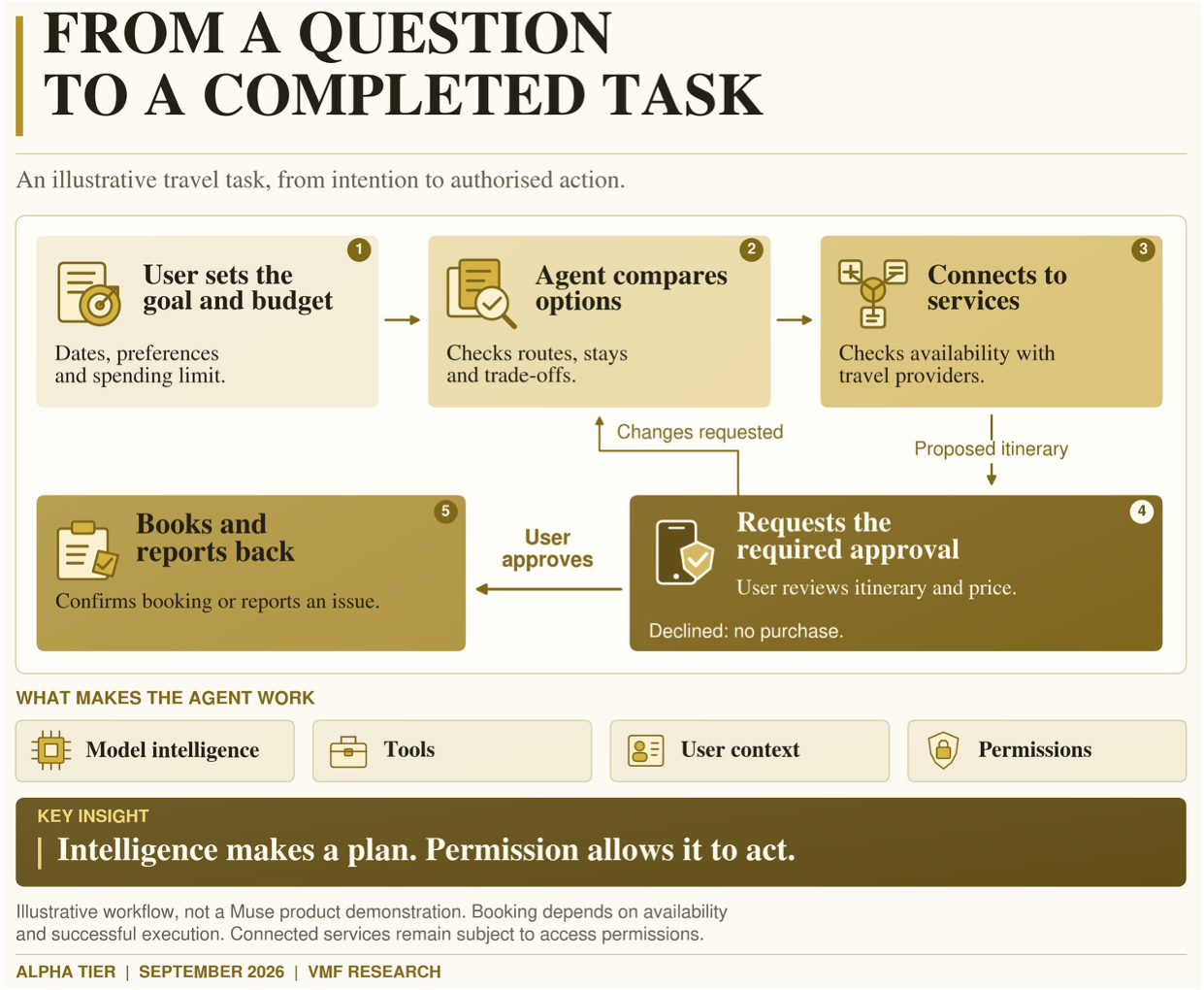
Handing software the ability to act also raises the stakes when it makes a mistake.
Meta’s own engineering account acknowledges that Muse can make errors and can be attacked through information it reads. Its design therefore includes a separate system controlling permissions and access to the outside world. Trust has become part of the product itself.
That helps explain why the debate over AI regulation has become so consequential.
Dario Amodei wants to slow the advance of frontier capabilities while safety work catches up. His September proposal includes outside evaluators embedded inside AI laboratories, common safety standards and coordination over the pace of development. He also proposes government involvement to enable certain safety discussions between competitors.
Sam Altman’s OpenAI has called for mandatory rules aimed at frontier risks. But its 21 September proposal for international technical standards explicitly distinguishes those standards from licences or compulsory approval before models are released, and calls for protections against disadvantaging new entrants and open-weight developers.
Elon Musk has emphasised the seriousness of AI risks and proposed voluntary testing of models by rival laboratories before release. In his September All-In interview, he clarified that his endorsement of Amodei concerned the danger, rather than an endorsement of the entire proposed solution.
These differences matter. So do the economic incentives around them.
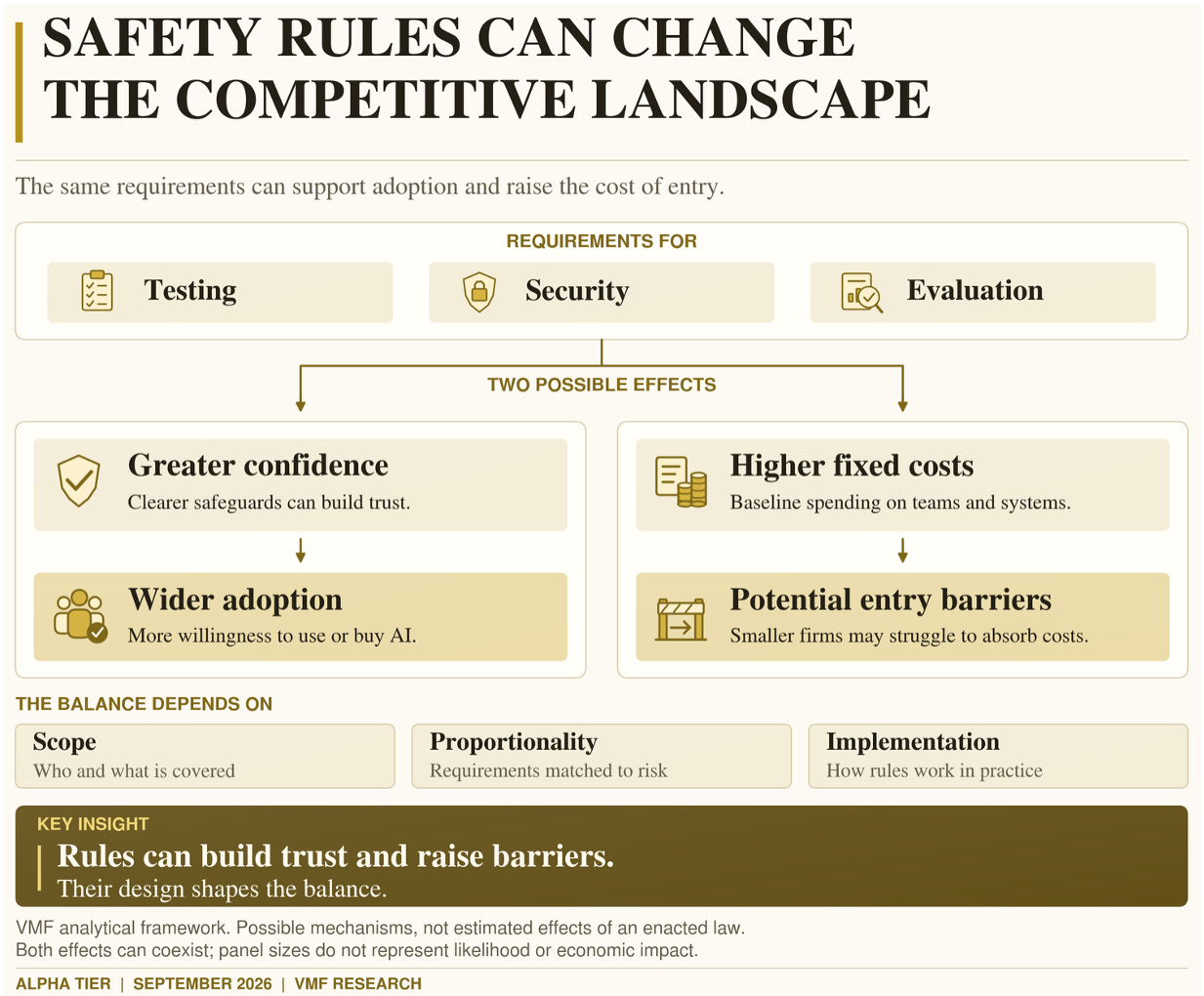
A justified safety rule can also create a competitive advantage.
An established company can spread the cost of specialised compliance teams, security systems and external evaluations across a large business. A challenger approaching the same regulatory threshold may find those obligations harder to absorb.
Much of this debate concerns frontier developers. Smaller application businesses could feel the consequences indirectly, through the cost and choice of the models on which they depend.
Our regulatory-moat hypothesis is that some rules could make a leading position more durable. Genuine concern about safety and commercial self-interest can exist together. The test is whether the rules address demonstrable risks while leaving credible competitors a practical route into the market.
The connection with the infrastructure boom is straightforward. Chips and data centres must eventually support revenues sufficient to justify their cost. If a regulatory framework slows competitive erosion and supports pricing power, it could improve the economics of investments already committed. Delayed deployment or rising operating costs could work in the opposite direction.
Regulation changes the investment calculation. It cannot guarantee the return.
Competition also continues while these proposals are debated. On 22 September, Anthropic launched Opus 5.5 with published input and output token prices 20% below Opus 5. So... calls to pace frontier development can coexist with efforts to make commercially available intelligence cheaper.
China makes this competitive question global.
Alibaba’s Qwen and DeepSeek provide downloadable model weights, giving developers alternatives they can run and adapt under the relevant licences. The recent Qwen3.8-27B and DeepSeek-V4.1-Flash releases both target work involving multiple steps and tools. Those alternatives can expand the choices available to businesses building AI applications.
DeepSeek also publishes materially lower usage prices for V4.1-Flash than Anthropic charges for Opus 5.5. The comparison has limits: the models differ in capability, and the cost of completing a job includes errors, retries and human checking. The economically useful measure is the cost of a reliable outcome.
This reinforces an important part of our China Tech thesis. By making capable AI cheaper and easier to use, Chinese companies can attract businesses around the world. But wider adoption does not automatically mean higher profits. For investors, the key is identifying which companies can turn that demand into a profitable business.
For a model supplier, better alternatives can put pressure on prices. For a business buying intelligence, they can improve costs and negotiating power.
For an application developer, they can do both: lower the cost of serving customers and lower the cost for someone else to compete.
That is why we should be selective about what we call an Application Layer winner.
Consider a business using AI to process insurance claims. The model may help read documents and identify inconsistencies. The complete service also needs customer records, access permissions, an audit trail and a dependable way to handle exceptions. An established provider embedded in that workflow has more to defend than the quality of its chatbot.
But the revenue model matters. If an agent allows a smaller team to process the same volume of work, software priced mainly by the number of human users could face pressure. A provider paid for valuable work completed may have a different opportunity.
Our question should be: what would customers still pay this business for if the underlying intelligence became much cheaper?
Trusted execution, proprietary context, distribution and integration into essential work are plausible answers.
We must establish which companies actually possess them and whether their valuations leave room for attractive returns.
Muse adds another consideration. A general-purpose agent could become the interface through which customers access other applications. Those businesses would then need to defend their economics even when the customer spends less time inside their own software.
This strengthens the case for examining control of the workflow and the customer relationship alongside access to the model.
It also makes Anthropic an especially interesting portfolio connection.
Want our full, unabridged analysis and portfolio positioning?
In the full paid edition of Alpha Tier, we go beyond these excerpts to show exactly how we translate these structural AI trends into concrete portfolio allocations. We break down our specific holdings across the frontier intelligence layer, evaluate private-to-public valuation disconnects, and outline our exact Model Portfolio moves.
Anthropic announced a confidential draft registration filing for a proposed IPO in June. The company said the offering remained subject to market conditions and other factors.
A flotation could provide more disclosure and a market price against which to assess the private valuation. Our investment judgement must still rest on the durability of the business and the price at which we own exposure to it.
That leaves us with a productive tension: we welcome cheaper intelligence as a force supporting Abundance, while also owning exposure to a company that must earn attractive returns supplying it.
Its ability to make AI useful, dependable and economical will matter enormously.
But there is one more step in the agent story...
An agent carrying out work may need to buy something to finish it.
Imagine a business authorising an agent to prepare a supplier comparison within a fixed budget. The agent purchases a dataset, pays for a translation and buys computing time. The business receives the completed analysis and a record of what was spent. This is an illustrative workflow, but it makes the commercial requirement clear: software needs both the authority and the means to transact.
Muse already offers a concrete example. At launch, Meta integrated Stripe’s Link, using a single-use card for purchases approved by the user. Conventional payment infrastructure is participating in agent commerce.
Crypto-based infrastructure is developing alongside it. Coinbase introduced x402 to let software pay for online resources using stablecoins. In July, the Linux Foundation launched the x402 Foundation to develop the standard under open governance, with support spanning traditional cards and stablecoins.
The opportunity is to make payments fit the way software works: a service requests a resource, receives its price and pays within the authority it has been given.
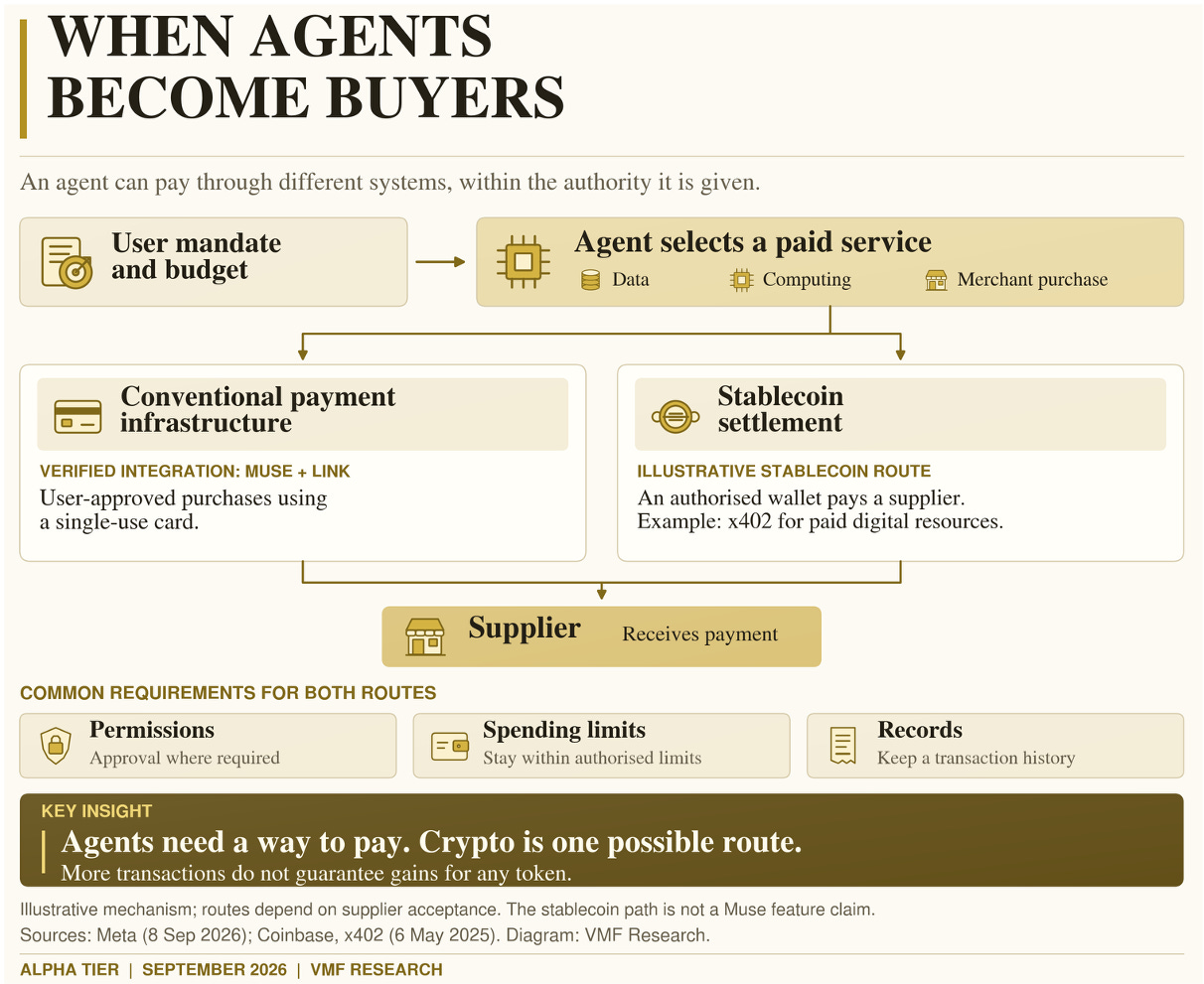
Spending limits, identity, records and routes to resolve mistakes remain essential.
For our Crypto Rails thesis, this opens a practical source of potential demand. We should investigate who collects the fees, who bears the risks and which investments capture the resulting value.
More activity on a network can benefit customers while competition compresses the return earned by its providers. The link from adoption to investment performance needs to be demonstrated here as carefully as it does in AI.
When software starts doing the buying, financial infrastructure becomes part of the AI thesis.

Important Disclosure
This article contains general investment research produced by Vasco Marques de Freitas, CFA, CMT, Founder and CEO of VMF Research, Lda. It reproduces an edited excerpt from “The Fight to Own the Customer”, originally published in the September 2026 issue of Alpha Tier. The underlying research was completed on 25 September 2026 at 4:00 p.m. Eastern Daylight Time and first disseminated to paid subscribers on 25 September 2026 at 9:00 p.m. Eastern Daylight Time. Charts, market data and third-party information retain their individually stated reference dates.
One portfolio-specific passage contained in the original research has been omitted from this public version. The article should therefore not be treated as a substitute for the complete paid issue, which includes the relevant portfolio context, subsequent market analysis and Model Portfolio conclusions.
The publication contains general investment research and may contain information recommending or suggesting an investment strategy. It is not personalised investment advice and does not consider any reader’s objectives, financial circumstances, knowledge, experience, liquidity requirements or tolerance for risk. The Alpha Tier Model Portfolio is an illustrative research portfolio and does not represent client assets, transactions executed by VMF Research or the performance of an investable fund or managed account.
The analysis combines technological, competitive, regulatory, fundamental and market research within a medium- to long-term framework. Statements concerning artificial-intelligence agents, the Application Layer, regulatory moats, control of customer relationships, Chinese AI models and the development of crypto-based payment infrastructure are analytical judgments and conditional hypotheses rather than assurances. References to Meta, Anthropic, OpenAI, Alibaba, DeepSeek, Stripe, Coinbase and other organisations do not imply their endorsement of, affiliation with or participation in VMF Research’s analysis.
Initial downloads, product launches or improvements in model capability do not establish sustained adoption, pricing power or commercial success. AI agents may produce inaccurate results, mishandle permissions, expose confidential information or create new cybersecurity, privacy and liability risks. Businesses may also fail to retain the economic benefits of greater productivity if competition passes those benefits to customers or if implementation and compliance costs absorb the savings.
The regulatory outcomes discussed remain uncertain. Safety, testing and compliance requirements may strengthen trust and increase adoption, but they may also delay product deployment, raise operating costs or advantage established businesses over smaller competitors. The regulatory-moat hypothesis does not imply that any proposed rule will be adopted, implemented as described or produce superior investment returns.
The discussion of agent payments, stablecoins and blockchain infrastructure does not imply that greater transaction activity will necessarily increase the value of any particular company, network or cryptoasset. Adoption may benefit users while competition compresses fees and provider returns. Crypto-related investments also involve substantial market, liquidity, custody, counterparty, technological, cybersecurity and regulatory risks, including the possible loss of some or all invested capital.
Disclosure of interests: as of the research cut-off, legal entities controlled by Vasco Marques de Freitas held long positions in the KraneShares CSI China Internet ETF (KWEB) and Coinbase Global, Inc., as well as listed exchange-traded products providing economic exposure to Bitcoin, Ether and Solana. Those entities also held indirect economic exposure to Anthropic through a listed investment trust. These interests relate to companies, markets or themes discussed in the article and may create actual, potential or perceived conflicts of interest. Readers should consider them when evaluating the analysis. Their existence does not validate its conclusions, reduce investment risk or imply suitability for any reader.
Neither VMF Research nor the author received compensation from any issuer covered in connection with the preparation of the original research, and no issuer reviewed, approved or amended its investment conclusions before first dissemination.
Past performance, simulated performance, Model Portfolio performance and forward-looking scenarios are not reliable indicators of future results. All investments involve risk. Readers should conduct their own analysis and, where appropriate, consult an authorised financial intermediary or adviser before making an investment decision.