

A rate hike is an awkward headline for a thesis called the Dovish Shock.
On 16 September, the Fed raised rates to 3.75-4.00%, with policymakers projecting another increase this year. The hawkish interpretation has substance.
Five days earlier, paid Tier One subscribers received The Price of Credibility. Its opening takeaways included a possibility worth revisiting now: “Our Dovish Shock could begin with a rate hike!”
We retain that conviction. Our argument concerns how long restraint can endure as maturing debt is refinanced at prevailing rates. Establishing credibility may give Warsh greater freedom to ease later, while mounting financing pressure could make that freedom increasingly necessary. The latest hike makes this a harder test; it does not establish that our scenario will follow.
September’s issue examines the competing demands behind that test: a Fed rebuilding its authority, a Treasury continually seeking buyers and an AI economy consuming capital today while promising greater productive capacity tomorrow.
Following The Treasury Just Blinked, this excerpt asks how much financial strain restoring market discipline might require. The full issue follows the consequences into monetary alternatives, the Abundance Shock and the Model Portfolio implications.
What follows was first published on 11 September 2026, before the rate decision. It explains why we remain focused on the constraints that could eventually change Warsh’s calculation.
Good reading.

Kevin Warsh wants markets to tell him something he has not already told them.
To understand the ambition, imagine a copper mine closing and the price of copper jumping. On another continent, an engineer changes a design, a manufacturer searches for a substitute and a recycler finds that yesterday’s scrap is worth collecting.
They need never learn what happened at the mine...
The price carries the news, and the incentive to respond.
Friedrich Hayek recognised the extraordinary coordination hidden inside these ordinary decisions. Knowledge scattered across millions of people could influence economic activity without first passing through a central authority. This remains one of the Austrian School’s most powerful insights.
Interest rates extend that coordination across time. They influence which investments receive scarce capital, which borrowers must wait and which promises become too expensive to finance. As believers in free markets, we admire Warsh’s attempt to recover more of the information those prices can convey.
At Jackson Hole, he called for “clear market signals, as unfiltered as possible”. His retreat from habitual forward guidance asks investors to form more independent judgements while preserving the Fed’s freedom to respond to an uncertain economy.
Yet investors have learned to examine a jobs report through the anticipated response of the Fed. They trade that expectation. Policymakers then examine the resulting prices for information about the economy.
The Fed can find itself listening to an echo of its own voice.
Ben Bernanke warned about this “hall of mirrors” in 2004. Add the expectation of a Fed put, the belief that sufficiently severe market losses will eventually summon support, and tomorrow’s anticipated intervention starts influencing today’s willingness to take risk and the prices they are prepared to pay today.
A quieter chairman cannot dismantle that expectation through silence alone.
Allowing prices to speak means being prepared to hear an uncomfortable answer.
For Washington, that answer arrives at each debt auction.
Gross federal debt stood at approximately $40.1 trillion on 3 September, including $32.4 trillion held by the public. The carrying cost is already substantial: CBO estimates net interest expenditure of $963 billion in the first ten months of fiscal 2026, equivalent to more than a fifth of federal revenue over that period.
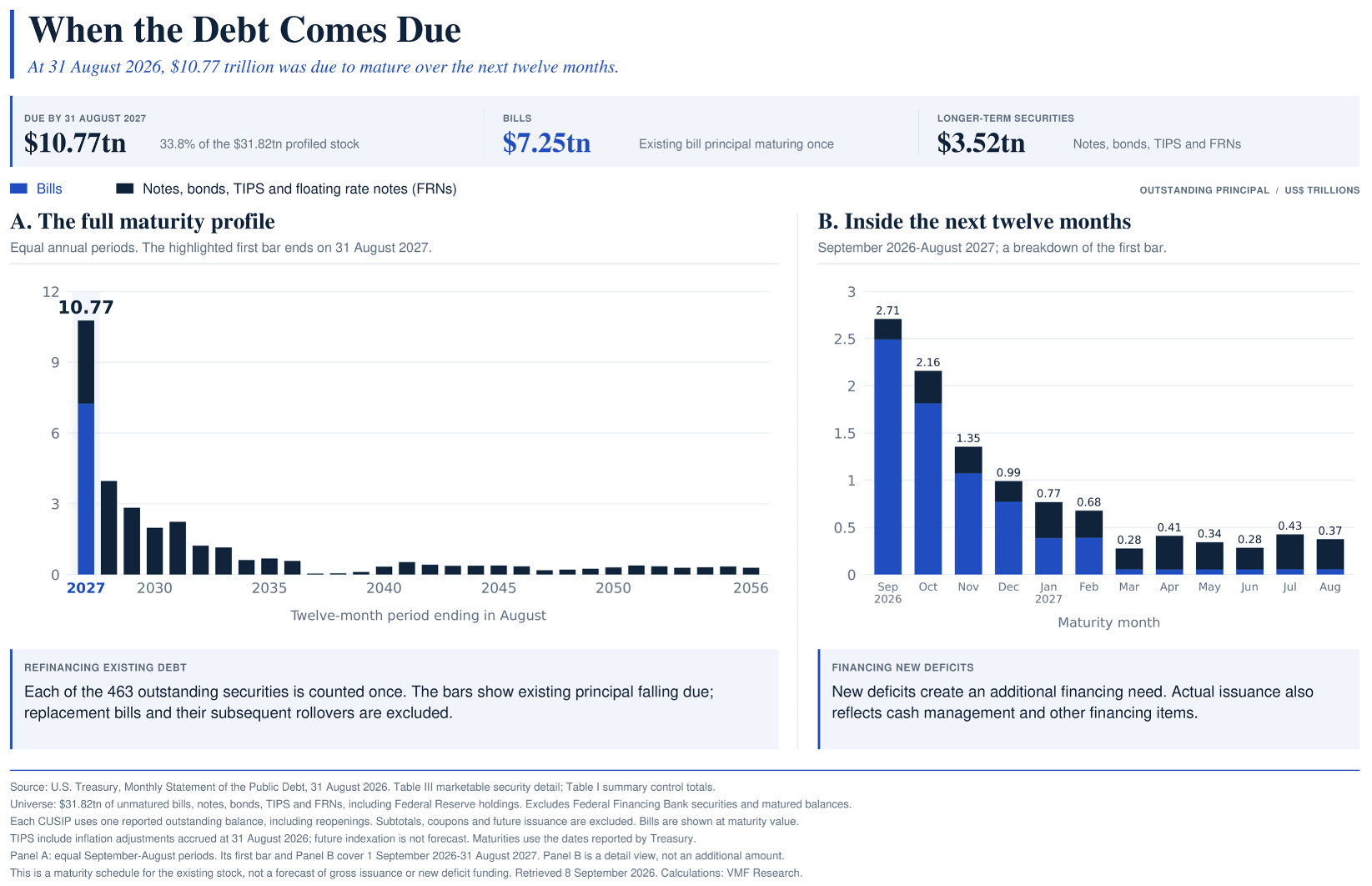
A low fixed coupon can shelter a borrower from changing conditions for years. Then the bond matures. Principal comes due, and replacement borrowing must compete at the prevailing price. Another piece of yesterday’s financing is exposed to today’s market.
Treasury bills bring that negotiation back sooner and more frequently.
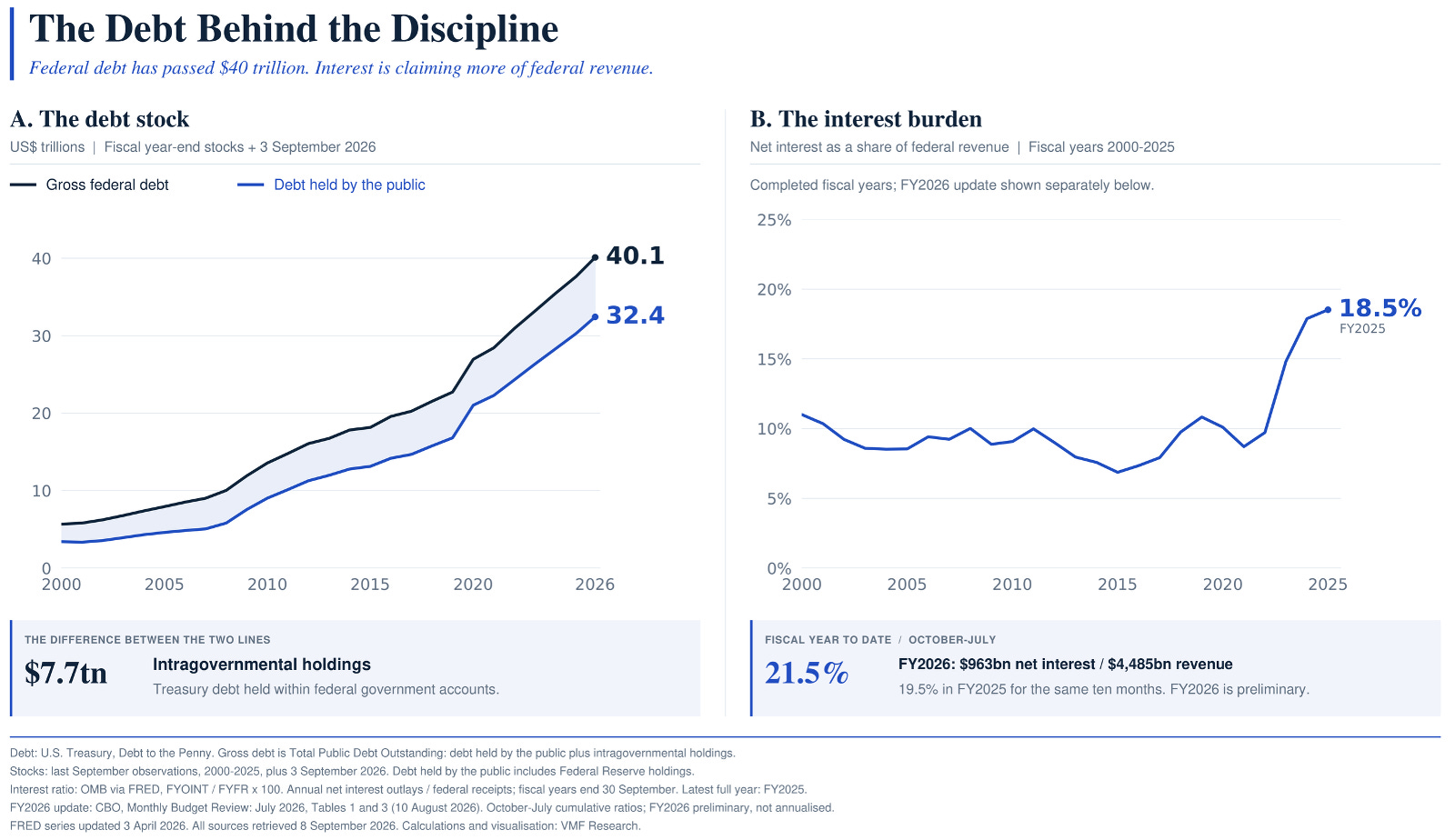
Alongside persistent deficits, the refinancing calendar keeps renewing the government’s need for willing lenders. Higher borrowing costs gradually become budget expenditure, competing with the priorities politicians would rather fund.
Warsh can ask for patience while monetary restraint works. The refinancing calendar does not pause.
The creditors arriving at those auctions are also changing.
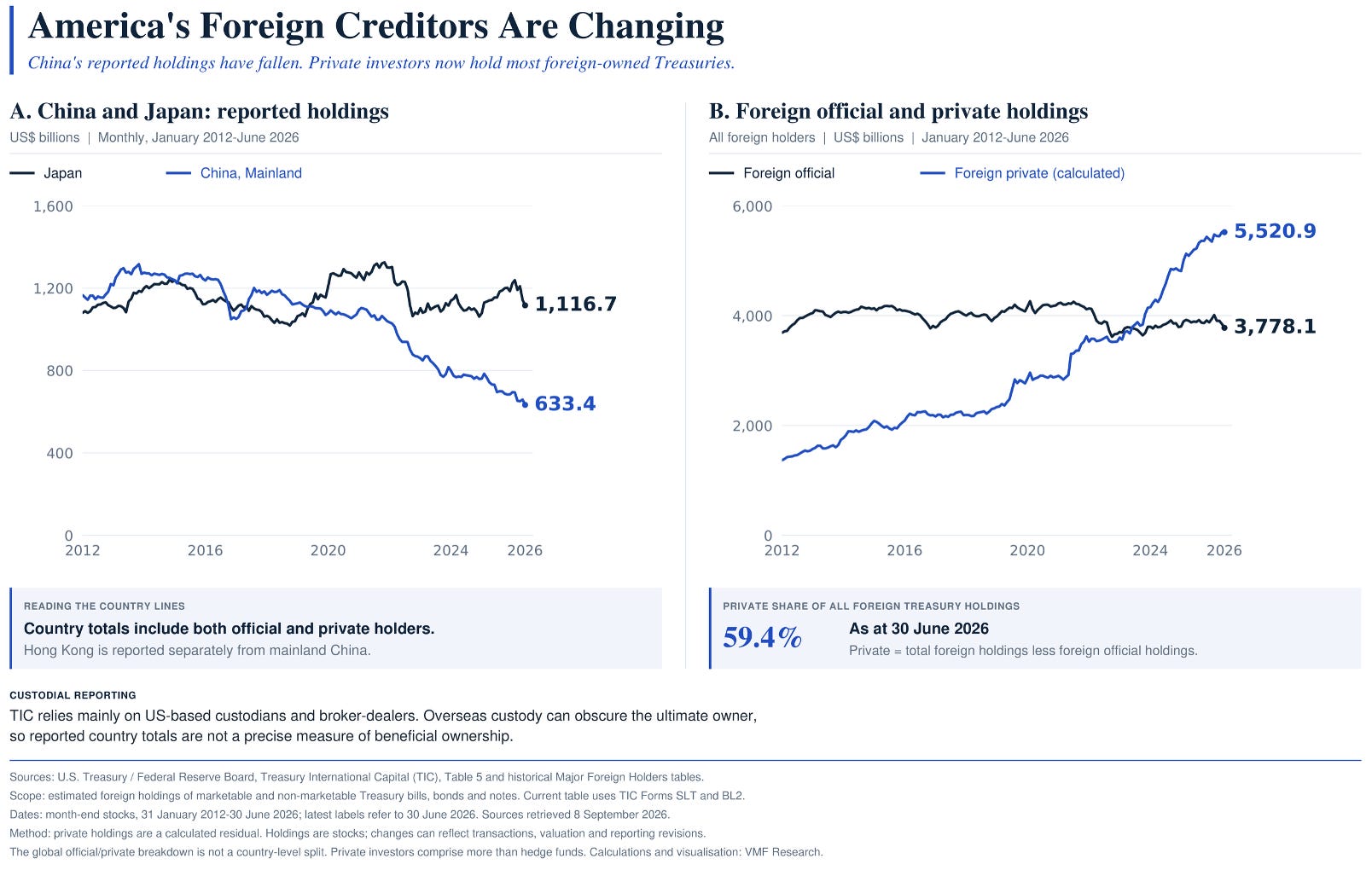
Over the year to June 2026, reported Treasury holdings in China and Japan declined, as did aggregate foreign official holdings. Total foreign holdings nevertheless rose from approximately $9.09 trillion to $9.30 trillion.
America continues to attract overseas capital but with a greater share of those holdings resting with private investors.
The terms on which that capital participates deserve attention.
For leveraged buyers, demand can depend on the cost and availability of their own financing. Washington’s access to funding can become entangled with its creditors’ access to funding, adding another channel through which pressure can spread.
Against this backdrop, we believe the hawkish interpretation of Warsh risks becoming too static.
A chairman dismissed as a Trump proxy risks having every rate cut interpreted as obedience. A chairman who has demonstrated independence has more room to argue that circumstances have changed. Establishing credibility now can increase his freedom to act later.
His determination to confront inflation can be sincere and still precede a forceful turn towards accommodation.
Our Dovish Shock thesis rests on that possibility.
We believe investors risk overestimating how long restraint can endure as refinancing costs feed through the system. If funding pressure broadens into credit and economic activity, we expect the Fed to turn more decisively than a simple extrapolation of Warsh’s present stance would suggest.
The potential surprise lies in the transition from establishing credibility to using it.
There are limits to this interpretation...
The Fed can support markets without cutting rates. That alone would not confirm the broader easing we expect. The test comes as America replaces maturing debt.
Buyers may remain willing, and borrowing costs may stay manageable. Therefore, if the Fed also keeps rates high through those refinancings, our thesis would weaken.
For now, we retain conviction in our Dovish Shock thesis. We do not dismiss every hawkish statement as theatre or expect every market setback to trigger a Fed rescue.
Our judgement concerns the constraints that may eventually change the monetary policy calculation:
Kevin Warsh is trying to restore authority to the price of money. His credibility will be tested by the consequences of allowing that price to adjust.
Scott Bessent faces those consequences on a more immediate timetable. He must keep finding buyers.
A subscription provides the full strategic asset allocation and model portfolio positioning for our Dovish Shock thesis, delivered when published, rather than requiring you to piece together our execution from market commentary weeks later.
Important Disclosure
This article contains general investment research produced by Vasco Marques de Freitas, CFA, CMT, Founder and CEO of VMF Research, Lda. It reproduces “A Hawk on Borrowed Time” from the September 2026 issue of VMF’s Strategic Asset Allocation. The underlying research was completed on 11 September 2026 at 4:00 p.m. Eastern Daylight Time and first disseminated to paid subscribers on 11 September 2026 at 9:00 p.m. Eastern Daylight Time. Charts and data retain their individually stated observation dates. Introductory commentary concerning subsequent policy developments was added for republication and should be distinguished from the original research.
The publication contains information recommending or suggesting an investment strategy. It is not personalised investment advice and does not consider any reader’s individual objectives, financial circumstances, knowledge, experience, liquidity requirements or tolerance for risk. References to the Tier One Model Portfolio concern an illustrative research portfolio, not client assets, transactions executed by VMF Research or the performance of an investable fund or managed account.
The analysis combines macroeconomic, monetary-policy, fixed-income and funding-market research within a medium- to long-term framework. Assessments of policy credibility, market signals, government refinancing and investor behaviour reflect VMF Research’s interpretations and conditional hypotheses, rather than official guidance or assurances. Views are reviewed through monthly publications, with weekly or ad hoc updates where material developments warrant reassessment.
Government bonds and other interest-rate-sensitive investments involve market, duration, inflation, liquidity and currency risks. Leveraged exposures introduce additional collateral, refinancing and forced-sale risks, even without deterioration in the underlying issuer’s creditworthiness. Historical relationships between borrowing costs, financial conditions and asset prices may change, and investors may lose some or all of their capital.
Neither VMF Research nor the author received compensation from any issuer, fund sponsor or other entity covered in connection with the preparation of the original research, and no covered entity reviewed, approved or amended its investment conclusions before first dissemination.
Past performance, Model Portfolio performance, historical market relationships and forward-looking scenarios are not reliable indicators of future results. Readers should conduct their own analysis and, where appropriate, consult an authorised financial intermediary or adviser before making an investment decision.