

Investors waiting for the Fed to blink may be watching the wrong building.
In The Hawk and the TACO Zone, we examined how rising borrowing costs could constrain Washington’s ambitions. The Treasury’s August decision to expand bond buybacks gave that argument a new chapter, and our Dovish Shock thesis another policy channel to watch.
Stanley Druckenmiller’s objection makes the story more interesting still. A government responding to pressure from its creditors may discover that the response itself changes what those creditors demand.
This excerpt was first published for paid Alpha Tier subscribers on 28 August 2026. It examines the policy developments behind that tension and their significance for the financial conditions we have been tracking for months.
The cross-asset analysis and Model Portfolio implications remain exclusive to subscribers, including the harder decision: whether improving evidence justified adding exposure or whether the market had already done enough of the work.
Good reading.
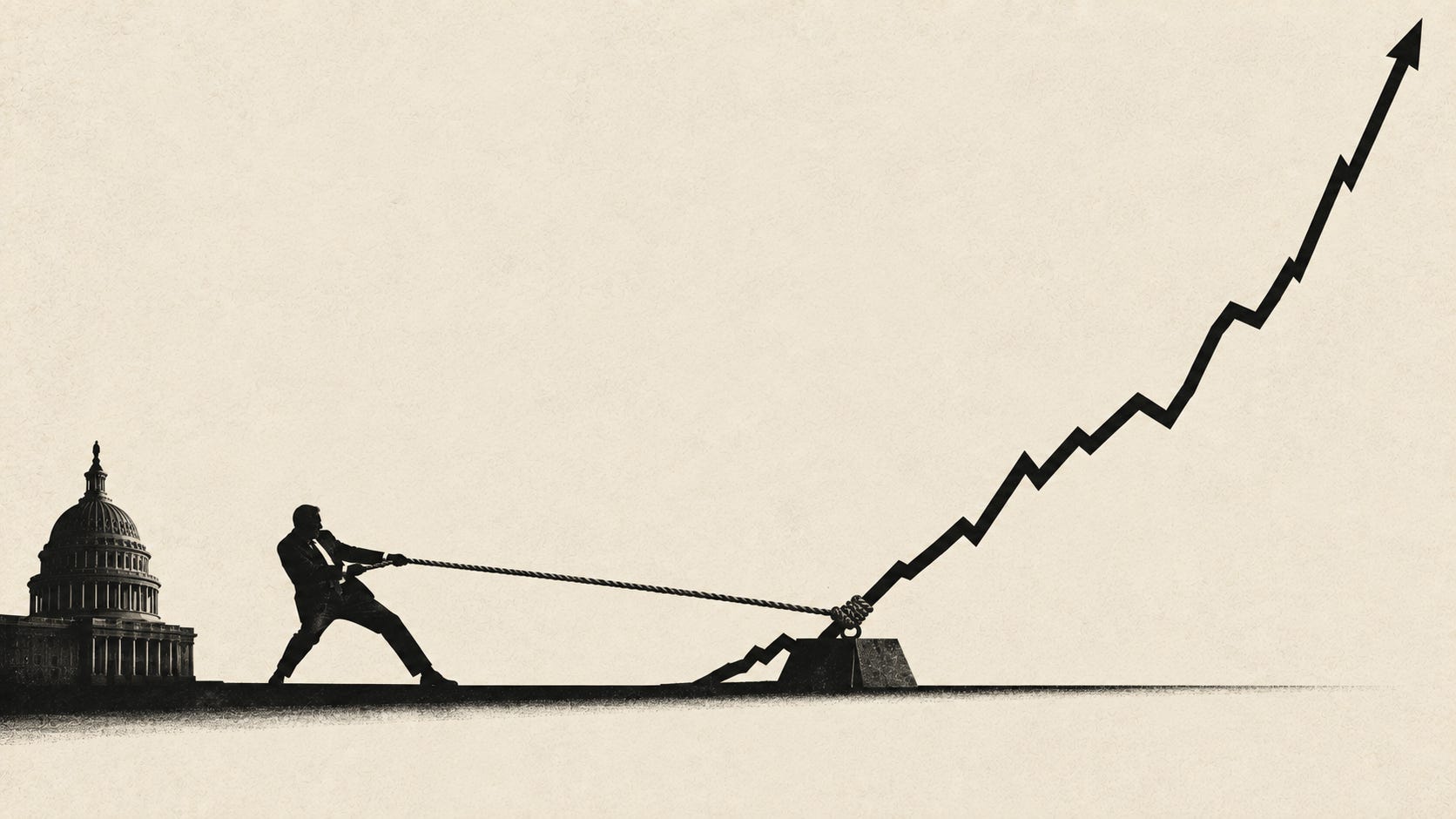
The long bond has been warning Washington for months.
We first introduced the TACO Zone earlier this year as shorthand for the point at which rising long-term Treasury yields cease to be merely a market price and begin to interfere with the political economy around them. Mortgage rates rise. Corporate financing becomes more expensive. Equity duration compresses. Interest expense accelerates. And an administration attempting to finance tax cuts, defence, industrial policy and an AI infrastructure boom discovers that the bond market has its own vote.
The exact level was never sacred.
But the behaviour around it was...
That is why we returned to the framework in August’s VMF’s Strategic Asset Allocation. The 30-year Treasury had again been pressing against the 5.10–5.20% region, and our conclusion was that the long end was becoming an increasingly important constraint on both fiscal and monetary freedom.
Then it pushed through.
On 19 August, the 30-year yield traded as high as roughly 5.34% intraday, close to levels last seen almost two decades ago. Treasury responded the same day. Beginning in September, liquidity-support buybacks in the 10-to-20-year and 20-to- 30-year sectors will rise from a maximum of $2 billion to at least $4 billion per operation. Treasury explicitly framed the change as additional support for liquidity in the long end.
We should take the Treasury at its word about the mechanics. This is not QE. It is not formal yield-curve control. Treasury has not announced a target for the 30- year yield, and Bessent has since confirmed that regular auctions, including long- dated issuance, will continue.
But the announcement answered the question we actually cared about.
The long bond produced a policy response.
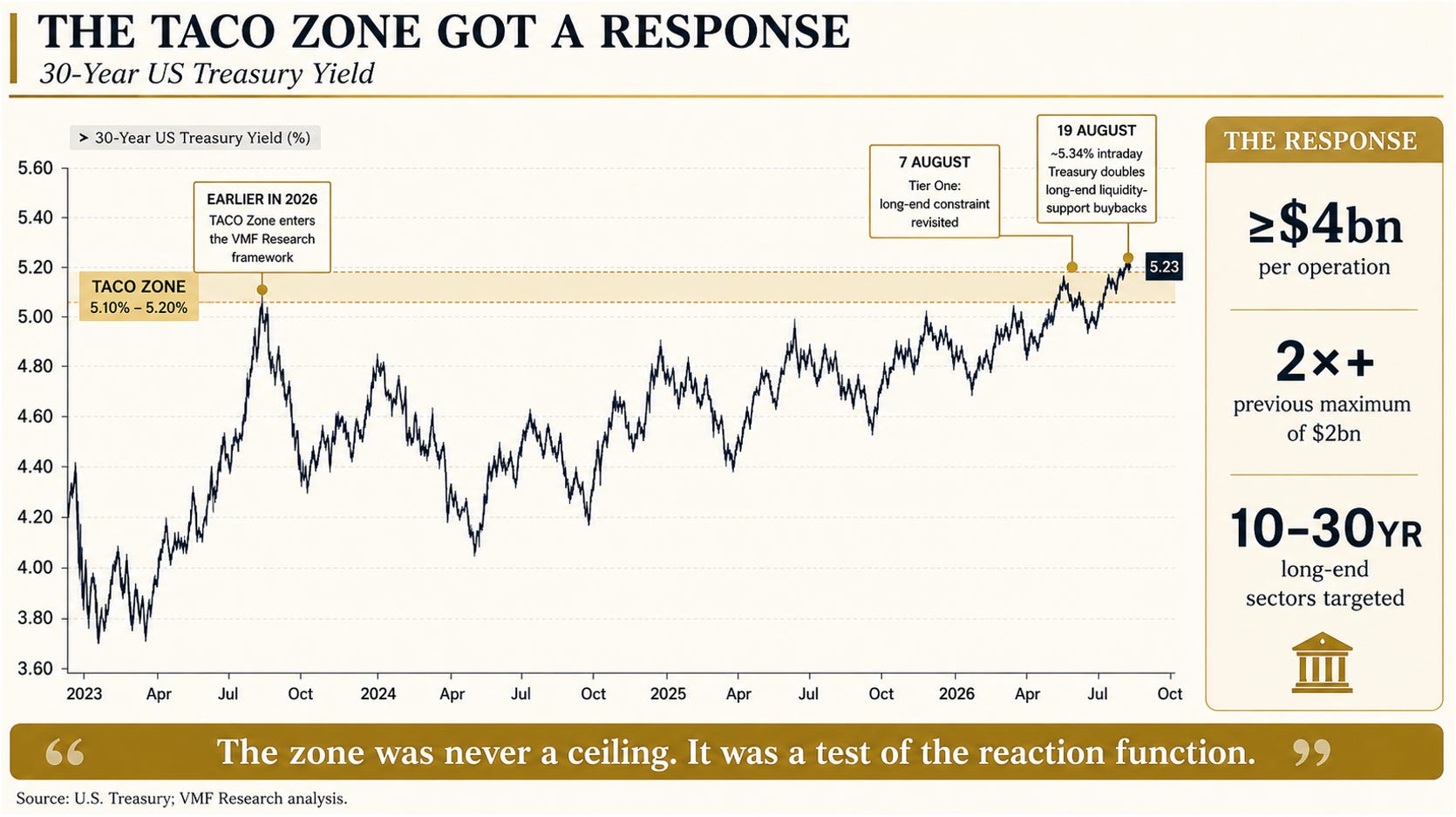
That is a more important development than whether $4 billion is large relative to a Treasury market measured in tens of trillions.
It is not.
But the signal is...
The market initially treated the announcement exactly as one would expect if the government had become less tolerant of rising long-term financing costs: long yields fell, the dollar weakened and both gold and Bitcoin moved higher.
For our Dovish Shock, that is significant.
We introduced the thesis because the market had reduced Kevin Warsh to a caricature: structurally hawkish, almost irrespective of the incoming data. Our argument was narrower and, we think, more useful. Warsh does not need to become a dove. He merely needs to deliver a policy path that is less restrictive than the path already embedded in asset prices.
That thesis has gained strength.
Not marginally.
Materially.
You might also like reading:

The reason is that the easing impulse we envisaged no longer depends entirely on Warsh. There is now a second actor... the Treasury.
And the Treasury controls something we have spent a considerable amount of time analysing in these pages: the Treasury General Account (TGA).
This brings us back to our 2025 work on Fed Net Liquidity.
Our shorthand has always been deliberately simple: Federal Reserve assets, less the TGA, less the overnight reverse-repo balance.
It is not an official Federal Reserve statistic. It is a way of tracking the major balance-sheet channels through which dollars are either available to the private financial system or absorbed from it.
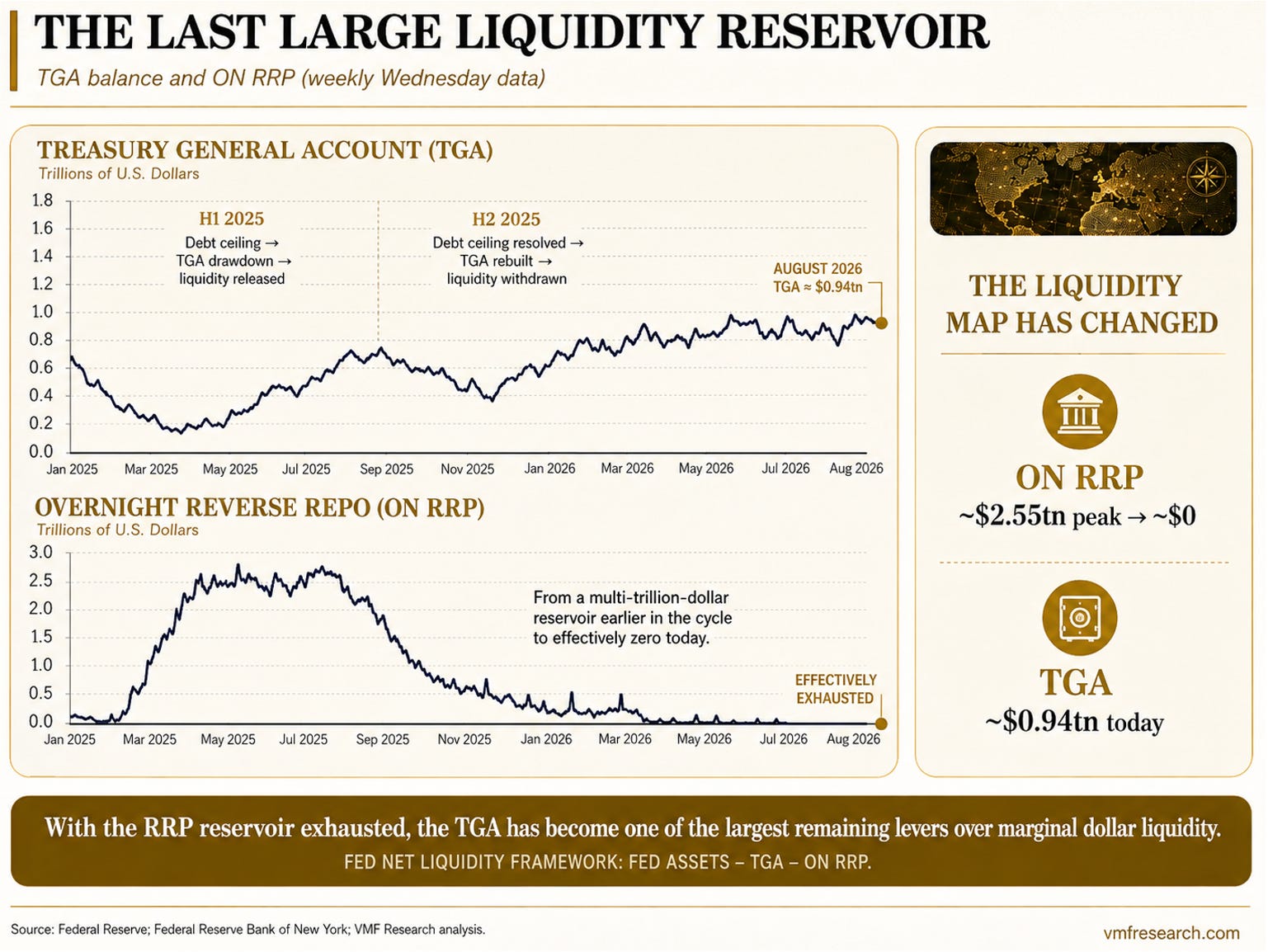
For several years, the reverse-repo facility acted as a huge liquidity reservoir. At its December 2022 peak, more than $2.5 trillion sat at the ON RRP facility. As Treasury issued bills and money-market funds migrated into them, that stock of cash was released back towards private markets and cushioned the liquidity effect of quantitative tightening.
That reservoir is now effectively empty.
On 21 August, domestic ON RRP usage was just $0.2 billion.
This changes the map.
There is no longer a multi-trillion-dollar RRP buffer capable of absorbing Treasury issuance while simultaneously releasing liquidity into the system. In this context, the TGA has become the dominant discretionary swing factor in our Net Liquidity framework.
And it is large.
The Treasury’s account at the Fed stood at approximately $936 billion on 19 August, after reaching roughly $970 billion in late July.
A dollar accumulated in the TGA is, all else equal, a dollar withdrawn from bank reserves. A dollar spent out of the TGA moves in the opposite direction.
This is not our interpretation of obscure financial plumbing. The New York Fed described precisely the same mechanism earlier this year when reviewing 2025: the debt-ceiling-driven TGA drawdown temporarily increased “system liquidity”, defined there as reserves plus ON RRP (the subsequent rebuilding of the account reversed that support).
We lived through that liquidity cycle in our Model Portfolios last year.
Now the lever is back in focus.
Bessent said this week that the enlarged TGA could be used to fund Treasury buybacks rather than requiring equivalent new short-term issuance. No amount has been committed, and we should not convert an available option into a forecast. But the fact that the Treasury Secretary is publicly discussing the TGA as a potential funding source changes the liquidity conversation.
A TGA drawdown would not be QE.
It would, however, release cash currently sitting idle at the Federal Reserve back into the financial system.
For markets, labels are less important than flows.
This is where our view has become more assertive.
When we first presented the Dovish Shock, we were describing an asymmetry. We are now beginning to observe the transmission mechanism.
Warsh remains the central monetary-policy variable. But the Administration is showing that it is unwilling to treat the long end as a passive spectator. The Treasury has increased buybacks precisely where pressure has been greatest.
Bessent has opened the possibility of using the TGA. The dollar has responded. Scarcity assets have responded. And the RRP buffer that obscured parts of the liquidity signal in previous years is no longer there.
The probability of our Dovish Shock has increased.
That does not mean its path will be clean.
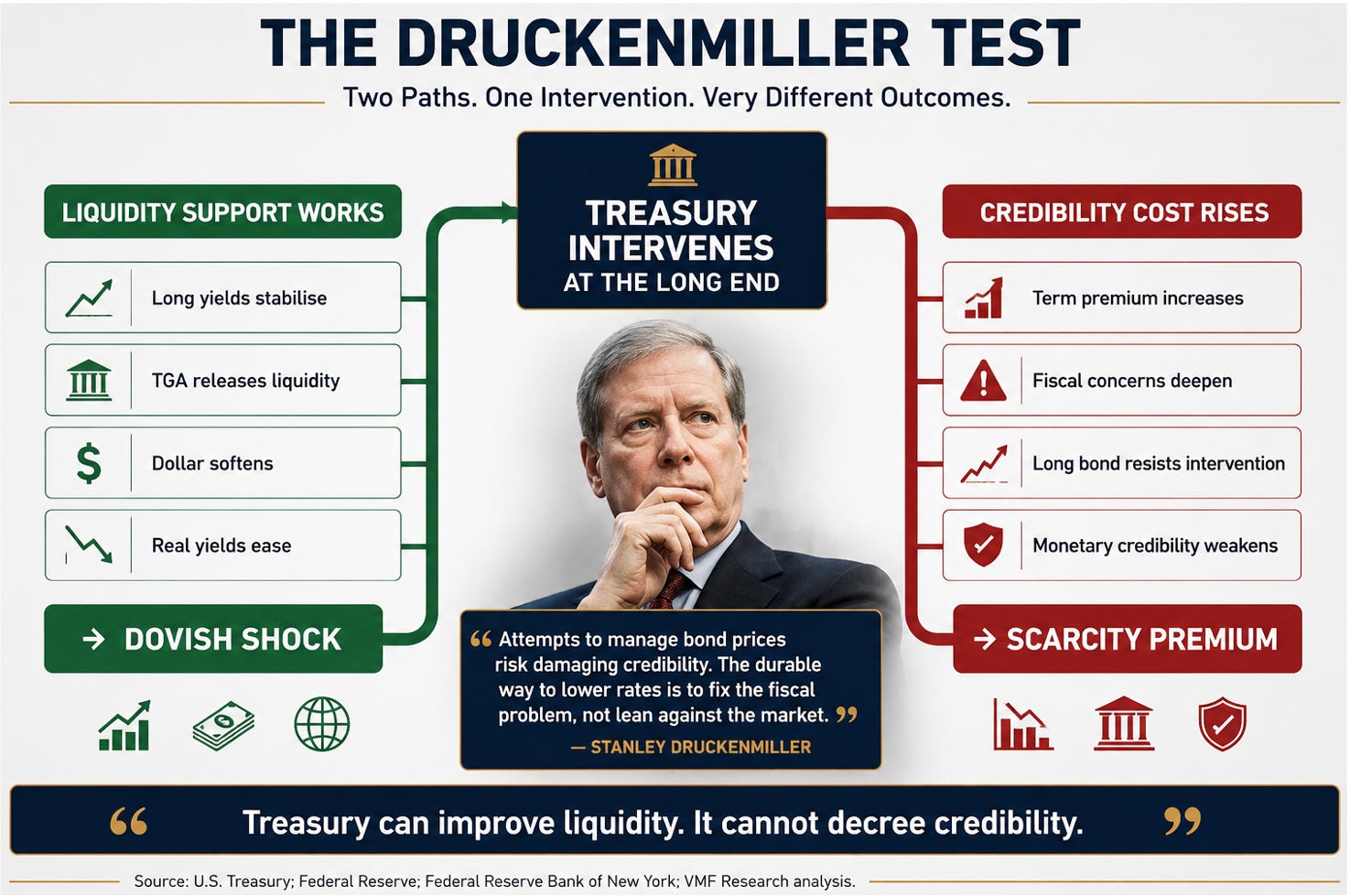
Stanley Druckenmiller has just articulated the strongest argument against what Treasury is doing, and it deserves considerably more attention than a footnote. Druckenmiller called the expansion of long-end buybacks a “mistake” that risks costing the United States credibility in its own bond market. His objection is not primarily about $4 billion.
It is about precedent.
Once the Treasury begins responding to an inconvenient bond price, how does the market distinguish liquidity management from price management?
And if 5.3% is uncomfortable enough to produce larger purchases, what happens at 5.5%?
Or 6%?
Does $4 billion become $8 billion?
Does the maturity range widen?
Does the TGA become a recurring source of intervention?
Druckenmiller’s warning is that the Treasury market’s greatest asset is precisely the thing that cannot be manufactured through buybacks: confidence that price discovery remains credible. He argues that the durable way to lower long-term rates is to address the primary deficit, not to lean against the market that is pricing it.
That criticism carries unusual weight.
Druckenmiller is not an academic observing the bond market from a distance. He built one of the great macro investing records by treating currencies, rates and liquidity as parts of the same system. He also knows both Bessent and Warsh personally and professionally. When someone with that background warns that a tactical liquidity measure risks becoming a credibility problem, we should listen.
But his objection does not weaken our Dovish Shock thesis.
It sharpens it.
There are now two possible paths.
The benign version is the one markets initially embraced: Treasury improves long-end functioning, Warsh proves less restrictive than expected, the TGA releases liquidity, real yields soften and the dollar loses support.
The more dangerous version is that investors conclude Washington has become too sensitive to bond prices, forcing a larger fiscal premium into the long end.
Those paths are very different for duration.
They are not necessarily as different for monetary scarcity.
Gold can benefit from easier liquidity. It can also benefit from declining confidence in sovereign financial discipline. Bitcoin and Ethereum are less directly exposed to real yields than gold, but more sensitive to the liquidity, dollar and risk-appetite consequences that often accompany changes in them. That is one reason we refuse to treat all of our Alternatives positions as the same trade.
That distinction will become central in the next section.
There is one final reason the current setup deserves our attention: the Dovish Shock never required an emergency easing cycle. That remains one of the most misunderstood parts of the thesis. A market positioned for hawkish policy can reprice violently when it receives less hawkishness, even if the absolute stance of policy remains restrictive.
The same logic now extends beyond the Fed.
Treasury does not need to cap the 30-year yield.
The TGA does not need to fall by $500 billion.
Warsh does not need to slash rates.
A series of smaller changes can point in the same direction:
less pressure from the policy rate;
more support at the long end;
a declining TGA;
lower real yields;
a softer dollar;
and a turn in liquidity.
The ingredients are no longer hypothetical. Some are already beginning to appear. That is why we are more confident in the Dovish Shock today than we were when we first published it.
And markets that are particularly sensitive to those ingredients have begun behaving accordingly. The question now is whether those moves are merely confirming what we already own… or whether the evidence has become strong enough to justify a change in positioning.
Important Disclosure
This article contains general investment research produced by Vasco Marques de Freitas, CFA, CMT, Founder and CEO of VMF Research, Lda. It reproduces “The Treasury Just Blinked” from the August 2026 issue of Alpha Tier. The underlying research, charts and Model Portfolio references are stated as of 28 August 2026, 4:00 p.m. Eastern Daylight Time, unless another date is expressly identified.
The publication contains information recommending or suggesting an investment strategy. It is not personalised investment advice and does not consider any reader’s individual objectives, financial circumstances, knowledge, experience, liquidity requirements or tolerance for risk. The Alpha Tier Model Portfolio is an illustrative research portfolio and does not represent client assets, transactions executed by VMF Research or the performance of an investable fund or managed account. The analysis combines macroeconomic, monetary-policy, fixed-income, liquidity and balance-sheet research within a medium- to long-term framework. The Dovish Shock and TACO Zone are conditional analytical frameworks, not assurances of particular policy or market outcomes. The TACO Zone does not represent a permanent yield threshold. Net Liquidity is an analytical proxy used by VMF Research, not an official Federal Reserve measure. Views are reviewed through monthly publications, with weekly or ad hoc updates where appropriate.
Treasuries, precious metals, cryptoassets and related financial instruments carry differing market, interest-rate, currency, liquidity, custody and counterparty risks. Cryptoassets also involve substantial technological, cybersecurity and regulatory risks. Exchange-traded products introduce product-specific dependencies that differ from direct ownership of the underlying asset. Investors may incur substantial losses, and policy intervention does not provide capital protection.
Disclosure of Interests: as of the research cut-off, legal entities controlled by Vasco Marques de Freitas held long positions in listed exchange-traded products providing economic exposure to Bitcoin and Ether, both discussed in this article. These holdings may benefit from increases in the value of the underlying assets and constitute financial interests and potential conflicts of interest. Readers should consider them when evaluating the analysis. Their existence does not validate its conclusions, reduce investment risk or imply suitability for any reader.
Neither VMF Research nor the author received compensation from any issuer covered in connection with the preparation of the original research, and no issuer reviewed, approved or amended its investment conclusions before first dissemination. Past performance, Model Portfolio performance, historical market relationships and forward-looking scenarios are not reliable indicators of future results. Readers should conduct their own analysis and, where appropriate, consult an authorised financial intermediary or adviser before making an investment decision.