

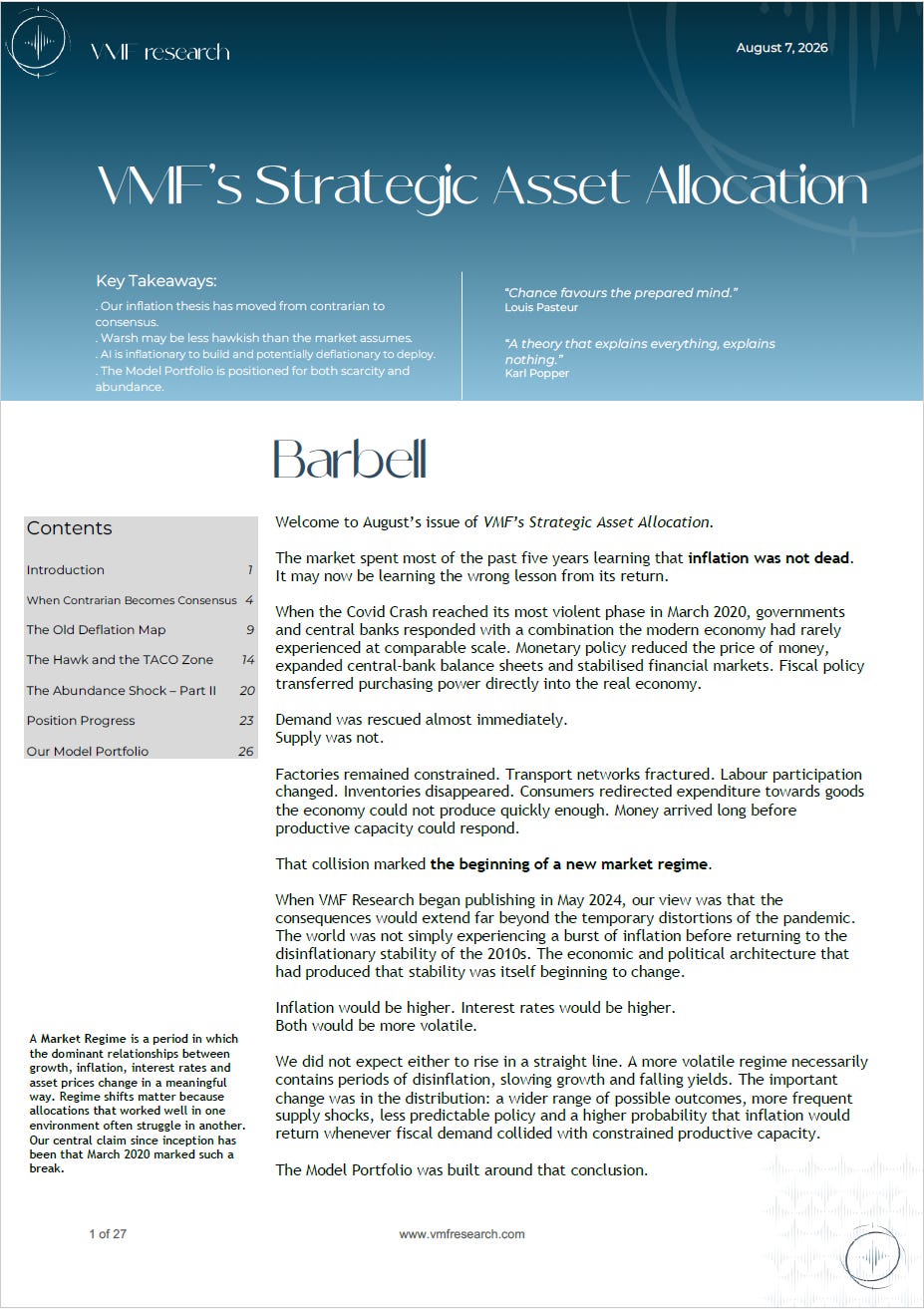
Four months ago, we published an article with a deliberately provocative premise:
Artificial intelligence is beginning to compress the cost of cognition itself.
That was The Abundance Shock.

The argument was never that everything was about to become cheap. Quite the opposite. We suspected that as useful intelligence became easier to reproduce, the economic value of the things that remained difficult to reproduce would rise: proprietary data, trusted distribution, intellectual property, embedded workflows, electricity, infrastructure and the physical bottlenecks required to make the whole system work.
Much of the research we have published since then has been an attempt to follow that idea downstream.
The early AI boom rewarded scarcity. Advanced processors, high-bandwidth memory, data-centre capacity and power were difficult to expand quickly, and the companies controlling those bottlenecks captured the economics.
Then the evidence began to shift.
In The China AI Reset, the important development was not another record-setting frontier model. It was evidence that increasingly capable intelligence could be delivered at radically lower prices.
Most businesses do not need the smartest system in existence. They need one capable of completing a valuable task reliably, securely and cheaply enough to leave room for an economic return. That is a much larger market.
From there, the thesis naturally moved towards the application layer.
If intelligence gets cheaper, value begins to migrate towards companies that already control customers, proprietary information, distribution and workflows.
The Boom Changes Owners pushed that argument further.
The Intelligence Dividend, The Discovery Machine and The Royalty Engine followed it into healthcare and biotechnology, where better intelligence can be especially valuable because the cost of a bad decision is so high.
And The Fuel Beneath the Boom brought us back to the physical world. Intelligence may be getting cheaper, but producing and deploying it requires staggering amounts of electricity, compute and infrastructure.
That is why we have never viewed abundance and scarcity as competing investment narratives.
They increasingly feed one another.
Which brings us to Part II.
Until now, most of our work on the Abundance Shock has asked an investment question:
Where does value migrate when intelligence gets cheaper?
August’s VMF’s Strategic Asset Allocation asks a much bigger one.
What happens to the economy if it gets cheap enough?
Human cognitive time sits inside almost every business. Companies pay people to analyse information, write software, review contracts, forecast demand, communicate with customers, conduct research, organise processes and make decisions. Historically, increasing the amount of that work required more skilled labour and more hours.
Machine intelligence changes that constraint.
And the relevant price is not the cost of a token.
It is the cost of completing a useful piece of work.
As capability improves and that cost falls, tasks that were previously uneconomic to automate begin crossing into commercial viability. Companies stop using AI merely as an assistant and start redesigning entire workflows around what it can do.
That is where the Abundance Shock stops being just a technology thesis.
It becomes a macroeconomic one.
VMF Research has argued since inception that the post-2020 world would be characterised by higher and more volatile inflation because nominal demand increasingly collides with constrained productive capacity. Fiscal activism, deglobalisation, defence spending, energy security and reindustrialisation all reinforce that framework.
The Abundance Shock is the first force we have encountered that could seriously push against it from the supply side.
Cathie Wood frames that possibility at the macro level: productivity rising fast enough to push unit costs lower even while economic activity accelerates. Marc Andreessen approaches it through consumer surplus: enormous value may accrue to companies and consumers without appearing neatly in conventional revenue or inflation statistics. Vinod Khosla focuses on perhaps the most consequential transmission mechanism of all: making scarce expertise far more abundant across healthcare, education, law, engineering and other labour-intensive services.
That is a serious idea.
It is not yet a proven one.
The productivity data are encouraging but noisy. General-purpose technologies often require years of organisational redesign before their full benefits appear. Measurement may itself be struggling to keep pace. And cheaper intelligence could create so much new demand that spending on compute, electricity and infrastructure continues rising even while the cost of individual tasks falls.
So we are not abandoning the inflation framework that has guided VMF Research.
We are stress-testing it.
The same AI buildout currently adding to demand for electricity, semiconductors, capital and construction may eventually expand productive capacity enough to ease the inflation pressure it helped create.
That possibility also sits directly beside our Dovish Shock thesis.
If productivity improves, unit labour costs weaken and underlying inflation moderates without a collapse in growth, Kevin Warsh would face a very different economy from the one investors have spent months preparing for.
That is what makes The Abundance Shock – Part II so important to us.
The original article asked what becomes scarce when intelligence becomes abundant.
This one asks whether abundance can become large enough to affect the price level, the labour market and the Federal Reserve itself.
The excerpt below was first published for paid Tier One subscribers on 7 August 2026. It examines the arguments of Wood, Andreessen and Khosla, the early productivity evidence and the reasons we now regard this thesis as a serious challenge to the macro framework that has guided VMF Research since inception.
We started by asking where the value would go if intelligence became cheap.
Now the more important question may be:
What if intelligence becomes cheap enough to change the economy around it?
Good reading.
That productivity test is critical because the first stage of the AI cycle has been unmistakably inflationary.
Data centres require semiconductors, memory, cooling systems, land, construction workers and vast quantities of dependable electricity. The capital committed to building that infrastructure competes with defence, energy security, reindustrialisation and other Fourth Turning priorities for many of the same scarce resources.
That is the part of the cycle the market can already see. The harder question is what happens when the intelligence produced by that infrastructure begins spreading through the rest of the economy.
This is the Abundance Shock we have been writing about for some time: the possibility that increasingly capable and inexpensive machine intelligence transforms cognition from a scarce economic resource into something available in almost unlimited quantities.
Intelligence is embedded in nearly every commercial activity. Businesses must interpret data, write software, evaluate contracts, communicate with customers, forecast demand, perform research, organise processes and allocate capital. Historically, most of that work required human time... an expensive input that is difficult to scale and constrained by the number of hours available.
AI changes the economics of that input. It does not need to match the world’s best expert across every discipline to matter. It needs to perform a sufficiently valuable task, with adequate reliability, at a cost materially below the existing alternative.
That threshold is already moving rapidly.
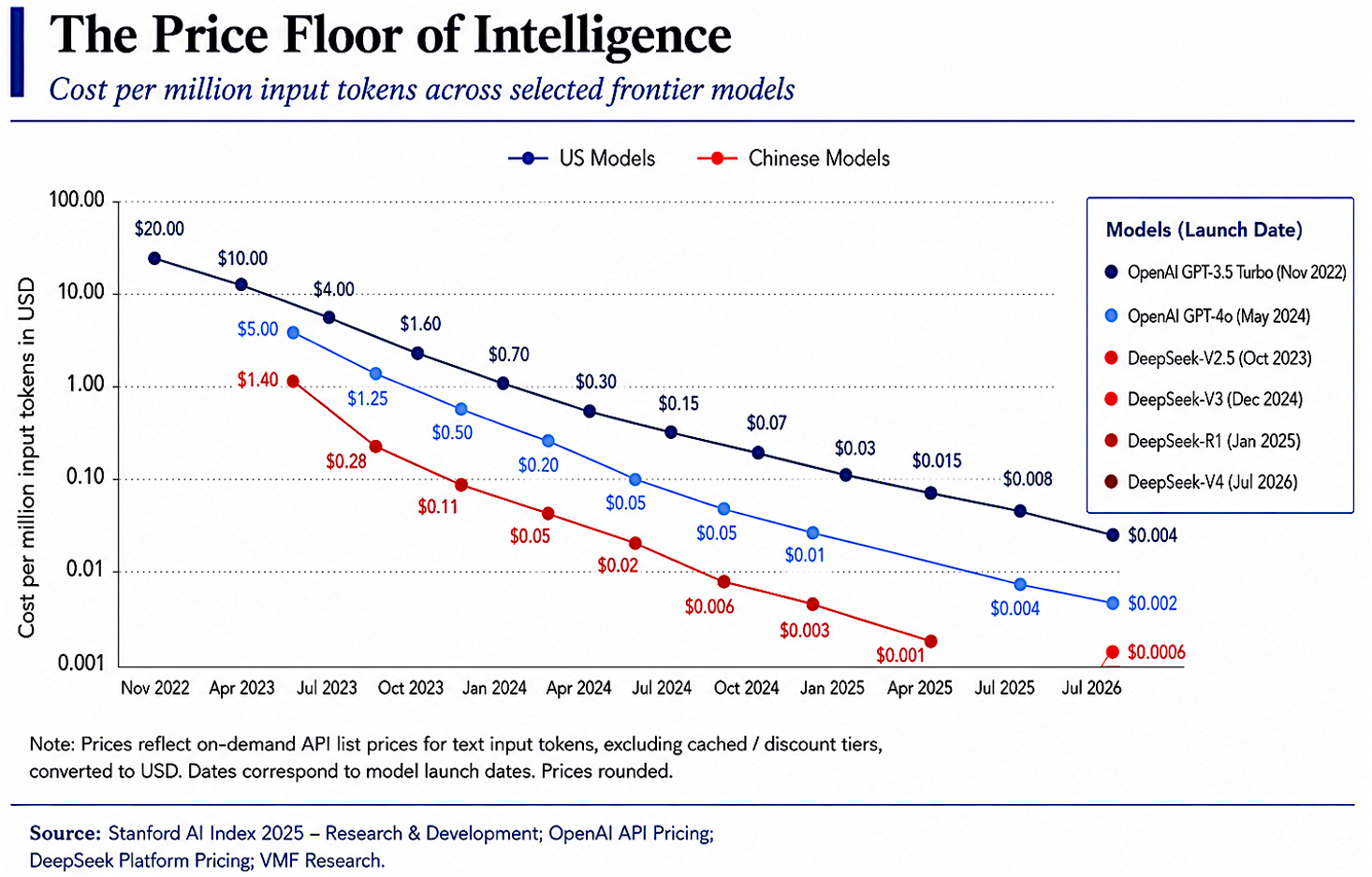
Stanford’s AI Index found that the cost of obtaining roughly GPT-3.5-level performance fell more than 280-fold between late 2022 and late 2024.
Since then, the price war has intensified, particularly as increasingly capable Chinese models have entered the market at dramatically lower price points. The precise comparisons vary by capability, token mix and usage pattern, but the direction is unmistakable: increasingly capable machine intelligence is becoming cheaper at extraordinary speed.
The important metric, however, is not the price of a token. It is the cost of completing a unit of economically useful work. A cheaper model can still prove expensive if it requires repeated attempts, extensive supervision or costly correction. But as capability improves alongside price, activities that were previously too expensive to automate become commercially viable. The cost of intelligence falls, the number of economically rational applications expands and companies begin redesigning complete workflows around what the technology can do.
This is where the Abundance Shock begins to challenge our original inflation framework. That framework argued that money and nominal demand were expanding faster than the economy’s physical capacity to respond. The AI countercase is that productive capacity itself may now begin expanding faster than conventional models assume.
Cathie Wood has made the most explicit macroeconomic version of this argument. She believes the market is positioned for stagflation when it should instead be preparing for a productivity-led deflationary boom. In her framework, artificial intelligence, robotics, energy storage, blockchain technology and biological innovation reinforce one another, driving unit costs lower even as real economic activity accelerates. She has gone as far as to argue that inflation could turn negative, allowing Kevin Warsh to reduce rates into economic strength rather than in response to recession.
Some of Wood’s numerical forecasts are deliberately aggressive. Productivity growth of 4–6% would represent an historic departure from the experience of recent decades, while her preferred real-time inflation measures are not directly comparable with the official indices used by the Federal Reserve.
We should treat that outcome as a scenario, not as established fact. But the mechanism is compelling. When output per worker rises faster, wages can increase without generating the same pressure on unit labour costs. Companies can produce more while employing proportionately fewer additional resources. The productivity dividend can then be distributed through some combination of higher margins, greater investment, better compensation and lower prices.
Marc Andreessen approaches the same issue from the company and consumer level. His focus is consumer surplus: the value created when a product or service becomes vastly more useful or affordable without a proportionate increase in what the customer pays. Andreessen argues that much of AI’s ultimate economic value may accrue not to the model providers themselves, but to the businesses and consumers using inexpensive intelligence to accomplish tasks that were previously costly, slow or impossible.
This matters because conventional accounting may capture only a fraction of the benefit.
If an AI system allows a small company to perform research that once required a large analytical department, the economic gain is real even when no new revenue category appears in the national accounts. If software improves dramatically while its price remains unchanged, measured inflation may fail to capture the quality adjustment. If an AI assistant saves an individual several hours each week without charging for each hour saved, much of the value appears as time and consumer surplus rather than recorded output.
Vinod Khosla extends the argument into the part of the economy where it could become most consequential: services. The great disinflationary achievements of globalisation were concentrated largely in manufactured goods. Services remained dependent on local labour, professional qualifications and the limited supply of human expertise. Healthcare, education, law, finance and other knowledge-intensive activities therefore continued becoming more expensive even as electronics, clothing and many physical products became cheaper.
Khosla believes AI can begin reversing that pattern by making expert-level knowledge available at extremely low marginal cost. A doctor supported by specialised AI systems may serve more patients. A teacher assisted by an adaptive tutor may provide more individualised instruction. An engineer may test more designs. A research team may evaluate more hypotheses. A small business may gain capabilities that previously belonged only to a large institution.
The professional does not need to disappear for supply to expand.
The human bottleneck merely needs to become less binding.
Together, Wood, Andreessen and Khosla describe three layers of the same potential shock. Wood describes the macroeconomic outcome: higher productivity and lower inflation. Andreessen explains the economic mechanism: falling costs and expanding consumer surplus. Khosla identifies the crucial transmission channel: making scarce expertise abundant inside the service economy.
That combination could become powerfully disinflationary. It could even produce outright deflation in the products, services and business models most directly exposed to collapsing intelligence costs.
But we should remain precise.
A fall in the price of software, analysis or administrative work is not the same as a sustained decline in the general price level. Housing, energy, infrastructure, commodities and many forms of physical labour remain constrained. Fiscal spending may absorb part of the new productive capacity. Cheaper intelligence may create so much additional demand that total spending on AI, compute and electricity continues rising even as the cost of each task falls.
AI can therefore be deflationary at the task level, disinflationary inside individual businesses and still fail to produce outright economy-wide deflation.
The best current evidence lies in productivity and unit labour costs.
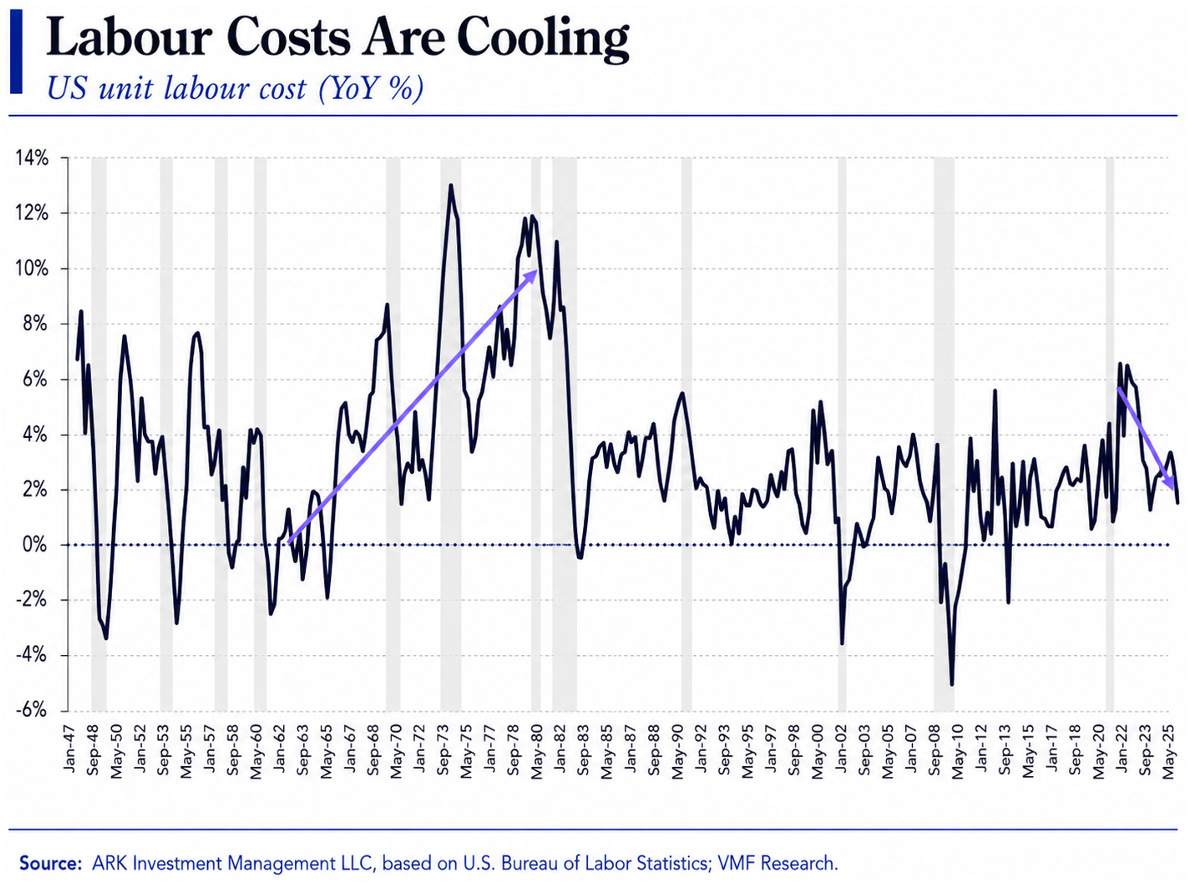
The preliminary second-quarter data released today show US non-farm business productivity increasing at a 1.4% annualised rate and 2.2% from a year earlier. Unit labour costs rose only 1.4% over the same four-quarter period. Since the end of 2019, productivity has grown at an annualised rate of 2.1%, compared with 1.5% during the preceding business cycle.
The Federal Reserve has noticed. Its July Monetary Policy Report described productivity growth as strong and concluded that current wage growth, when considered alongside productivity, was roughly consistent with 2% inflation over time. The Fed also judged that AI’s aggregate contribution remains modest so far, suggesting that much of the potential Intelligence Dividend may still lie ahead.
Encouraging does not mean conclusive.
Productivity is real output divided by hours worked, and both sides of that calculation are estimated and repeatedly revised. Today’s release revised first-quarter productivity higher by half a percentage point. Total factor productivity is even more elusive because it is not directly observed; it is the residual left after statisticians estimate the contributions of labour and capital.
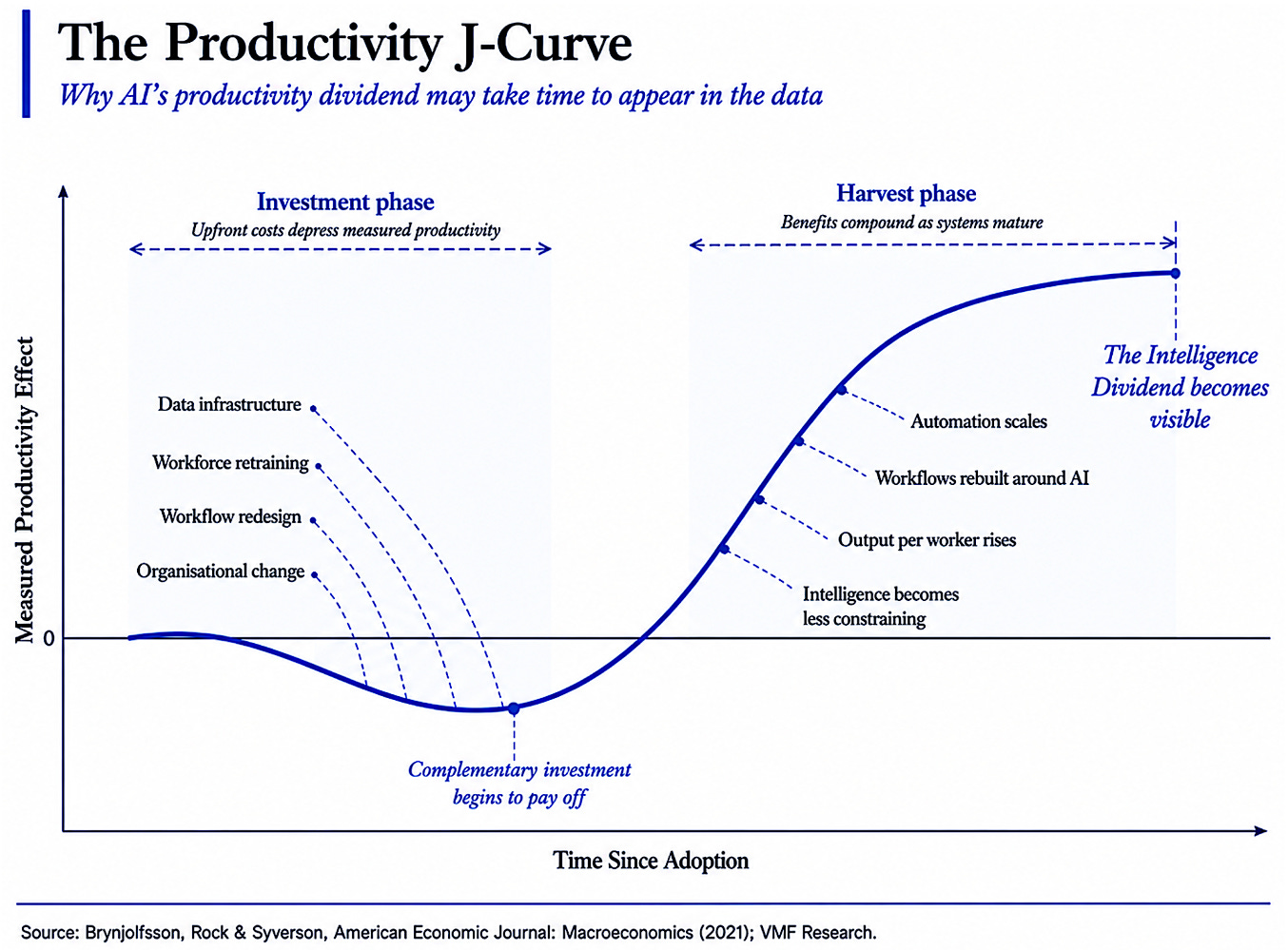
AI may also remain hidden in the data for longer than investors expect. General-purpose technologies require companies to redesign processes, retrain workers, improve data and develop entirely new organisational structures. Those complementary investments impose costs before their benefits appear. Economists Erik Brynjolfsson, Daniel Rock and Chad Syverson describe this as the Productivity J-Curve: measured productivity can initially disappoint while organisations build the intangible capital needed to use the technology, then accelerate later as those investments begin paying off.
Measurement itself may also be falling behind the economy. The Bureau of Economic Analysis is developing new statistics for AI-related production and has found that treating internally created data as a capital asset would increase the estimated contribution of IT-related capital to US growth by roughly one-third between 2002 and 2024.
The absence of an obvious AI boom in today’s aggregate productivity figures would therefore not disprove the thesis.
But neither should every favourable productivity release be attributed to AI.
Business formation, capital deepening, labour-market composition, remote work and post-pandemic reorganisation may all be contributing. The signal will emerge gradually and probably unevenly across industries.
That is why we will monitor more than one number.
We will watch productivity over rolling four-quarter periods, unit labour costs, wage growth relative to output per hour, the price of completing real AI tasks, adoption inside commercial workflows and inflation across the service categories most exposed to machine intelligence. We will also examine where the benefit is going: towards lower consumer prices, higher corporate margins, increased wages or another wave of capital expenditure.
The Abundance Shock is not yet strong enough to overturn our original Market View.
The structural forces behind higher and more volatile inflation remain in place. The physical construction of the AI economy is reinforcing several of them. But the technology being built with those scarce resources may become the most powerful positive supply shock of our generation.
That possibility represents a genuine test of the framework that has guided VMF Research since its inception... and we will treat it accordingly.
We will monitor the evidence relentlessly, search actively for what could prove us wrong and watch these trends like hawks, pun very much intended.
Whether the Abundance Shock already justifies a change to the Model Portfolio is the question we address next.
You might also like reading Part I
Important Disclosure
This article contains general investment research produced by Vasco Marques de Freitas, CFA, CMT, Founder and CEO of VMF Research, Lda. It reproduces an excerpt from the August 2026 issue of VMF’s Strategic Asset Allocation. The research, views and Tier One Model Portfolio information are stated as of 7 August 2026, 4:00 p.m. Eastern Daylight Time, unless another date is expressly identified. The original issue was first disseminated to paid subscribers on 7 August 2026 at 9:00 p.m. Eastern Daylight Time.
The publication contains information recommending or suggesting an investment strategy. It is not personalised investment advice and does not consider any reader’s individual objectives, financial circumstances, knowledge, experience, liquidity requirements or tolerance for risk. The Tier One Model Portfolio is an illustrative research portfolio designed to communicate VMF Research’s strategic asset-allocation framework, Market View and investment conclusions. It does not represent client assets, transactions executed by VMF Research or the performance of an investable fund or managed account.
The analysis combines macroeconomic, technological, monetary-policy, labour-market and strategic asset-allocation research within a medium- to long-term framework. Statements concerning artificial intelligence, productivity, unit labour costs, consumer surplus, the future cost of economically useful intelligence, disinflation, deflation and the potential effects of technological adoption on economic growth and Federal Reserve policy are analytical judgments and conditional hypotheses rather than assurances.
References to Cathie Wood, Marc Andreessen and Vinod Khosla describe and interpret views relevant to the economic scenarios considered in the research. They should not be understood as implying any affiliation with, endorsement by or participation of those individuals or their organisations in VMF Research’s analysis.
The economic effects of artificial intelligence remain highly uncertain. Falling model or inference costs may not translate into equivalent reductions in the cost of completing economically useful work. Adoption may require substantial additional investment, organisational redesign, data infrastructure and human supervision. Productivity gains may arrive later or prove smaller than anticipated, while growing demand for semiconductors, electricity, data centres and other physical infrastructure may offset part of any disinflationary effect. Improvements in productivity may also be driven by factors unrelated to artificial intelligence, and official economic data are subject to estimation error and revision.
Neither VMF Research nor the author received compensation from any individual, issuer, fund sponsor or other entity covered in connection with the preparation of this research, and no covered entity reviewed, approved or amended its investment conclusions before first dissemination.
Past performance, Model Portfolio performance, historical economic relationships and forward-looking scenarios are not reliable indicators of future results. Readers should conduct their own analysis and, where appropriate, consult an authorised financial intermediary or adviser before making an investment decision.