

Lacy Hunt changing his mind deserves more attention than another hot CPI print.
For decades, Hunt was one of the clearest advocates of the secular deflation case. His framework was simple but powerful: excessive debt eventually drags on economic activity. More income is diverted towards servicing past borrowing, each additional dollar of credit produces less growth, money velocity falls and inflation weakens.
For a long time, the evidence was on his side.
After 2008, central-bank balance sheets exploded, government debt kept climbing and economists repeatedly warned that inflation was around the corner. Yet consumer-price pressure remained subdued, growth disappointed and long-dated Treasury yields continued their forty-year decline.
Hunt understood something many others did not. Creating liquidity was not the same as creating spending.
What makes his latest work so interesting is that he has not suddenly decided debt no longer matters. He has gone back and asked why the old relationship between debt, growth and inflation worked so reliably for so long.
His answer will sound familiar to regular readers of VMF Research.
The debt supercycle coincided with an extraordinarily benign supply environment. China was integrating into the global economy. Hundreds of millions of workers joined the global labour pool. Production moved towards lower-cost locations. Supply chains became ruthlessly efficient. Energy was cheap, capital plentiful and globalisation continuously expanded the economy’s ability to meet demand.
Debt restrained spending while supply kept getting easier to expand.
That combination helped produce the disinflationary world Hunt spent decades describing.
It is no longer the world we live in.
Today, commercial efficiency increasingly takes second place to national security. Governments want domestic semiconductor capacity, stronger electricity grids, more defence production, strategic inventories and less dependence on geopolitical rivals. Capital is being demanded simultaneously by defence, energy, AI, reindustrialisation and infrastructure.
These are exactly the forces behind the higher-and-more-volatile inflation regime we have written about since VMF Research began publishing in May 2024 (and, frankly, the framework through which we had already been looking at markets well before then).
Hunt has now travelled a long way in the same direction.
He believes the long-run US inflation range may have shifted materially higher and that interest rates are likely to become much more volatile than during the great disinflation. For someone whose name became almost synonymous with debt-driven deflation, that is a meaningful change of view.
And this is where things become more interesting for us.
There is little value in spending the next five years repeating a thesis the rest of the market has finally learned.
When we launched VMF Research, the idea that inflation, interest rates and policy volatility were moving into a structurally higher range still sat well outside the comfortable post-2008 consensus. Today, fiscal dominance, deglobalisation, industrial policy, energy security and capital scarcity are standard macro vocabulary.
Even Lacy Hunt is now looking through much the same lens.
So what are we supposed to see that the market does not?
His own work provides part of the answer.
Hunt may have revised his secular view, but he has not discarded the cyclical mechanisms that made him such an effective deflationist. An oil shock can lift headline inflation and long-term yields, then weaken household purchasing power, corporate margins and employment badly enough to suppress demand. Monetary restraint still matters. Credit stress still matters. Leverage still matters.
And there is another force worth taking seriously: productivity.
Artificial intelligence is currently consuming enormous amounts of capital, electricity, semiconductors and construction capacity. From that angle, it fits perfectly inside the inflationary regime.
But we are not building data centres for the pleasure of owning data centres.
We are building them because the intelligence they produce may eventually allow businesses to do more with less labour, less time and lower marginal cost.
If that begins to happen at scale, the next disinflationary impulse could emerge from inside the very investment boom that currently looks inflationary.
That does not require us to abandon the post-2020 framework. It requires us to do what good investors should do when a thesis works: raise the standard of evidence and look harder for the next thing the market is underestimating.
The excerpt below was first published for paid subscribers on 7 August 2026. It examines what made Hunt’s old deflationary framework work, why he now believes the environment has changed and why his remaining instincts may prove particularly useful now that the secular inflation thesis has become mainstream.
Lacy Hunt has moved towards our side of the argument.
That is gratifying.
It is also a good reason to start looking somewhere else.
Good reading.
Few economists have defended the secular deflationary case with greater consistency, intellectual rigour or longevity than Lacy Hunt.
For decades, Hunt argued that excessive debt would ultimately suppress rather than stimulate economic activity.
The mechanism was straightforward.
Debt allows expenditure to be brought forward. But the resulting obligations must eventually be serviced from future income. As debt accumulates, a larger share of household, corporate and government resources is redirected towards interest and principal payments rather than current consumption or productive investment.
Each additional unit of borrowing generates progressively less economic activity.
Growth slows.
Money circulates less rapidly.
Inflation weakens.
Long-term interest rates decline.
That framework placed Hunt far outside the dominant inflationary interpretation of monetary policy after the Global Financial Crisis. Many analysts looked at the extraordinary expansion of central-bank balance sheets and concluded that runaway consumer-price inflation was inevitable.
Hunt saw something different.
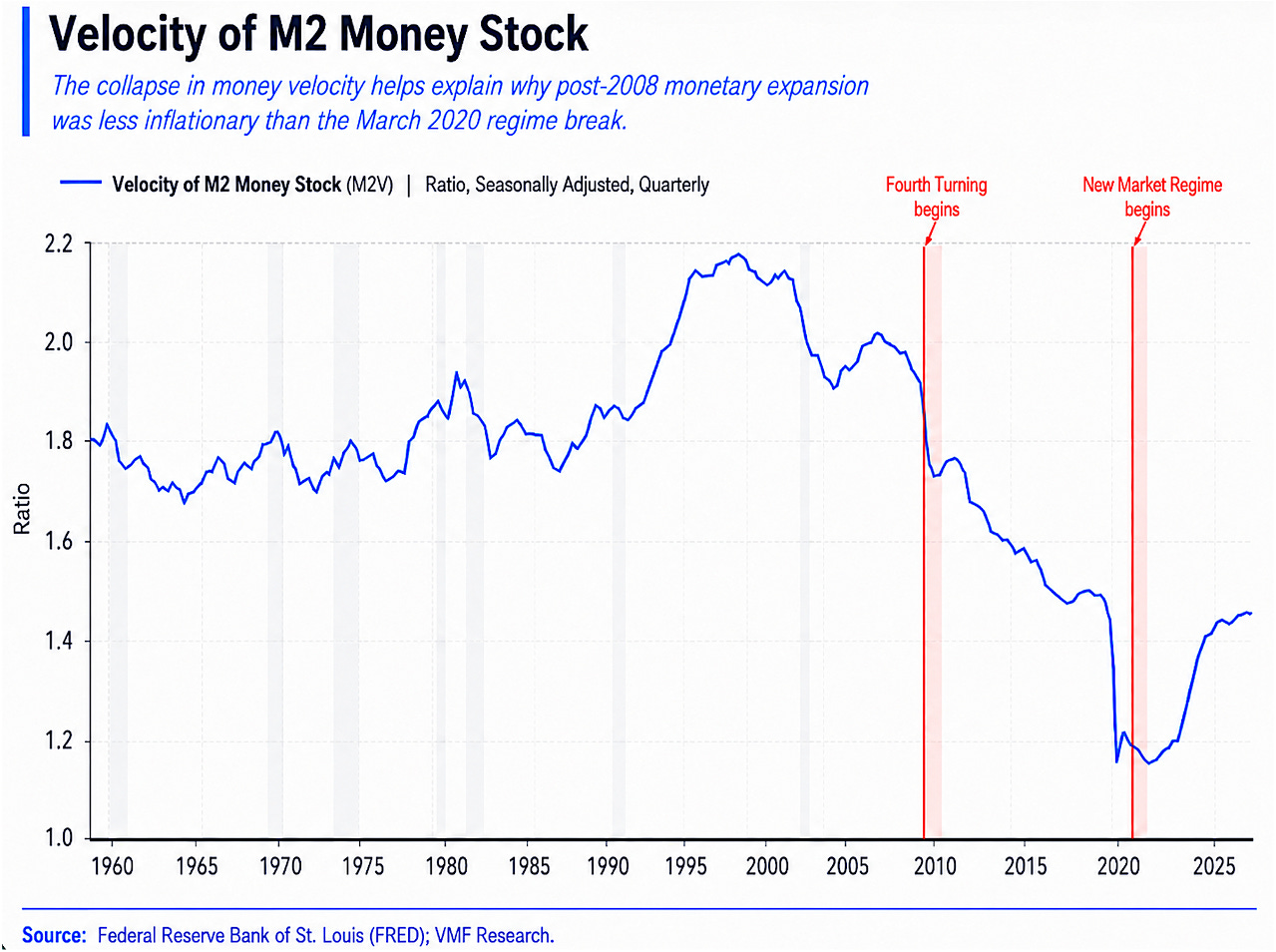
He observed that liquidity was accumulating inside a heavily indebted financial system whose capacity and willingness to spend were deteriorating. The Federal Reserve could increase the quantity of money, but it could not compel households, companies and banks to deploy it productively.
Money existed.
Velocity collapsed.
The real economy remained subdued.
For much of the period between 2008 and 2020, Hunt was right.
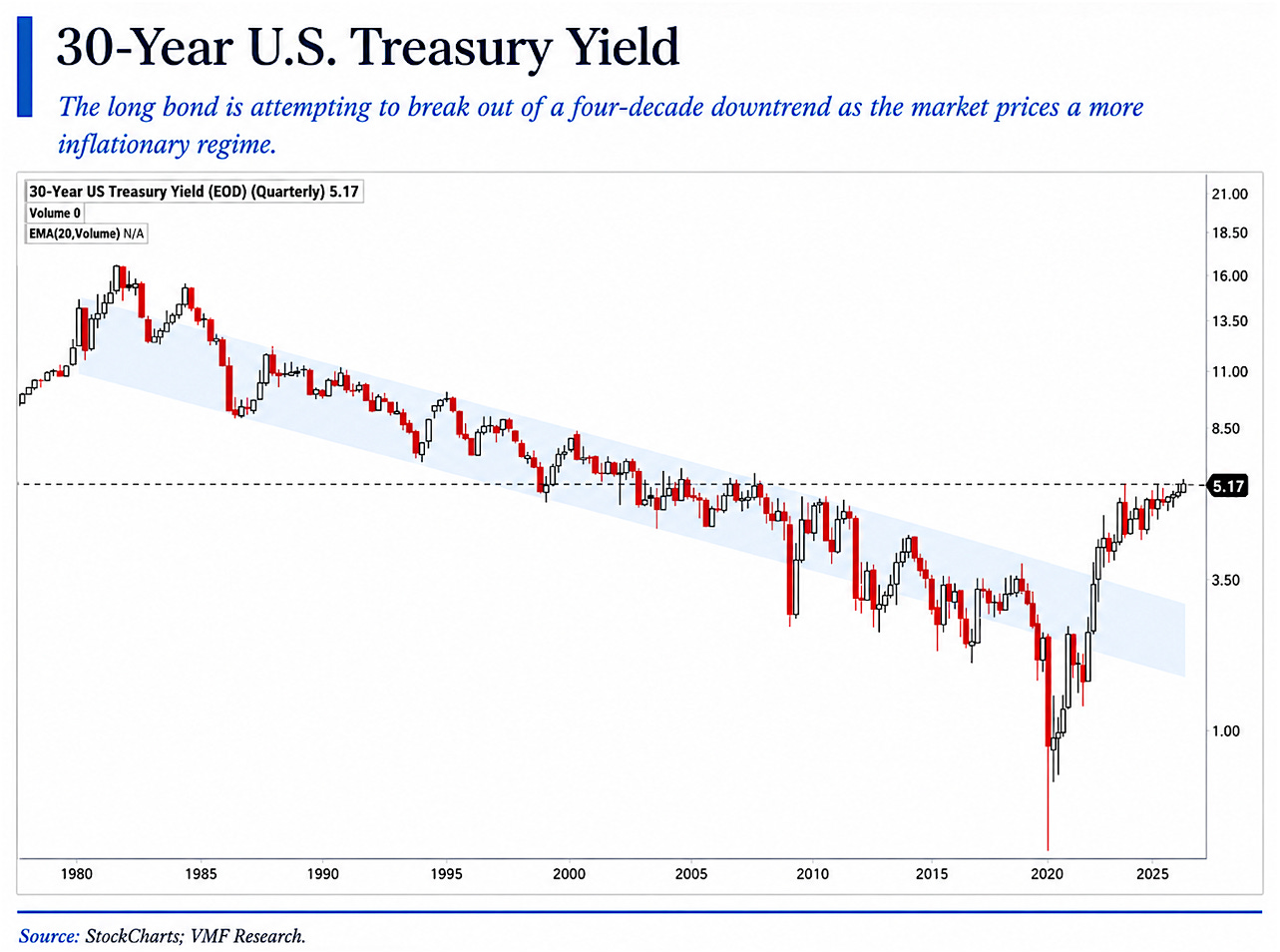
The Federal Reserve expanded its balance sheet by several trillion dollars. Government debt continued rising. Yet inflation repeatedly undershot expectations, economic growth remained modest and long-term Treasury yields continued the secular decline that had begun during the Volcker era.
The thirty-year Treasury yield fell from double-digit levels in the early 1980s to below 1% during the Covid Crash.
The consensus repeatedly waited for inflation.
Hunt repeatedly explained why it failed to arrive.
His latest work does not discard that framework. It asks a more fundamental question: what made it work for so long?
Hunt now places much greater weight on the unusually favourable supply environment that accompanied the globalisation era. China’s integration into the world economy, the arrival of hundreds of millions of lower-cost workers, increasingly efficient supply chains, abundant capital and cheap energy created one of the largest positive supply shocks in modern history.
Productive capacity expanded while debt servicing restrained demand. At the same time, money velocity declined sharply, allowing enormous increases in debt and liquidity to be absorbed without producing sustained consumer-price inflation.
Debt was disinflationary, but it did not operate in isolation. It operated inside a world in which supply was unusually elastic.
That world is disappearing.
Strategic rivalry is replacing commercial integration. Tariffs, friendshoring and domestic semiconductor production are replacing the lowest-cost-producer model.
Supply chains are being redesigned around resilience and redundancy. Labour-force growth is slowing, while defence, energy, grid infrastructure, reindustrialisation and artificial intelligence are competing for increasingly scarce capital and skilled workers.
In Hunt’s revised framework, liquidity can no longer be assumed to disappear harmlessly into a constantly expanding global production system. It may instead collide with labour shortages, insufficient energy infrastructure, lower economies of scale and physical bottlenecks. Rising debt may still weaken long-term growth, but it need not remain disinflationary if policymakers continue creating nominal demand faster than productive capacity can respond.
That is a significant intellectual evolution.
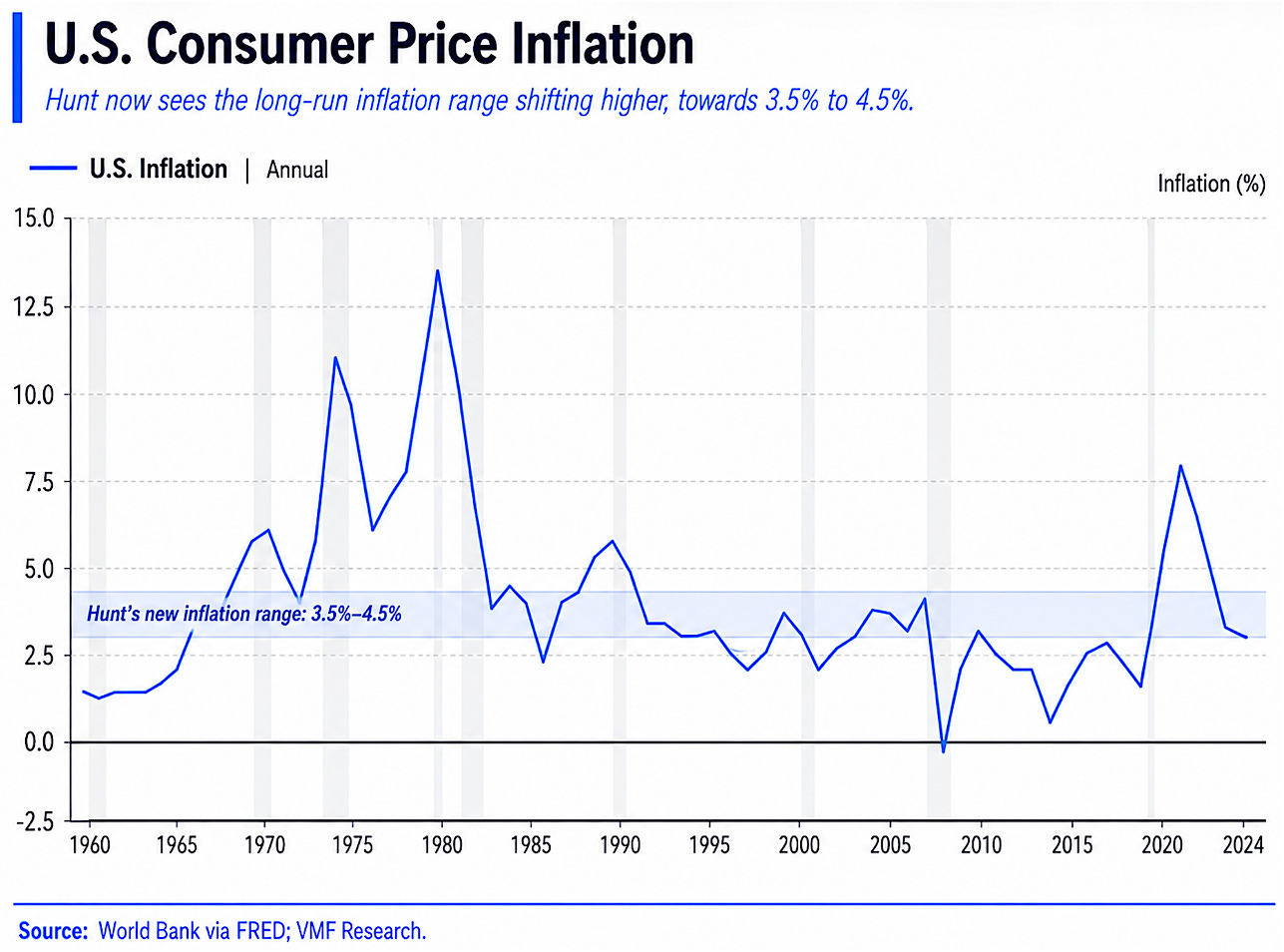
Hunt now believes that the long-run US inflation range may be migrating from approximately 1.5–3.5% towards 3.5–4.5%, with a meaningful risk of episodes above 5%. He also expects interest rates to become more volatile as higher inflation expectations, greater demand for real capital and a less dependable Treasury term premium replace the forces that drove yields steadily lower between 1990 and 2020.
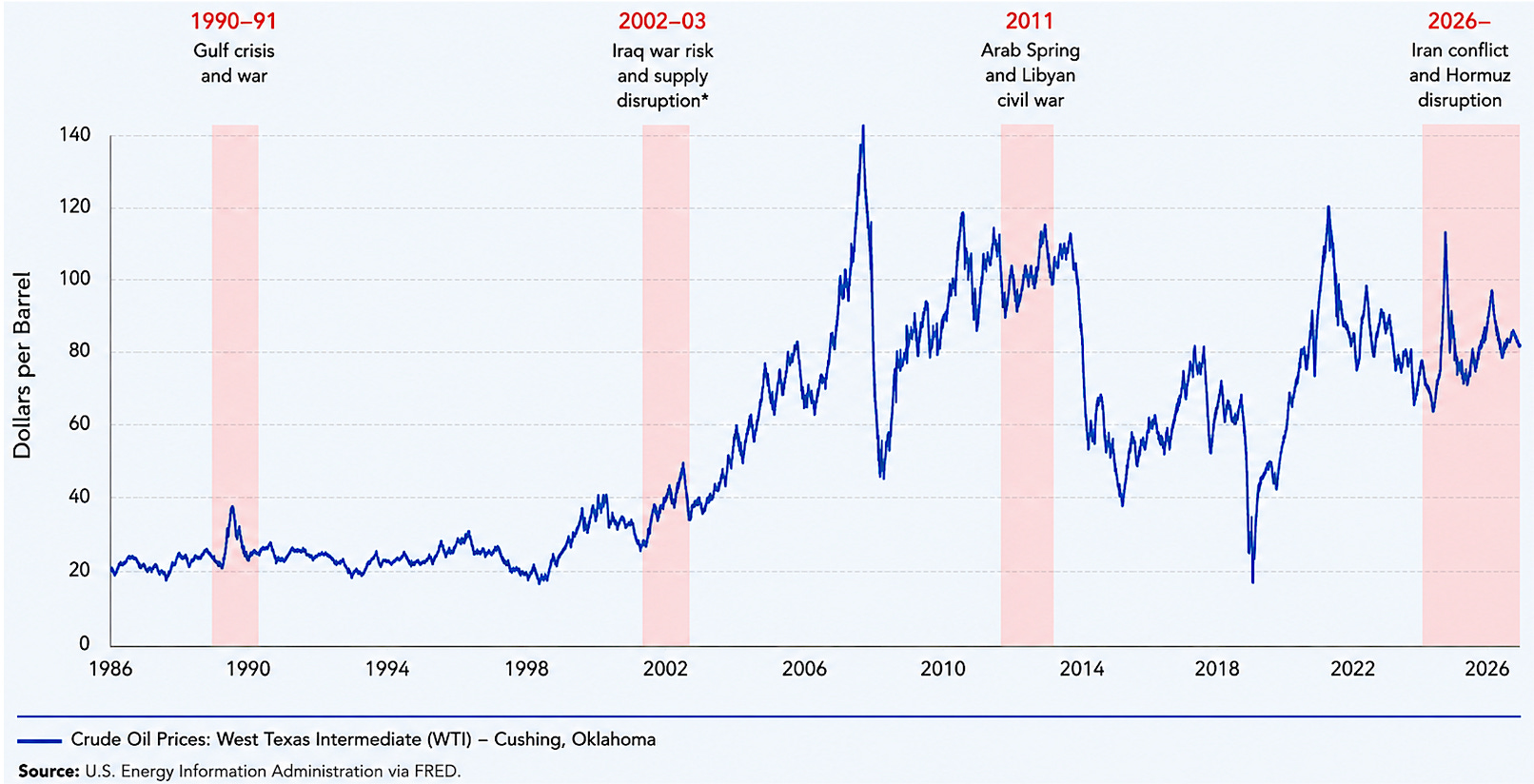
Yet his first-quarter analysis of the latest oil shock shows that he has not abandoned the cyclical forces at the heart of his earlier work.
An energy shock initially appears inflationary because it raises the cost of almost everything that must be produced, heated or transported. Petrol becomes more expensive. Utility bills rise. Distribution costs increase. Headline inflation responds quickly, and long-term yields may rise before the damage to economic activity becomes visible.
But Hunt argues that an oil shock striking an already leveraged and financially vulnerable economy carries a second, more persistent consequence.
Higher energy bills reduce household purchasing power. Businesses attempt to pass those costs to customers, but weak demand limits their ability to do so. Margins compress. Investment is postponed. Hiring slows. Lay-offs increase. Delinquencies and bankruptcies rise as already fragile balance sheets absorb another blow.
The initial inflation surge can therefore be temporary even when the economic damage is not.
As households reduce spending and companies lose pricing power, the slowdown eventually suppresses the very inflation the shock created. The economy experiences what Hunt considers more accurately described as a cost-push recession rather than simple stagflation: prices rise first, but output and employment subsequently fall. Inflation fades because demand has been weakened, not because productive capacity has improved.
The oil shock is therefore less the origin of the problem than the catalyst that exposes it. Hunt finds a similar pattern in earlier episodes, when energy-price surges arrived in economies already burdened by slowing growth, financial stress or excessive leverage.
The visible shock came from oil... the lasting damage emerged through incomes, profits, employment and credit.
This distinction also explains why Hunt does not advocate an aggressive monetary response to every temporary increase in inflation. Tightening into a supply shock cannot produce more energy. It can only weaken demand further. Easing aggressively risks allowing the initial price increase to spread into expectations and broader inflation.
His preferred response is restrained: tolerate the temporary impulse, preserve credibility and allow the economy’s own slowdown to prevent it from becoming permanent.
Hunt therefore continues to see important routes towards disinflation. Recession can destroy demand. Monetary restraint can slow money and credit. Financial stress can reduce spending. A favourable technological shock can expand productive capacity.
What has changed is the environment surrounding those cyclical forces.
Disinflation is no longer the automatic destination of every increase in debt. It has become one possible movement inside a structurally higher and more volatile inflation regime.
Artificial intelligence occupies an especially important place in that debate. Hunt recognises that AI may eventually generate meaningful productivity gains. Better software, automated processes and more efficient decision-making could allow the economy to produce more from the same labour and capital.
His concern is about sequencing.
The productivity dividend may arrive later, while the capital expenditure required to build it is arriving now.
Data centres require semiconductors, cooling systems, transmission infrastructure and enormous quantities of dependable electricity. Those investments are being made while the grid is already constrained and while defence, domestic manufacturing and energy infrastructure are drawing upon many of the same resources. Hunt therefore believes that AI’s near-term effect may be more inflationary than disinflationary: the economy must first finance and construct an extraordinarily resource-intensive system before it can harvest its productivity gains.
That is a serious argument, and we do not dismiss it.
We deeply respect Hunt’s work, the analytical consistency with which he defended his earlier views and the intellectual honesty required to revise them when the underlying conditions changed. His historic deflationary framework explained the post-2008 world far better than the repeated predictions of runaway inflation made by many of his contemporaries.
His new framework is also remarkably close to the Market View that has shaped VMF Research since its inception.
We have argued that the combination of fiscal activism, deglobalisation, capital scarcity, geopolitical fragmentation and constrained productive capacity would leave inflation and interest rates higher and more volatile.
That view informed our large Alternatives Book, our exposure to natural resources and our deliberate underweight to conventional fixed income.
It has benefited the Model Portfolio materially.
Hunt’s turn does not tell us that the view is wrong.
It tells us how far it has travelled...
When one of the modern era’s most committed and respected deflationists identifies inflation as the greater structural risk, the inflation thesis can no longer be described as marginal or contrarian. It has become the central macroeconomic framework through which investors interpret the world.
Geopolitical conflict is viewed first through energy prices.
Defence expenditure through capital scarcity.
Fiscal policy through Treasury supply.
Industrial policy through labour and commodity constraints.
Strong growth through the prospect of tighter monetary policy.
Even AI is initially interpreted through the electricity, semiconductors and investment it consumes rather than the costs it may eventually eliminate.
The inflationary lens is not necessarily wrong.
But it has become so dominant that nearly every new development is now made to confirm it.
And that is where we turn next.
You might also like reading:

Important Disclosure
This article contains general investment research produced by Vasco Marques de Freitas, CFA, CMT, Founder and CEO of VMF Research, Lda. It reproduces an excerpt from the August 2026 issue of VMF’s Strategic Asset Allocation. The research, views and Tier One Model Portfolio information are stated as of 7 August 2026, 4:00 p.m. Eastern Daylight Time, unless another date is expressly identified. The original issue was first disseminated to paid subscribers on 7 August 2026 at 9:00 p.m. Eastern Daylight Time.
The publication contains information recommending or suggesting an investment strategy. It is not personalised investment advice and does not consider any reader’s individual objectives, financial circumstances, knowledge, experience, liquidity requirements or tolerance for risk. The Tier One Model Portfolio is an illustrative research portfolio designed to communicate VMF Research’s strategic asset-allocation framework, Market View and investment conclusions. It does not represent client assets, transactions executed by VMF Research or the performance of an investable fund or managed account.
The analysis combines macroeconomic, monetary-policy, fixed-income, geopolitical, energy-market, technological and strategic asset-allocation research within a medium- to long-term framework. Statements concerning debt, money velocity, inflation regimes, interest rates, Treasury yields, oil shocks, monetary-policy transmission, artificial intelligence and productivity are analytical judgments and conditional hypotheses rather than assurances. References to Lacy Hunt describe and interpret views discussed in the underlying research and should not be understood as implying any affiliation with, endorsement by or participation of Mr Hunt in VMF Research’s analysis.
Investments and asset classes discussed within VMF’s Strategic Asset Allocation may involve substantial risks, including changes in inflation and interest rates, duration and credit risk, commodity-price volatility, geopolitical disruption, policy error, currency movements, liquidity constraints, technological disruption and the possible loss of capital. Historical relationships between debt, inflation, economic growth and interest rates may change. Oil shocks may produce different economic or market outcomes from previous episodes, and potential productivity gains from artificial intelligence may arrive later, prove smaller or affect inflation differently than anticipated. Macroeconomic, valuation and technical frameworks may fail.
Neither VMF Research nor the author received compensation from any issuer, fund sponsor, individual or other entity covered in connection with the preparation of this research, and no covered entity reviewed, approved or amended its investment conclusions before first dissemination.
Past performance, Model Portfolio performance, historical market relationships and forward-looking scenarios are not reliable indicators of future results. Readers should conduct their own analysis and, where appropriate, consult an authorised financial intermediary or adviser before making an investment decision.