

The market got one election right. It got the other spectacularly wrong.
In America, investors were already positioning for a Democratic takeover of Congress weeks before the ballots were counted.
In Brazil, they had increasingly embraced the prospect of a new, more market-friendly government.
The American blue wave became a historic tsunami. Brazil delivered an entirely different verdict.
And both elections exposed something we believe investors would be foolish to ignore.
Political outcomes can be anticipated. Their economic consequences are considerably harder to price.
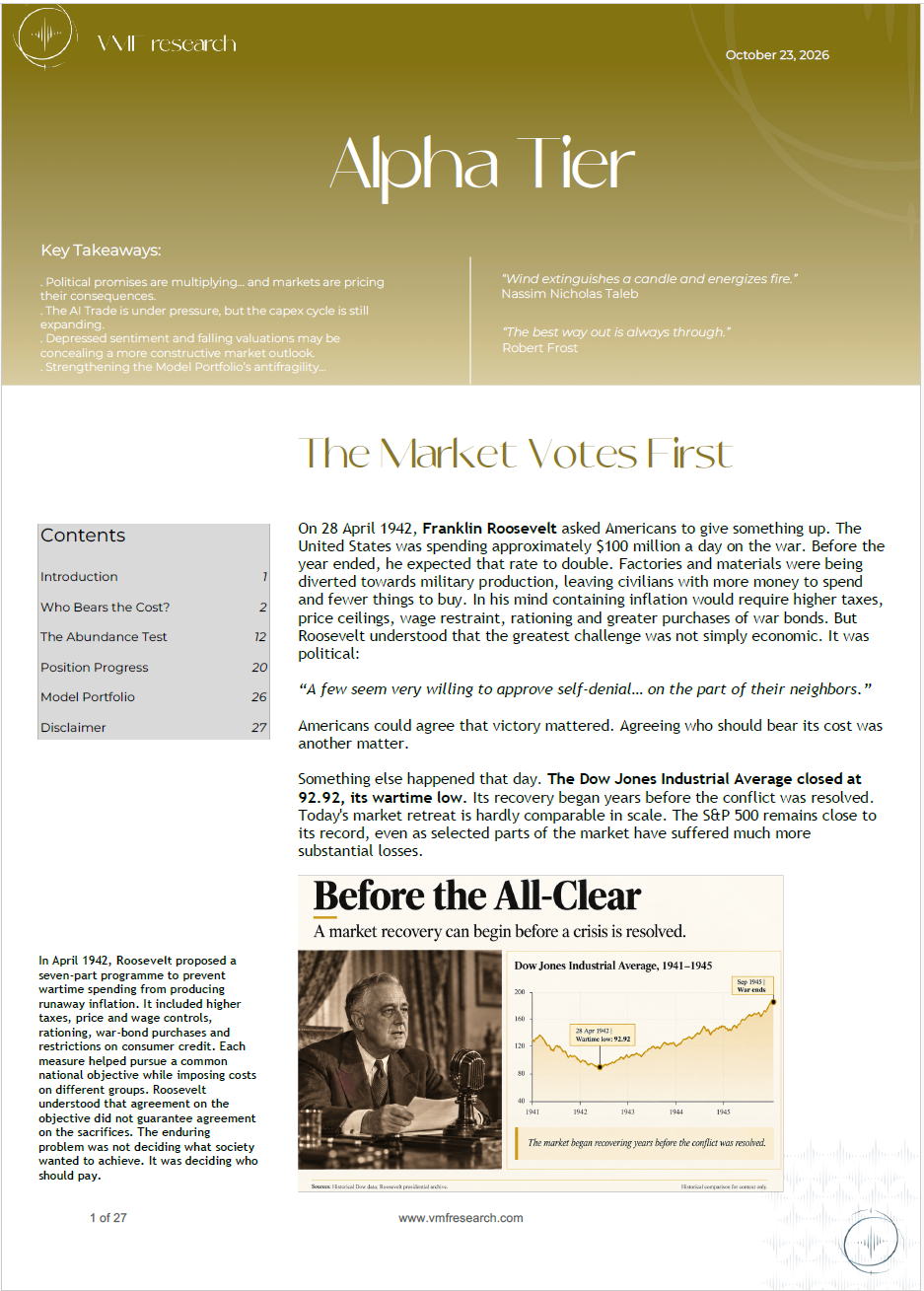
On 23 October 2026, eleven days before the American midterms and two days before Brazil’s presidential runoff, we published October’s Alpha Tier, The Market Votes First.
The title was deliberate.
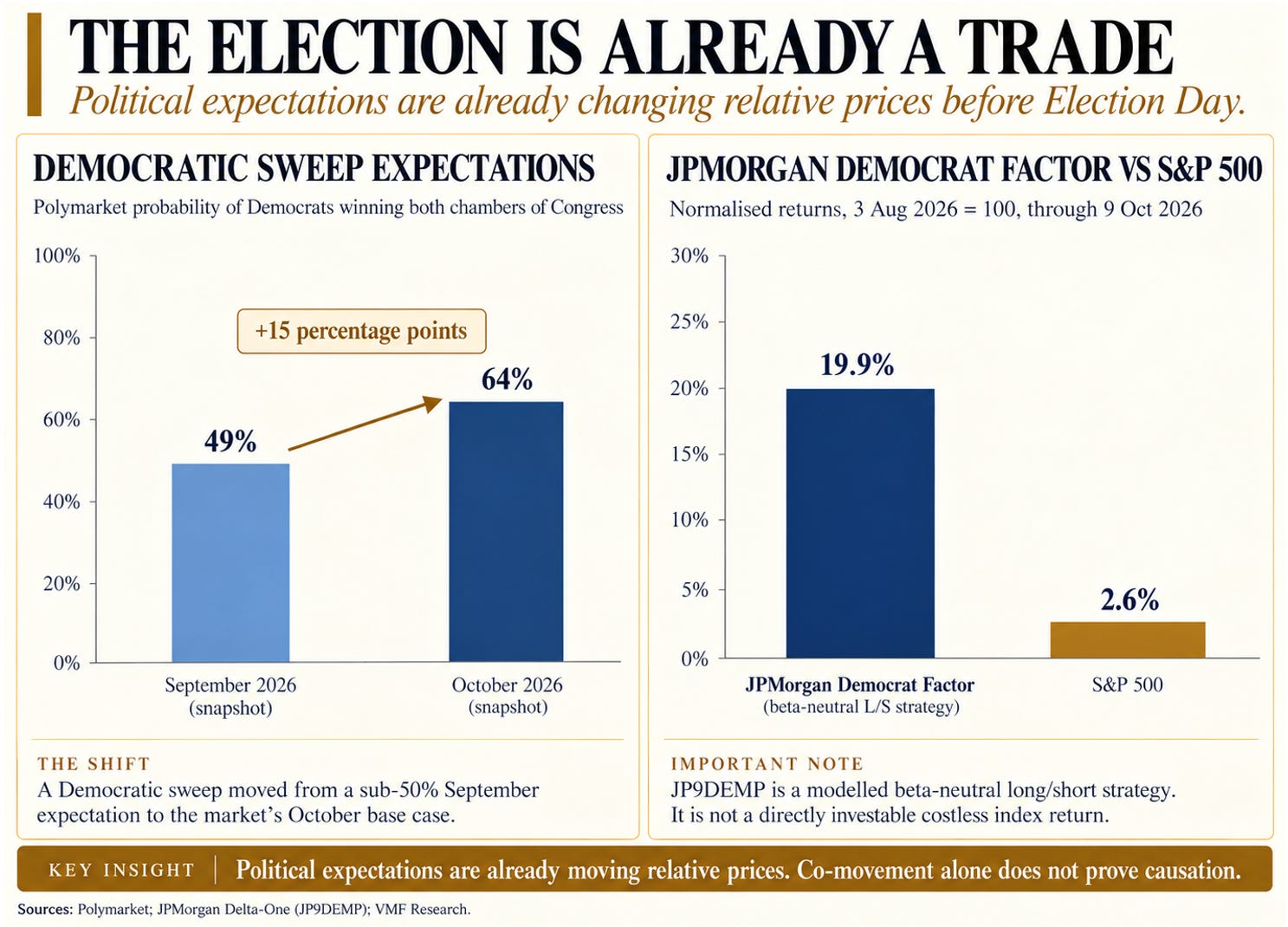
We were watching an extraordinary repricing unfold across financial markets, well before voters had delivered their verdicts.
Prediction markets were assigning approximately a two-thirds probability to a Democratic sweep of Congress, up sharply from September. A JPMorgan strategy constructed to capture the changing electoral odds had already gained almost 20%, compared with roughly 2.6% for the S&P 500 over the period examined.
In Brazil, investors had poured money into the prospect of political change. Trading activity in Brazilian equities had reached extraordinary levels as expectations improved.
The election campaigns were still underway. The financial consequences were already being traded.
But what caught our attention wasn’t simply the growing probability of a Democratic victory.
It was what was happening to the investments that had dominated the market.
For much of the AI boom, one of Wall Street’s most profitable assumptions had been remarkably simple: own the companies expected to benefit from artificial intelligence and avoid those believed vulnerable to its disruption.
By mid-October, that trade was coming apart.
Over just five sessions, Goldman Sachs’ basket of perceived AI winners lost approximately 12%. Its basket of AI-at-risk companies gained roughly 4%.
Investors who were long the winners and short the losers were suddenly losing on both sides.
Professional investors were cutting directional exposure, with hedge-fund net positioning approaching a five-year low even as gross exposure remained substantial. The violent rotation was exposing the risks of an increasingly crowded investment consensus.
And the turmoil extended beyond equities. Bonds, precious metals and crypto were responding to tightening financial conditions, often challenging the diversification investors had expected from them.
We had spent months studying the economic forces behind the AI boom. Now markets were forcing a more uncomfortable question upon its investors.
What happens when the future everyone wants to own becomes too expensive to finance?
That question led us back to a framework we have used since VMF Research began publishing: the Fourth Turning.
In October, we examined how political promises were colliding with economic constraints across several countries.
Brazil’s election offered competing visions of growth, fiscal discipline and social reform. France was confronting rising borrowing costs, popular unrest and increasingly radical proposals concerning government debt.
And in the United States, the enormous investment required to secure technological supremacy was running into an obstacle that politicians could no longer ignore.
The electricity bill.
The AI industry wants more data centres, more computing capacity and vastly more power.
Households want affordable electricity. Governments want technological leadership without sacrificing political support. Investors want the extraordinary capital being committed to produce attractive returns.
Everyone wants the benefits of abundance. The argument is about who pays to build it.
That was the thread running through our October research.
When governments promise more than their economies can comfortably finance, the conflict eventually moves beyond ordinary disagreements over spending.
It can become a struggle over taxation, regulation, creditors’ rights and, ultimately, the purchasing power of money itself.
This is why our Debasement Trade remains so important to our long-term investment framework.
And why the political resistance gathering around AI infrastructure deserves considerably more attention than the usual election commentary.
But there was another conclusion emerging from our research.
One that ran directly against the growing pessimism.
We believed the market was approaching conditions that could support a substantial recovery.
Sentiment had deteriorated sharply. Professional positioning had become defensive. Valuations were falling across parts of the market even as expectations for future AI capital expenditure continued to increase.
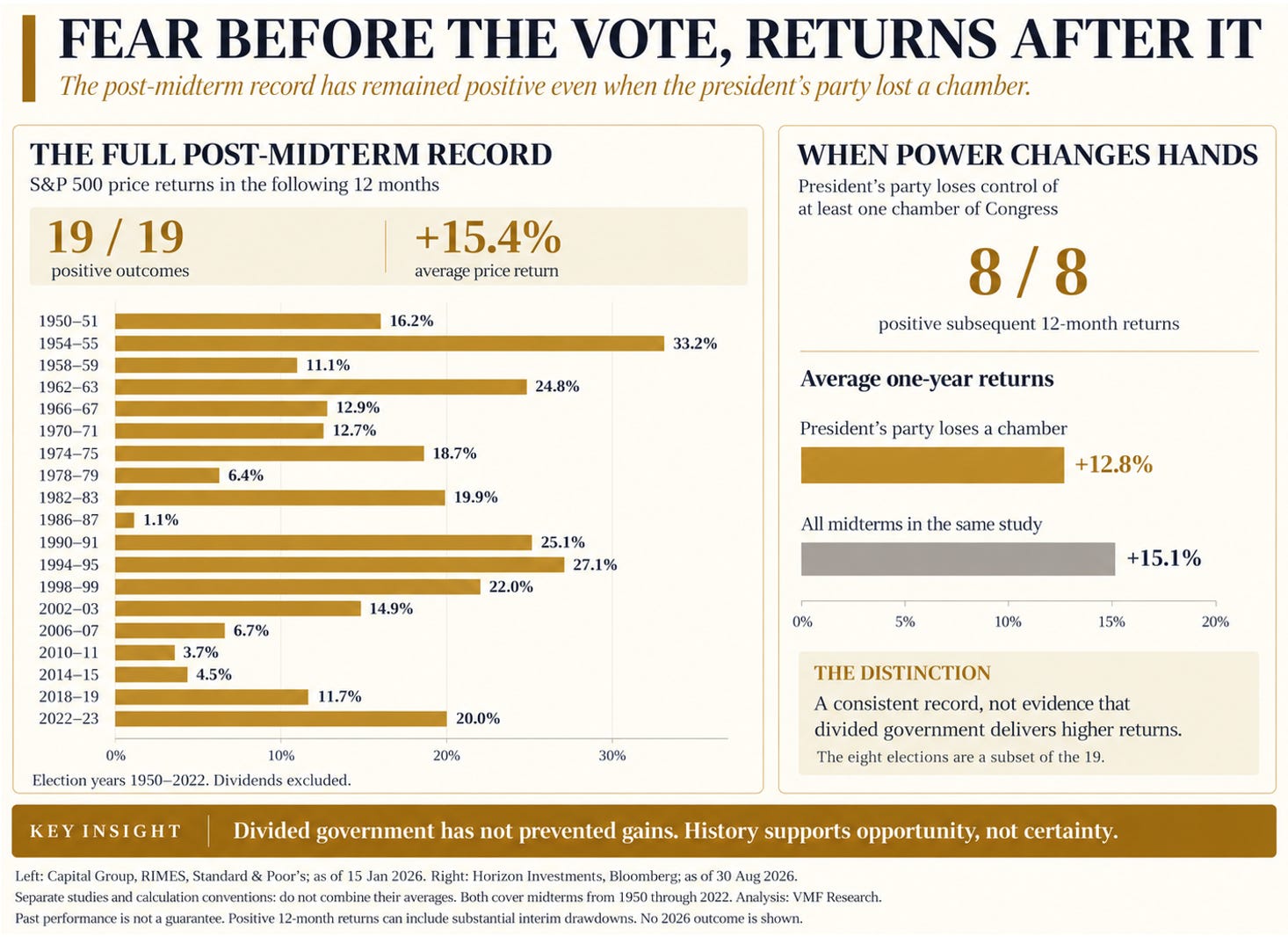
And the historical record surrounding American midterm elections offered an extraordinary counterpoint to the prevailing anxiety.
Across the nineteen midterm elections between 1950 and 2022, the S&P 500 had been higher twelve months after every single one.
In the eight instances when the president’s party lost control of at least one chamber of Congress, the result was the same.
Those observations were never a guarantee. Nor did they tell us how painful the intervening months might become.
But they challenged the increasingly popular assumption that political upheaval must necessarily end in a sustained bear market.
At the same time, we were preparing for a less favourable possibility.
Earlier in October, our Strategic Asset Allocation research had led us to introduce a small position in ultra-long-duration US government debt.
The objective was to provide a measure of protection against a particular scenario: a disinflationary slowdown in which expensive money finally overwhelmed economic growth and investors’ willingness to take risk.
That position began fulfilling its intended role as long-term yields retreated. We subsequently extended the same approach to Alpha Tier, seeking to strengthen the portfolio’s ability to withstand outcomes beyond our central expectations.
We explained the original reasoning in our public article, The Market Sets the Terms.
The Market Sets the Terms

The world’s most important bond market had spent months teaching investors an expensive lesson.
Then the voters had their say.
Brazil rejected the political outcome financial markets had increasingly favoured. Lula secured another presidential term, forcing investors to reconsider assumptions that had supported Brazilian assets.
The United States delivered the opposite electoral surprise. The anticipated Democratic wave became a historic sweep of both chambers of Congress.
Those results have changed the political landscape.
They have not resolved the economic conflicts that made these elections so important to investors in the first place.
America still needs to finance its ambitions. The AI industry still needs enormous amounts of electricity and capital. Governments still face competing demands from voters, businesses and creditors.
And the financial markets still have to determine what those competing demands mean for future earnings, borrowing costs and asset valuations.
The next stage could include powerful rallies, painful setbacks or both. None would settle the underlying investment questions on its own.
Indeed, the Democratic victory has made one of those questions more intriguing than ever.
What if tougher conditions for building AI infrastructure actually make some existing businesses more valuable?
A data-centre developer facing delayed permits, higher electricity costs and increasingly demanding financing terms may discover that extraordinary demand for computing power is insufficient to guarantee an attractive investment return.
But a business that already controls scarce infrastructure, reliable power and the means to serve customers could face very different economics.
The same political pressure might penalise one company while strengthening another’s competitive position.
There is an equally consequential question on the monetary side.
Will political gridlock restrain Washington’s financial ambitions? Or will the growing struggle to reconcile fiscal promises with economic reality eventually strengthen the forces behind our Debasement Trade?
What does that imply for assets whose value rests on productive earning power, and for those whose appeal is partly rooted in distrust of governments’ ability to preserve the value of money?
These are questions about the ownership of tomorrow’s wealth.
And they cannot be answered simply by predicting the next move in the S&P 500.
October’s Alpha Tier brought these threads together before the elections, examining the implications for the AI investment cycle, the monetary outlook, market valuations and the increasingly complex relationship between risk and opportunity.
Paid subscribers received The Market Votes First on 23 October 2026, together with our full investment reasoning, Model Portfolio decisions and the risks we were preparing for.
That research provides a framework for interpreting the election results and the market developments that follow, rather than depending on any single day’s price action to prove its conclusions.
And as the political consequences become clearer, we will continue testing those conclusions against the evidence.
For readers who want to understand where we believe the greatest opportunities may emerge (and which investments could face the most difficult adjustments) the complete research is available to Alpha Tier subscribers.
The elections have settled who governs.
They have done very little to settle who pays.
And we suspect that second question will have a far greater influence on investment returns in the years ahead.
Discover The Market Votes First, October’s issue of Alpha Tier, and the research behind our investment positioning.
Good investing!
Vasco Marques de Freitas, CFA, CMT
Important Disclosure
This article contains general investment research commentary produced by Vasco Marques de Freitas, CFA, CMT, Founder and Chief Executive Officer of VMF Research, Lda. It introduces and discusses investment themes, conclusions and portfolio decisions developed in The Market Votes First, the October 2026 issue of Alpha Tier. The underlying research was completed on 23 October 2026 at 4:00 p.m. Eastern Daylight Time and first disseminated to paid subscribers on 23 October 2026 at 9:00 p.m. Eastern Daylight Time.
This article is an original editorial commentary intended to introduce and promote the full paid research, rather than a reproduction of the complete publication. It incorporates subsequent political and financial-market developments, including the Brazilian presidential runoff on 25 October, the US midterm elections on 3 November and the market response immediately thereafter. These later developments were not known at the original research cut-off and should not be interpreted as information available when the underlying investment conclusions were formulated. Historical charts and observations retain their original reference dates unless expressly indicated otherwise.
VMF Research produces investment research and recommendations under the applicable provisions of Regulation (EU) No 596/2014 on market abuse and Commission Delegated Regulation (EU) 2016/958, subject to supervision by Portugal’s Comissão do Mercado de Valores Mobiliários (CMVM). The underlying Alpha Tier publication contains investment recommendations within that framework. This public article does not reproduce all the recommendations, valuations, portfolio allocations or associated risk assessments contained in the original research. Its promotional nature and omission of certain securities do not, by themselves, determine its regulatory classification or remove any applicable disclosure obligations.
This material is not personalised investment advice and has not been prepared by reference to any reader’s investment objectives, financial circumstances, knowledge, experience, liquidity requirements or tolerance for risk. It does not constitute portfolio management, order execution, an offer to sell or a solicitation to purchase any financial instrument. Readers remain responsible for assessing the suitability of any investment for their own circumstances.
Neither VMF Research nor the author received compensation from any issuer covered in the original October publication in connection with its preparation. No covered issuer reviewed, approved or amended the investment conclusions before first dissemination.
The Alpha Tier Model Portfolio is an illustrative research portfolio, intended to communicate VMF Research’s investment methodology, strategic convictions and published investment conclusions. It does not represent actual client assets, transactions executed by VMF Research or the performance of an investable fund or managed account. Its allocations, changes and reported returns are hypothetical research constructs based on the published methodology and reference prices. Unless otherwise stated, reported returns exclude taxes, transaction costs, custody charges, bid–ask spreads and foreign-exchange effects.
The underlying research reflects the evidence available at its stated cut-off and is intended within a medium- to long-term investment framework, subject to periodic review. Information has been obtained from sources considered reliable, including official statistics, regulatory filings, issuer disclosures, market data and third-party research, but its completeness, accuracy and continued relevance cannot be guaranteed.
Past performance, simulated performance, historical market relationships, valuation estimates and forward-looking scenarios are not reliable indicators of future results. All investments involve risk, including market volatility, political and regulatory changes, liquidity risk, adverse valuation movements and the possible loss of some or all invested capital. Readers should conduct their own due diligence and, where appropriate, consult an authorised financial adviser before making investment decisions.