

The world’s most important bond market had spent months teaching investors an expensive lesson.
By early October, rising US Treasury yields were punishing bondholders, squeezing equity valuations and creating growing strains in financing markets.
Inflation seemed to explain everything.
We weren’t convinced.
Behind the headlines, something more complicated was unfolding. Real interest rates were rising, governments and businesses were competing for capital, and volatility was threatening to turn leveraged investors from buyers into forced sellers.
We began to wonder whether the market inflicting so much damage might soon offer something investors had almost forgotten it could provide:
Protection.
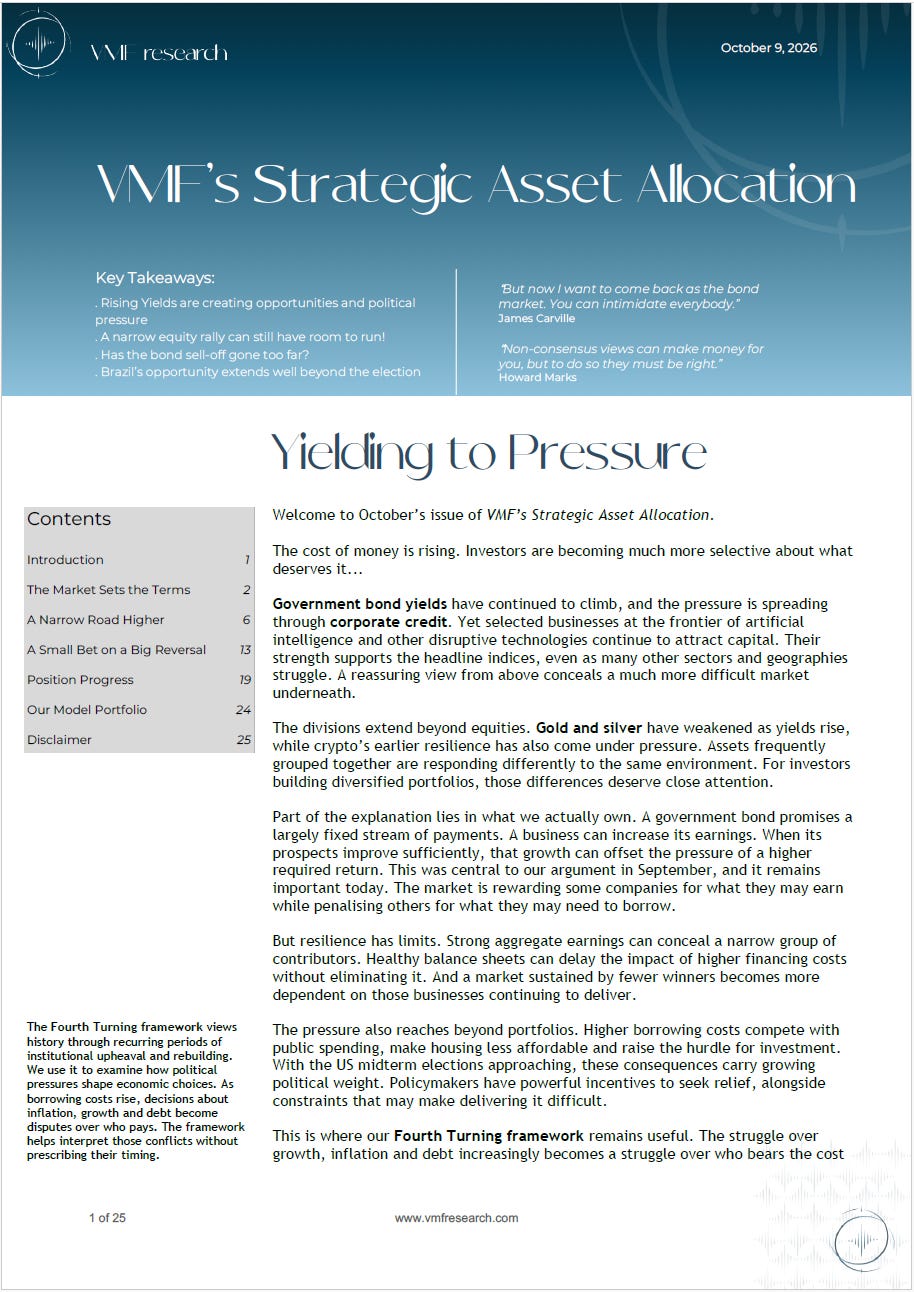
When we published October’s VMF’s Strategic Asset Allocation, Yielding to Pressure, on 9 October 2026 at 9:00 p.m. Eastern Daylight Time, the evidence remained uncomfortable. Long-duration Treasuries had endured extraordinary losses, and their technical picture was still decidedly bearish.
Yet the investigation led us to introduce a small position in ultra-long-duration US government debt later in that issue. Subscribers received the complete reasoning, including the instrument, allocation, funding source and circumstances under which the hedge could fail.
Since then, long-term yields have retreated as another risk-off wave has swept through equities.
That is encouraging. The position is beginning to serve the defensive purpose we envisaged. But it is far too early to declare victory, and a modest hedge was never intended to offset every possible portfolio loss.
What matters is that the market which helped create the pressure is now offering some relief.
The excerpt below takes us back to where that decision began, before the reversal, when we were still trying to understand what the relentless rise in yields was really telling us.
After a decade of punishing bondholders, long Treasuries had become easy to dismiss. Their price was becoming much harder to ignore.
Good reading.
The bond market can tighten financial conditions without waiting for the next central-bank meeting.
When investors demand a higher return from government debt, they raise the benchmark against which other investments compete. A company considering a new factory, a household applying for a mortgage and a government refinancing its obligations all face versions of the same calculation: does the expected benefit still justify the cost?
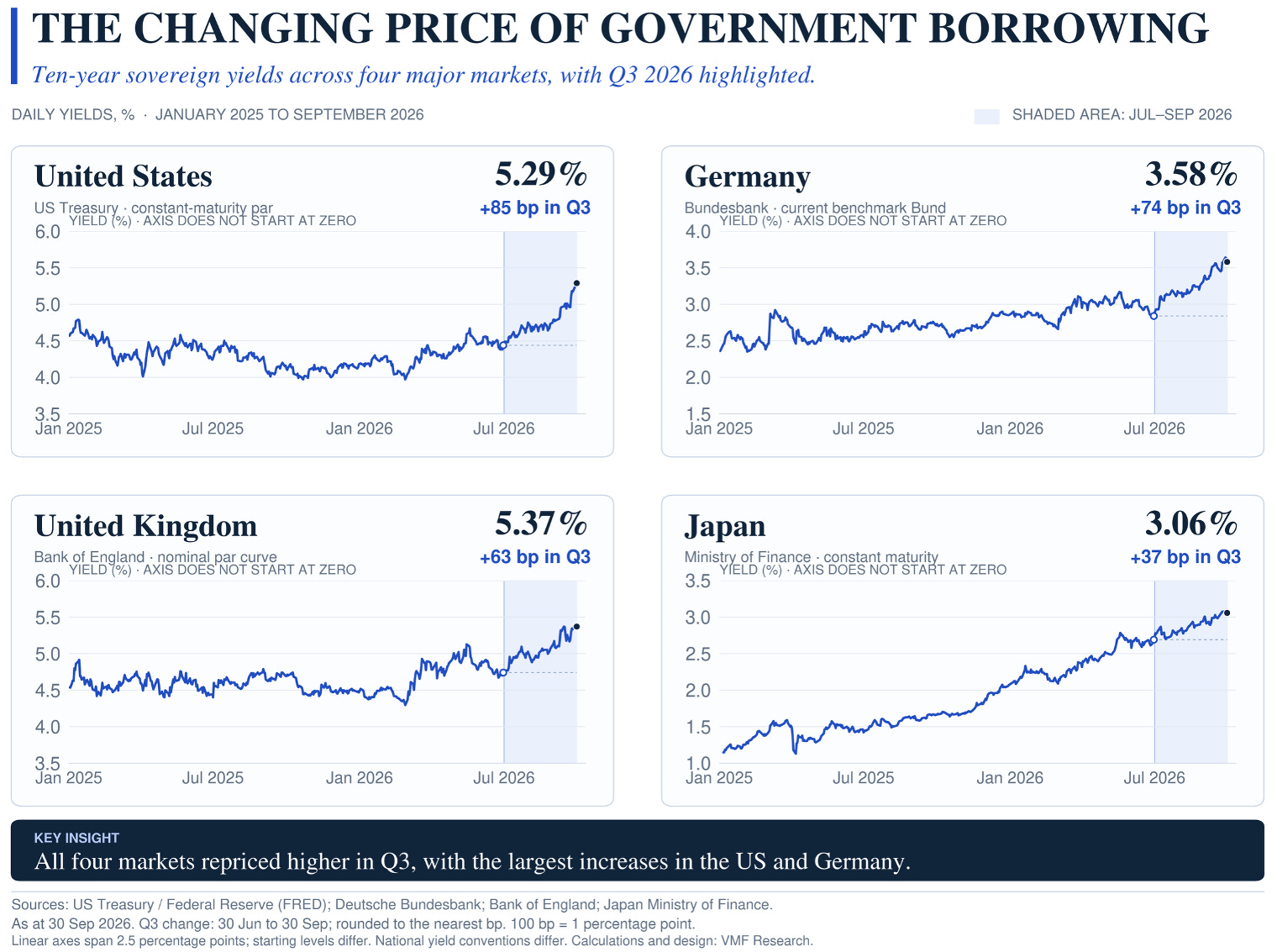
That calculation is changing. The US 10-year Treasury yield rose from 4.75% at the end of August to 5.28% on 2 October. An increase of more than half a percentage point in little over a month changes both the value of existing investments and the economics of new ones.
The international picture requires care, however. Sovereign bond markets respond to shared forces, including energy prices and competition for capital, alongside domestic inflation, fiscal policy and central-bank decisions. Similar movements in yields can therefore reflect different combinations of opportunity and risk.
Start with growth.
An economy offering more profitable investment opportunities can support higher real interest rates. Businesses compete for financing because they expect to earn attractive returns from deploying it. The infrastructure required to build abundance, from power generation to computing capacity, can intensify that competition before its productivity benefits become widely available.
This is an important feature of our Abundance Shock thesis. Technological progress can eventually lower the cost of producing goods and services while the investment required to achieve it raises demand for capital today.
Inflation creates a different pressure. Higher energy prices can increase costs across the economy and encourage expectations that central banks will keep policy tighter for longer. They can also reduce households’ purchasing power and squeeze business margins. The initial pressure on yields may therefore contain the seeds of a subsequent slowdown.
Investors must also decide how much compensation they require for committing money over many years. A long-term Treasury yield reflects expectations for future short-term rates together with a term premium: compensation for bearing the risks associated with holding the longer-dated bond. Uncertainty about inflation, future issuance and the policy response can influence that premium.
These forces can operate simultaneously. The investment consequences depend on their relative importance at any given time.
The rise in real yields makes the current adjustment particularly relevant. Yields on inflation-protected Treasury (TIPS) provide a market measure of real yields. Their difference from comparable nominal Treasury yields is known as breakeven inflation, or inflation compensation. That spread also reflects risk premia and relative liquidity, so it should not be read as a precise inflation forecast.
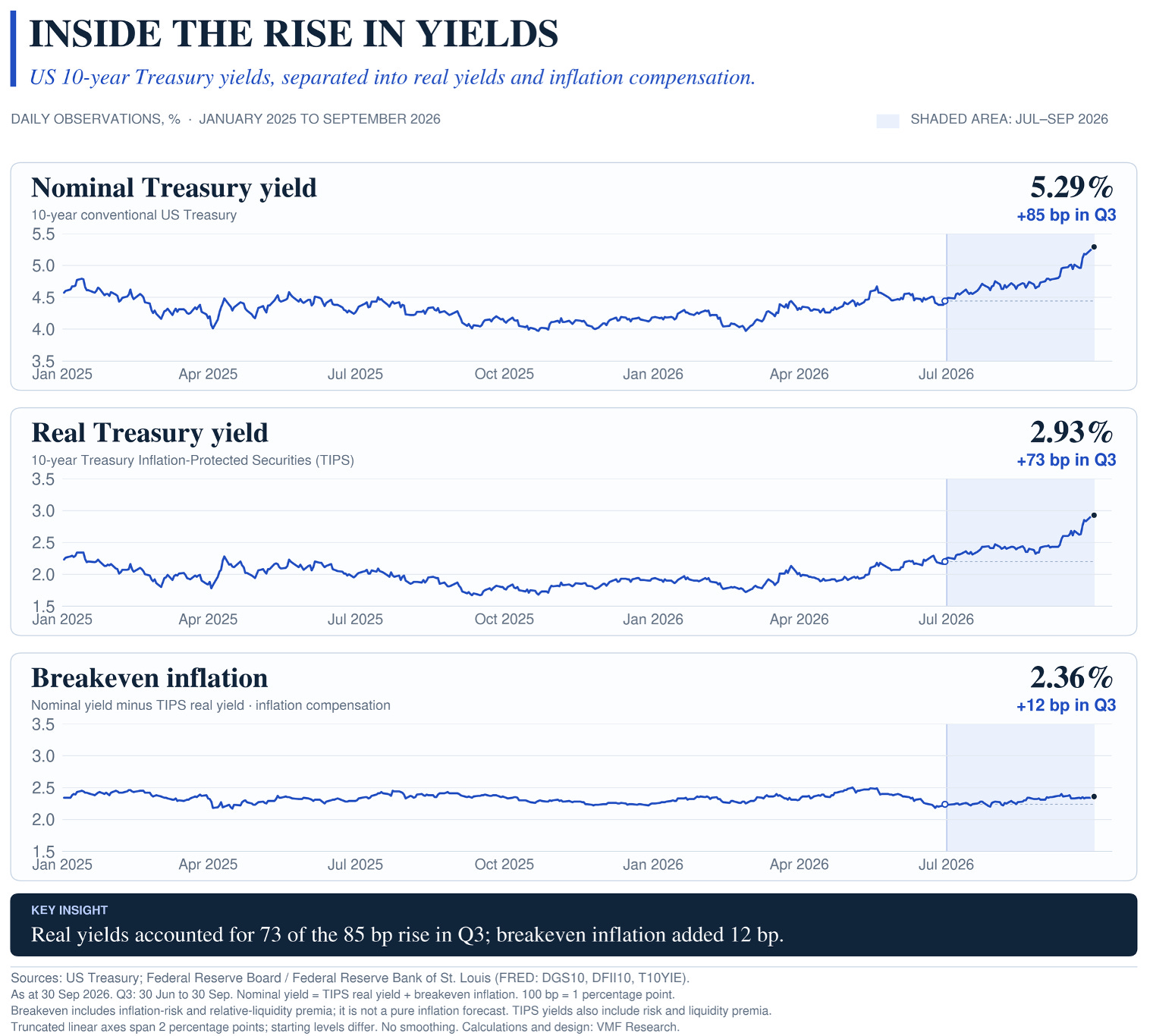
When real yields rise, investors can obtain a higher quoted return above realised inflation from inflation-linked government debt. Competing investments must offer sufficient prospective reward to remain attractive. Stronger expected profits can help a business clear that higher hurdle. Assets whose cash flows cannot improve have less room to adjust.
The speed of the adjustment matters too.
Borrowers and investors can adapt more easily to a stable financing environment than to one being repriced sharply from week to week. Rapid yield increases produce immediate losses on existing bonds. They can also force leveraged investors to reduce positions and make dealers less willing to hold securities while arranging the next transaction.
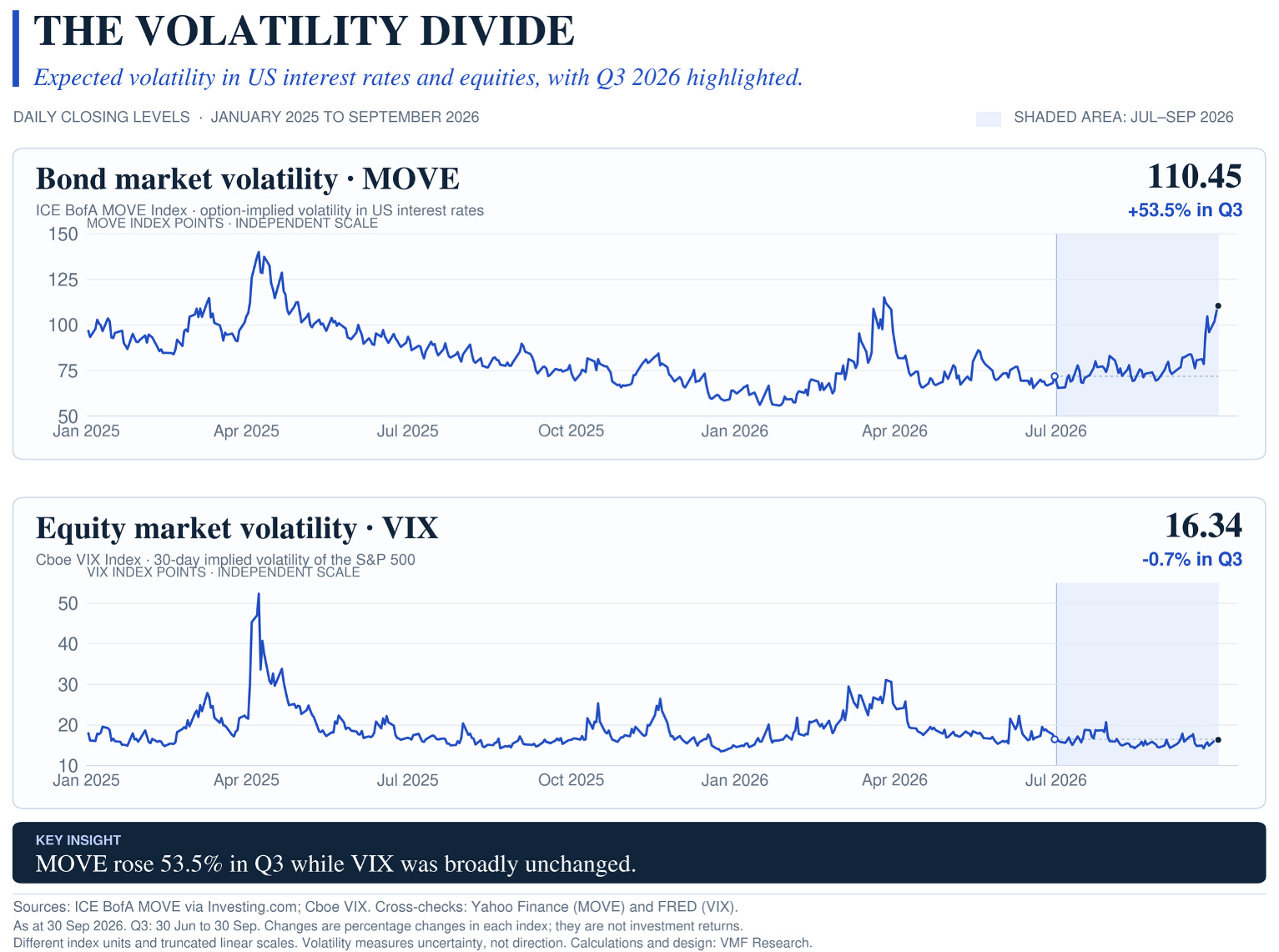
This is why we are paying close attention to the MOVE index, an options-based measure of expected volatility in US interest rates. Often described as the bond market’s counterpart to the VIX, it measures uncertainty about the movement in rates rather than forecasting their direction.
The recent increase in bond volatility, alongside comparatively subdued equity-index volatility, deserves attention. Treasury securities serve as investments, benchmarks for pricing other assets and collateral for financing. Disruption in this market can therefore spread well beyond the investors who own the bonds.
As intermediaries become more cautious, trading conditions can deteriorate. Selling then has a larger effect on prices, potentially producing further losses and more selling. A change in valuation can develop into a problem of market functioning...
Corporate credit provides another test of how far the pressure is spreading.
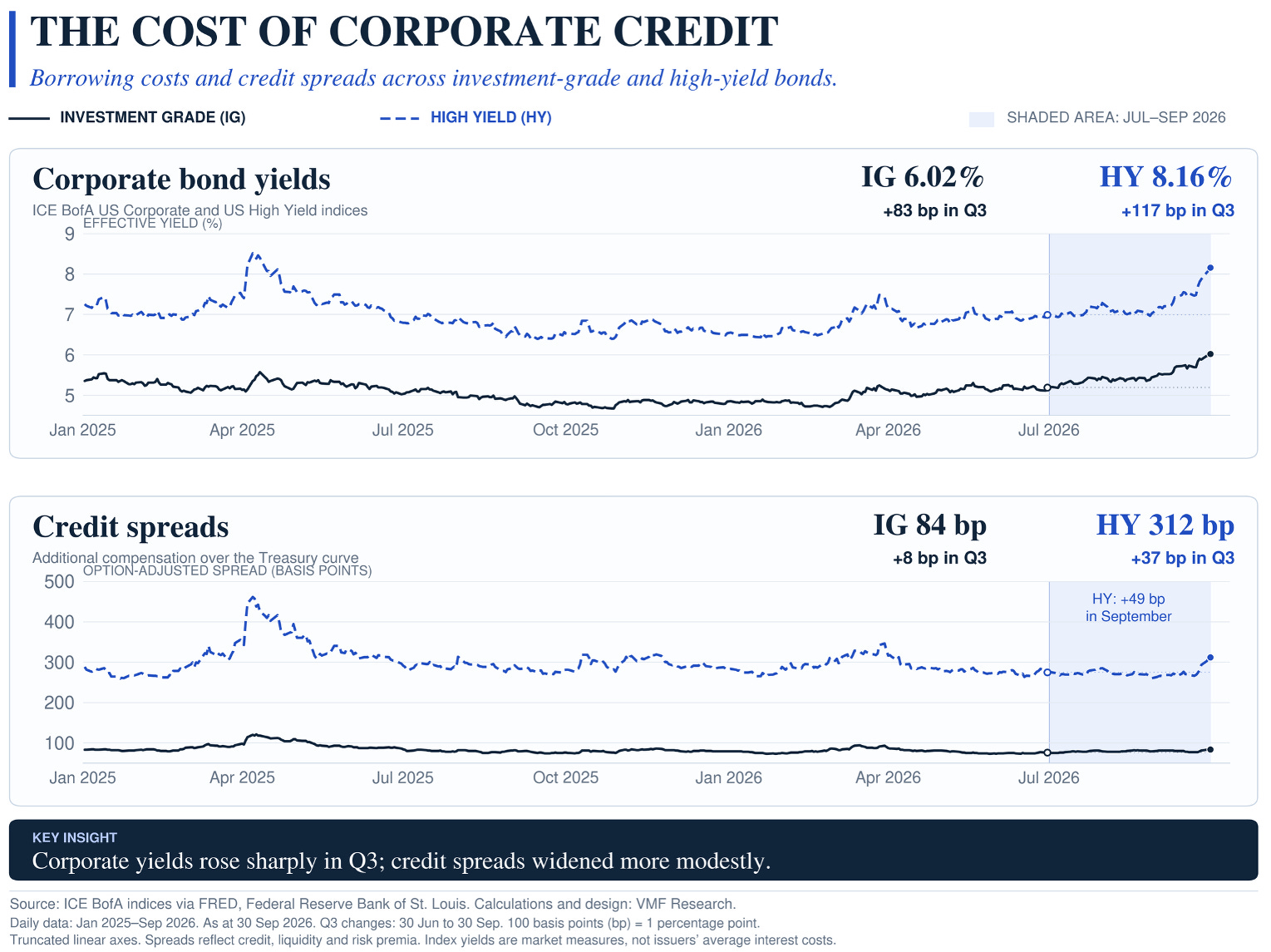
A company’s borrowing cost reflects the relevant government yield and an additional spread compensating investors for holding its debt. Corporate yields can rise because the government benchmark rises, because investors demand a wider spread, or because both happen together.
That distinction matters particularly in high yield, where weaker borrowers have less financial room for error.
Between 25 September and 1 October, the ICE BofA US High Yield Index’s effective yield increased from 7.87% to 8.22%. Over the same period, its option-adjusted spread widened from 2.93 to 3.24 percentage points. Investors were demanding more compensation beyond the Treasury benchmark as well as a higher overall yield.
A wider spread can reflect concerns about defaults, liquidity and the willingness to bear risk. It warrants closer attention to borrowers’ finances; it does not, at this moment, establish that a default wave is imminent.
The transmission to the economy also takes time.
A company that secured long-term, fixed-rate funding may experience little immediate change in its interest bill. A business facing imminent refinancing, or relying on floating-rate debt, encounters the new conditions much sooner.
Higher yields become more threatening when they persist long enough to meet those refinancing needs, when lenders demand wider spreads, and when rising volatility makes financing less dependable. That combination can influence hiring, investment and capital allocation before it becomes obvious in aggregate earnings.
For our analysis, the level, speed and persistence of the rise in yields all matter.
So does the financial position of the borrower.
This helps explain how the same environment can leave one company’s investment programme largely intact while forcing another to retreat. It also provides the starting point for understanding the equity market’s increasingly selective leadership, which we examine next.
Important Disclosure
This article contains general investment research produced by Vasco Marques de Freitas, CFA, CMT, Founder and CEO of VMF Research, Lda. It reproduces “The Market Sets the Terms” from the October 2026 issue of VMF’s Strategic Asset Allocation. The underlying research was completed on 9 October 2026 at 4:00 p.m. Eastern Daylight Time and first disseminated to paid subscribers on 9 October 2026 at 9:00 p.m. Eastern Daylight Time. Introductory commentary concerning subsequent market developments was added for republication and should be distinguished from the original analysis. Charts and market data retain their individually stated reference dates.
The publication contains information recommending or suggesting an investment strategy. It is not personalised investment advice and does not consider any reader’s objectives, financial circumstances, knowledge, experience, liquidity requirements or tolerance for risk. The Tier One Model Portfolio is an illustrative research portfolio designed to communicate VMF Research’s strategic asset-allocation framework, Market View and investment conclusions. It does not represent client assets, transactions executed by VMF Research or the performance of an investable fund or managed account.
The analysis combines macroeconomic, monetary-policy, fixed-income, market-structure and strategic asset-allocation research within a medium- to long-term framework. Conclusions concerning inflation, real interest rates, term premia, Treasury yields, bond-market volatility, corporate financing conditions and the Dovish Shock thesis reflect analytical judgments and conditional hypotheses rather than assurances. Views are reviewed through monthly publications, with weekly or ad hoc updates where material developments warrant reassessment.
Treasury yields contain components that cannot be observed separately with certainty. TIPS real yields, breakeven inflation and model-estimated term premia are useful analytical measures but should not be interpreted as pure indicators of expected growth, inflation or fiscal risk. The MOVE index measures expected interest-rate volatility; it does not itself trigger margin calls or forced selling. Leveraged Treasury positions may nevertheless face collateral demands, funding pressures and losses arising from changes in market prices or financing conditions.
Ultra-long-duration government bonds carry substantial interest-rate risk. Falling yields can produce significant capital appreciation, but rising yields can generate equally substantial losses. Their ability to provide portfolio protection depends on the economic environment. In particular, inflationary shocks, persistent high real rates or deteriorating fiscal credibility may cause long-duration bonds to decline alongside equities and other risk assets. Bond funds maintaining long-duration exposure do not provide the same fixed maturity and contractual principal repayment as individual Treasury securities held to maturity.
The subsequent decline in long-term yields discussed in the introduction is consistent with the scenario considered in the original research, but does not establish that the broader Dovish Shock thesis has materialised, that the hedge will remain effective or that future returns will be positive. Benchmark yield movements should not be confused with the realised performance or total contribution of any particular Model Portfolio position.
Neither VMF Research nor the author received compensation from any issuer, fund sponsor or other covered entity in connection with the preparation of the original research, and no covered entity reviewed, approved or amended its investment conclusions before first dissemination.
Past performance, simulated performance, Model Portfolio performance, historical market relationships and forward-looking scenarios are not reliable indicators of future results. All investments involve risk, including volatility, liquidity risk and the possible loss of some or all invested capital. Readers should conduct their own analysis and, where appropriate, consult an authorised financial intermediary or adviser before making an investment decision.