

AI has a dirty little secret...
The smarter the digital world becomes, the more brutally physical its requirements become.
Models can improve in weeks. Software can be copied in seconds. Inference costs can collapse almost overnight.
Power plants cannot.
Transmission lines cannot.
And uranium mines certainly cannot.
That contradiction may become one of the defining investment problems of the next decade.
The market has spent enormous amounts of time debating which model will win, which chip will dominate and which platform will capture the next wave of AI spending.
But every one of those arguments eventually runs into the same wall:
Electricity.
A data centre does not care how elegant the software is if the grid cannot keep it running.
And for workloads that must operate around the clock, availability is not a secondary feature. It is the product.
That is where nuclear power enters the story.
Not because AI suddenly created the uranium bull case.
It did not.
The uranium market was already tightening. The existing global reactor fleet consumes more uranium than primary mines produce each year. Reactor life extensions, restarts and new construction were already pushing future requirements higher. Utilities had already spent years contracting less material than they would ultimately need.
AI simply makes the bottleneck harder to ignore.
It adds a new source of electricity demand to a fuel market that was already living on borrowed inventory.
And something more interesting is beginning to happen.
Governments and state-linked buyers are moving before the demand arrives.
India is securing uranium for a nuclear fleet it has not yet built. China has become a major force in long-term contracting. Kazakhstan, despite being the world’s largest producer, has moved towards building strategic inventories of its own.
The buyers are moving before the miners.
That changes the character of the commodity.
When countries begin accepting the carrying cost of securing future supply because the consequences of not having it are far greater, uranium stops behaving like an ordinary industrial input.
It starts behaving like a strategic reserve asset.
That matters because the supply response is painfully slow.
The uranium price can move in an afternoon.
A mine may take a decade.
Permitting, geology, financing, processing infrastructure and politics all stand between a higher commodity price and an additional pound of production. Even established mines routinely disappoint.
Meanwhile, reactors do not casually switch themselves off because fuel became more expensive.
Uranium represents only a fraction of the economics of operating a nuclear plant. Once the reactor exists, security of supply matters far more than saving a few dollars on the fuel bill.
That asymmetry is what makes the setup interesting.
Supply is slow.
Demand is stubborn.
Inventories are finite.
And the world is asking nuclear power to do more.
July’s Alpha Tier followed our AI thesis out of the digital economy and into the physical constraint underneath it. The same abundance of intelligence that may pressure one scarcity can intensify another.
More useful intelligence can mean more automation.
More automation can mean more computation.
More computation means more electricity.
And electricity needs fuel.
The excerpt below was first published for paid Alpha Tier subscribers on 24 July 2026 at 9:00 p.m. Eastern Daylight Time. It examines why uranium is becoming strategically more important, why years of deferred procurement matter, and why a market capable of repricing in weeks is dependent on supply that may require years to respond.
The AI boom may ultimately be remembered for algorithms.
But algorithms do not keep the lights on.
The fuel beneath the boom does.
Good reading.
Reliable power has a fuel.
Nuclear generation operates continuously, at scale and with far less dependence on weather than most competing sources of electricity. US energy data place its capacity factor at approximately 91% (materially above natural gas, coal, hydro, wind or solar). For data centres running valuable workloads around the clock, availability is not an attractive feature.
It is the product.
The demand side is becoming more visible. Global data-centre electricity consumption could rise approximately two-and-a-half times by 2030, while AI related power use may grow even faster. Renewables will supply part of that increase, but intermittency, grid congestion and the slow expansion of storage leave an essential role for dependable generation. Nuclear power is increasingly being treated as one of the few scalable answers.
Yet the uranium case does not require every AI electricity forecast to prove correct.
The existing reactor fleet already consumes more uranium than the world mines each year. Life extensions, restarts and new construction were strengthening demand before the latest data-centre boom. Artificial intelligence adds urgency, political support and a new class of well-capitalised power buyers.
It accelerates a shortage that was already forming.
The clearest recent evidence comes from India. The country currently operates approximately 8 gigawatts of nuclear capacity but is targeting 100 gigawatts by 2047. Reaching that objective will require sustained construction over two decades... and considerably more fuel than India can produce domestically.
Its procurement strategy is moving ahead of the reactors. A recently agreed contract with Canada’s Cameco covers almost 22 million pounds of uranium from 2027 through 2035. India and Australia have also completed the administrative arrangements required to permit Australian uranium exports under their existing nuclear-cooperation framework. Australia controls roughly 28% of known global uranium reserves, opening another potentially important supply route to one of the world’s largest future consumers.
So, India is securing fuel for generating capacity that has not yet been built.
It is not alone.
China represented roughly half of global long-term uranium contracting in 2024. Kazakhstan, already the world’s largest producer, has moved towards building strategic inventories of its own. Sovereign and state-linked buyers are increasingly competing with utilities for material whose future availability can no longer be assumed.
The buyers are moving before the miners.
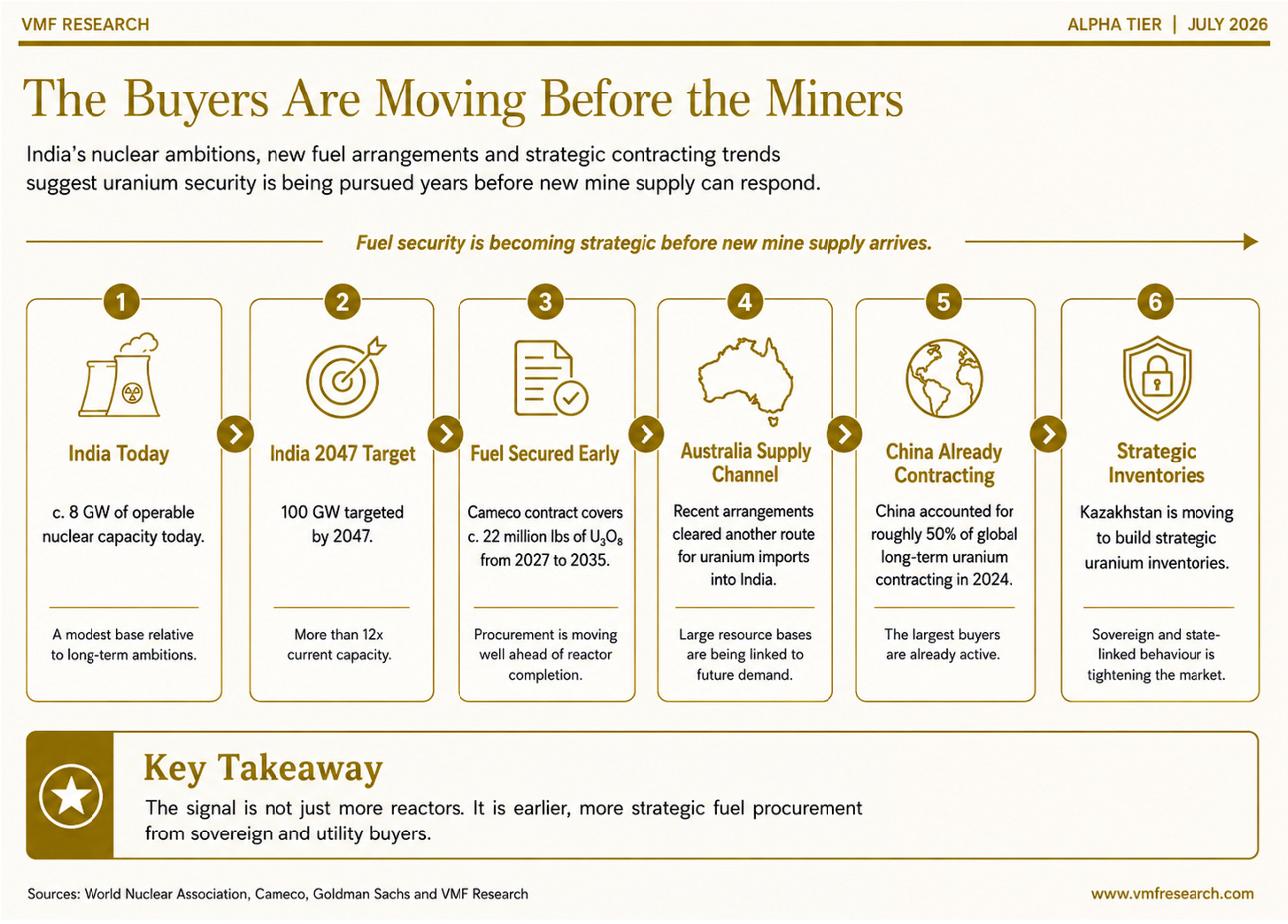
The important signal is the order of events. Fuel is being secured before the corresponding demand fully reaches the market. Buyers are accepting the carrying cost of early procurement because the potential cost of insufficient supply is far greater than the benefit of waiting for a slightly lower price.
Uranium is beginning to behave less like an ordinary industrial input and more like a strategic reserve asset.
The market is poorly positioned for that transition.
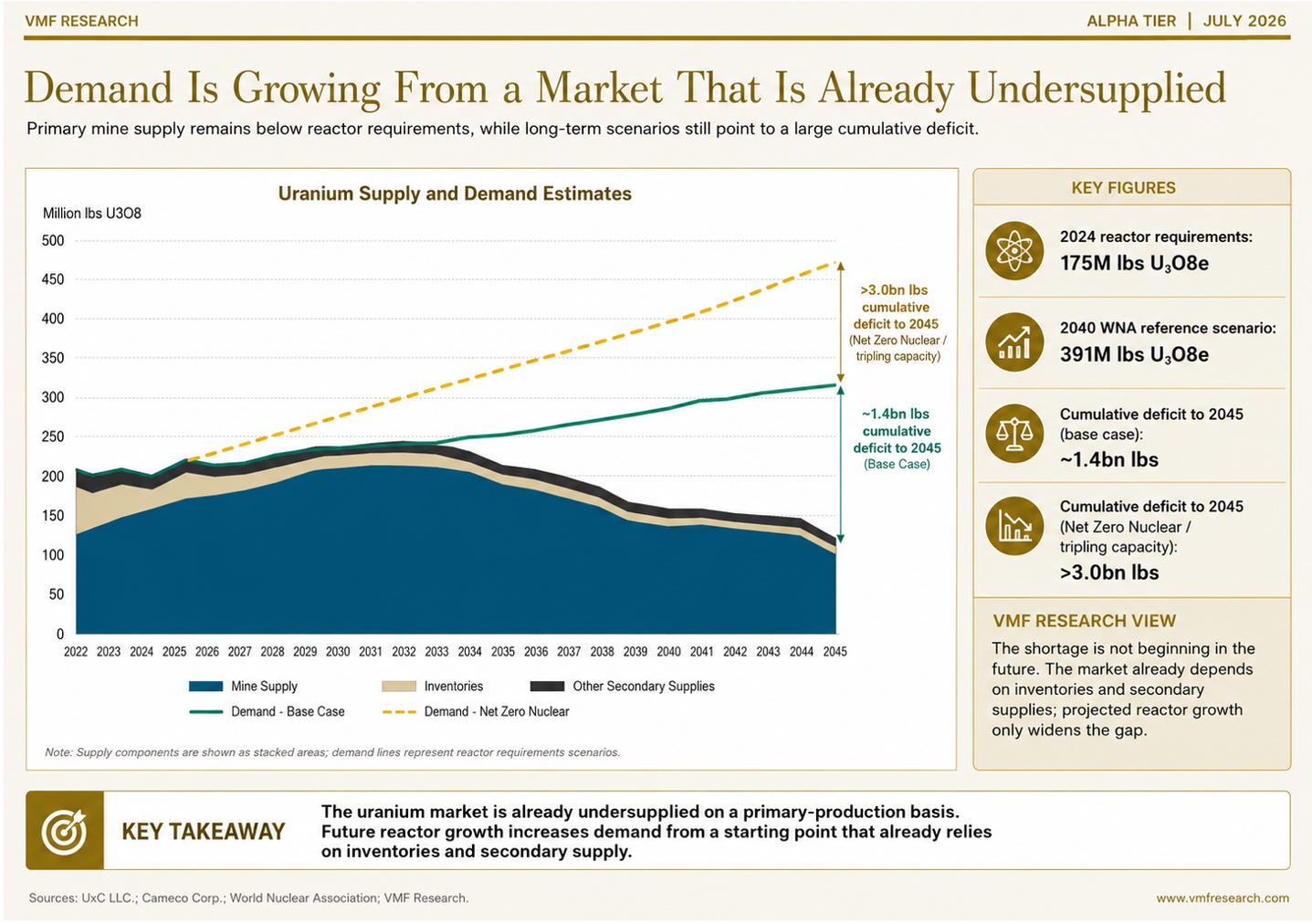
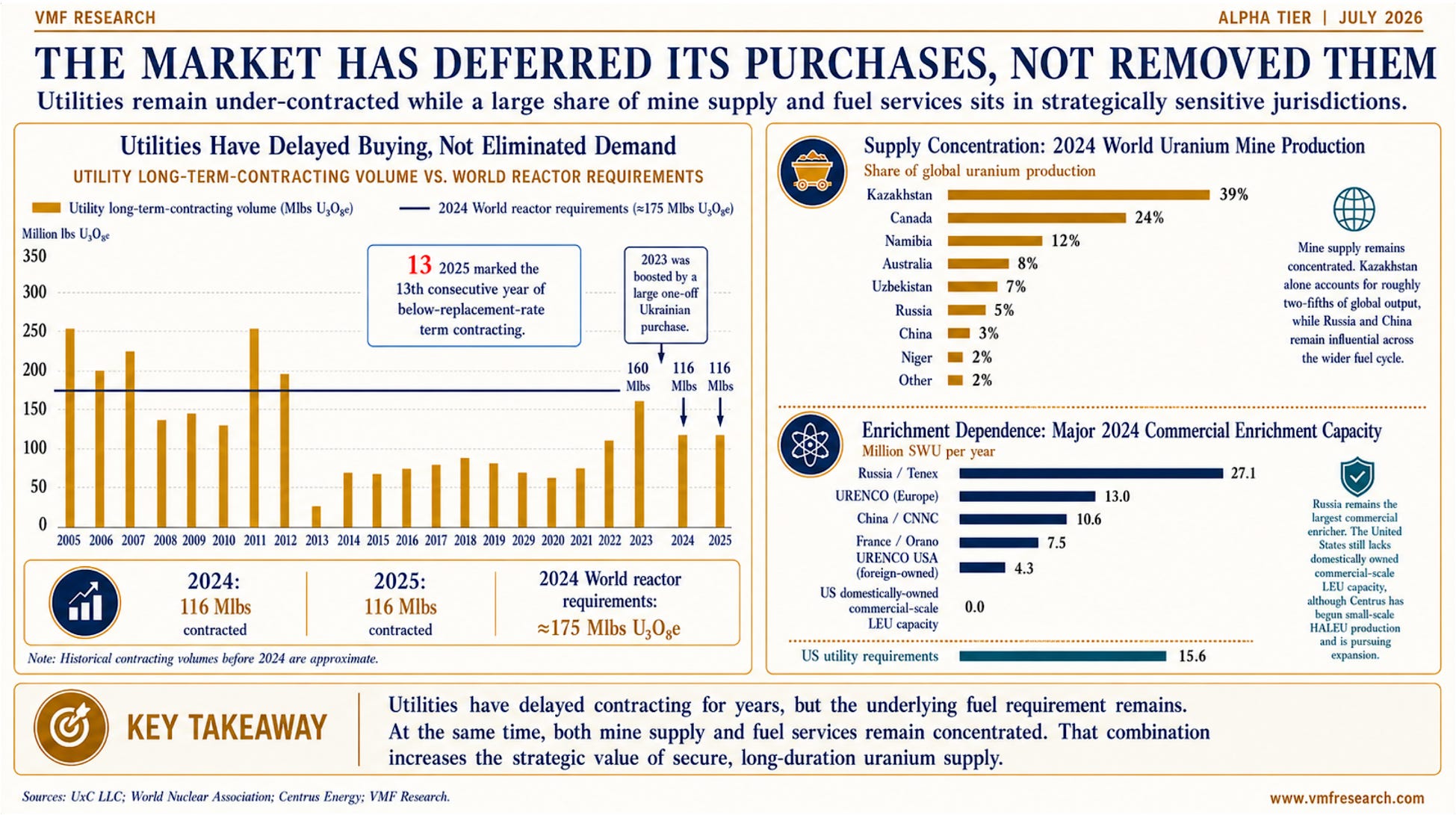
World mine production already falls short of the annual requirements of the existing reactor fleet. For decades, the difference was supplied through inventories, military stockpiles, reprocessing, underfeeding and other secondary sources created partly by the enormous overproduction of the Cold War.
Those buffers postponed the adjustment. They did not create new mines.
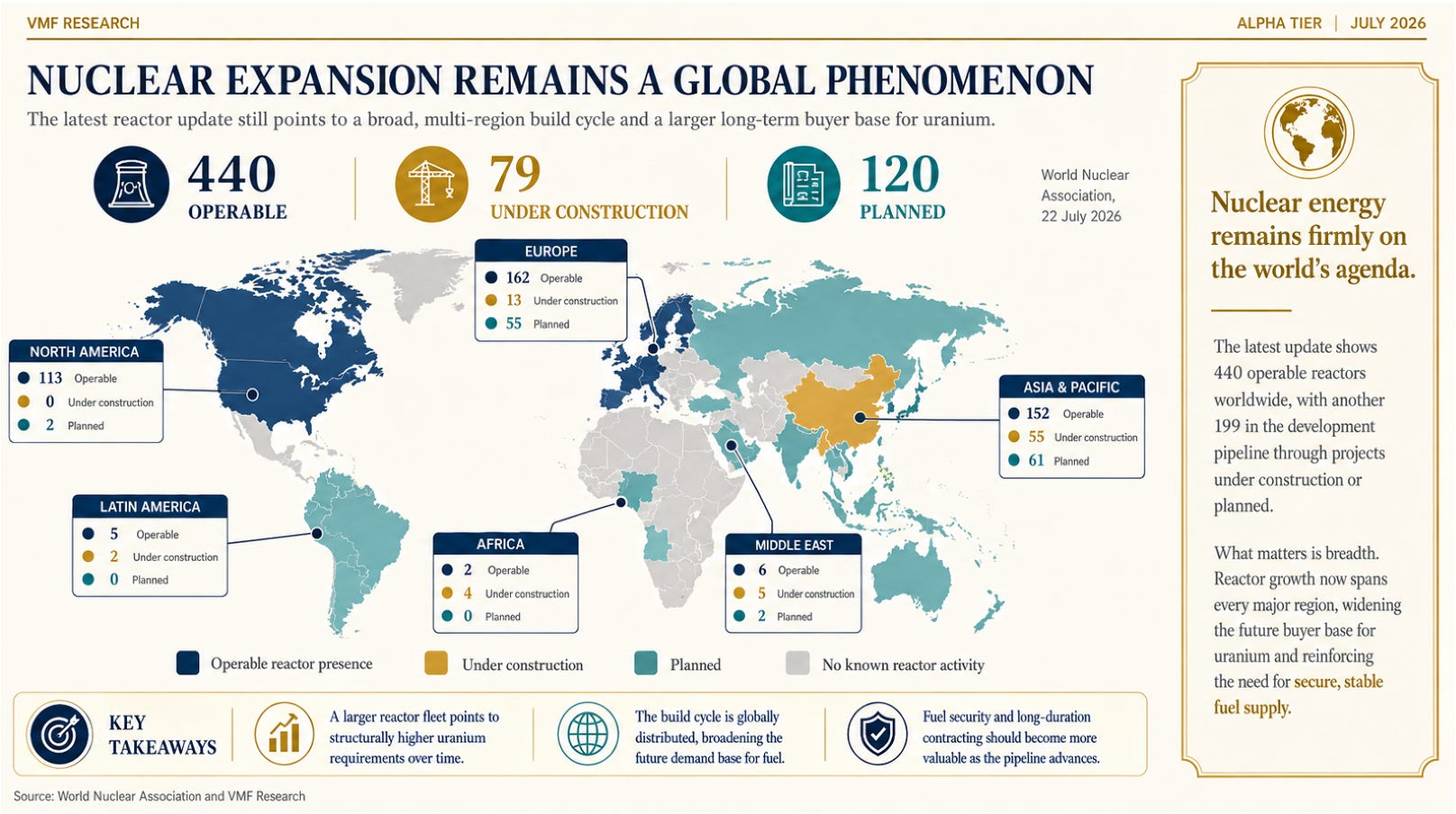
The world now has 440 operational reactors, with 79 under construction and another 120 planned. The World Nuclear Associations' reference scenario projects annual reactor requirements rising from approximately 175 million pounds of U₃O₈ equivalent in 2024 to 391 million pounds by 2040.
Not every proposed reactor will be completed. Timetables will slip, policies will change and construction costs will remain difficult to control. The broad direction is nevertheless clear. Demand is expected to rise from a market that cannot fully supply today’s consumption from primary production.
Supply-and-demand scenarios compiled from UxC and Cameco data indicate a cumulative uranium shortfall of approximately 1.4 billion pounds through 2045 under the base case. If the international objective of tripling global nuclear capacity by 2050 were achieved, the projected deficit would exceed 3 billion pounds.
These forecasts are not promises. Their value lies in illustrating the scale of the response required. Balancing the market would demand a combination of substantially higher mine output, additional secondary supply, lower reactor growth or sustained inventory depletion. None is assured.
The textbook answer to a commodity shortage is higher prices. Higher prices encourage production, attract capital and eventually restore equilibrium.
Uranium complicates that sequence.
The commodity price can move in weeks. A mine may require a decade. Resources must be discovered, delineated and permitted. Processing infrastructure must be financed and constructed. Governments can alter royalties, taxes or operating conditions. Technical studies must survive contact with geology, and projects that appear economic on paper can suffer delays, dilution and cost overruns before producing a single pound.
Even established operations regularly miss production targets.
Supply therefore responds slowly and unpredictably.
Demand is less flexible.
Uranium represents a relatively small share of the total cost of operating a nuclear power plant. Once the facility exists, its owner has little economic incentive to interrupt generation in order to save a few dollars on fuel. The reliability of supply is considerably more important than obtaining every pound at the lowest available price.
Utilities have nevertheless spent much of the past decade postponing the decision. Long-term contracting has remained below replacement requirements for 13 consecutive years. Approximately 116 million pounds were contracted in both 2024 and 2025, materially below annual reactor demand. Even the apparent return to replacement-level contracting in 2023 was distorted by a large one-off purchase from Ukraine.
The market has deferred the purchases.
It has not removed the reactors.
As older contracts expire and available inventories decline, utilities must eventually return to the term market (or accept greater exposure to a comparatively thin spot market that may not contain the volumes they require).
The geographical structure of supply makes waiting more dangerous. Kazakhstan accounted for approximately 39% of world uranium production in 2024. Canada represented another 24%, while Namibia, Uzbekistan and Australia provided much of the remainder. A portion of Kazakhstan’s output is transported through Russia, which also remains central to conversion and enrichment (the specialised stages required to transform mined uranium into usable reactor fuel).
Ore in the ground is not the same as assured fuel in a reactor. Mining, conversion, enrichment, fabrication and transport form one interconnected supply chain. A bottleneck at any point can tighten the entire system, raise inventory requirements and increase the strategic value of supply from politically dependable jurisdictions.
The uranium cycle is therefore being shaped by two forces at once:
More reactors require more fuel.
Deglobalisation requires more secure fuel.
Western governments are attempting to rebuild capabilities that were allowed to erode during decades of inexpensive imports. The United States, once the world’s dominant uranium enricher, now has no domestically owned commercial enrichment capacity and has lost almost all of its mine production. Reconstructing that chain will require capital, time and prices capable of rewarding the investment.
The path from a tighter uranium market to uranium equities is not automatic.
It is, however, powerful when it works.
Higher long-term prices expand the margins of existing producers. Better cash flow supports mine extensions, restarts and brownfield development. Resources that were uneconomic at lower prices become more valuable, improving financing conditions for developers and raising the strategic value of credible projects.
The operating leverage can be substantial.
Capturing it without allowing one mine, jurisdiction or management team to determine the outcome is the more difficult part.
Physical uranium offers the cleanest exposure to the commodity, but none of the earnings leverage available to producers. A single miner can deliver far greater upside, yet the result may depend on one asset performing exactly as expected. Junior miners increase the optionality further, together with the financing, dilution and execution risks attached to projects that may remain years from production.
URNM ( URNM 0.00%↑ ) offers the more balanced expression.
The Sprott Uranium Miners ETF (URNM) combines established producers, developers and physical uranium within one vehicle. As of 30 June, it held 26 issuers, with approximately 82% invested in uranium-related equities and 18% in physical uranium. The structure therefore captures higher fuel prices, expanding producer margins and the increasing strategic value of credible future supply without making the thesis dependent on one mine succeeding.
Tier One subscribers will already know the position. URNM has been held in VMF’s Strategic Asset Allocation Model Portfolio since August 2024. The original recommendation performed strongly before the ETF surrendered a substantial part of its advance over the past several months.
That correction has not weakened the uranium thesis.
But it has restored the asymmetry.
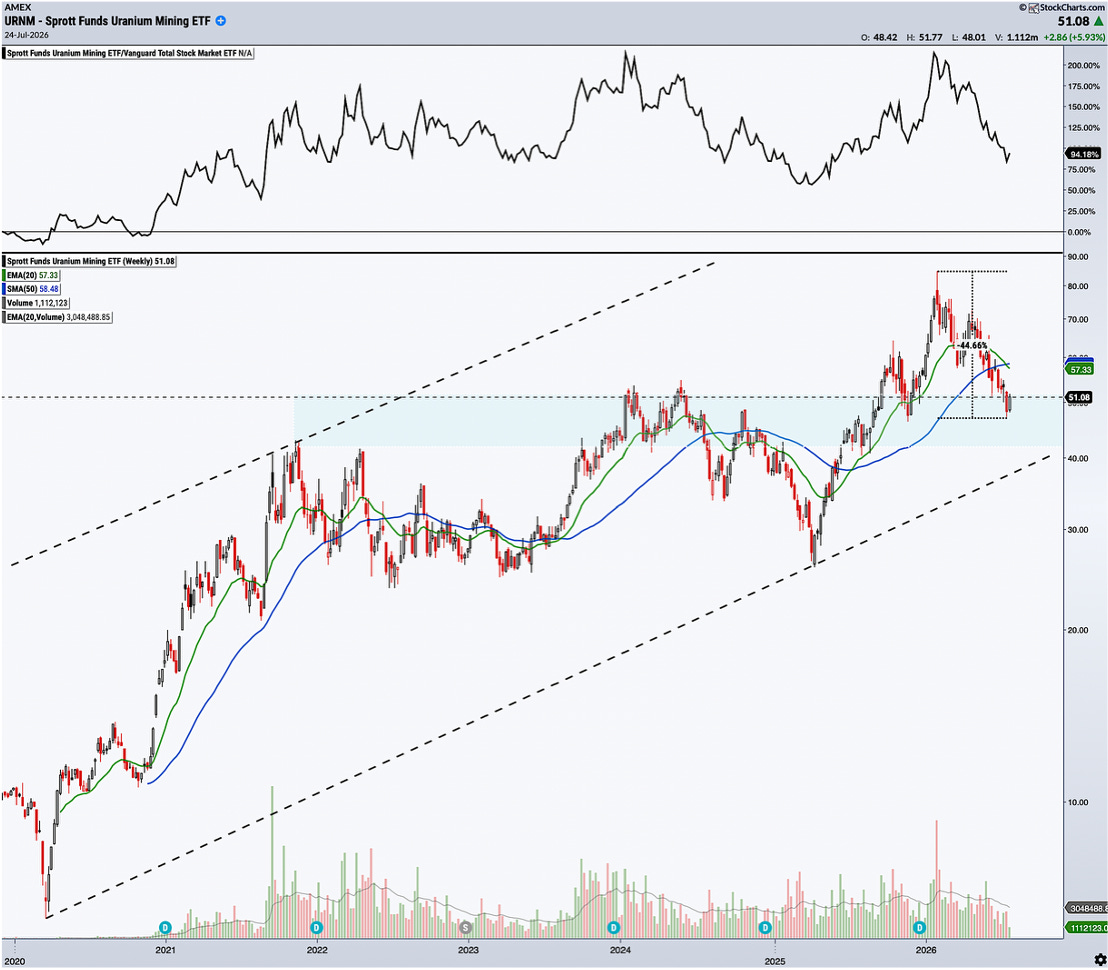
Since inception, URNM has maintained a constructive relative-strength trend against the broader US equity market. That long-term market confirmation lends credibility to the fundamental case, even though the path has been exceptionally volatile. The short-term picture is now far less comfortable. Since the beginning of the year, the ETF has fallen almost 45%, broken below its shorter-term trend measures and returned to an important support zone.
Momentum is weak. But the long-term structure remains intact. That combination is precisely why the position now merits consideration inside Alpha Tier.
There is an obvious parallel with our China exposure. In both cases, the fundamentals are improving faster than the price action. But the portfolio implications are different. China already represents a meaningful overweight, and adding more would deepen an existing concentration before the broad technical evidence confirms the thesis.
You might also like reading:

URNM diversifies the portfolio into another sector, another set of earnings drivers and another physical bottleneck. Its short-term technicals are equally damaged, but its long-term relative-strength structure remains considerably more constructive.
We are therefore willing to act before a full technical recovery.
Important Disclosure
This article contains general investment research produced by Vasco Marques de Freitas, CFA, CMT, Founder and CEO of VMF Research, Lda. It reproduces an excerpt from the July 2026 issue of Alpha Tier. The research, views and Alpha Tier Model Portfolio information are stated as of 24 July 2026, 4:00 p.m. Eastern Daylight Time, unless another date is expressly identified. The original issue was first disseminated to paid subscribers on 24 July 2026 at 9:00 p.m. Eastern Daylight Time.
The publication contains information recommending or suggesting an investment strategy. It is not personalised investment advice and does not consider any reader’s individual objectives, financial circumstances, knowledge, experience, liquidity requirements or tolerance for risk. The Alpha Tier Model Portfolio is an illustrative research portfolio and does not represent client assets, transactions executed by VMF Research or the performance of an investable fund or managed account.
The analysis combines thematic, fundamental, commodity, energy-market, geopolitical, technical and portfolio-construction research within a medium- to long-term investment framework. Statements concerning future electricity demand, nuclear-power deployment, uranium requirements, contracting activity, mine supply and the potential effects of artificial intelligence on energy consumption are analytical judgments and scenario-based estimates rather than assurances. Forecasts may change materially as reactor construction, energy policy, commodity markets and supply conditions evolve.
Investments in uranium, uranium-mining companies and related exchange-traded funds involve substantial risks, including commodity-price volatility, mine-development and operating risk, permitting delays, cost inflation, financing and dilution risk, political and jurisdictional uncertainty, changes in nuclear-energy policy, reactor delays or cancellations, supply responses, inventory releases, geopolitical disruption, currency movements, liquidity constraints and the possible loss of capital. Higher uranium prices or greater nuclear-power demand may not translate into higher earnings or investment returns for uranium-related companies or funds. Technical and relative-strength signals may also fail.
Neither VMF Research nor the author received compensation from any issuer or other entity discussed in connection with the preparation of this research, and no issuer reviewed, approved or amended its conclusions before first dissemination.
Past performance, Model Portfolio performance and commodity-price history are not indicative of future results. Readers should conduct their own analysis and, where appropriate, consult an authorised financial intermediary or adviser before making an investment decision.