

Markets are not merely volatile right now.
They are fractured.
Across asset classes, across geographies, across sectors, even across individual risk factors, price action is becoming more and more uneven. Indexes can still look deceptively calm on the surface, but underneath them the dispersion is extraordinary. Some assets are being punished as if the future has already been cancelled. Others are being bid as if the next cycle has already begun.
That is the environment we tackled in February’s issue of Alpha Tier.
In that issue, we argued that three uncertainty waves are colliding at once: monetary-policy uncertainty, geopolitical uncertainty, and disruptive-innovation uncertainty.
And when markets are forced to absorb all three at the same time, they stop agreeing on the future. That is when dispersion becomes historic.
But that is also when opportunity begins to emerge.
Because when uncertainty gets this extreme, positioning gets stretched, psychology gets brittle, and the bar for positive surprises falls remarkably low. In our view, that is one of the most important truths in markets right now.
The excerpt below comes from the section titled “The Agentic Era.” It sits inside that broader framework. Because while markets are busy repricing fear across the board, a deeper shift is taking place beneath the surface: AI is no longer just answering questions. It is beginning to act. And once software becomes a doer, not just a tool, the implications spread far beyond technology stocks. They reach business models, financial rails, and entire asset classes.
That is what this excerpt explores.

To understand why crypto is getting hit this hard we need to address about what sits the core of this entire disruptive innovation wave.
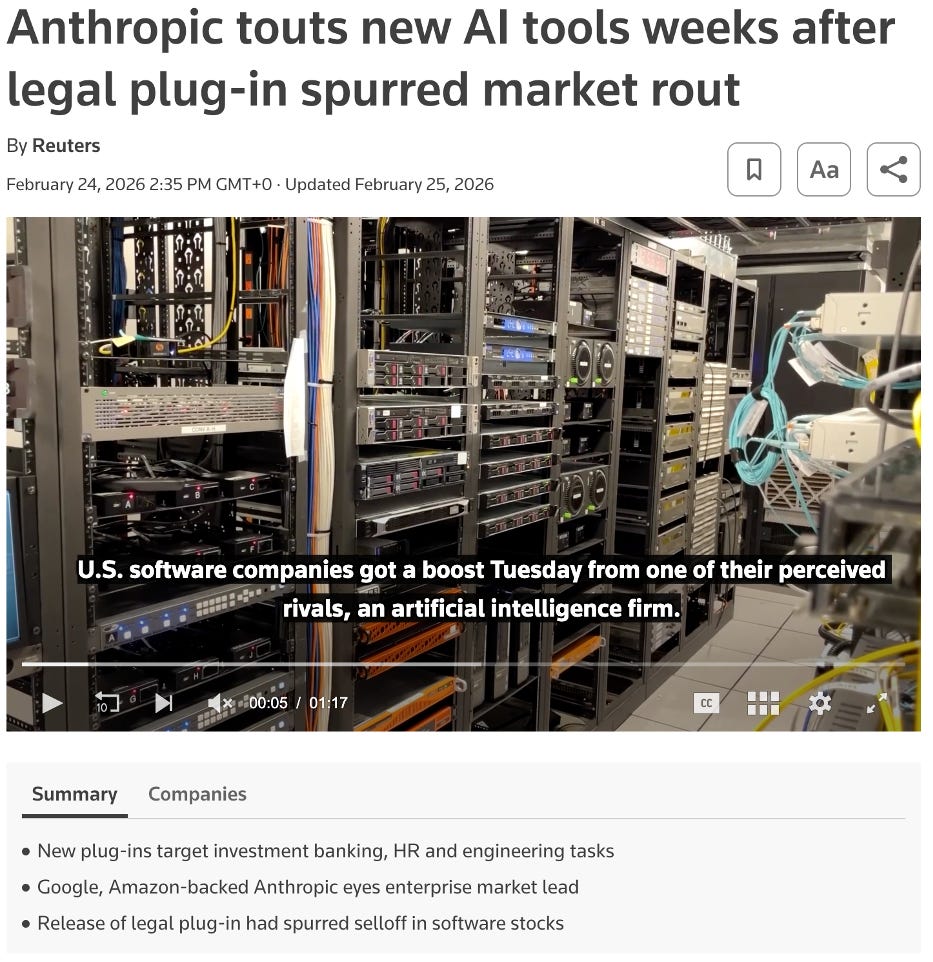
It’s the Agentic AI era, and few companies are pushing it harder right now than Anthropic, through Claude and the fast-expanding ecosystem of tools and plug-ins being built around it.
But what does that actually mean... “Agentic AI”? Most people still think of AI as a smart autocomplete machine: you ask, it answers.
Agentic AI is different. It doesn’t just respond, it acts. It can take a goal, break it into steps, call tools, move across apps, and iterate until the job is done. It’s closer to an autonomous operator than a chatbot.
Picture the difference with something concrete.
A classic chatbot can tell you how to refinance a mortgage.
An agent can do it: pull your statements, compare rates, request offers, schedule calls, draft emails, and bring you the top two options with trade-offs clearly laid out, then execute the paperwork once you approve.
Or think about a small business owner.
A chatbot can explain VAT rules. An agent can reconcile invoices, flag anomalies, file documents, chase late payments, and update cash-flow forecasts, day after day, without you even thinking about it.
And Wall Street is already building this.
Goldman Sachs - GS 0.00%↑ is working with Anthropic to develop Claude-based agents for tasks like trade and transaction accounting, due diligence, and onboarding - exactly the kind of operational work that used to consume armies of humans and endless process checklists.
This is why the market is repricing so violently: once software becomes a doer, it stops being a feature... and starts becoming a substitute.
But this is where the story gets even more interesting, because agentic AI doesn’t just create winners.
It also creates a new category of problems.
An internet designed at human scale doesn’t have a native way to distinguish a person from a machine at scale, without creating friction, surveillance, or both.
And as agents begin to transact, coordinate, and communicate across platforms like humans do, impersonation becomes cheaper than ever: one actor can effectively become a thousand “people.” Detection tools like CAPTCHAs are fighting an arms race they can’t win.
Then comes the enterprise version of the same risk.
When agents can take actions inside real systems (finance, procurement, CRM, support, compliance) the attack surface expands. Permissioning, logging, audit trails, and governance stop being “nice-to-haves.”
They become the gating factor to deploying agents at scale.
That’s exactly why McKinsey and BCG have been emphasizing safety, security, and governance frameworks as foundational, not optional.
Now we can connect the dots to blockchain.
Because what agentic AI really needs is a trust and settlement layer - a way to prove identity (or personhood), carry permissions across platforms, transact in tiny increments, and leave an auditable trail... without forcing the whole world to trust a single gatekeeper.
This is where blockchains can become the missing infrastructure.
a16z lays out the logic cleanly:
Blockchains can help raise the marginal cost of impersonation through proof-of-personhood systems (scarcity at the identity layer).
They can support portable “passports” for agents, so the same agent can operate across apps and marketplaces with verifiable identity, permissions, and payment endpoints.
They can enable machine-scale payments: micropayments, agent-to agent commerce, and programmable revenue splits that traditional payment rails were never designed for.
And they can support privacy-preserving verification using modern cryptography (think proving a fact without revealing the underlying sensitive data).
And this isn’t just theory anymore.
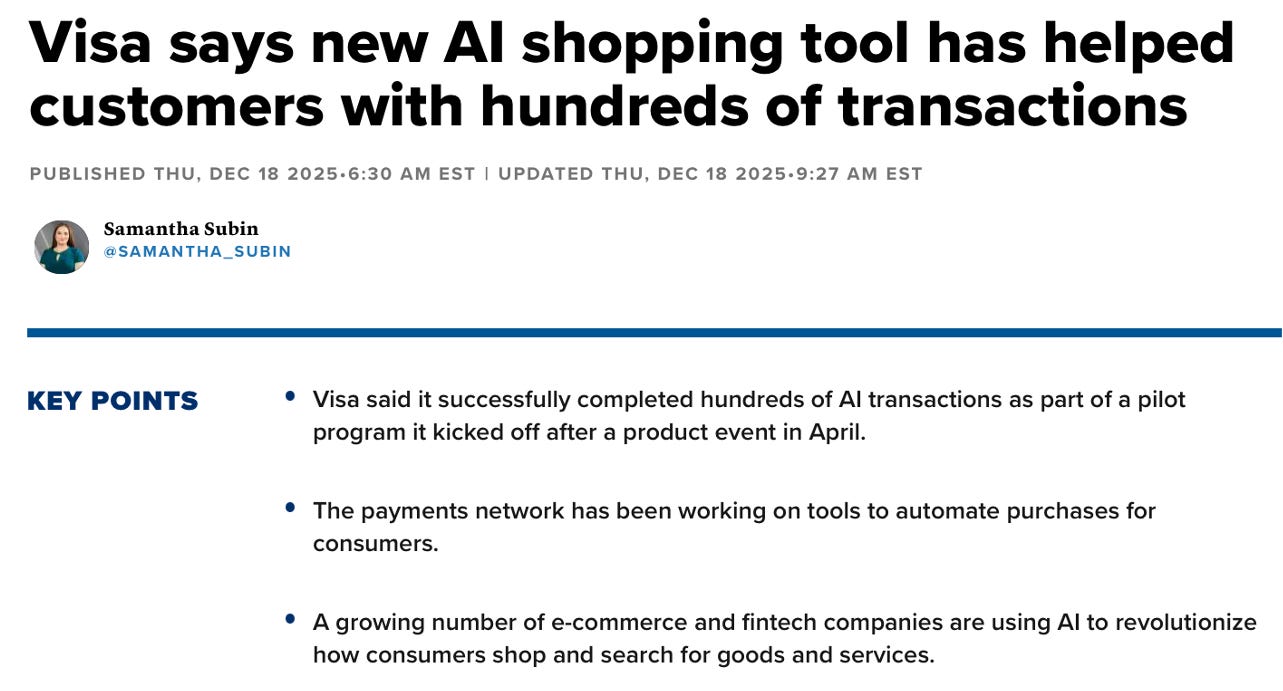
Visa - V 0.00%↑ has already announced it has completed secure AI-initiated transactions with partners, explicitly framing 2026 as the year when agents don’t merely assist shopping — they complete purchases.
Anthropic itself is pushing Claude deeper into enterprise workflows through plug-ins designed for tasks across investment banking, wealth management, HR, engineering, and design, i.e., exactly the terrain where agents need identity, permissions, and auditability.
Even ARKK 0.00%↑ has spelled out a simple, powerful implication: agents that can custody private keys on blockchains gain the ability to hold assets and interact with decentralized markets... a form of autonomy that’s harder, if not impossible, to replicate with legacy rails.
So yes... in our view, this agentic shift materially corroborates our long-standing crypto thesis.
Because when you boil down the “blockchain for AI agents” investment theme, you end up with the same primitives we’ve been building exposure to all along: programmable settlement, composable finance, tokenization, and the rails for global digital value transfer.
In that context, Ethereum and Solana stand out as the kind of platforms that could benefit asymmetrically if this “agent economy” actually scales: not because they’re memes, but because they are potential settlement layers for a world where software is transacting, not just talking.
And this is also why our recommendations matter even more in this frame.
On our premium subscription, we have recommended an entry point to secure pre-IPO exposure to SpaceX and AI leaders like Anthropic and xAI before the Wall Street markups.
It’s’ about having exposure to the other side of the stack - the AI paradigm shift itself (including Anthropic and xAI) alongside the broader ecosystem where value accrues as intelligence becomes the new platform.
Which brings us back to where we started: the bar is low for positive surprises across the uncertainty fronts we dissected in the last section.
And if that’s true, then these support zones in Bitcoin, Ethereum, and Solana, after months of punishment, could very well prove to be a monetizable bottom.
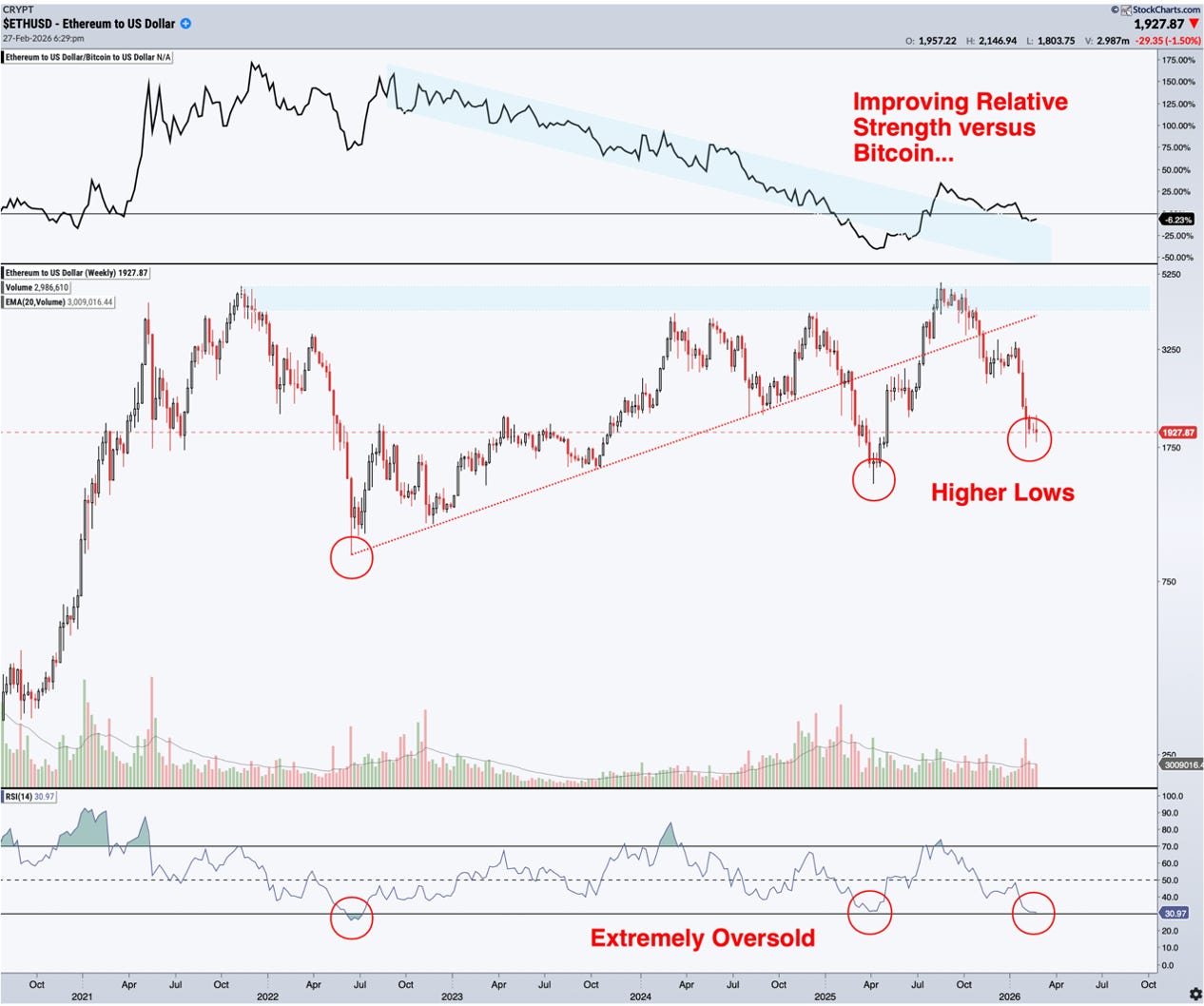
Because even though the technical damage is still obvious, the message from the tape is starting to shift. Look at Ethereum on the chart above: it has begun to print higher highs despite the broader weakness.
More importantly, it’s starting to show early relative strength versus Bitcoin, a subtle tell that the market may be waking up to the fundamentals that sit behind this entire thesis.
And those fundamentals are no longer one-dimensional.
Tokenization is already pushing crypto beyond speculation, turning it into financial plumbing. Now add a second tailwind: the Agentic AI era, which increases the value of programmable settlement, identity, and auditable rails.
Together, they point to a simple conclusion: crypto is becoming more useful, not less - and usefulness is what turns a volatile speculative asset into durable infrastructure.
That’s why we remain firm in our conviction.
You might also like reading:


Check our Leaderboard updates - Top 10 Positions - February 18th, 2026

Looking for where to start?
