

A thirty-year Treasury is not necessarily held by someone with thirty years to spare.
Some hedge funds finance those bonds with short-term borrowing. Tighter funding or larger collateral demands can turn a willing lender to Washington into a forced seller. For these investors, volatility can determine whether they are able to keep holding the debt at all.
This complicates the contrast we explored in A Hawk on Borrowed Time. Kevin Warsh wants clearer market signals, less shaped by Federal Reserve guidance. Scott Bessent must keep refinancing the government in the market producing those signals.
The Treasury describes its expanded buybacks as liquidity support. Our research asks how far that support can stabilise the long end without obscuring the information in its prices. The funding deserves equal attention: issuing new bills and drawing down cash held at the Fed have different consequences for the surrounding financial system.
So... can Washington obtain more dependable financing without making its creditors more dependent on intervention?
First published for paid Tier One subscribers on 11 September 2026, this excerpt follows that question beyond buybacks, into changing reserve preferences and the digital dollars bringing new buyers to American debt. It advances the investigation behind our Dovish Shock thesis. The full September issue carries the analysis through to the Model Portfolio.
Good reading.

The Treasury does not get to wait for the market to agree with it. America’s bills fall due anyway, and every refinancing forces Scott Bessent to confront the price investors demand to keep lending.
What Warsh would like to recover as an economic signal arrives at the Treasury as a financing cost.
On 19 August, Bessent’s department responded. The Treasury announced that the maximum size of its long-end liquidity-support buybacks would increase from $2 billion to at least $4 billion per operation, covering the ten-to-thirty-year sectors from 9 September through 4 November.
Its stated purpose was to improve liquidity.
For our Alpha Tier subscribers, the significance extended beyond those purchases. We interpreted the announcement as evidence that the administration’s tolerance for rising long-term yields had limits. Investors watching the Fed for signs of accommodation had received an answer from the other side of Washington.
The financing mechanics deserve precision.
To understand what these buybacks can achieve, follow the cash. The Treasury pays investors to take bonds off their hands. If it funds those purchases by selling short-term bills, it replaces longer-term debt with shorter-term debt.
The Treasury can also draw on cash already held in its account at the Fed, known as the TGA. Drawing down that balance releases funds into the banking system. This can ease financial conditions without a Fed rate cut. But borrowing to replenish the account can absorb that liquidity again.
Buybacks can provide relief... they do not solve the budget deficit.
On 24 August, five days after the announcement, Stanley Druckenmiller challenged the plan in The Wall Street Journal. The criticism was especially pointed. Druckenmiller had worked alongside Bessent at Soros Fund Management and understood the pressures facing his former colleague.
He called the initiative “price management”.
His argument was straightforward: investors were demanding higher yields for reasons Washington needed to address. Inflation and persistent deficits were influencing the price they charged to lend.
Trying to suppress that price risked silencing the warning while leaving its causes intact.
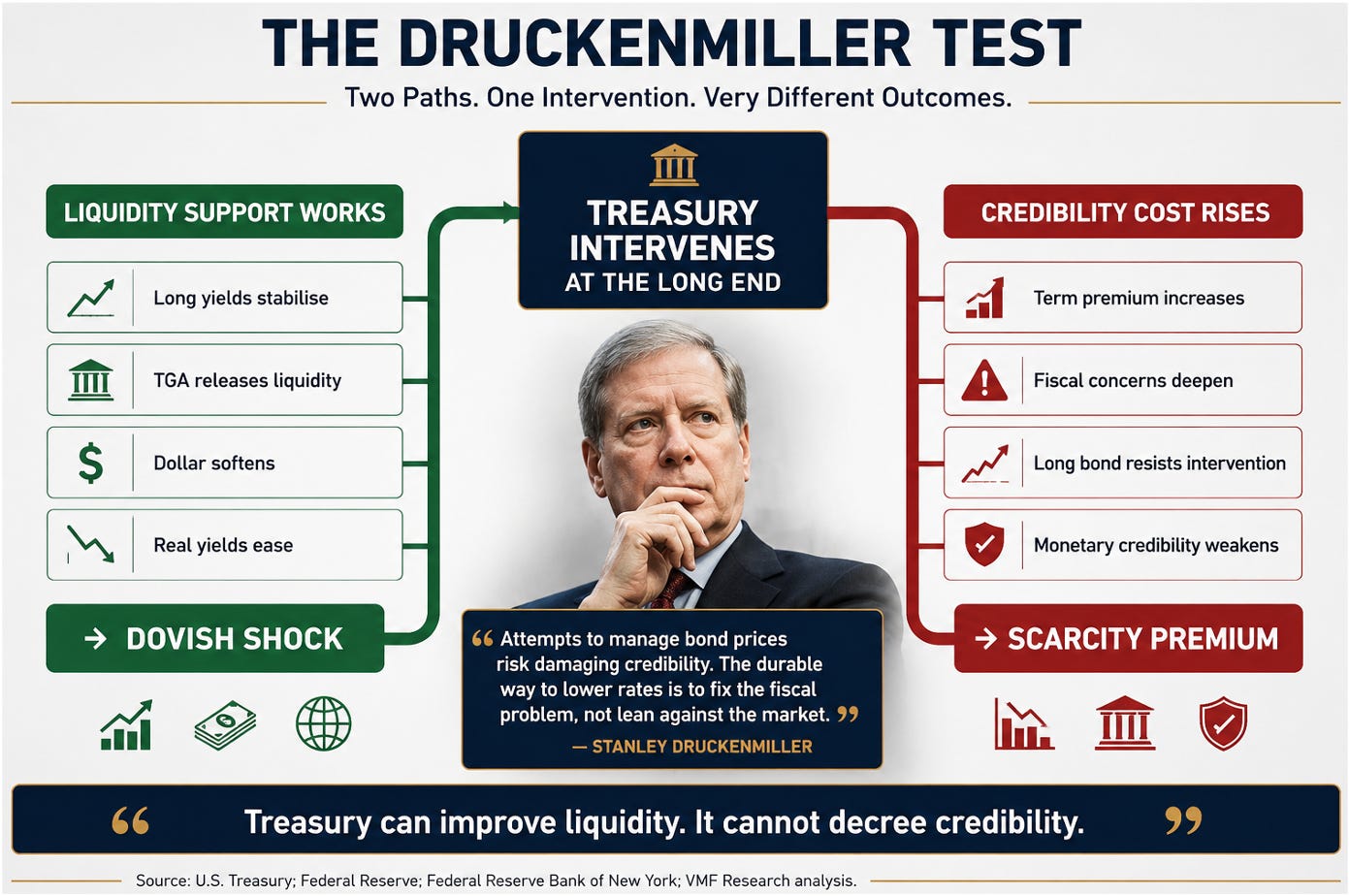
We share the concern about credibility.
Well-designed liquidity support can strengthen a market. The danger begins when investors conclude that the government finds the market’s verdict unacceptable and intends to keep intervening until the price becomes more convenient.
A bondholder might welcome the immediate support while becoming less comfortable with the currency in which that bond will be repaid...
The dollar fell after Bessent’s announcement on 19 August. Its subsequent behaviour brings us back to the puzzle we exposed earlier in the What the Headlines Miss section. The chart on page 6 shows the summer rebound faltering, even as long- term Treasury yields remained elevated inside our TACO Zone.
Higher yields can make dollar assets more attractive. But the extra interest is only part of the return. For investors abroad, losses on the dollar can outweigh that advantage. And higher yields do not always signal confidence in stronger growth. They can also reflect demands for compensation against inflation and the risks of persistent government borrowing.
That is the possibility we are watching. High yields and a weakening dollar can express the same unease. The charts alone cannot establish the cause, but they help explain our concern: supporting Treasury bond prices may offer immediate relief without restoring confidence in the money those bonds promise to repay.
For a central bank, this raises a practical question about how to protect its country’s reserves. These assets form a financial buffer for difficult times. Earning interest is useful, but so is reducing dependence on any one currency or government.
Gold offers that independence. It pays no interest, and its price can fall sharply. Yet physical bullion held outright is nobody else’s debt. There is no issuer who must honour a payment or find new lenders when an old obligation falls due.
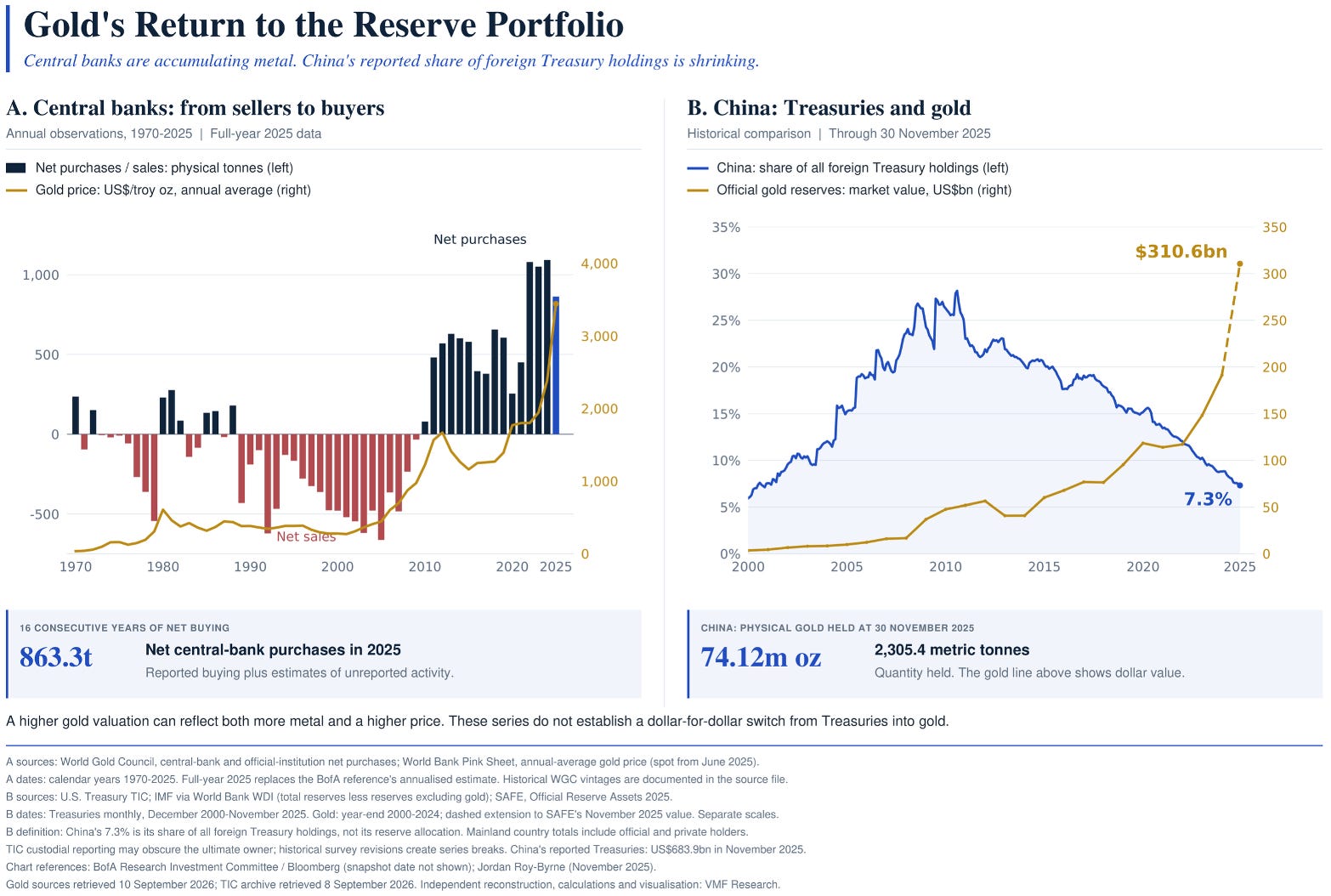
Its growing role is already visible. According to the ECB, gold represented 27% of global official reserves at the end of 2025. US Treasuries accounted for 22%. Rising gold prices explain much of that shift: the metal already held became more valuable. Central banks also continued buying additional gold, although purchases slowed from the exceptional pace of previous years. The change therefore reflects both accumulation and appreciation.
China makes the accumulation easier to see.
Its official figures show another 650,000 ounces added during August, taking reported holdings to 76.73 million ounces. Those are additional ounces, so the increase cannot be explained by a rising gold price.
Alongside the decline in China’s reported Treasury holdings shown earlier, this is consistent with a gradual diversification of its reserves. We cannot establish that each dollar withdrawn from Treasuries went into gold. But we can observe a larger holding of physical metal alongside a smaller reported holding of American government debt.
Even the location of the metal is receiving renewed attention.
On 2 September, the Dutch central bank disclosed a redistribution that reduced New York’s share of its gold reserves from 31.3% to 18.5%. Most of the adjustment involved sales in New York and purchases in London, alongside physical transfers. Total gold holdings were unchanged. The bank cited crisis preparedness and the ability to mobilise its reserves quickly.
That is a revealing consideration. An emergency reserve must be accessible when financial conditions are strained and political relationships may be least predictable. Ownership, custody and liquidity all enter the decision.
Bessent, meanwhile, has a very modern way of reaching the next buyer of American debt...
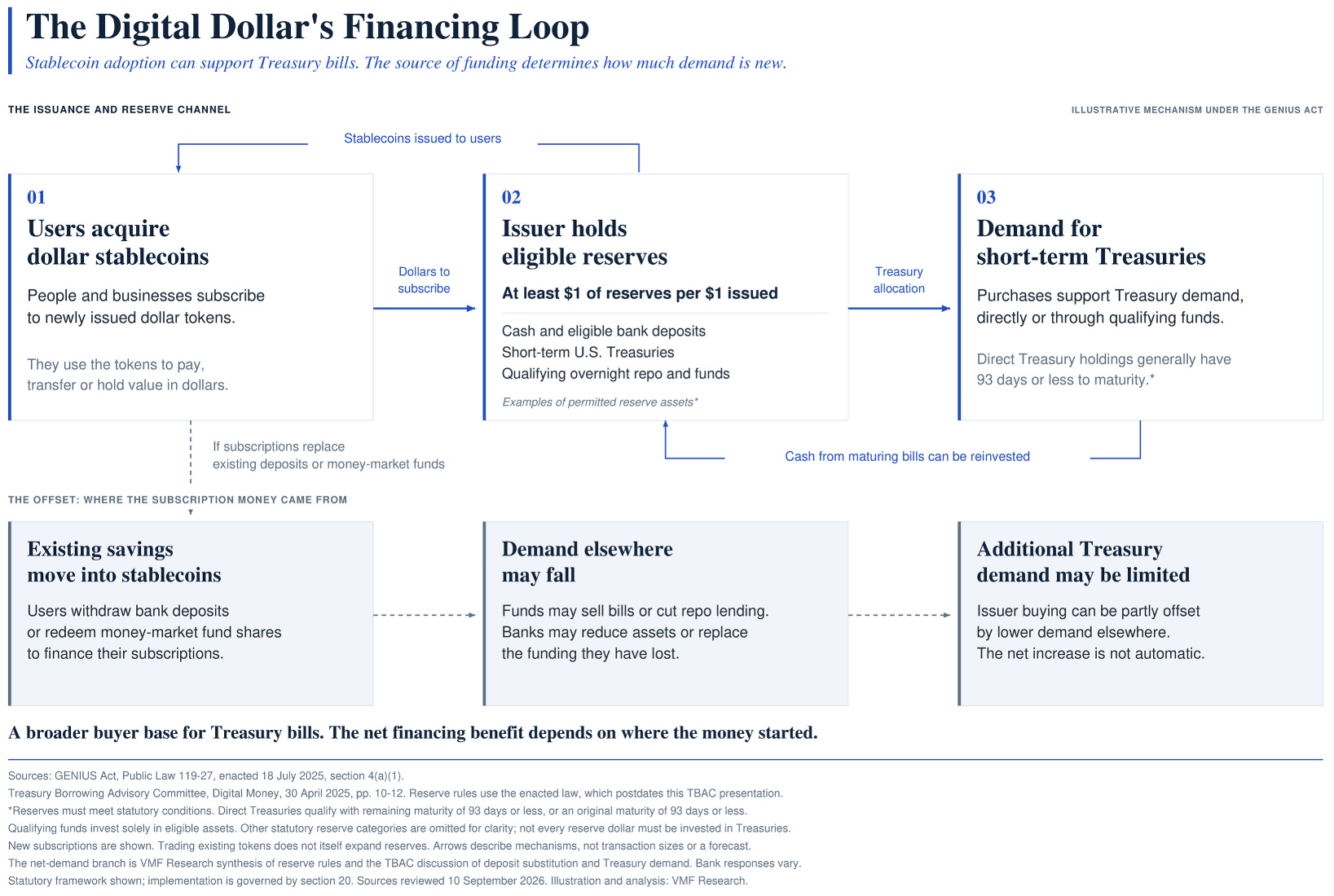
Consider a saver outside the United States who wants to hold dollars on a phone. That person may never open an American brokerage account or participate in a Treasury auction. Yet buying a dollar stablecoin can place their savings behind US government debt through the issuer’s reserve portfolio.
The GENIUS Act establishes a framework requiring at least one-for-one backing with eligible reserve assets, including cash and short-dated Treasuries. It gives the expansion of digital-dollar payments a direct connection to demand at the short end of the government bond market.
Bessent has made the policy objective explicit. When the legislation was signed, he linked stablecoin adoption to both stronger international use of the dollar and increased demand for Treasuries.
Washington’s enthusiasm has a financing logic: a larger digital-dollar economy can bring a larger audience to America’s debt.
The opportunity is substantial, but the net contribution depends on where the money originates. Moving savings from a money-market fund into a stablecoin may simply move Treasury ownership between intermediaries. Treasury’s own advisory committee has acknowledged that offset. And a growing appetite for bills does not automatically supply buyers willing to lend for thirty years.
For our Alternatives book, these tensions create opportunities with different drivers.
Gold draws support from the search for an asset that carries no sovereign promise. Bitcoin offers a digital form of monetary scarcity. And the networks carrying stablecoin payments may benefit as more financial activity moves onto them. Here, however, adoption must translate into lasting economic value for their tokens.
These assets do not need a single forecast to rise together. Some investors are seeking protection from the monetary system’s vulnerabilities. Others are investing in the technology helping that same system extend its reach.
Both forces can operate at once.
That brings us closer to resolving the puzzle we framed in “What the Headlines Miss”. It helps explain the simultaneous strength of precious metals and crypto. Yet another piece remains: the resilience of equities whose valuations depend heavily on profits many years into the future.
Elevated long-term yields should make those distant earnings less valuable today, all else equal. But markets rarely hold everything else equal. The question is whether investors are seeing something in tomorrow’s earnings powerful enough to outweigh today’s higher cost of money.
To understand that, we must look beyond Washington’s efforts to finance yesterday’s commitments. We must examine what the economy may be capable of producing tomorrow.
Important Disclosure
This article contains general investment research produced by Vasco Marques de Freitas, CFA, CMT, Founder and CEO of VMF Research, Lda. It reproduces “Old Debts, New Dollars” from the September 2026 issue of VMF’s Strategic Asset Allocation. The underlying research was completed on 11 September 2026 at 4:00 p.m. Eastern Daylight Time and first disseminated to paid subscribers on 11 September 2026 at 9:00 p.m. Eastern Daylight Time.
The publication contains information recommending or suggesting an investment strategy. It is not personalised investment advice and does not take account of any reader’s objectives, financial circumstances, knowledge, experience, liquidity needs or risk tolerance. The Tier One Model Portfolio is an illustrative research portfolio and does not represent client assets, transactions executed by VMF Research or the performance of an investable fund or managed account.
The analysis combines macroeconomic, monetary-policy, fixed-income, liquidity, reserve-management and digital-asset research. Conclusions concerning Treasury buybacks, the Treasury General Account, long-term yields, changes in Treasury demand, reserve diversification, gold, stablecoins and digital assets are analytical judgments and conditional scenarios rather than assurances.
Treasury buybacks are debt-management operations and do not, by themselves, constitute quantitative easing or yield-curve control. Their effect depends on scale, maturity, financing and surrounding issuance. A TGA drawdown can add bank reserves, all else equal, but later borrowing or other Treasury operations can offset that effect. Buybacks may improve liquidity without sustainably lowering long-term yields and may also affect perceptions of fiscal and monetary credibility.
Gold, Bitcoin, cryptoassets, stablecoins and related instruments involve materially different risks, including market, liquidity, custody, counterparty, technological, cybersecurity, regulatory and currency risks. Stablecoin growth does not necessarily create net new Treasury demand, and greater demand for short-dated bills does not necessarily translate into demand for long-dated government bonds.
Disclosure of interests: as of the research cut-off, legal entities controlled by Vasco Marques de Freitas held long positions in listed exchange-traded products providing economic exposure to Bitcoin, Ether and Solana. These interests may create actual, potential or perceived conflicts of interest and should be considered when evaluating the analysis. Their existence does not validate the conclusions, reduce investment risk or imply suitability for any reader.
Neither VMF Research nor the author received compensation from any issuer, fund sponsor or other covered entity in connection with the preparation of the original research, and no covered entity reviewed, approved or amended its investment conclusions before first dissemination.
Past performance, Model Portfolio performance, historical market relationships and forward-looking scenarios are not reliable indicators of future results. Readers should conduct their own analysis and, where appropriate, consult an authorised financial intermediary or adviser before making an investment decision.