

Today I’m going to show you exactly what sits behind the paywall at VMF Research. This post shares a full section from the February issue of VMF’s Security Selection (“Stress Test”).
VMF’s Security Selection is our Tier Two publication dedicated to one thing: stock picking. It’s where we test business-model durability, hunt for asymmetry, and avoid value traps that only look cheap because the economics underneath are quietly deteriorating.
That work matters more than ever, because markets are being torn apart by record levels of uncertainty. The result is extreme dispersion, with some assets compounding while others unravel on a single headline or a single shift in perception.
At the security-selection level, one of the biggest sources of uncertainty right now is obsolescence fear driven by gargantuan leaps in AI capability. The market is reacting violently, and that can create opportunity… but only if you can tell the difference between a business that is being unfairly punished and a business whose core economics are drifting toward irrelevance.
In February we went deep on that exact question. We dissected the value proposition of our Model Portfolio positions most exposed to AI, including both the winners and the names the market is perceiving as losers.
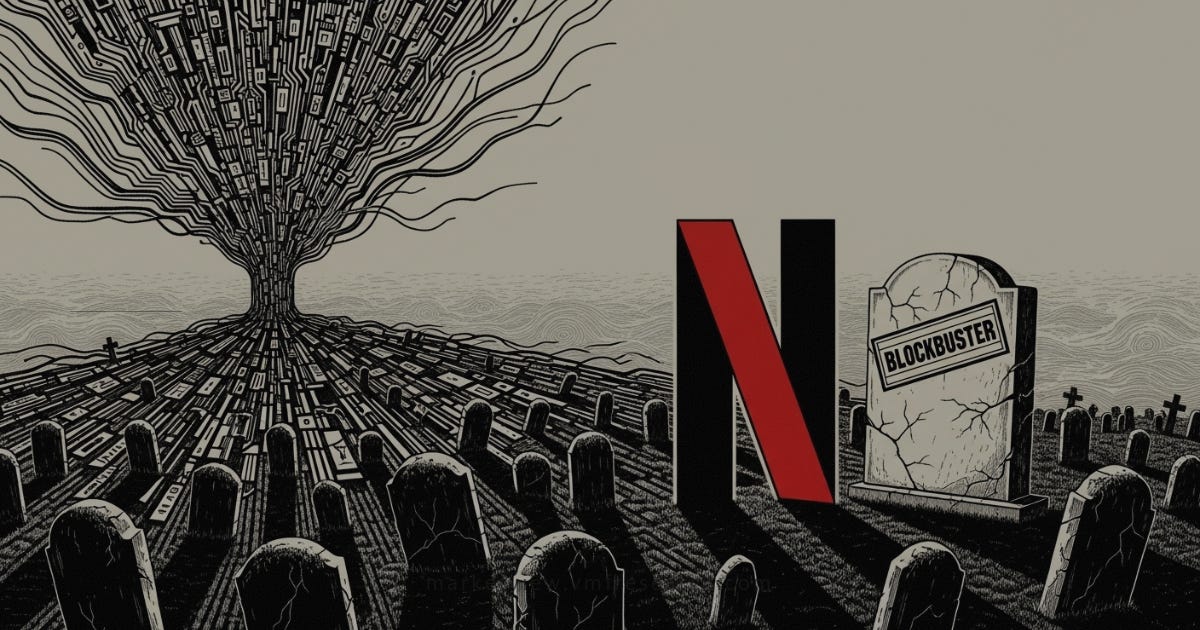
To set the exercise up, we revisited the Blockbuster and Netflix story through our own lens. Because just as then, disruption is rewriting habits, and there are “Blockbusters” hiding in plain sight today. There are also a few “Netflixes.” Our job is to flag which is which.
As always, the truly actionable work remains behind the paywall.
Here is “The Blockbuster Test.”
Picture the late 1990s.
Friday evening. You’ve finally got a break. You want a movie. Not tomorrow. Not “when it ships.” Now.
That “now” was Blockbuster’s real product.
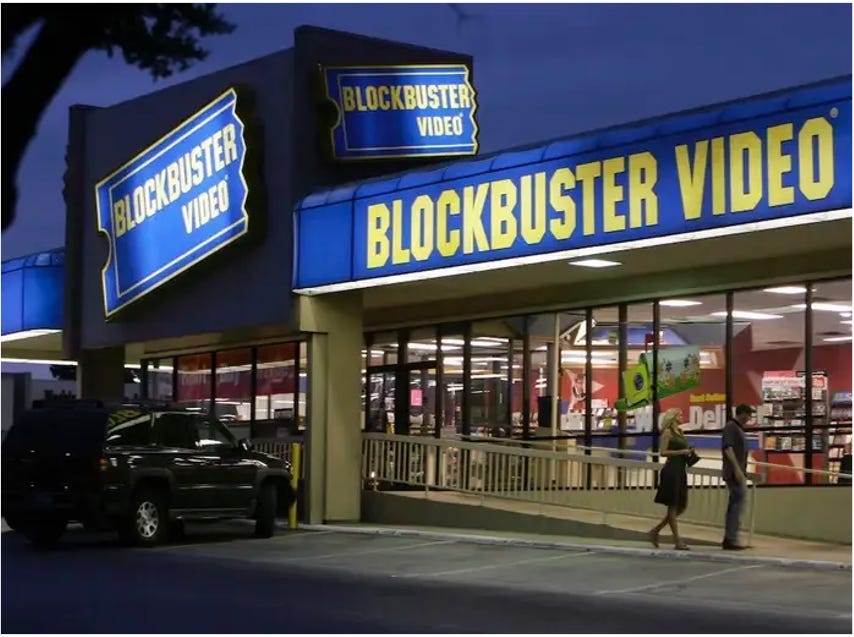
Blockbuster’s value proposition was simple and brilliant: instant access to entertainment, packaged as a ritual.
Thousands of stores. Bright lights. Walls of covers. A front aisle stacked with “New Releases” like candy at the checkout. You’d browse with your family or friends, argue about what to watch, and walk out with the weekend in a plastic case. It was convenience, the old-fashioned kind: you drove to it.
But under that ritual sat a very specific business model.
Blockbuster was a high fixed-cost retail network designed to monetize foot traffic.
Stores created local dominance: one in every neighborhood, then two, then three.
Inventory was managed like a supermarket: allocate shelf space to the highest-turning titles.
The “New Release” section was the engine: it pulled you in with the movies you actually wanted this week.
And once you were in the store, you’d buy the extras: candy, soda, popcorn, maybe a game rental, maybe a used DVD.
Then came the part investors loved and customers hated: late fees. Late fees were not a side hustle. They were a feature of the economics. They monetized human forgetfulness.
The business didn’t just rent you the tape... it charged you for the friction of returning it on time.
That is what made Blockbuster look like a machine. It wasn’t just the revenue. It was the predictability: you could open stores, drive recurring traffic, and harvest that friction at scale.
And for years it worked so well that it created one of the most dangerous illusions in markets... the illusion of permanence... that consumer habits don’t change:
“This can’t go away. People will always want movies.”
But customers weren’t loyal to Blockbuster. They were loyal to being entertained at home. Blockbuster’s edge wasn’t movies. It was distribution. The stores were the distribution system.
And that’s the key: when technology, harnessed by a once-in-a-generation innovator, changed distribution, Blockbuster’s moat gradually became a speed bump.
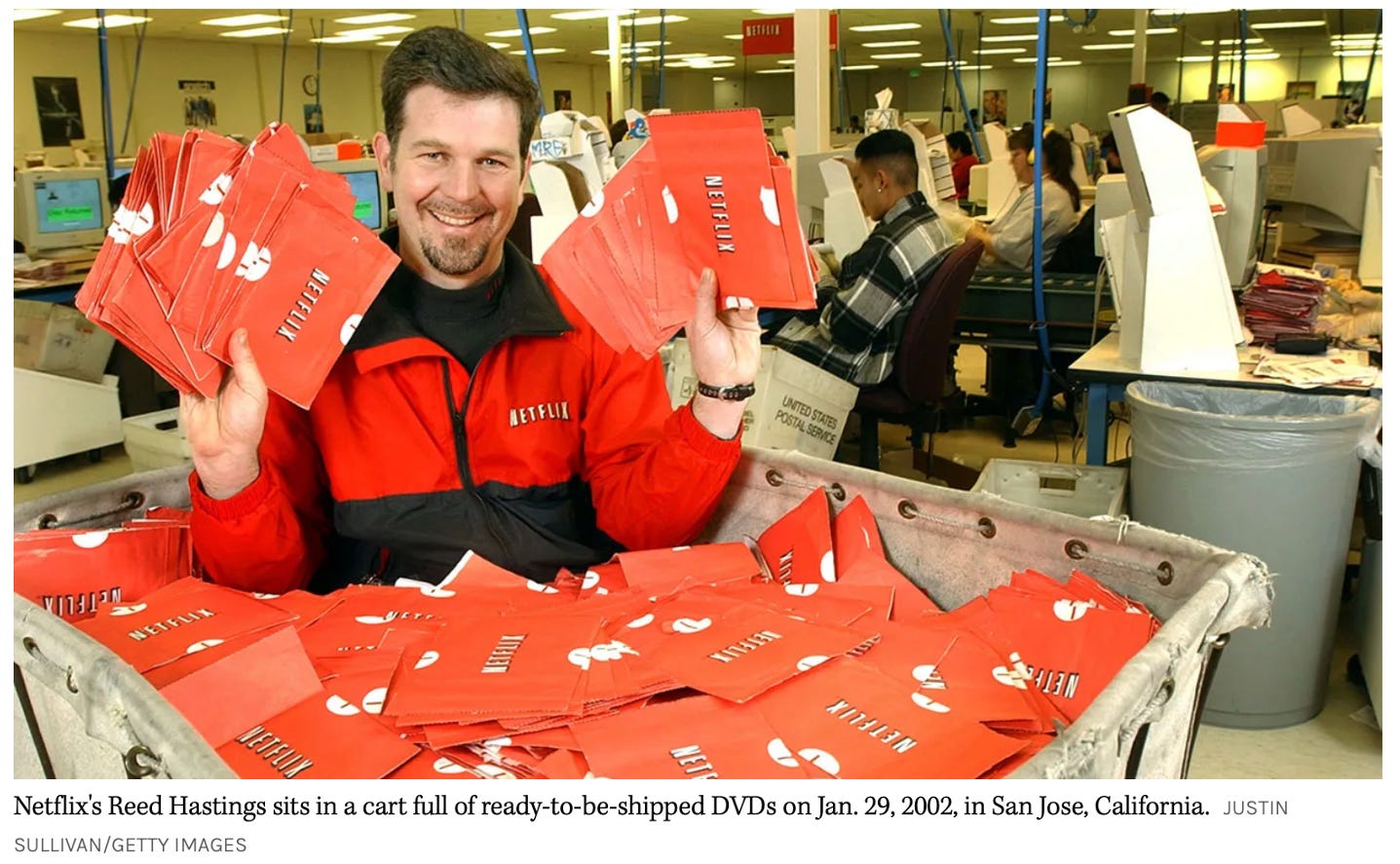
Netflix understood this early... not because it had a better store, but because it attacked the pain points that Blockbuster depended on.
First, it removed the return trip.
DVDs-by-mail didn’t feel revolutionary at first. It sounded almost boring: pick a movie online, get it in an envelope, send it back when you’re done. But it did something psychologically powerful: it made the Blockbuster ritual feel like work.
No driving. No “out of stock.” No walking around under fluorescent lights hoping the new release wasn’t gone.
And most importantly... no late fees.
Now imagine what that means strategically. If you’re Blockbuster, you can’t match that without blowing up a big chunk of your own profit pool. Because the thing customers despised was also the thing that quietly made the model so lucrative.
That’s why the Netflix story isn’t just “a rival appeared.” It’s that a rival showed up with an offer that forced Blockbuster to hurt itself in order to compete. Netflix wasn’t asking Blockbuster to tweak pricing or improve store execution. It was asking Blockbuster to abandon the very frictions that quietly powered its economics.
And then came the moment that should be burned into every investor’s brain:
Ironically, Netflix offered itself to Blockbuster for $50 million.
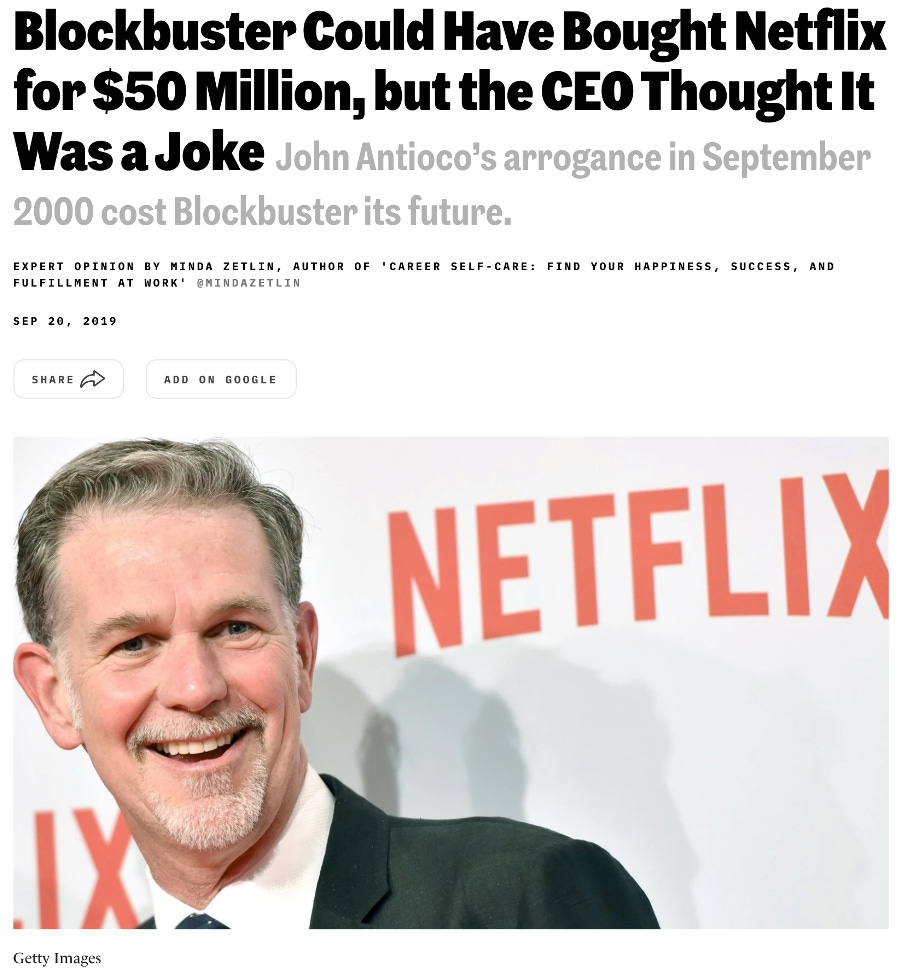
This wasn’t some casual, back-channel feeler. It was a formal pitch made by (Netflix co-founder and first CEO) and Reed Hastings (Netflix co-founder and CEO) to John Antioco, Blockbuster’s CEO, at the company’s headquarters in Dallas.
And the reason Netflix pitched itself matters just as much as the price. In Randolph’s telling, the dot-com crash had changed the air completely: Netflix was burning cash and selling to Blockbuster felt like the cleanest way out... a lifeline that would give the idea distribution, credibility, and time.
So, Netflix framed the proposal in a way designed to appeal to an incumbent: let Netflix run the online business, while Blockbuster keeps doing what it knows... stores.
The trip itself underscores how serious they were. Randolph describes finally getting the meeting and being told, essentially: “Dallas. Tomorrow.” They scrambled to make it happen on almost no notice.
Then came the number: $50 million.
According to Randolph, Antioco was “struggling not to laugh.” And he reportedly waved away the whole premise with the classic incumbent tell... calling the “dotcom hysteria” overblown. It feels insane to reject that deal today.
But hindsight has a way of turning yesterday’s reasonable decision into today’s punchline.
Let’s pause and step into John Antioco’s shoes for a moment. At the time, Blockbuster was the empire. It had the stores. It had the brand. It had the relationships. It had the customer habit. Friday night practically belonged to it.
And what sat across the table in Dallas?
A company that looked, on the surface, like a quirky workaround. Remember, Netflix wasn’t streaming yet1. It wasn’t the global platform it is today. It was a DVD-by-mail service with a website, postage costs, and a business model that, to an incumbent retailer, at most looked like a novelty. According to Marc Randolph’s own telling, Netflix was burning cash and the pitch was born out of a very real need for survival in the post-dot-com crash environment.
So no... passing on a $50 million acquisition didn’t look insane in real time. It looked like swatting away a rounding error. And that’s precisely why this meeting matters. Because it exposes the mindset that creates value traps:
Blockbuster didn’t think it was rejecting the future.
It thought it was rejecting a rounding error.
The real mistake wasn’t arrogance. It was misdiagnosis.
Blockbuster believed its value proposition was movies. It wasn’t. Its value proposition was instant access through physical distribution... and that meant the company’s moat was only as durable as the relevance of the store.
Once you see that, the rest of the story becomes almost mechanical. Consumer habits began to shift... and when habits shift, the old model doesn’t decline gracefully.
It collapses.
People got busier. Convenience stopped being “nice to have” and became non-negotiable.The internet became normal. Choosing a title on a screen became easier than browsing shelves. And the idea of driving to a store — finding parking, wandering aisles, discovering the new release was gone, started to feel less like a ritual... and more like friction.
That’s the moment when Blockbuster’s greatest asset flips. Its store network, once the pride of the empire, the source of its dominance, turned into a fixed-cost trap. Because stores don’t shrink on demand. Leases don’t renegotiate themselves. Staff doesn’t evaporate. Inventory doesn’t become weightless.
And that’s where technology stops being “competition” and becomes obsolescence: when a new distribution method doesn’t merely steal market share... it makes the old distribution method less relevant every month.
Blockbuster tried to respond. But every response was compromised by what the company was. It tried to remove late fees, but it couldn’t do it cleanly because the economics had been built around that friction. You either keep the profit and irritate customers... or you remove the irritation and vaporize a meaningful chunk of your margin.
And while Blockbuster wrestled with that impossible trade-off, another wave hit... the one that turned Netflix from clever to lethal:
Streaming.
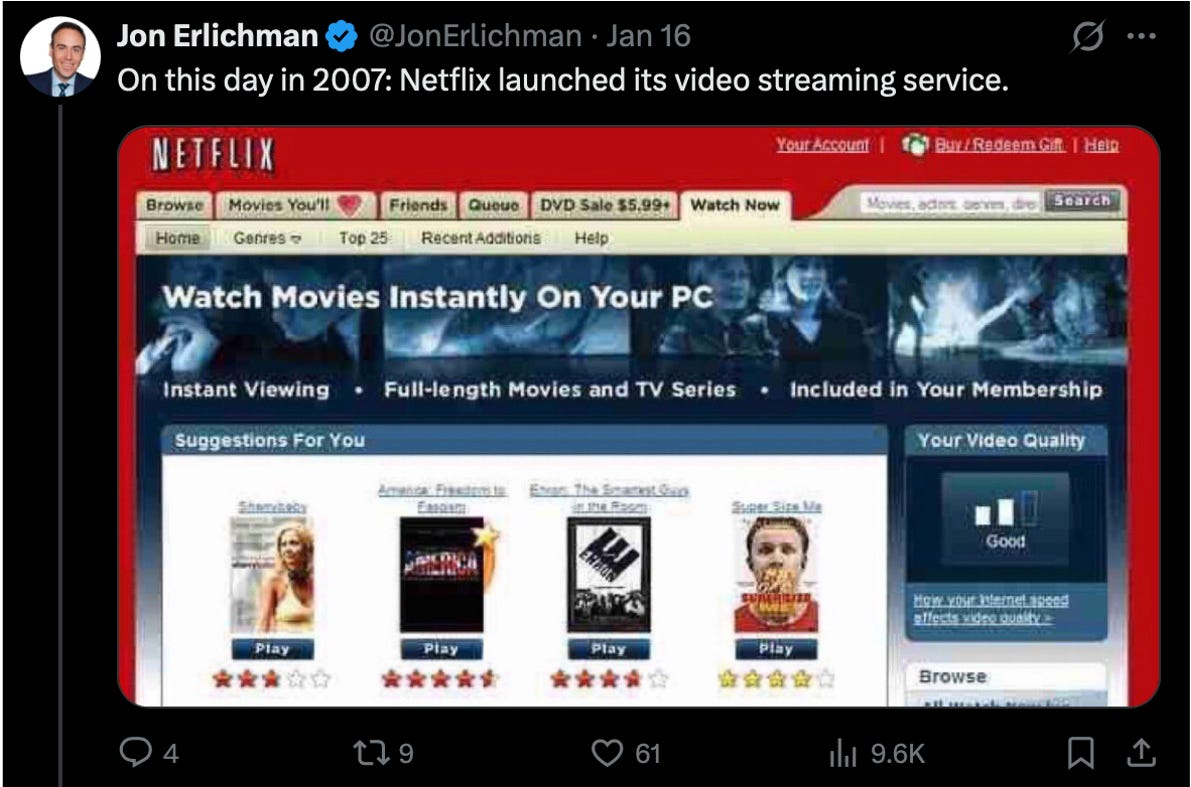
DVD-by-mail still lived in the old world. It still moved physical objects. It still had delivery time. Streaming destroyed the last excuse for the store. Once customers could hit “play” and get a movie instantly, the entire Blockbuster value proposition, “come to us for instant access”, flipped on its head.
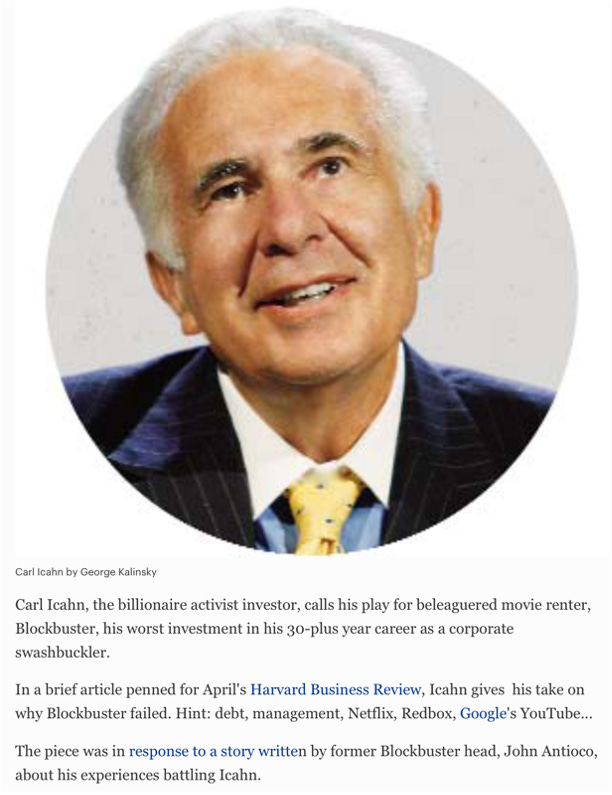
The instant “access” was now inside your living room. The store wasn’t a convenience anymore.
It was friction.
And it was right then, when the company’s value proposition was under siege, that the balance sheet stopped being just another variable and started becoming destiny.
A business can survive a transition if it has two things: time and flexibility.
Blockbuster had neither. Even before the disruption fully hit, Blockbuster loaded itself with leverage as part of its separation from Viacom (paying a $5-per-share dividend and arranging a $1.45 billion credit facility to finance that special distribution).
So, when the world began moving from physical distribution to digital, Blockbuster wasn’t just dragging a sprawling store footprint behind it... it was doing it with debt on its back. And that combination: high fixed costs plus leverage, is how strategic problems turn into financial emergencies.
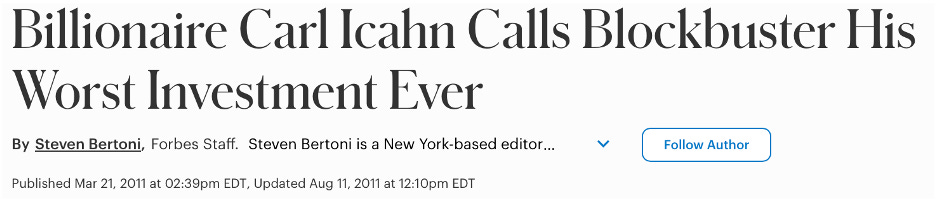
Now here’s the nuance that matters for us because it’s where investors tend to get hurt. Blockbuster didn’t just fool dumb money. It attracted sophisticated capital, including Carl Icahn. In early 2005, Blockbuster CEO John Antioco got the call: Icahn had bought nearly 10 million shares and was coming in as an activist.
You can see why. From the outside, it looked like the perfect value setup: a dominant brand, a massive footprint, a stock already crushed, sentiment disgustingly negative... and an easy, comforting story investors tell themselves at exactly the wrong moment: customers will come back once management fixes execution. But you can’t execute your way out of a business model that’s becoming irrelevant. That’s the value trap: the numbers make it look “cheap” precisely because the economics underneath are melting. The market isn’t offering you a bargain. It’s offering you a warning.
Blockbuster didn’t lose because it was stupid. It lost because it was built for a world that stopped existing.
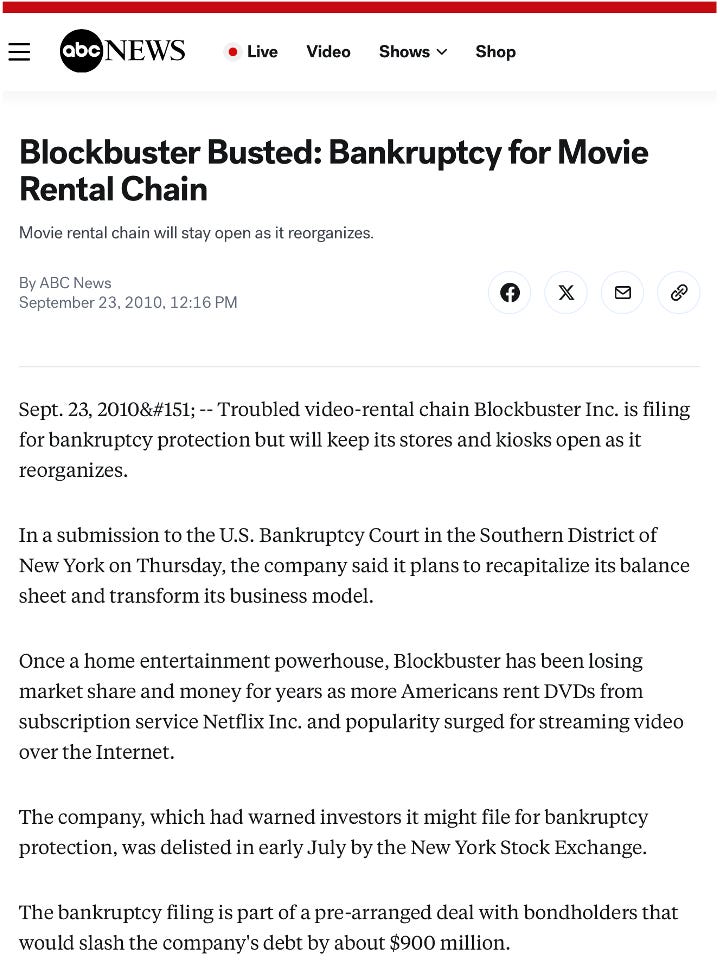
And that’s precisely the reason why Blockbuster’s tale is relevant right now... because the world is changing at breathtaking speed... and what Netflix (through smart use of technology and fabulous execution) did to Blockbuster, AI can now do to a lot of businesses.
That’s the real lesson.
Back then, disruption still moved in chapters. There was time between the first crack in the dam and the flood. There were years where executives could argue, delay, pilot a response, call it a transition, and convince themselves they were still in control.
Even then, Blockbuster still failed.
But today we’re staring at something very different. AI doesn’t need to build 9,000 stores to beat you. It doesn’t need trucks, DVDs, envelopes, or a decade of habit formation. It doesn’t even need customers to consciously “switch.”
Because AI doesn’t just change distribution. It changes the unit economics of execution. It takes tasks that used to require teams... and turns them into outputs.
It takes workflows that used to justify headcount... and turns them into software. It takes service and turns it into instant, cheap, always-on capability.
And when that happens, the old business model doesn’t get gently competed down. It gets repriced. Overnight, what looked like a moat becomes an expense line.
What looked like expertise becomes a commodity. What looked like a stable profit pool becomes a melting ice cube.
Which means there may be “Blockbusters” hiding in plain sight all around us... companies that still look dominant, still look quality, still look cheap... simply because the numbers on the page are backward-looking proof from a world that is already disappearing.
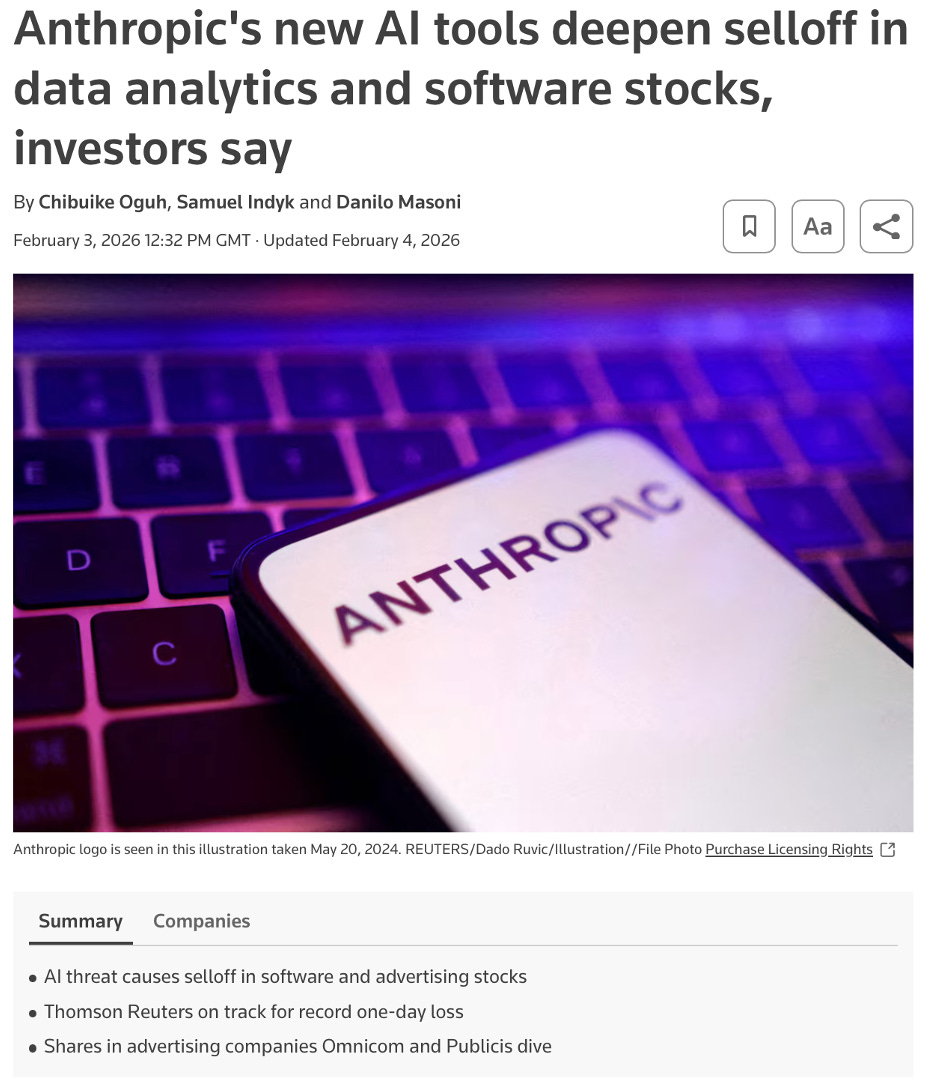
That’s the work in front of us.
We need to stress test every single Model Portfolio position for this step change in what technology can already do... not someday, not in five years... now!
And that forces us to do far more than traditional analysis.
We’re not starting with chart patterns. We’re not starting with valuation multiples. And we’re certainly not polishing a discounted cash flow model until it tells us what we want. We’re starting with something more structural: the value proposition.
Our job is both simple and urgent. For every position, we’ll define the real reason customers pay, where the moat truly comes from, and then ask the one question Blockbuster investors learned too late:
Does this disruptive technology make that value proposition stronger… or does it make it irrelevant?
Because once technology flips the customer’s default behavior, you don’t get to negotiate the timeline.
You only get to live with it.
Stay disciplined. Have a great week.
-Vasco
You might also like reading:


Check our Leaderboard updates - Top 10 Positions - February 18th, 2026

Looking for where to start?


Netflix launched its streaming service in 2007, nearly a decade after starting as a DVD by mail company. At the beginning, streaming was offered as a complementary feature to DVD subscribers at no additional cost. The early version functioned through a web browser and allowed users to instantly watch a limited catalog of movies and TV shows without waiting for physical delivery. The initial streaming library was relatively small, roughly around one thousand titles, and consisted largely of older films and licensed television content rather than new releases. What began as a modest add on would eventually become the core of Netflix’s business model and fundamentally reshape the entertainment industry.