

The most dangerous moment for a good investment thesis is not when the market disagrees with you. It is when the market finally agrees.
This is a nice problem to have. But it is still a problem.
When VMF Research began publishing in May 2024, our central macro view was decidedly outside the mainstream. We believed March 2020 had marked more than a temporary inflation shock. Something deeper had changed in the political economy that produced four decades of declining inflation and interest rates.
Governments had discovered how quickly the normal limits on intervention could disappear. Fiscal policy could put purchasing power directly into the economy. Central banks could stabilise markets on an extraordinary scale. Strategic competition could justify industrial policy. Security could outrank efficiency.
And all of that costs money.
Redundant factories are more expensive than concentrated ones. Domestic supply chains often cost more than imports. Strategic inventories consume capital. Defence, energy security and reindustrialisation require enormous quantities of labour, commodities and financing before producing anything useful.
As we wrote in August:
Resilience is valuable. It is rarely cheap.
That thinking shaped the Model Portfolio from the beginning. We were never betting that CPI would rise every month. We were positioning for a world in which inflation, interest rates and policy would travel across a wider and less predictable range, and where scarcity would periodically matter much more than investors raised during the 2010s had been conditioned to expect.
Two years later, very little about that argument sounds radical.
Fiscal dominance, defence spending, deglobalisation, energy security, industrial policy and structurally higher rates have become routine subjects of investment debate. Governments openly subsidise domestic manufacturing, semiconductors, power infrastructure and strategic resources. Markets now seem capable of finding an inflation angle in almost anything.
That last part is what interests us.
A geopolitical conflict becomes an energy-price story. Fiscal expansion becomes a Treasury-supply story. Strong growth becomes a reason for tighter monetary policy. Even artificial intelligence is often discussed first in terms of the electricity, semiconductors and capital required to build it.
None of those interpretations is absurd. Most contain a great deal of truth.
But when an explanation becomes the default explanation, investors should become uncomfortable.
Markets have a habit of taking yesterday’s difficult lesson and turning it into tomorrow’s lazy assumption.
And there is now evidence worth considering on the other side.
The first stage of the AI buildout is clearly resource-intensive. Data centres need processors, cooling, land, construction and extraordinary amounts of dependable power. It is competing for many of the same scarce inputs as defence, reindustrialisation and the rebuilding of energy infrastructure.
Yet we are spending all that capital to manufacture something whose price is collapsing:
Intelligence.
If machine intelligence allows businesses to write more software, perform more research, automate more processes and serve more customers without increasing labour and other inputs proportionately, productive capacity begins to expand in ways our original inflation framework must take seriously.
We do not know yet how large that effect will become.
That is precisely the point.
A thesis earns its keep by helping us interpret new evidence. It becomes dangerous when we start protecting it from that evidence.
August’s VMF’s Strategic Asset Allocation therefore does something deliberately uncomfortable. It revisits the Market View that has shaped Tier One since inception at the moment that view is receiving some of its strongest validation.
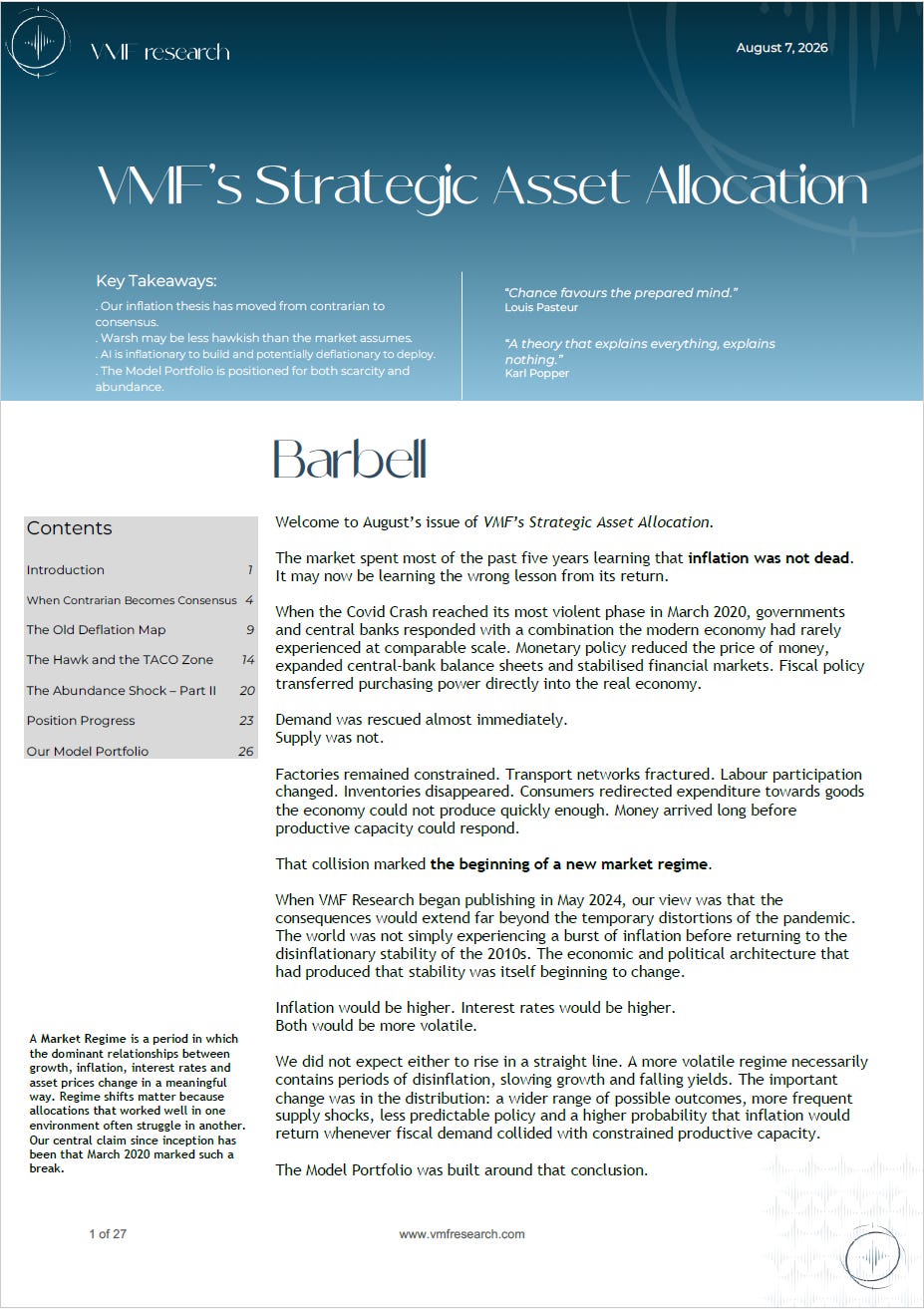
The excerpt below was first published for paid subscribers on 7 August 2026. It explains how the post-2020 regime emerged, why even some of the great defenders of the old deflationary order are changing their minds, and why that intellectual victory should make us more demanding rather than more complacent.
The investment problem has changed.
We no longer need to convince the market that the old regime is gone.
We need to find what the market might be missing now that almost everyone knows it.
When contrarian becomes consensus, the work starts again.
Good reading.

March 2020 did not necessarily begin the Fourth Turning.
It made the Fourth Turning investable.
Strauss and Howe describe a Fourth Turning as a crisis era in which the old institutional order is challenged, collective priorities displace individual preferences and society mobilises in response to threats it regards as existential. A First Turning follows the eventual resolution: an era of stronger institutions, greater social coordination and a new civic order. The framework is interpretive rather than mechanically predictive, but it offers a useful way to understand why economics, politics and markets can change together rather than independently.
The pandemic accelerated that transition because it revealed how quickly the normal limits on policy could disappear.
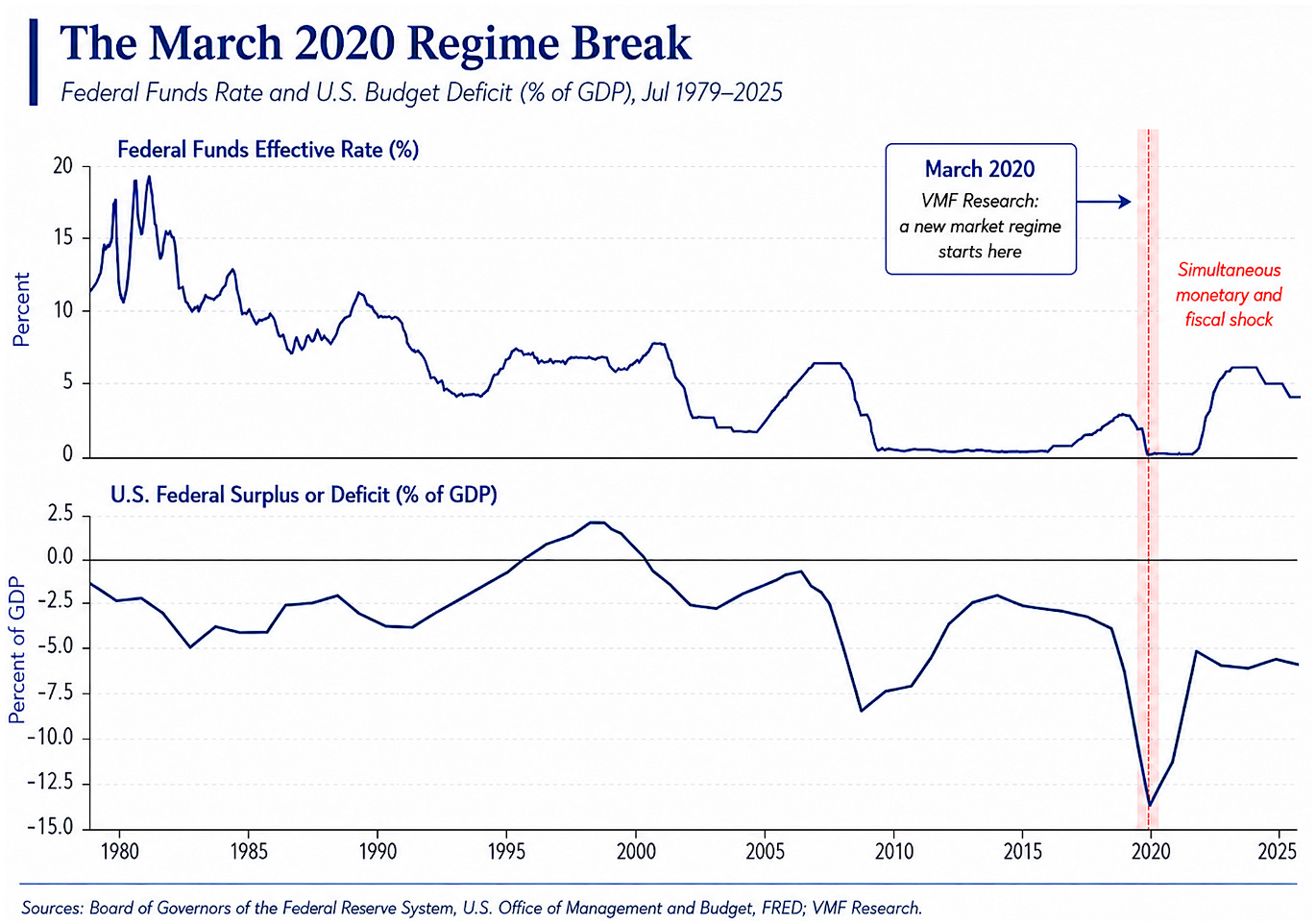
The Federal Reserve reduced its policy rate to the effective lower bound, expanded its securities purchases and deployed a broad collection of emergency facilities.
Fiscal authorities simultaneously provided transfers, income support, credit guarantees and business assistance. The scale and coordination of the intervention supported a rapid recovery, but it also placed powerful demand stimulus into an economy whose productive capacity remained impaired.
The immediate inflationary consequence was visible.
The more durable consequence was political.
Once governments demonstrate that they can mobilise fiscal and monetary resources on an extraordinary scale, the boundary of what future crises can demand changes. Policies previously regarded as exceptional enter the available toolkit.
Households, businesses and markets begin to incorporate a different reaction function.
The state becomes more willing to absorb risk.
The central bank becomes more closely entangled with financial stability and government financing.
The public becomes less willing to accept economic pain when large interventions appear possible.
That does not mean every future downturn will produce another identical stimulus programme.
It means the political constraint against intervention has weakened.
The pandemic also accelerated forces that had been developing before the first lockdown...
China and the United States were already moving from commercial integration towards strategic competition. Supply chains built around the lowest-cost producer were becoming politically uncomfortable. Energy systems designed primarily around price were being reconsidered through security and resilience. Defence expenditure was beginning to rise. Industrial policy was returning to economies that had spent decades trusting global markets to allocate production.
Covid transformed those tendencies into priorities.
Just-in-time became just-in-case.
Efficiency became redundancy.
Global supply became domestic capacity.
Commercial dependence became strategic vulnerability.
The economics of those choices are clear. Redundant factories cost more than concentrated ones. Domestic production frequently costs more than importing from the lowest-cost supplier. Strategic inventories tie up more capital than lean supply chains. Defence, energy security and grid resilience require large amounts of commodities, labour and financing before they generate useful output.
Resilience is valuable.
It is rarely cheap...
That was the central economic conclusion behind the Market View with which VMF Research began publishing.
The new regime was never simply about a larger money supply. It reflected a deeper change in the interaction between politics, policy and productive capacity. Governments can create financial claims. They cannot create engineers, power plants, transformers, semiconductor factories, strategic mines or skilled workers by decree. When fiscal and monetary demand expand faster than the economy’s ability to produce, prices become the rationing mechanism.
March 2020 brought those forces together.
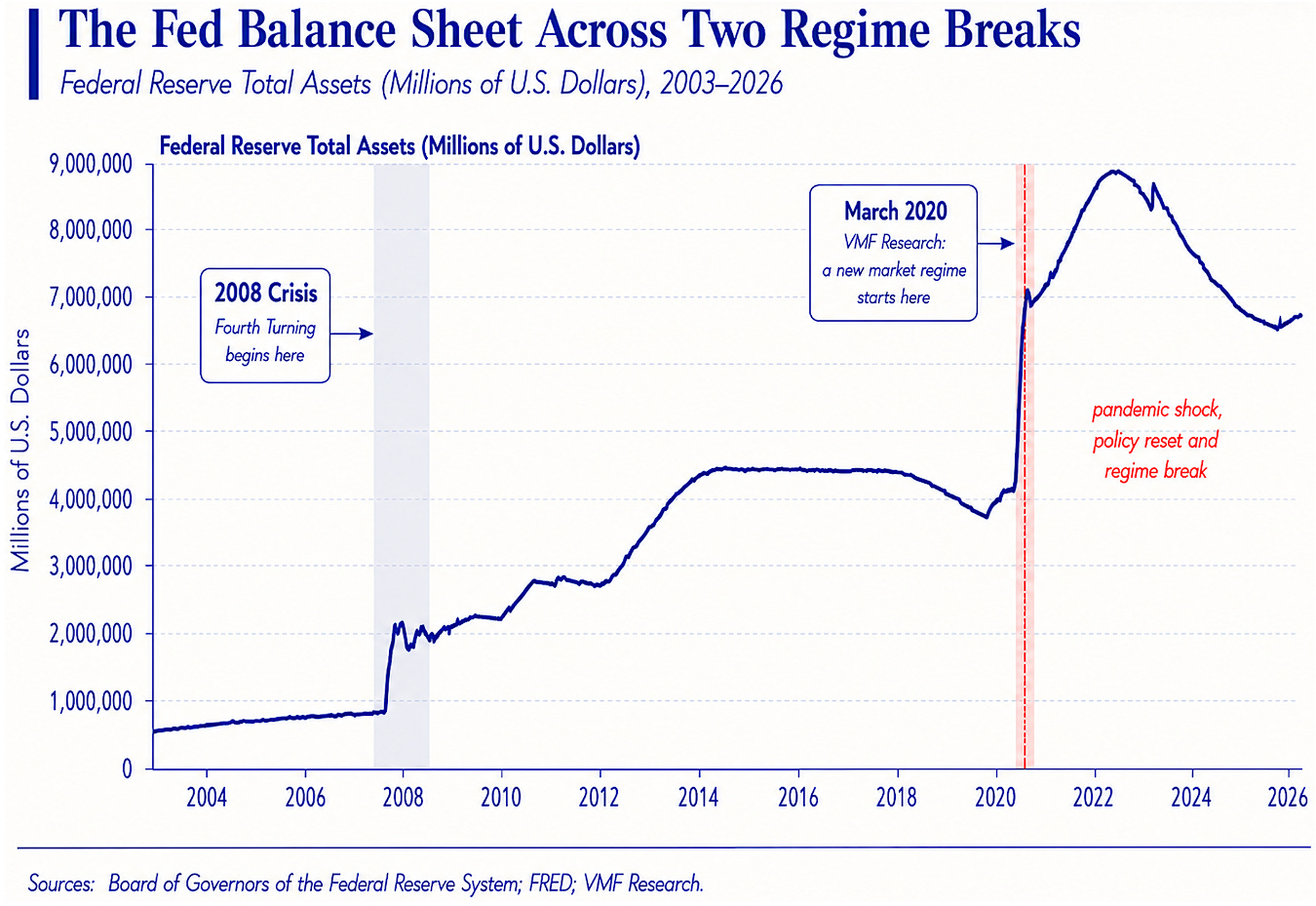
The Fourth Turning may have begun with the institutional and financial crisis of 2008. That episode permanently expanded the role of the Federal Reserve’s balance sheet and established the central bank as the ultimate stabiliser of financial markets.
But much of the money created after 2008 remained inside the financial system.
Asset prices rose.
Consumer-price inflation did not.
The response to the Covid Crash was fundamentally different.
The Federal Reserve returned interest rates to zero and expanded its balance sheet at extraordinary speed. Fiscal authorities simultaneously transferred purchasing power directly to households and businesses. Demand was supported immediately, while productive capacity remained impaired.
Monetary and fiscal policy did not merely operate alongside one another.
They reinforced one another.
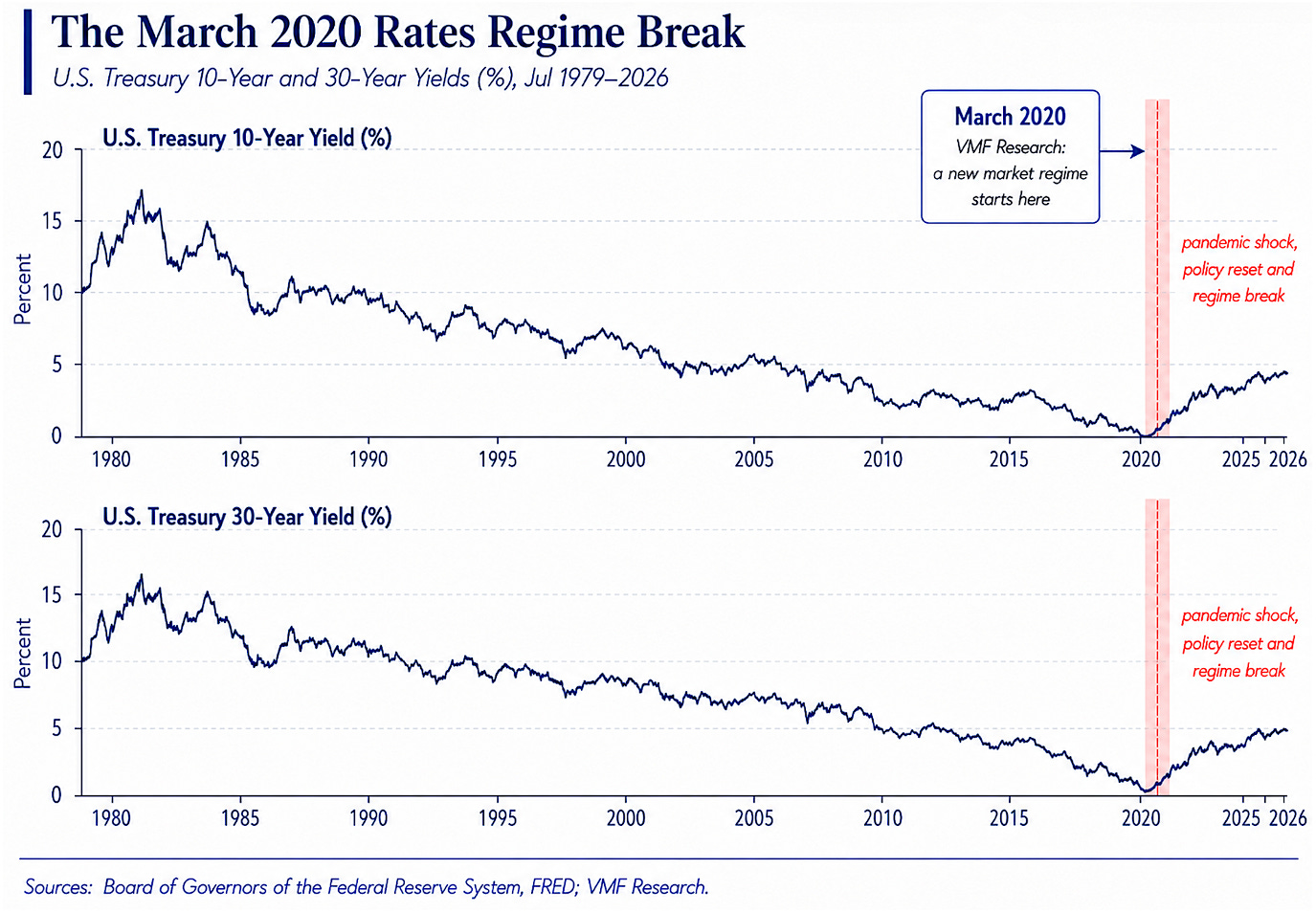
The charts throughout this section capture the significance of that moment. The federal funds rate collapsed as the budget deficit approached levels without modern peacetime precedent. The Federal Reserve’s balance sheet moved sharply higher. Ten- and thirty-year Treasury yields reached the lows from which they would begin reversing a four-decade secular trend.
No single market series can establish the beginning of a new regime.
Together, however, they identify an unmistakable break.
March 2020 marked the moment when policy support escaped the financial system and entered the real economy with sufficient force to collide with constrained supply.
That was why we believed inflation and interest rates would become higher and more volatile than they had been during the preceding decades. And that view shaped the Model Portfolio from its inception. The large Alternatives Book, the emphasis on precious metals and crypto assets, the exposure to natural resources inside the Equity Book and the deliberate underweight to conventional fixed income were all expressions of the same strategic conclusion.
We were not forecasting that inflation would rise every month. We were positioning for a world in which inflation, policy and interest rates would move across a wider and less predictable range (and in which the traditional relationship between stocks and bonds could become less dependable).
The old regime rewarded financial duration. The new one would reward scarcity, adaptability and real productive capacity.
Much of that view has since been validated.
Fiscal deficits remain large even outside recession. Globalisation is fragmenting. Governments are rebuilding defence, energy and industrial capacity. Supply-chain efficiency is increasingly being sacrificed for security. The electricity grid has become a strategic bottleneck. Capital requirements are rising across semiconductors, artificial intelligence, reindustrialization and national infrastructure.
Long-term interest rates have responded accordingly.
The forty-year decline in Treasury yields ended around the Covid Crash. Bond investors now demand greater compensation for inflation uncertainty, fiscal supply and term risk. Markets treat stronger growth with suspicion and interpret new government spending through its possible inflationary consequences.
What was once a contrarian Market View has become increasingly conventional...
That does not make it wrong.
But it changes the investment problem.
The greatest opportunities rarely appear when an important thesis is being ignored. They appear when a correct thesis becomes so widely accepted that every new development is forced into the same conclusion.
Our concern is therefore not that the post-2020 regime thesis has failed.
It is that it has become too easy to repeat.
The evidence of that migration is now difficult to ignore. Investors who spent decades warning about debt-driven deflation are reconsidering their frameworks. Analysts who once believed excessive leverage would keep inflation and long-term interest rates permanently subdued are beginning to argue that deglobalisation, capital scarcity and constrained productive capacity have changed the equilibrium.
The higher-and-more-volatile inflation regime is moving from the edge of macroeconomic debate towards its centre.
At the same time, the incoming evidence is becoming less one-sided.
Productivity is improving. Wage pressure appears less threatening when measured against output per worker. The cost of applying intelligence is falling rapidly. And the Federal Reserve itself is beginning to examine whether technology is expanding the economy’s productive capacity faster than its traditional frameworks can capture.
None of this invalidates the post-2020 regime.
A world of higher and more volatile inflation can still produce powerful periods of disinflation. Indeed, volatility implies movement in both directions. But it changes the question investors should be asking.
The original challenge was recognising that the disinflationary stability of the previous era had ended. The challenge today may be recognising that the market has learned that lesson so completely that it now interprets almost every geopolitical, fiscal and economic development through the same inflationary lens.
Our Market View has not failed.
It has moved towards consensus.
And when a formerly contrarian thesis becomes the market’s organising assumption, it must be tested more aggressively… not defended more emotionally.
The clearest evidence of how far this intellectual migration has travelled comes from one of the most respected deflationary thinkers of the past several decades.
Lacy Hunt spent much of his career explaining why excessive debt, falling velocity and weak demand would suppress inflation and long-term interest rates.
For a very long time, he was right.
Now, his view is changing.
To understand why the inflationary regime has become so widely accepted (and what the market may consequently be overlooking) we must first understand what changed his mind.
Important Disclosure
This article contains general investment research produced by Vasco Marques de Freitas, CFA, CMT, Founder and CEO of VMF Research, Lda. It reproduces an excerpt from the August 2026 issue of VMF’s Strategic Asset Allocation. The research, views and Tier One Model Portfolio information are stated as of 7 August 2026, 4:00 p.m. Eastern Daylight Time, unless another date is expressly identified. The original issue was first disseminated to paid subscribers on 7 August 2026 at 9:00 p.m. Eastern Daylight Time.
The publication contains information recommending or suggesting an investment strategy. It is not personalised investment advice and does not consider any reader’s individual objectives, financial circumstances, knowledge, experience, liquidity requirements or tolerance for risk. The Tier One Model Portfolio is an illustrative research portfolio designed to communicate VMF Research’s strategic asset-allocation framework, Market View and investment conclusions. It does not represent client assets, transactions executed by VMF Research or the performance of an investable fund or managed account.
The analysis combines macroeconomic, monetary-policy, geopolitical, technological, market and strategic asset-allocation research within a medium- to long-term framework. Statements concerning inflation regimes, fiscal policy, interest rates, artificial intelligence, productivity, disinflation and potential changes in market leadership are analytical judgments and conditional hypotheses rather than assurances. Forecasts and scenario outcomes may change materially as economic data, policy, technology and market conditions evolve.
Investments discussed within VMF’s Strategic Asset Allocation may involve substantial risks, including market volatility, changes in inflation and interest rates, geopolitical disruption, regulatory intervention, currency movements, liquidity constraints, technological disruption and the possible loss of capital. Improvements in productivity or artificial-intelligence capabilities may not translate into lower inflation, stronger corporate earnings or superior investment returns. Likewise, inflationary, technical and valuation frameworks may fail.
Disclosure of interests: as of the research cut-off, legal entities controlled by Vasco Marques de Freitas held long positions in the KraneShares CSI China Internet ETF (KWEB), ARK Innovation ETF (ARKK) and Malibu Life Holdings Limited, as well as listed exchange-traded products providing economic exposure to Bitcoin, Ether and Solana. These interests may create actual, potential or perceived conflicts and should be considered when evaluating the analysis, recommendations and Model Portfolio conclusions. The existence of an interest does not validate a recommendation, diminish its risks or imply suitability for any particular reader.
Neither VMF Research nor the author received compensation from any issuer, fund sponsor or other entity covered in connection with the preparation of this research, and no covered entity reviewed, approved or amended its investment conclusions before first dissemination.
Past performance, Model Portfolio performance and forward-looking scenarios are not reliable indicators of future results. Readers should conduct their own analysis and, where appropriate, consult an authorised financial intermediary or adviser before making an investment decision.