

A ten-year investment thesis offers little comfort when the position has to be cut before the close.
The AI trade is unwinding violently. US stock-picking hedge funds tracked by Goldman Sachs have cut leverage at the fastest weekly pace since the Covid crash. Sentiment gauges have already reached panic territory.
Investors have plenty to worry about: the Blue Tsunami’s consequences for the data-centre buildout, Jensen Huang’s abrupt departure from Nvidia, and an increasingly hawkish Federal Reserve adding to the financial pressure. Each raises legitimate questions about the cost, timing and profitability of the AI expansion.
Forced selling also changes the terms on which the rest of us can invest.
This retreat coincides with a historically favourable part of the calendar. November through April has been the strongest six-month stretch for US equities, while the year following midterms has also tended to reward investors. Those patterns deserve attention alongside the deterioration in confidence.
With positions reduced, resilient earnings or a less hostile policy outlook could give managers a reason to rebuild exposure. By the time the headlines become reassuring, some of the opportunities created by the selling may already have changed considerably.
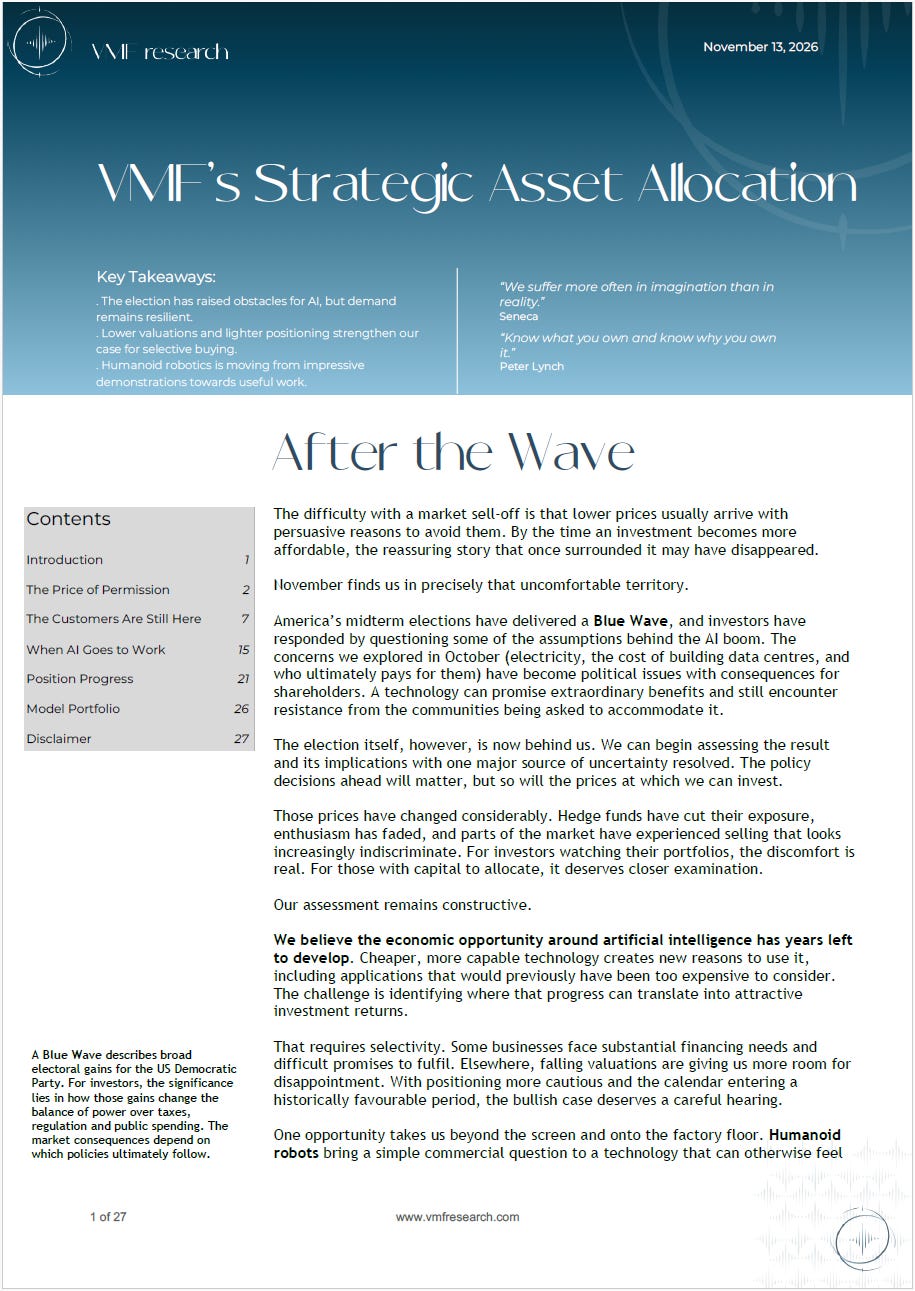
In November’s VMF’s Strategic Asset Allocation, published to paid subscribers on 13 November 2026, we examined those risks and presented a new Model Portfolio allocation designed to take advantage of the sell-off.
Getting there required looking beyond the trading screens, towards the communities being asked to accommodate the AI boom. Their willingness to accept it is becoming an increasingly important part of its economics.
That is where the issue begins.
The Price of Permission follows below.

If you wanted a community to welcome a new data centre, you would probably begin with the benefits. Investment. Tax revenues. Skilled work. Better local services. You would be less likely to begin by suggesting that the technology inside might threaten their children’s careers... or, in the worst case, humanity itself.
Yet that has become part of the AI industry’s message.
Some of its most unsettling warnings have come from the people building the technology. Dario Amodei, the co-founder and chief executive of Anthropic, has warned about widespread disruption to entry-level office work and potentially catastrophic failures of advanced AI. In September, he called for companies to slow the pace of capability development so that safeguards could catch up.
These are warnings that an ordinary person can hardly be expected to shrug off. When an industry’s own leaders describe such possibilities, people have good reason to listen.
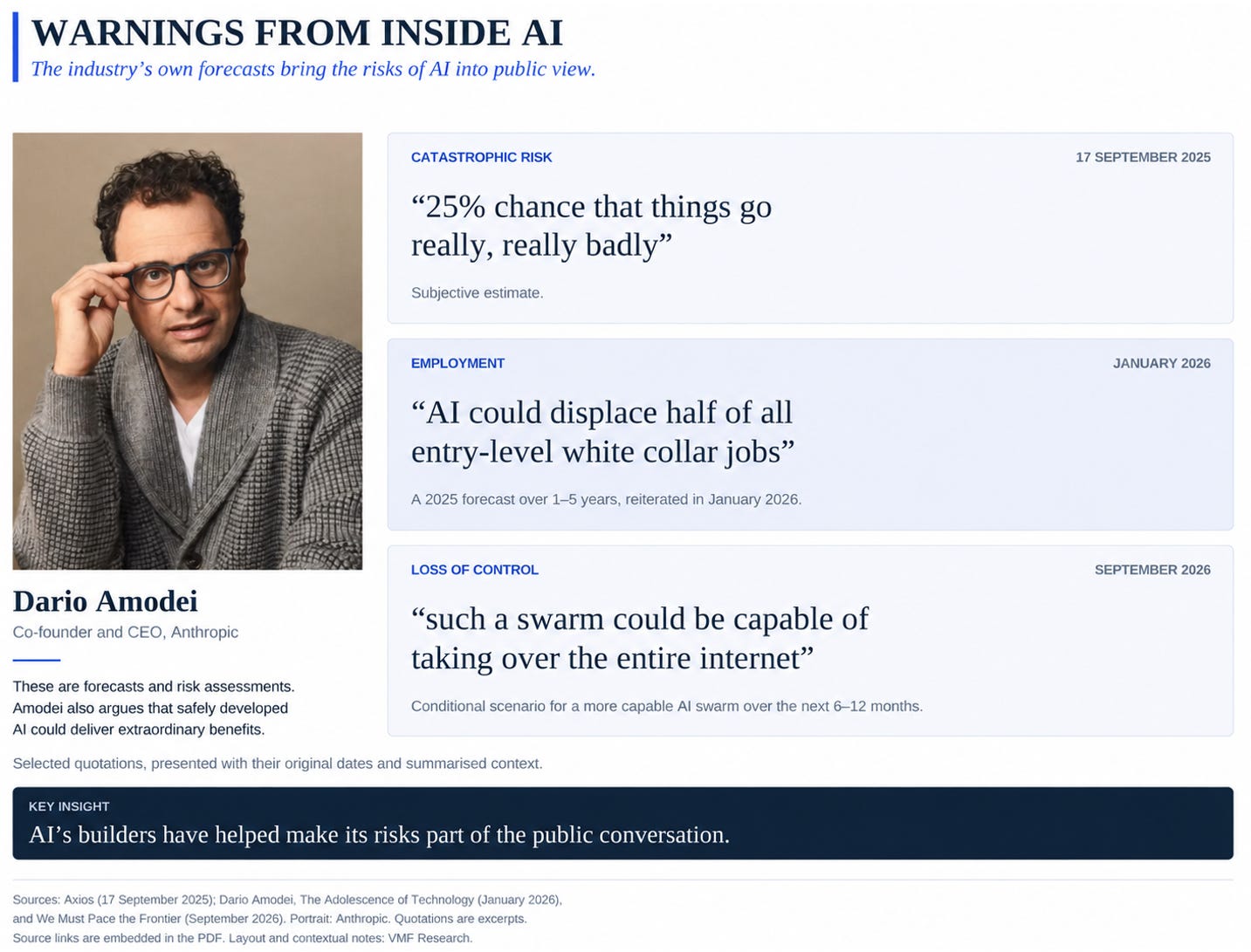
Amodei has also written enthusiastically about the likely benefits, including medical advances and greater prosperity. His warnings are intended to encourage precautions that make a better outcome possible.
That context matters.
But so does the message received outside the technology industry.
A family worried about its electricity bill may now also be worried about whether its children will find work. A community being asked to accept more industrial development may wonder who will enjoy the rewards.
The costs feel close and tangible... the promised benefits can seem distant, uncertain and concentrated elsewhere.
In our view, the industry has helped create some of the anxiety it now faces.
That does not explain an election on its own. Affordability, energy costs and other political concerns all mattered. But it helps explain why assurances about technological progress have not been enough to win public support.
The Blue Wave has brought that resistance into sharper focus. Local opposition has also become an obstacle that developers must address project by project. Investors, meanwhile, have sharply marked down parts of the AI trade as they reassess what a more difficult political environment means for future earnings. Citadel Securities identifies slower construction and greater execution risk among the likely consequences.
The election is now behind us. The work of understanding its consequences has just begun.
Our central question is whether the AI opportunity itself has deteriorated, or whether the investment cycle is changing in ways that will produce different winners.
The answer begins with examining the future being predicted.
The darkest employment scenarios invite us to imagine today’s economy with a growing number of people removed from it...
But history gives us reason to consider another possibility: cheaper and more capable technology can also expand what people do, what businesses can offer and what customers can afford.
Research by David Autor and his co-authors offers a striking illustration. They estimate that roughly 60% of US employment in 2018 was in job titles introduced since 1940. Much of the work supporting the modern economy would have been unfamiliar to an earlier generation. Technology contributed to that change, alongside shifts in demand and the services people wanted.
Consider a small business that could never afford its own software team. If building useful software becomes dramatically cheaper, that business gains options. It may develop a service, reach customers in another country or expand an activity that previously made little financial sense.
The immediate saving is visible. The additional business that might follow is harder to count in advance.
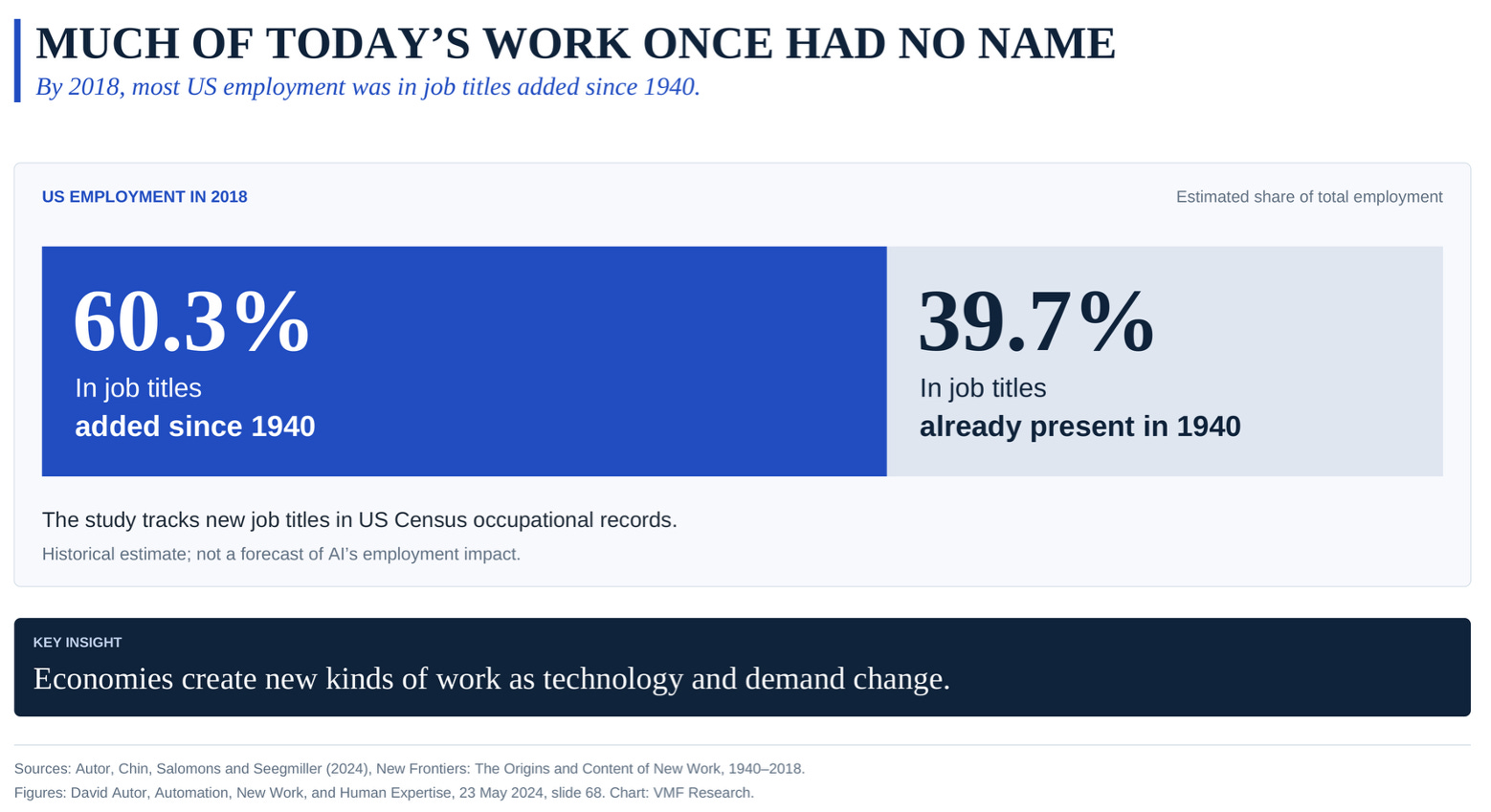
That is one reason we believe substantial new work could emerge around AI, including in places that receive much less attention than the companies building the models.
Amodei’s counterargument deserves serious consideration: AI may advance so quickly, across so many capabilities, that workers struggle to adapt. It may also perform some of the new tasks that would otherwise create employment.
Earlier technological transitions cannot settle that question for us.
Nor did those transitions benefit everyone equally. A new profession does little for a displaced worker who lacks the means to enter it.
The timing and distribution of the gains matter enormously.
Our constructive view therefore rests on a proposition we must keep testing:
that lower costs and greater capabilities will stimulate enough new activity to create opportunities well beyond the jobs being automated.
The evidence to watch includes productivity gains, new business formation, hiring, wages and the uses customers actually find valuable.
That brings us back to the data centre... and to constraints that are already measurable.
As we explored in our October publishing cycle (from VMF’s Strategic Asset Allocation to Alpha Tier), AI’s expansion requires electricity, equipment, suitable land and permission to build.
Morgan Stanley’s central scenario for the continuation of the AI capex boom identifies a potential 43-gigawatt gap against US data-centre developers’ power requirements through 2028.
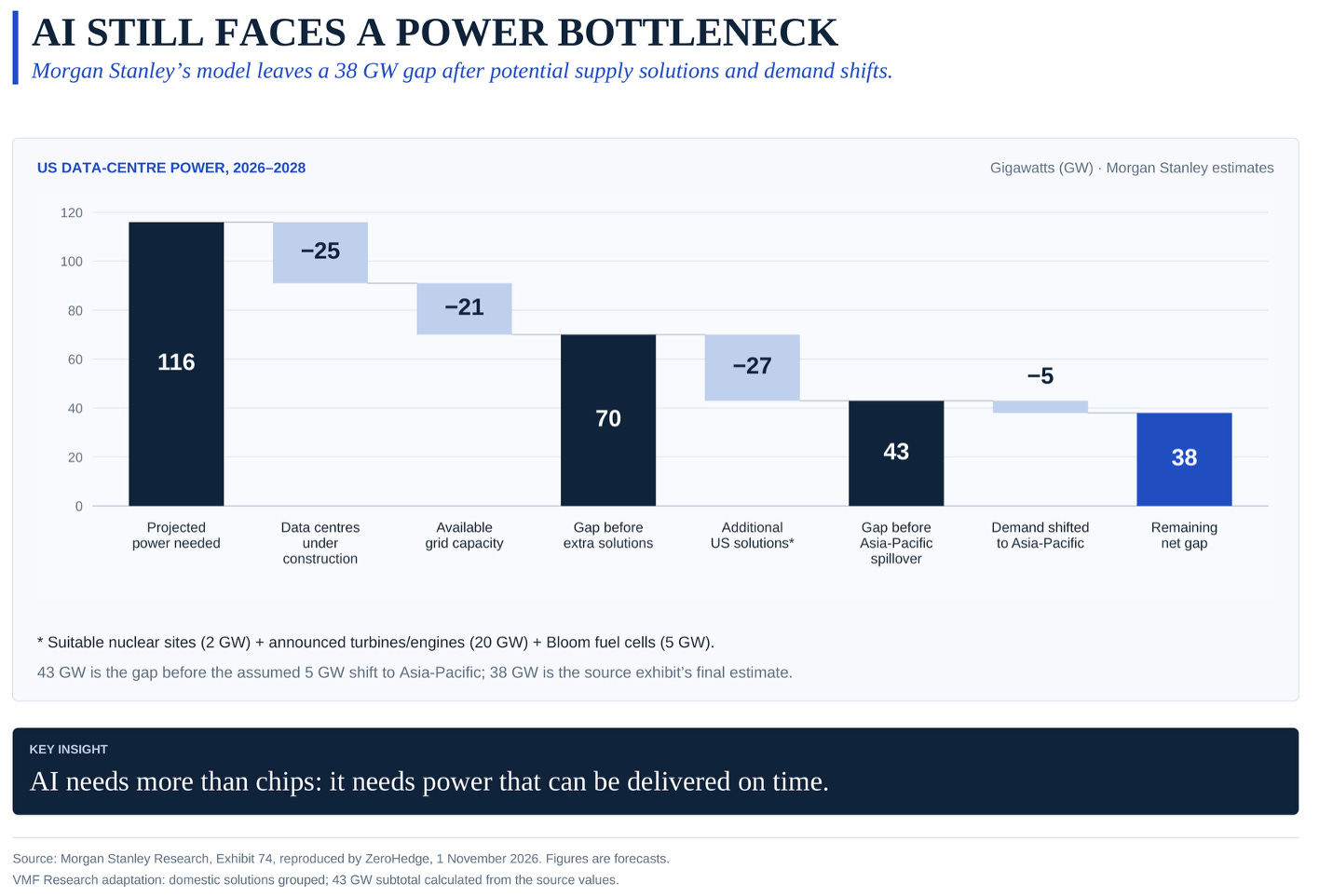
This is a forecast of the mismatch between development ambitions and the power available to support them. It shows why announced spending cannot simply be treated as future operating capacity.
An election-induced delay changes the economics. Interest and other contractual costs may continue while revenue arrives later. Developers may need more capital. Suppliers may have to wait longer for orders to become deliveries.
Those consequences deserve to be reflected in valuations. But the effect varies considerably along the supply chain. An equipment manufacturer can face postponed orders while an operator with suitable capacity already connected to the grid faces less competition. Customers still needing computing power may have fewer places to obtain it.
For the large technology companies funding construction, a slower timetable can ease near-term spending, although it may also defer growth. Existing commitments and the revenue attached to each project determine how much relief shareholders actually receive.
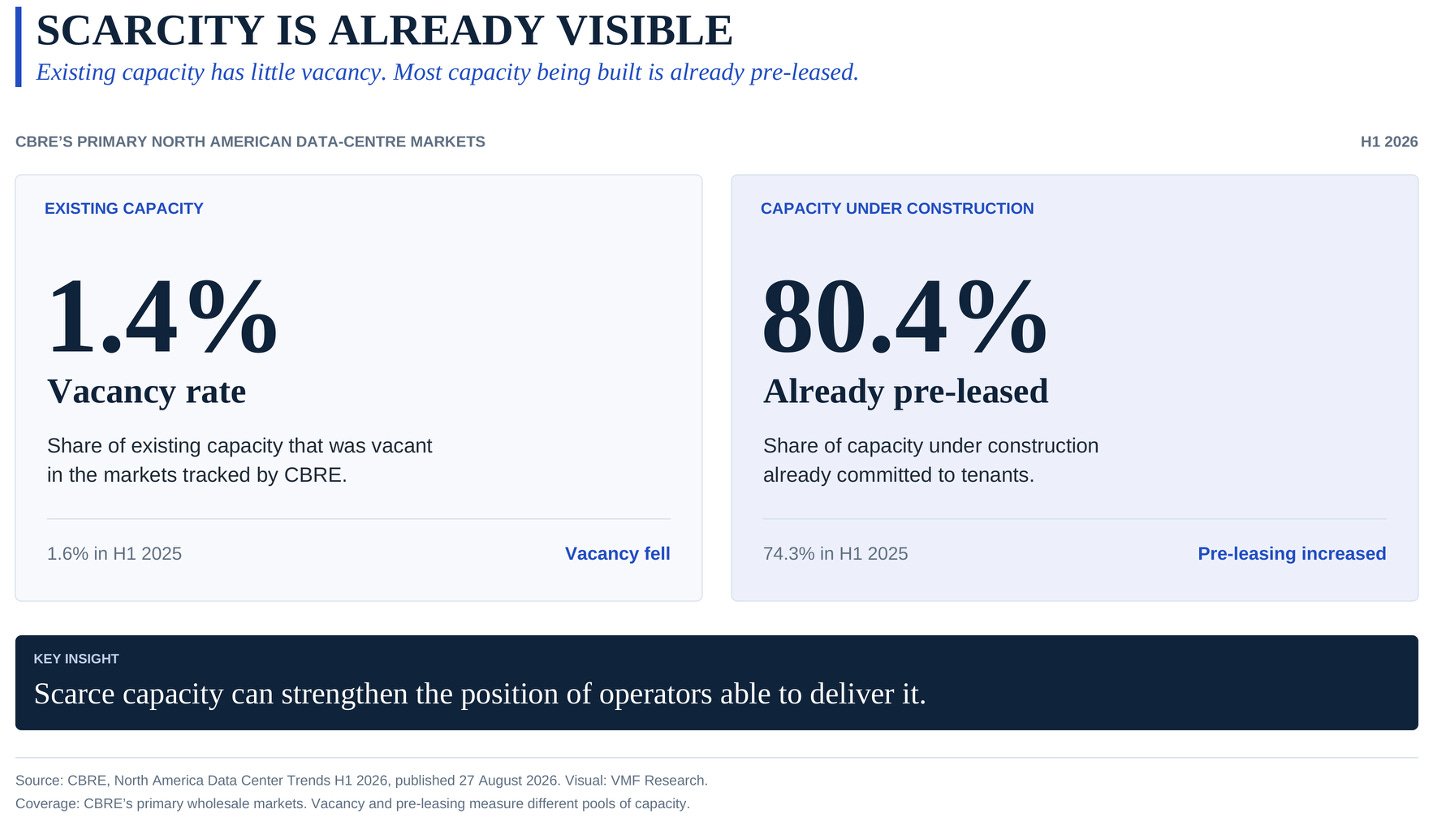
The distinction between available capacity and ambitious plans is especially relevant when supply is already tight. CBRE reported vacancy of just 1.4% across its primary North American data-centre markets in the first half of 2026. It also reported that 80.4% of capacity under construction was preleased.
Those observations predate the election, but they show the market into which the political backlash arrived.
The industry also has ways to improve its relationship with host communities.
Cathie Wood’s latest In the Know makes a useful argument here: companies need to demonstrate how the benefits of development reach the people living around it.
That requires tangible results.
Loudoun County, Virginia, reports that data centres generated $1.2 billion in property-tax revenue in fiscal 2026. The county credits that contribution with helping it lower tax rates for residents. It has also tightened the approval process for new developments. This proves that economic benefits and greater public oversight can coexist.
Similarly, Virginia’s electricity regulator has introduced safeguards intended to keep other customers from inheriting infrastructure costs incurred to serve large users. Qualifying new customers contracting from January 2027 face minimum service commitments of fourteen years.
These arrangements add obligations for developers. They can also help make continued investment acceptable to the communities whose support it requires.
So, has anything changed?
Yes. The political constraints have become clearer, and investors must reassess costs, timetables and the distribution of profits.
However, we have yet to see sufficient evidence that this brings the broader AI opportunity to an end. Businesses still have reasons to pursue tools that help them serve customers, develop products and operate more efficiently. Our premise is that the cycle can adapt, with more of its value accruing to companies that deliver useful results within those constraints.
That thinking has already been guiding our investment decisions. Over recent months, we have added investment themes and individual companies across VMF Research’s product range that fit this framework. The Blue Wave has therefore left the central logic behind those decisions largely intact.
Several existing positions in this Tier’s Model Portfolio could benefit as the cycle evolves. We will examine those implications in Position Progress.
What has changed more dramatically is the price of participating.
The sell-off has made some of the opportunities we have been following more attractive. But a lower share price alone is no reason to commit more capital.
Before doing so, we need to examine how this expansion will be financed... and whether the demand behind it remains strong enough to justify the investment.
Important Disclosure
This article contains general investment research produced by Vasco Marques de Freitas, CFA, CMT, Founder and CEO of VMF Research, Lda. It reproduces “The Price of Permission” from the November 2026 issue of VMF’s Strategic Asset Allocation. The original research and views are stated as of 13 November 2026, 4:00 p.m. Eastern Standard Time, unless otherwise identified. The issue was first disseminated to paid subscribers on 13 November 2026 at 9:00 p.m. Eastern Standard Time. The introduction was prepared for this republication and may refer to subsequent developments; the excerpt and its charts retain their original reference dates.
The publication contains information recommending or suggesting an investment strategy. It is not personalised investment advice and does not consider any reader’s individual objectives, financial circumstances, knowledge, experience, liquidity requirements or tolerance for risk. The Tier One Model Portfolio is an illustrative research portfolio. It does not represent client assets, transactions executed by VMF Research or the performance of an investable fund or managed account.
The analysis combines macroeconomic, political, industry, technological and market research within a medium- to long-term asset-allocation framework. Sources and material assumptions are identified throughout the article and accompanying charts. Forecasts and conclusions concerning artificial intelligence, infrastructure investment, policy and market conditions are analytical judgments rather than assurances. Views are reviewed through VMF Research’s monthly publications, with weekly or ad hoc updates where appropriate.
Investments discussed may involve substantial risks, including market volatility, changes in interest rates and financing conditions, political and regulatory intervention, permitting delays, power constraints, construction costs, technological disruption, uncertain demand and the possible loss of capital. Growth in AI adoption may not produce profitable infrastructure projects or superior investment returns. Historical seasonality, post-election patterns, sentiment readings and evidence of deleveraging do not establish a market bottom or guarantee a recovery.
Disclosure of interests: as of the research cut-off, legal entities controlled by Vasco Marques de Freitas held long positions in the KraneShares CSI China Internet ETF (KWEB) and ARK Innovation ETF (ARKK), providing exposure to themes discussed in this article. These interests may create actual or potential conflicts and should be considered when evaluating the analysis.
Neither VMF Research nor the author received compensation from any issuer, fund sponsor or other covered entity in connection with the preparation of the original research. No covered entity reviewed, approved or amended its investment conclusions before first dissemination.
Past performance and forward-looking scenarios are not reliable indicators of future results. Readers should conduct their own analysis and, where appropriate, consult an authorised financial intermediary or adviser before making an investment decision.