

The Nasdaq lost 10% last week. Anthropic went public in the middle of the carnage.
It is difficult to imagine a more revealing moment for the AI trade.
Hedge funds are slashing exposure. Financial conditions are becoming more demanding. Even the Debasement Trade has been caught in the liquidation, with precious metals and crypto suffering extraordinary losses.
Meanwhile, an increasingly hawkish Federal Reserve has investors wondering whether policymakers are about to tighten their way into a recession.
The market’s verdict appears increasingly clear: the AI boom has gone too far.
We are not convinced.
If this really is another dot-com-style infrastructure bust, the evidence should eventually appear where it matters most: in customer demand, utilisation rates and the prices businesses are willing to pay for computing power.
So we went looking...
In November’s VMF’s Strategic Asset Allocation, first published to paid subscribers on 13 November 2026, we examined GPU rental prices, data-centre occupancy, pre-leasing commitments and the extraordinary differences in AI spending across businesses.
Some of what we found challenges the prevailing narrative.
And last week’s historic Anthropic IPO makes the investigation even more interesting.
With Anthropic (ANT) joining SpaceX (SPCX) on public markets, investors will have increasingly detailed financial evidence with which to judge the economics of the AI revolution.
Long-standing VMF Research readers will remember that we identified a route to indirect exposure to both companies before their public listings.
Now comes the harder question: how much of the extraordinary demand for intelligence will eventually translate into attractive shareholder returns?
That is precisely the distinction we have been investigating throughout our Abundance Shock research.
The selling has been extraordinary. The risks are real. And some of the investments financing this revolution may well disappoint.
But we see little reason to declare the entire AI opportunity exhausted while customers continue finding new reasons to use it.
The investigation we published ten days ago is particularly relevant today.
The Customers Are Still Here follows below.
Good reading.

The market is questioning how the AI boom will be financed. Demand tells a more encouraging story. A data centre needs two things before it can earn its first dollar: electricity to run the machines and capital to pay for them. Both have become harder to secure.
The election made clear that communities expect a greater say in where these facilities are built, what they consume and who pays for the infrastructure around them. Meanwhile, the investors financing the expansion have begun asking more demanding questions of their own.
How much money will this take? When will it come back? And what happens if the next generation of chips arrives before the previous one has paid for itself?
These are reasonable questions. They also help explain why an investment theme built around extraordinary technological progress has become so uncomfortable to own. But before concluding that the AI boom is running out of road, we should ask another question.
Have the customers stopped showing up?
That is where the evidence becomes more interesting.
The financing problem is real. Building computing infrastructure requires substantial spending before the revenues arrive, and an increasing share of that spending is being supported by debt. The Bank for International Settlements has documented the growing role of borrowing and financing arrangements that sit outside companies’ conventional balance sheets.
The scale is striking. Goldman Sachs’ figures show that Alphabet, Amazon, Microsoft, Meta and Oracle had collectively issued approximately $296 billion of debt globally by 4 November. This is their total issuance, rather than a measure of borrowing exclusively devoted to AI, but it illustrates how extensively these companies are drawing on capital markets.
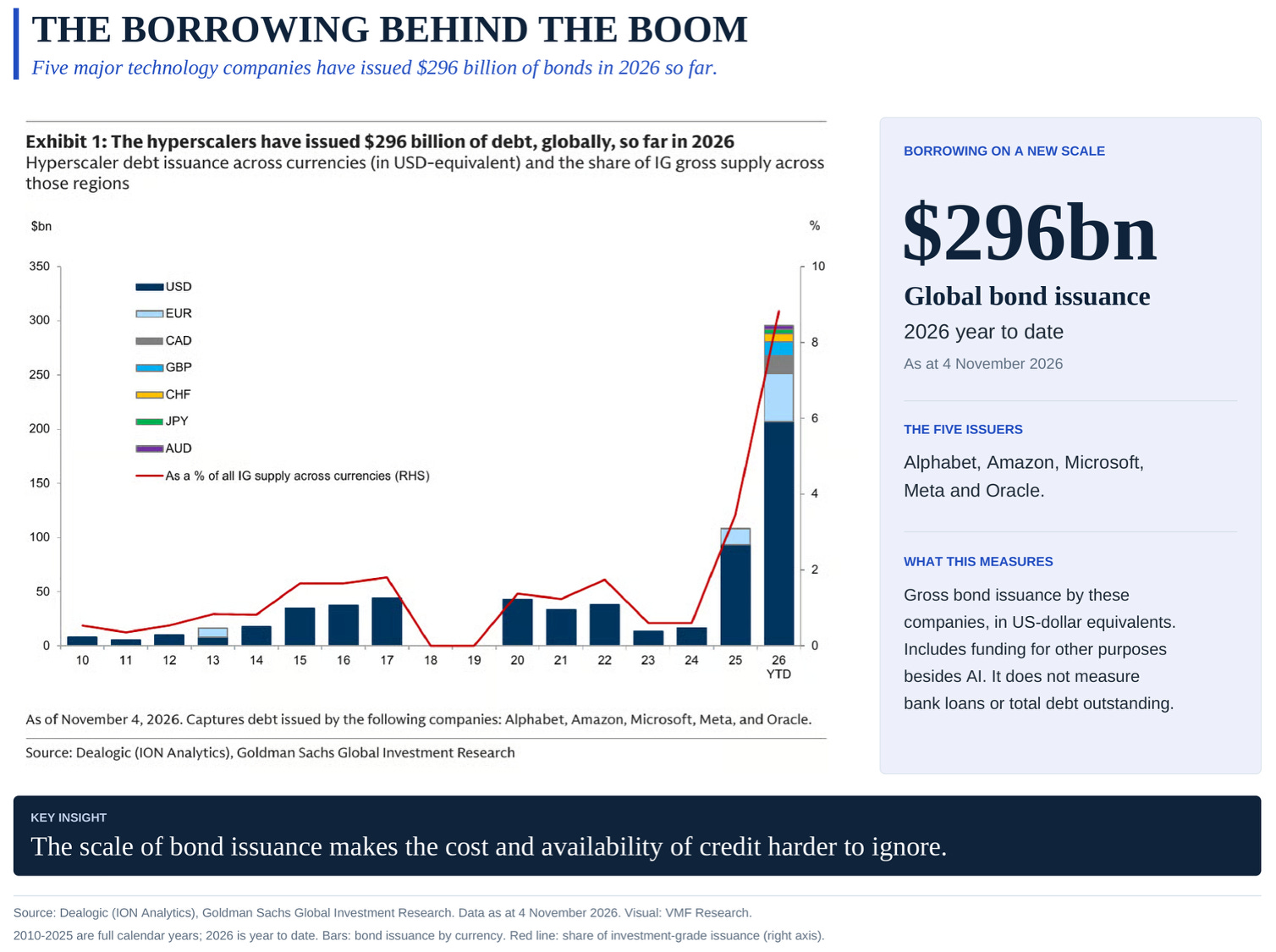
Borrowing on this scale makes the price of money matter enormously.
Lenders begin with the return available on government debt. They then demand an additional return for accepting the possibility that a company will struggle to repay them. That additional compensation is the credit spread.
When government yields rise, the starting point becomes more expensive. When lenders become nervous about the borrower, the spread increases too.
On a hypothetical $10 billion of new borrowing, a two-percentage-point increase in the interest rate adds $200 million to the annual interest bill. That is money which must be earned before shareholders receive anything.
The distinction between those two components matters today. Treasury yields fell during part of the AI sell-off, giving our long-duration bond holdings a welcome lift.
Yet that did not remove concerns about the companies financing the expansion. Government bonds could rally while lenders became more cautious about AI borrowers.
This is the background to the comparison now troubling investors: the fiber-optic boom that accompanied the dot-com bubble of the late 1990s and early 2000s.
Back then, companies borrowed and spent heavily to build the networks that would carry the internet. The technology was transformative. The commercial opportunity was real. Neither fact prevented a spectacular investment bust.
The mistake was building capacity faster than paying demand could absorb it. Internet traffic continued to grow rapidly, but improvements in transmission technology and competing construction programmes expanded supply even faster. Much of the fibre remained unused while the companies that had financed it struggled. Demand eventually caught up with substantial parts of that infrastructure. But... for many original investors, it arrived too late.
That is the warning we should take seriously. A technology can change the world and still produce terrible returns for those who finance it at the wrong price, with too much debt or on the wrong timetable.
The question is whether today’s computing market is already displaying the same symptoms.
One useful place to look is the rental market for GPUs: the specialised chips used to train and run AI models. These machines are expensive to buy, so many customers rent access to them. The rental price provides a practical indication of how much customers value the computing capacity available to them.
Older chips are particularly revealing. If each new generation rapidly made its predecessors commercially useless, we would expect the rent earned by those older machines to come under relentless pressure.
The longer history shows that rents did decline as the market developed. But it also shows that the decline did not continue indefinitely.
SemiAnalysis’ published ranges for one-year H1001 rental contracts fell through much of 2024 and 2025 before recovering. The midpoint rose from approximately $1.70 per GPU-hour in October 2025 to $2.40 in April 2026. That is a recovery of roughly 41% in an older chip’s rental price.
More recent observations point in the same direction. Between 11 October and 9 November, Silicon Data’s rental benchmarks rose for the older A100 and H100, as well as the newer B200. These are separate benchmarks from the historical contract series, but they provide another check on current conditions.
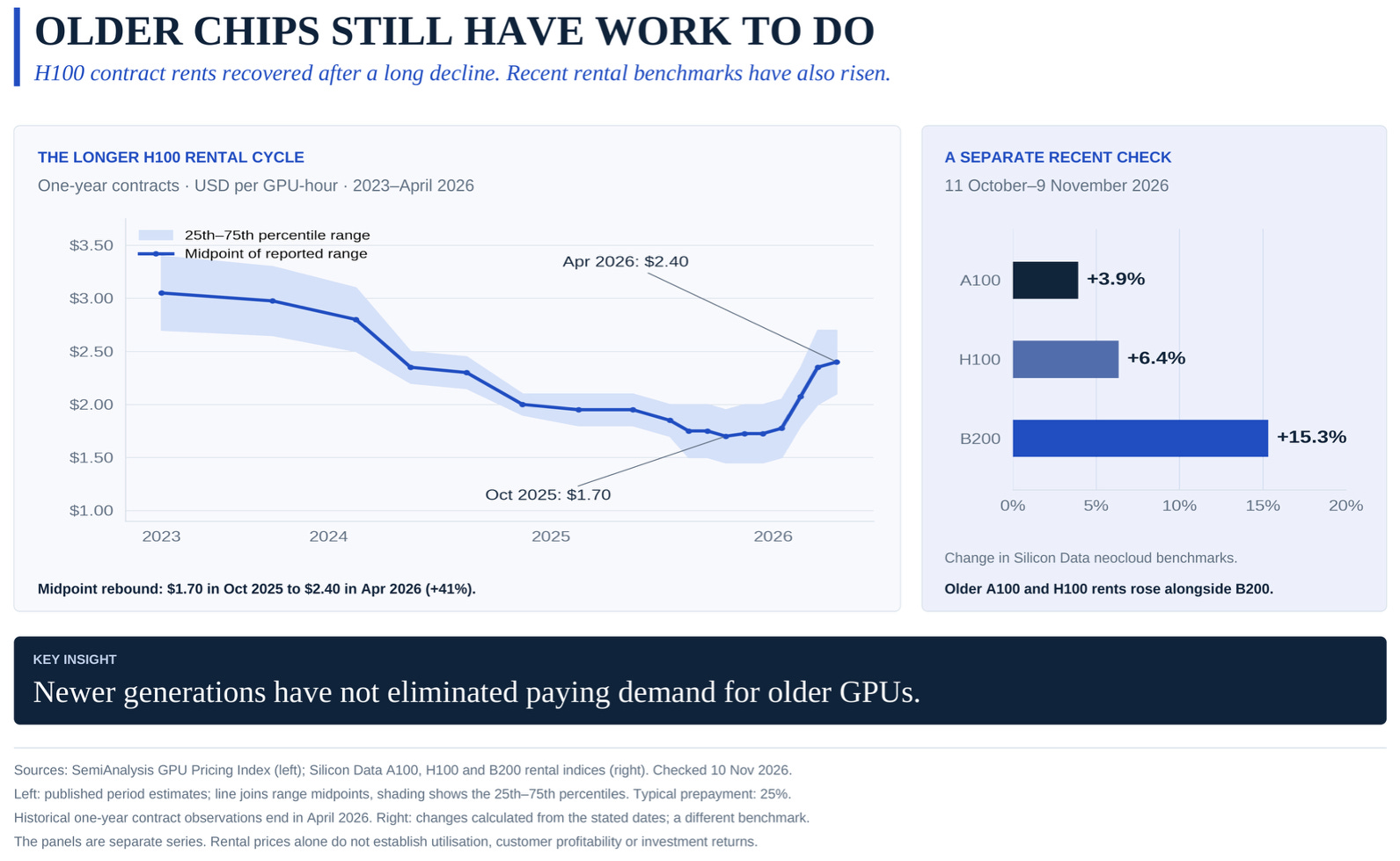
This matters because a chip does not have to be the newest or fastest to remain useful. Customers have different workloads, budgets and requirements. Equipment that is no longer the first choice for the most demanding task can still earn money performing other work. The arrival of a new generation does not automatically remove the commercial value of the installed base.
Nor do higher rents automatically prove that every computing project will be profitable. Prices reflect available supply as well as demand, and shortages can be intensified by delays in delivering power or equipment.
Nevertheless, these observations are difficult to reconcile with the claim that customers have lost interest in computing capacity.
The data-centre evidence reinforces that point. As we saw in the previous section, CBRE reported 1.4% vacancy across its primary North American markets in the first half of 2026, with 80.4% of capacity under construction already pre-leased. So, even while existing supply increased by 33.7% year on year, vacancy still declined, meaning that substantial additions to capacity were finding customers.
Taken together, these figures suggest a healthier balance between supply and demand than the comparison with the dot-com-era fiber boom might imply.
Existing facilities have little vacancy.
Much of the capacity being built already has tenants.
Older computing equipment continues to attract rental demand.
We cannot assume those conditions will last forever. But they give us a sound reason to question whether the market has become too pessimistic about the expansion’s remaining life.
And there is another reason to believe demand can broaden...
The largest AI companies dominate the headlines so completely that it is easy to forget how differently the rest of the economy uses the technology.
Ramp’s September figures put median monthly AI spending among businesses paying for AI on its platform at $15.70 per employee. Within the highest-spending 10%, the median was $813.43. Within the top 1%, it was $9,567.53.
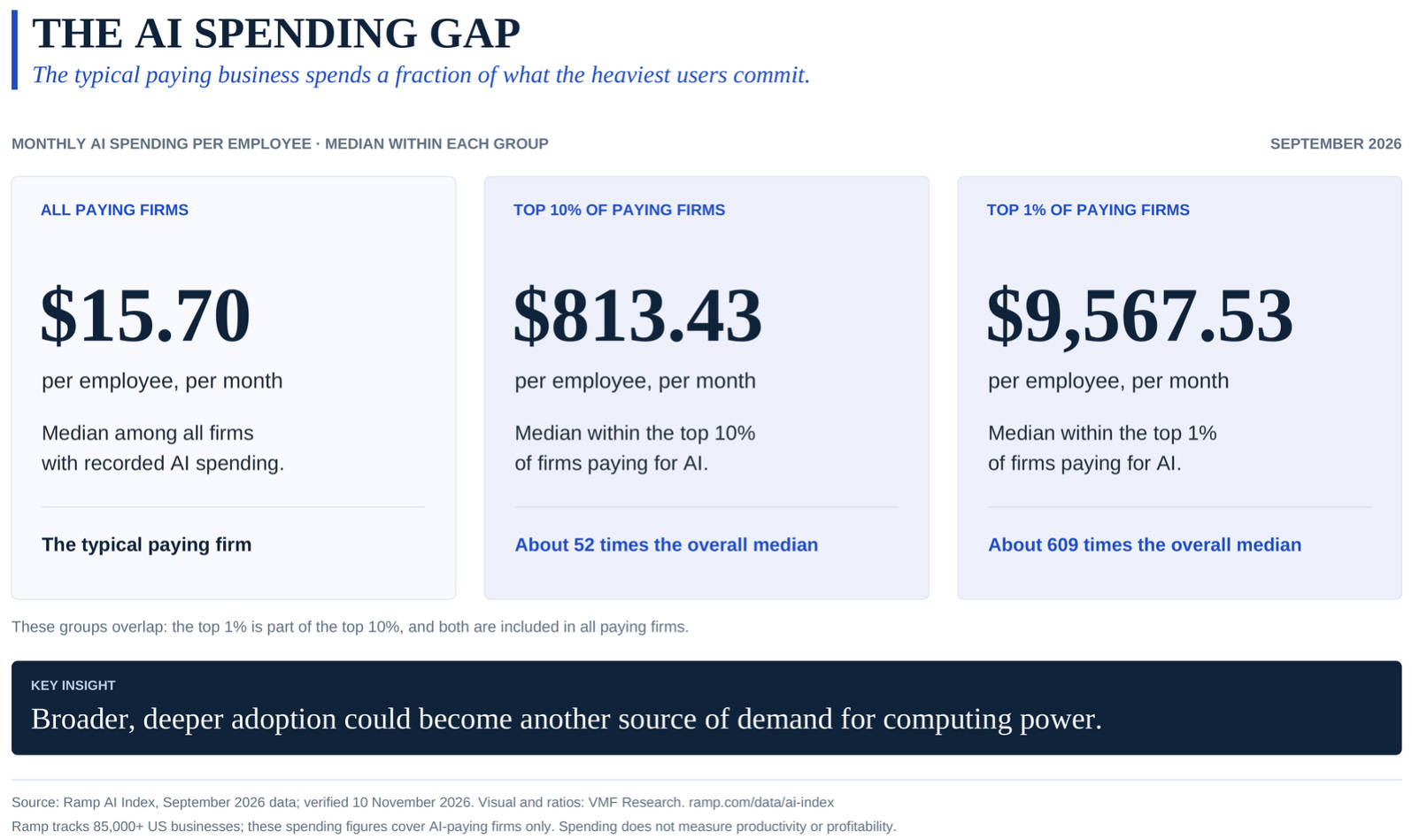
We should not expect an ordinary retailer to spend like an AI laboratory. The differences partly reflect entirely different business models.
But they do show why the spending intensity of the most enthusiastic adopters tells us little about how deeply AI has penetrated the typical business.
A company paying for a few subscriptions has adopted AI in one sense. It may still be a long way from redesigning how it processes orders, develops products, supports customers or manages its accounts.
Each useful application creates another reason to consume computing capacity. Imagine a manufacturer that begins by using AI to help its sales team prepare quotations. If the tool works well, the next opportunity might be checking technical documents, helping engineers diagnose problems or improving maintenance planning. Adoption can spread through a business one worthwhile task at a time.
Cathie Wood’s efficiency argument fits here. In her November In the Know discussion, she suggested that constraints on power, chips and data centres could force companies to use resources more efficiently earlier in the investment cycle.
Greater discipline could reduce waste and help the expansion endure.
There is an economic mechanism behind that view. When a task becomes cheaper to perform reliably, more businesses can justify using the technology for it. A GPU can remain expensive to rent while improvements in software allow each rented hour to accomplish more. The rental price of the machine and the cost of completing a useful task are different things.
That creates the possibility of a larger market: more customers, more applications and more work performed.
The commercial test remains whether customers receive enough value to keep paying. We therefore want to see adoption turn into recurring revenue and, ultimately, cash.
Strong demand today supports the investment case... sustainable customer economics will determine how far it can run. This is also why we remain selective about where we invest.
Some companies will benefit from supplying scarce infrastructure. Others will benefit from putting increasingly capable AI to work inside an existing business.Some will spend heavily and earn disappointing returns.
The opportunity is large enough to contain all three outcomes.
What has changed over the past few months is the price at which investors can participate.
For much of the AI boom, investors faced an uncomfortable bargain. The business opportunity was exciting, but buying into it often meant paying a price that left little room for disappointment.
In our view, that bargain has changed.
Consider what has happened inside the AI infrastructure industry. In its early-November analysis, Citadel Securities reported that forward earnings estimates for this group had risen 31% since the end of June, while the valuation multiple investors were willing to pay had fallen 36%. Semiconductors showed a similar divergence: higher expected earnings, substantially lower multiples.
In plain English, the market was expecting more profit but offering to sell us each dollar of that expected profit at a much lower price.
The change also shows up in the broader technology market. Goldman Sachs’ valuation chart put the Nasdaq 100 at 18.4 times expected earnings over the following twelve months on 5 November, below both its five-year and ten-year averages.
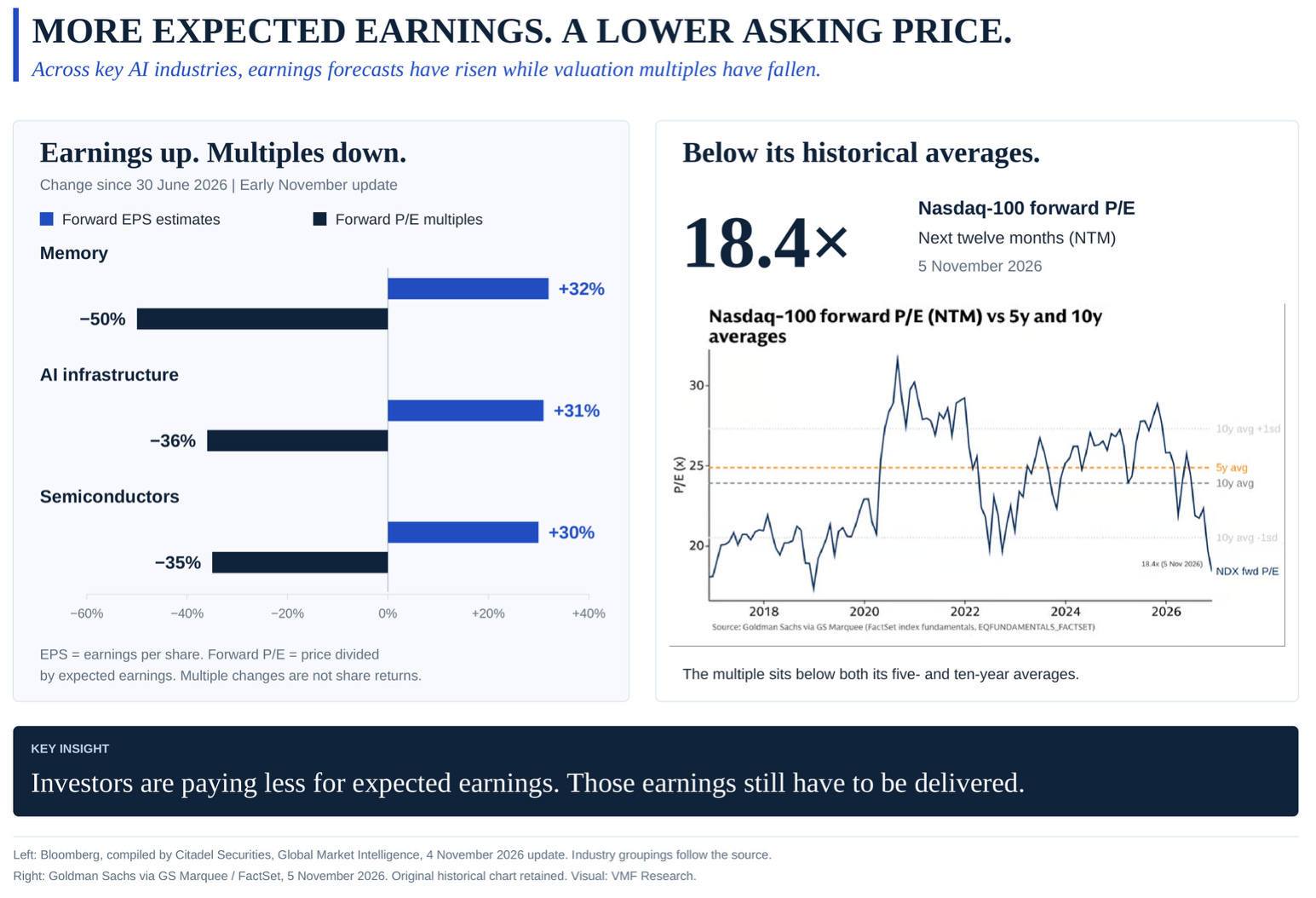
A lower multiple can, of course, be a warning that earnings forecasts are too optimistic. Analysts do not always recognise a deterioration before share prices do.
That is why we spent time examining the customers, the available capacity and the spread of AI adoption. Those indicators give us reasons to believe that the commercial opportunity remains substantial, even as financing and political constraints alter its development.
We still need companies to turn that opportunity into cash. But we are being asked to pay considerably less for their prospects. And the price is only part of what has changed. To understand the violence of this sell-off, we also need to understand the people doing the selling.
Imagine running a hedge fund that has borrowed to increase its positions. Several of your largest holdings start falling together. Losses mount, volatility rises and your risk limits begin to bite. You may still believe in the businesses you own. That does not necessarily give you permission to keep owning as much of them.
The instruction becomes simple: make the portfolio smaller. In the industry, this is called de-grossing. Funds reduce the combined size of their long and short positions, selling some of the shares they own and buying back some of those they have bet against. This can produce a peculiar market. Popular companies fall sharply while previously unpopular companies rise, even without a corresponding reversal in their business prospects.
The recent unwind has been unusually severe. In its update following the 5 November sell-off, Morgan Stanley reported that active reductions in long/short funds’ positions since June amounted to 10.7% of their gross market value at the end of June, the largest such reduction in at least a decade. Separately, The Wall Street Journal reported that October had brought the fastest unwinding of stock-picking funds’ positions in more than ten years.
The change is particularly relevant to our discussion. Morgan Stanley’s prime brokerage figures showed AI-related stocks accounting for approximately 32% of US funds’ net exposure, down from 47% at the June peak. US long/short net leverage had fallen to a one-year low.
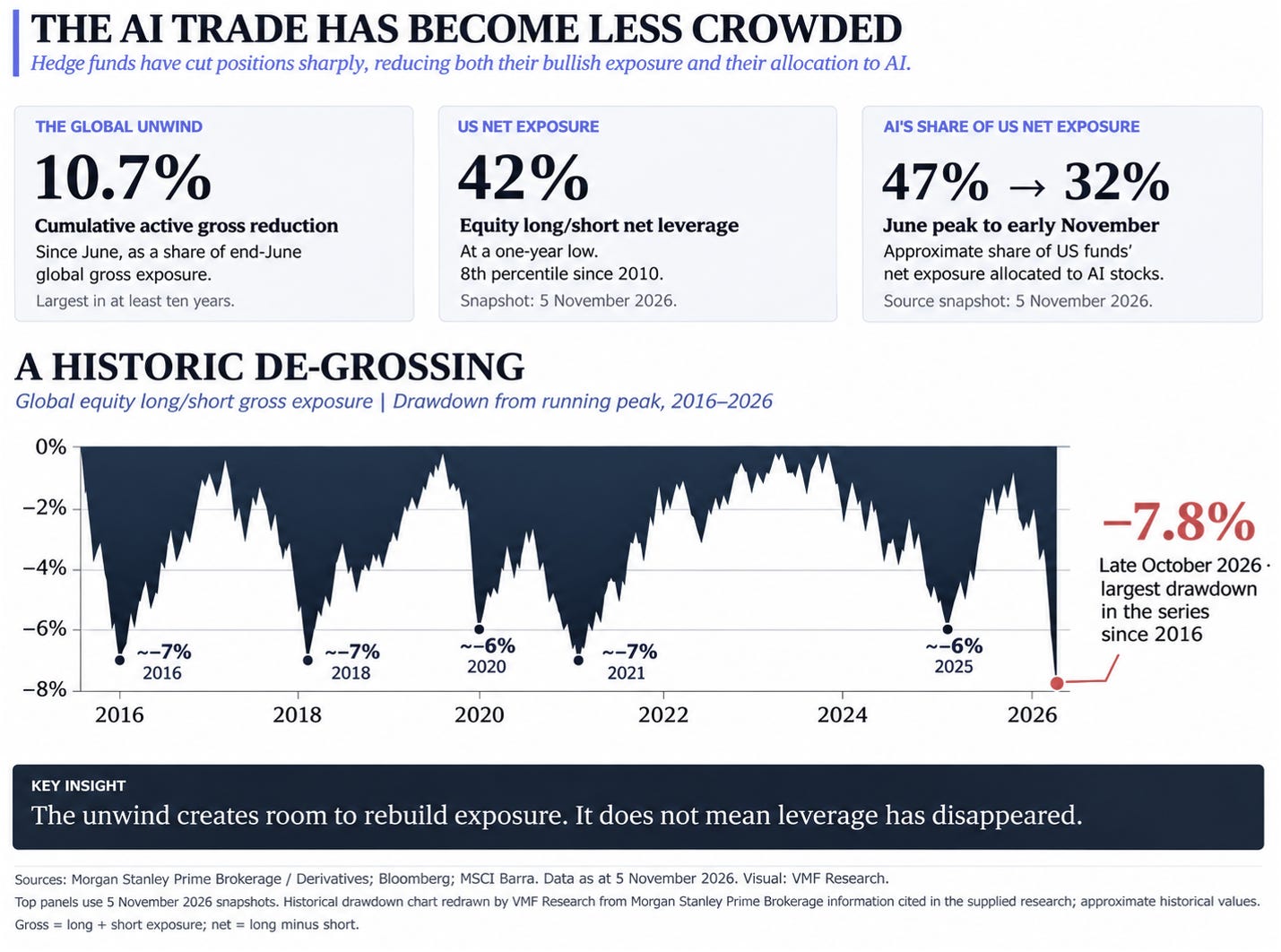
The trade investors are debating today is therefore materially less crowded than the one they were debating a few months ago.
This does not mean professional investors have abandoned AI, or that every forced seller has finished. There is still substantial exposure in the system.
But it changes the starting point.
When investors already own large positions, a promising development may produce surprisingly little additional buying. After a substantial reduction in exposure, improving conditions can give those same investors a reason to rebuild.
That possibility matters when we look at the mood surrounding the market.
Goldman Sachs’ derivatives-based US Panic Index reached 9.57 out of 10 on 5 November. On the same day, CNN’s broader Fear & Greed Index fell to 20 out of 100, within its “extreme fear” range.
Among individual investors, the latest AAII survey offers another useful perspective. In the week ending 11 November, 51.4% expected share prices to fall over the next six months, while only 30.8% expected them to rise. Bearishness was well above its historical average of 31.5%.
These measures capture different things: the price of protection, broader market behaviour and investors’ stated expectations. Together, they describe a market in which confidence has become scarce.
That does not mean everyone has stopped buying. Citadel Securities recorded sustained retail buying through October and early November. Investors can feel anxious and still purchase shares. We should distinguish pessimism from a complete withdrawal of capital.
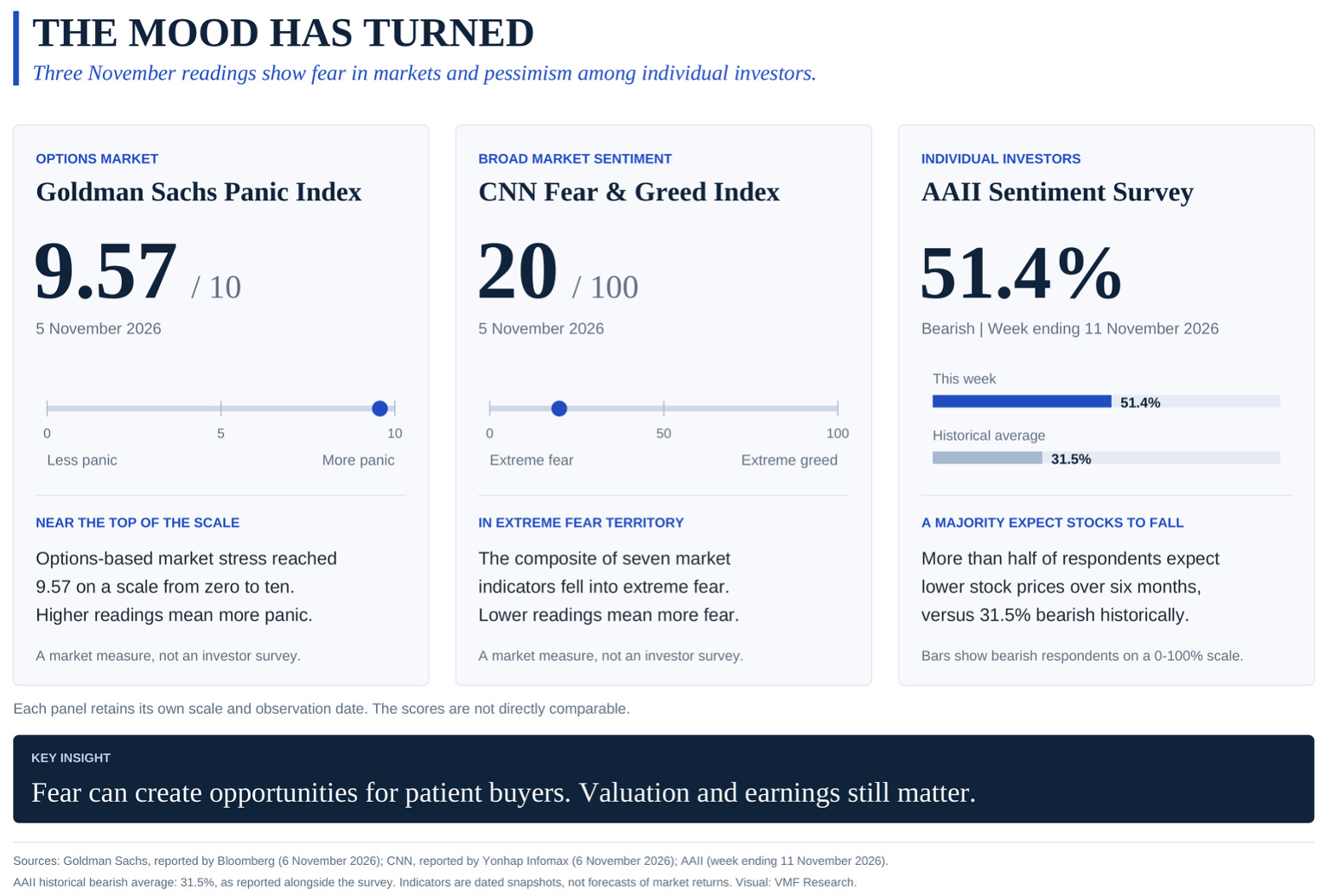
For us, the significance of depressed sentiment is what it does to expectations. When investors assume that everything will go well, even respectable results can disappoint. Once expectations have been marked down, businesses have a lower hurdle to clear.
Fear can persist. Prices can fall further. But the combination of lower valuations and diminished enthusiasm gives us a more interesting starting point than high valuations accompanied by universal confidence.
We are also entering a part of the year that has historically been favourable for equities.
Fidelity’s long-run analysis shows that, since 1945, the S&P 500 has delivered an average price return of roughly 7% from November through April, compared with approximately 2% from May through October.
The midterm calendar adds another favourable historical pattern. J.P. Morgan Asset Management reports that, across the completed midterm cycles since 1950, the S&P 500 gained an average of approximately 15% over the following twelve months.
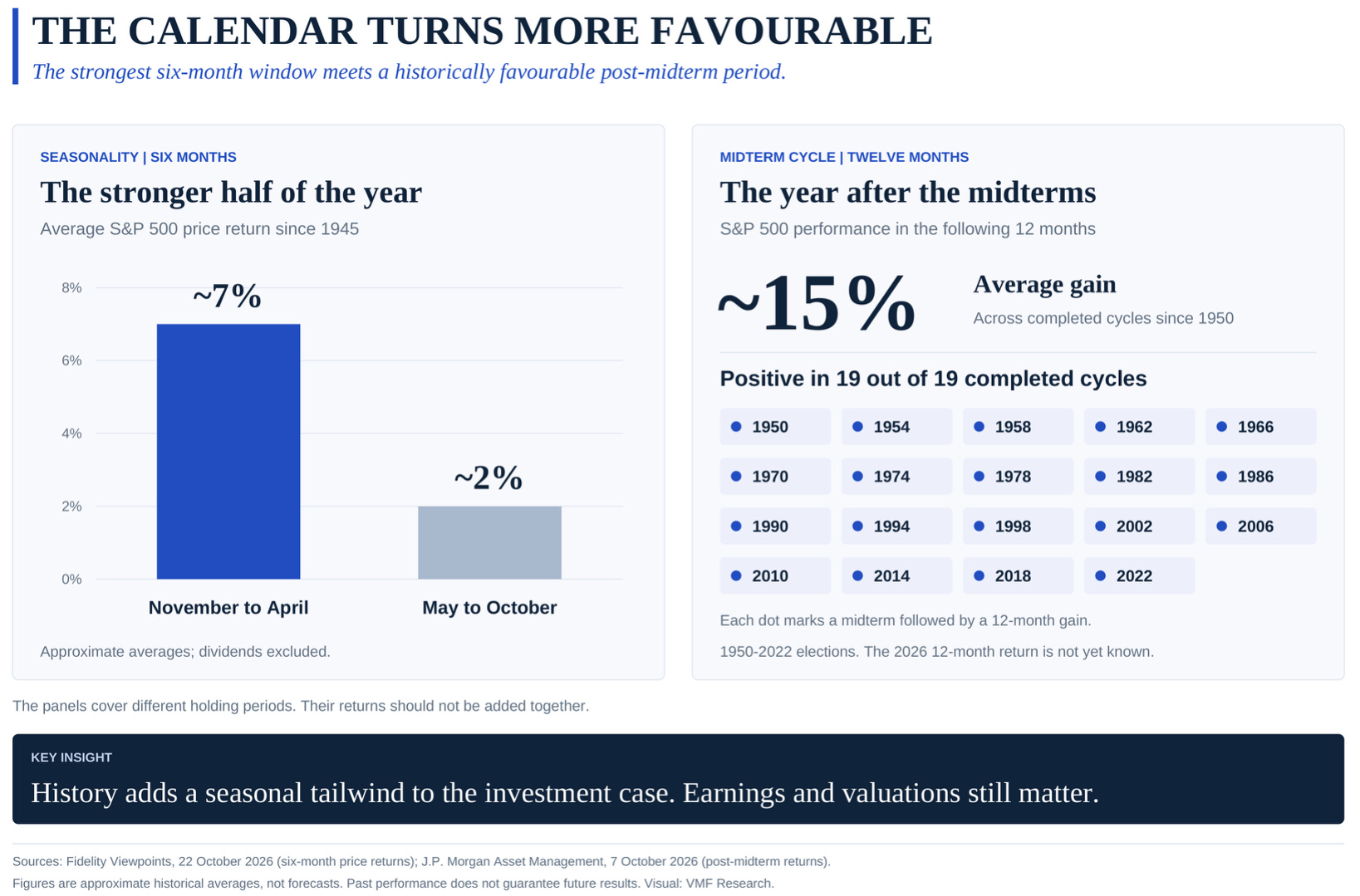
A calendar cannot repair a weak business or make an unaffordable project viable. Nor do these historical averages tell us what the market must do next.
They do, however, add support to a case that already rests on more substantial foundations.
We see evidence of continued demand for computing power and a large opportunity for businesses to expand their use of AI. We can buy parts of that opportunity at materially lower valuations. Professional investors have already reduced positions substantially, while sentiment shows considerable apprehension.
Seasonality now provides another reason to look ahead constructively.
Taken together, these developments make us willing to increase our exposure to the AI theme.
The task is to choose where that additional capital can earn an attractive return.
The companies that benefited most from the first stage of the boom will not necessarily capture the greatest rewards from its next stage.
Our attention is turning towards an application where the technological progress is becoming particularly interesting... and where the potential market extends far beyond spending on software.
Factories, warehouses and other businesses already spend enormous sums getting physical work done. If increasingly capable machines can perform a growing share of that work safely, reliably and at an attractive cost, the economic opportunity could be immense.
The recent sell-off gives us a reason to examine that opportunity with renewed interest.
The next chapter of AI may begin when intelligence gets a pair of hands.
Important Disclosure
This article contains general investment research produced by Vasco Marques de Freitas, CFA, CMT, Founder and Chief Executive Officer of VMF Research, Lda. It reproduces “The Customers Are Still Here” from the November 2026 issue of VMF’s Strategic Asset Allocation. The underlying research was completed on 13 November 2026 at 4:00 p.m. Eastern Standard Time and first disseminated to paid subscribers on 13 November 2026 at 9:00 p.m. Eastern Standard Time. VMF Research produces investment research and recommendations under the applicable provisions of Regulation (EU) No 596/2014 on market abuse and Commission Delegated Regulation (EU) 2016/958, subject to supervision by Portugal’s Comissão do Mercado de Valores Mobiliários (CMVM). The underlying publication includes investment recommendations and strategic asset-allocation conclusions. This article is not personalised investment advice and has not been prepared with reference to any reader’s investment objectives, financial circumstances, knowledge, experience, liquidity requirements or tolerance for risk. It does not constitute portfolio management, order execution, an offer to sell or a solicitation to purchase any financial instrument.
The analysis combines macroeconomic, fundamental, technological, market-structure, sentiment and liquidity research within a medium- to long-term investment framework. Assessments concerning the Abundance Shock, AI investment cycle, monetary policy, financing conditions and future corporate profitability reflect analytical judgements and conditional hypotheses rather than guarantees. Research conclusions are subject to periodic review as new evidence becomes available.
The article examines indicators of demand for artificial intelligence, including GPU rental prices, data-centre vacancy rates, preleasing commitments and corporate adoption and expenditure. These indicators measure different aspects of market activity and should not be interpreted as direct or interchangeable measures of profitability, sustainable demand or future investment returns. Rental rates may reflect temporary supply shortages, infrastructure constraints or changes in equipment availability. Preleasing commitments do not eliminate counterparty, financing, completion or utilisation risk. Increased AI adoption and expenditure do not necessarily translate into attractive earnings or free cash flow for infrastructure providers or their shareholders.
AI-related investments may involve substantial risks, including technological obsolescence, excessive capital expenditure, financing costs, customer concentration, competition, regulatory intervention, energy constraints and uncertainty concerning future demand and profitability. Historical comparisons with earlier technological investment cycles, including the dot-com and fibre-optic infrastructure booms, are illustrative and do not establish that current markets will experience comparable outcomes.
References to the public listings of Anthropic and SpaceX concern developments subsequent to the original research. Their listings provide additional opportunities for financial analysis but do not establish the validity of earlier investment theses or guarantee future shareholder returns. Historical indirect exposure to these businesses should not be confused with direct ownership of their publicly traded shares, and their subsequent market performance should not be attributed to an illustrative Model Portfolio unless supported by its published methodology.
Disclosure of Interests: Neither VMF Research nor the author personally held financial instruments included in the VMF’s Strategic Asset Allocation Model Portfolio at the original research cut-off. As disclosed in the November issue, legal entities controlled by the author held long positions in the KraneShares CSI China Internet ETF (KWEB), ARK Innovation ETF (ARKK) and Malibu Life Holdings Limited. Other VMF Research publications have also disclosed interests held through controlled entities in Scottish Mortgage Investment Trust PLC, providing potential indirect exposure relevant to the technology businesses discussed. Such interests may create actual, potential or perceived conflicts and should be considered when evaluating the analysis. Interests and underlying exposures may have changed since their respective disclosure dates.
Neither VMF Research nor the author received compensation from any issuer, fund sponsor or other covered entity in connection with the preparation of the original research. No covered entity reviewed, approved or amended its investment conclusions before first dissemination.
The Tier One Model Portfolio is an illustrative research portfolio, designed to communicate VMF Research’s strategic asset-allocation framework, Market View and investment conclusions. It does not represent actual client assets, transactions executed by VMF Research or the performance of an investable fund or managed account. Portfolio allocations, changes and reported returns are hypothetical research constructs based on the published methodology and reference prices. Information has been obtained from sources considered reliable, including regulatory filings, issuer disclosures, official statistics, market data and third-party research, but its completeness, accuracy and continued relevance cannot be guaranteed.
Past performance, simulated performance, historical market relationships, valuation estimates and forward-looking scenarios are not reliable indicators of future results. All investments involve risk, including volatility, liquidity risk, changing financial conditions and the possible loss of some or all invested capital. Readers should conduct their own analysis and, where appropriate, consult an authorised financial adviser before making investment decisions.
The H100 is an NVIDIA graphics processing unit, or GPU, used to train AI models and run them once trained. Training develops a model’s capabilities; running it produces answers and other outputs. Customers can rent access to this computing power instead of buying the equipment.