

An AI boom is an unlikely reason to reconsider government bonds. Yet that is where September’s research has taken us.
Rising yields are usually discussed through the language of inflation. Inflation certainly belongs in the explanation. But it does not explain everything investors are being asked to price.
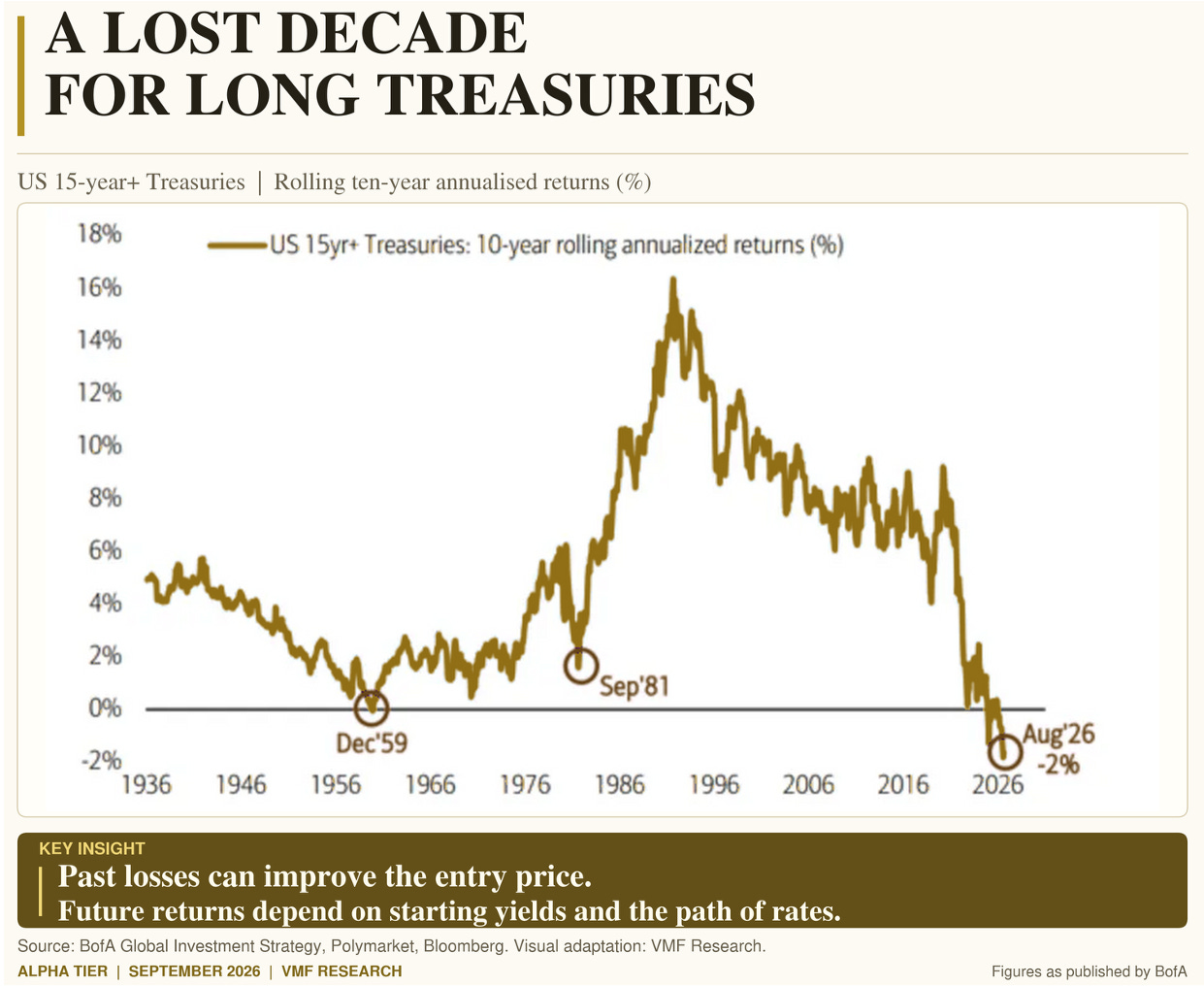
Long-dated US Treasuries have just endured something remarkably rare. By August, their trailing ten-year annualised return was approximately minus 2%, equivalent to a cumulative loss of roughly 18%. Across almost ninety years of history, that stands out as an exceptional outcome.
That damage has improved the terms available to the next buyer. It has not told us whether the adjustment is finished.
The harder question is why today’s yields are so high.
If investors are mainly demanding protection against persistent inflation, the implications are one thing. If part of the pressure reflects a world in which governments are borrowing heavily while businesses compete for capital to build data centres, power infrastructure and the productive capacity behind AI, the story becomes more interesting.
A more productive economy could eventually reduce inflation pressure while still supporting higher real interest rates.
Our recent research has examined the businesses building the Abundance Shock. This section asks what building it might do to the price of money itself.
And whether, after one of the worst decades bondholders have experienced, long Treasuries are beginning to offer something worth investigating again.
This excerpt was first published for paid Alpha Tier subscribers on 25 September 2026. The full issue carries the argument into implementation, entry conditions and the Model Portfolio decision.
Good reading.

A government can promise to repay you in thirty years. It cannot promise what that money will buy.
Nor can it promise that the interest rate you accept today will still look attractive when the world has changed around it.
Those two uncertainties sit at the heart of the bond market. They also explain why a rise in government borrowing costs can carry several different messages about the future.
Inflation is the most immediate explanation. It deserves our attention. But long-term yields also reflect the returns available elsewhere, the demand for capital, the credibility of monetary policy and the willingness of investors around the world to hold someone else’s debt.
Some of those forces can push yields higher because the economic outlook has deteriorated. Others can do so because it has improved.
For investors, the distinction matters enormously...
In the September issue of VMF’s Strategic Asset Allocation, we examined the price of monetary credibility. In VMF’s Security Selection, we explored the productive possibilities opening up through technological progress. The bond market is where those two discussions meet: what tomorrow’s money will be worth, and what tomorrow’s economy might be capable of producing.
Start with what we are actually buying.
A conventional Treasury bond promises fixed dollar coupons and the repayment of principal at maturity. Its coupon does not increase when inflation accelerates. It does not participate in a productivity boom. When investors demand a higher return, the existing bond’s price must fall until those unchanged payments offer a competitive yield.
That yield contains several layers of information.
The useful starting approximation is:
Long-term government yield ≈ expected average short-term nominal interest rates over the bond’s life + a term premium.
This is the framework underlying the New York Fed’s Treasury term-premium estimates. Both components concern the future; neither can be read directly from today’s policy rate.
The split must be estimated using a model.
The first component includes the real interest rates investors expect to earn, plus compensation for expected inflation. If the purchasing power of money is expected to erode more quickly, lenders generally require more dollars back. If productive investment opportunities become more attractive, expected real short-term rates can rise as well.
The second component, the term premium, reflects the compensation investors require for bearing interest-rate risk over time rather than continually reinvesting in short-term instruments. A thirty-year commitment exposes its owner to much more uncertainty about the value of those fixed payments.
Here we need to distinguish expected inflation from inflation risk.
Two investors might both expect inflation to average 2%. One is confident it will stay close to that number. The other sees a substantial chance of a prolonged inflation shock. Their central forecasts match; their willingness to hold a fixed nominal payment may not. Inflation-risk compensation forms part of the nominal term premium. Adding it again as a separate premium would count it twice.
Nor must the term premium always be positive. If long government bonds reliably gain value during recessions, investors may accept a lower expected return in exchange for that protection. When inflation causes bonds to fall alongside equities, that protection becomes less dependable and investors may demand more compensation to hold them.
There is also a credit premium, compensating investors for expected losses from missed payments and the risk around those losses. The observed credit spread also reflects influences such as liquidity. For the United States, which borrows in its own currency, concern about public finances can instead appear through inflation risk, heavier debt supply and higher required returns. Political or legal payment disruption remains possible, but fiscal anxiety need not express itself as an expectation of outright default.
Finally, Treasuries provide valuable services as liquid assets and financial collateral. Investors can accept a lower yield for those services. Changes in that demand affect prices too.
These are related economic forces, rather than five independently observable numbers we can simply add together.

This framework changes how we interpret the current inflation shock.
US consumer prices rose 3.4% over the year to August. Core inflation, excluding food and energy, was 2.4%, while energy prices were 16.3% higher. That gap helps explain the pressure households are feeling, and why the source and persistence of inflation matter as much as the headline number.
The Federal Reserve responded on 16 September by raising its target range by a quarter of a percentage point to 3.75–4.00%. Its statement also described strong productivity growth and robust capital investment.
Inflation pressure and economic strength are present in the same policy discussion.
Higher interest rates cannot produce another barrel of oil. They can restrain spending, influence financing conditions and reduce the likelihood that an initial price shock becomes embedded in wages, prices and expectations.
For the long-term bondholder, credibility is crucial. A rate increase that persuades investors inflation will be contained can help lower long-term yields. A rate cut that undermines that confidence can push them higher. The Fed controls its policy setting; it does not dictate the price at which investors will lend for thirty years.
That is also why our Dovish Shock thesis requires careful interpretation. Monetary easing that becomes possible because inflation is falling would have different implications from easing that investors believe will accommodate inflation. The reason policy changes matters to the bond an investor owns.
Now bring technological progress into the picture.
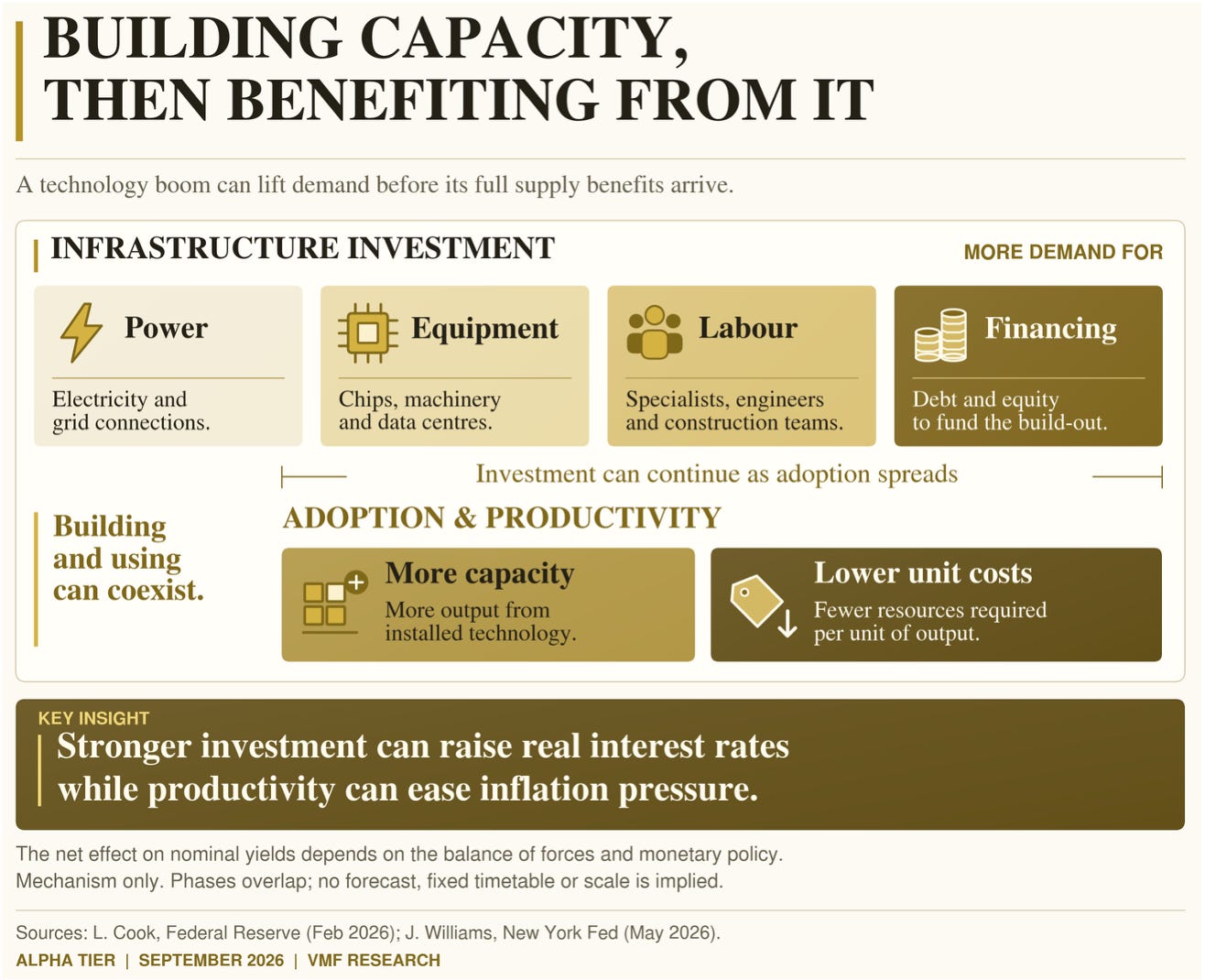
Before artificial intelligence can make more of the economy cheaper to operate, someone must build the infrastructure that enables it. Data centres require power, equipment, construction capacity and capital. Those demands arrive before the full productivity benefits spread through the businesses using the technology.
The transition can therefore create pressure in opposite directions at different speeds. Investment raises demand for scarce resources now. Better tools can expand productive capacity and lower costs over time. Fed Governor Lisa Cook has highlighted this timing problem in assessing AI’s economic effects.
This is entirely consistent with our Abundance Shock thesis. The construction phase can be expensive even when the capacity being built eventually makes important activities cheaper.
A business that can produce the same output with less labour, energy or administrative effort has more room to reduce prices, increase margins or expand production. Competition determines how much of the gain reaches customers.Adoption determines how quickly it arrives.
But cheaper intelligence also makes previously uneconomic activities worth pursuing. More research, more software and more services become possible. Some of the saving is spent on doing more.
That brings us to a distinction that is essential to the Treasury investment case:
A more productive economy can experience lower inflation and higher real interest rates at the same time.
If new projects offer attractive returns, businesses have more reason to invest.
Their demand for financing can raise the real return required to attract savings. Government debt must compete with those opportunities. New York Fed President John Williams has discussed how productivity improvements can affect both inflation and the real neutral interest rate, the rate consistent with a balanced economy.
Suppose expected inflation falls by one percentage point, while expected real rates rise by the same amount. Before changes in risk premia, the nominal yield has no reason to fall.
Our technological thesis can therefore be correct without every long-duration bond becoming a winning investment.
This is the connection with our discussion of What Tomorrow is Worth. A successful company can grow the cash flow that investors discount. A conventional Treasury’s promised payments remain fixed. Stronger growth can improve the company’s earnings prospects while raising the return investors require from both securities.
For our Abundance Shock to drive long-term nominal yields lower, the decline in expected inflation and associated risk compensation must outweigh any increase in expected real rates and other required premia. That outcome would not require a sustained fall in the overall price level.
How do we distinguish these forces in the market?
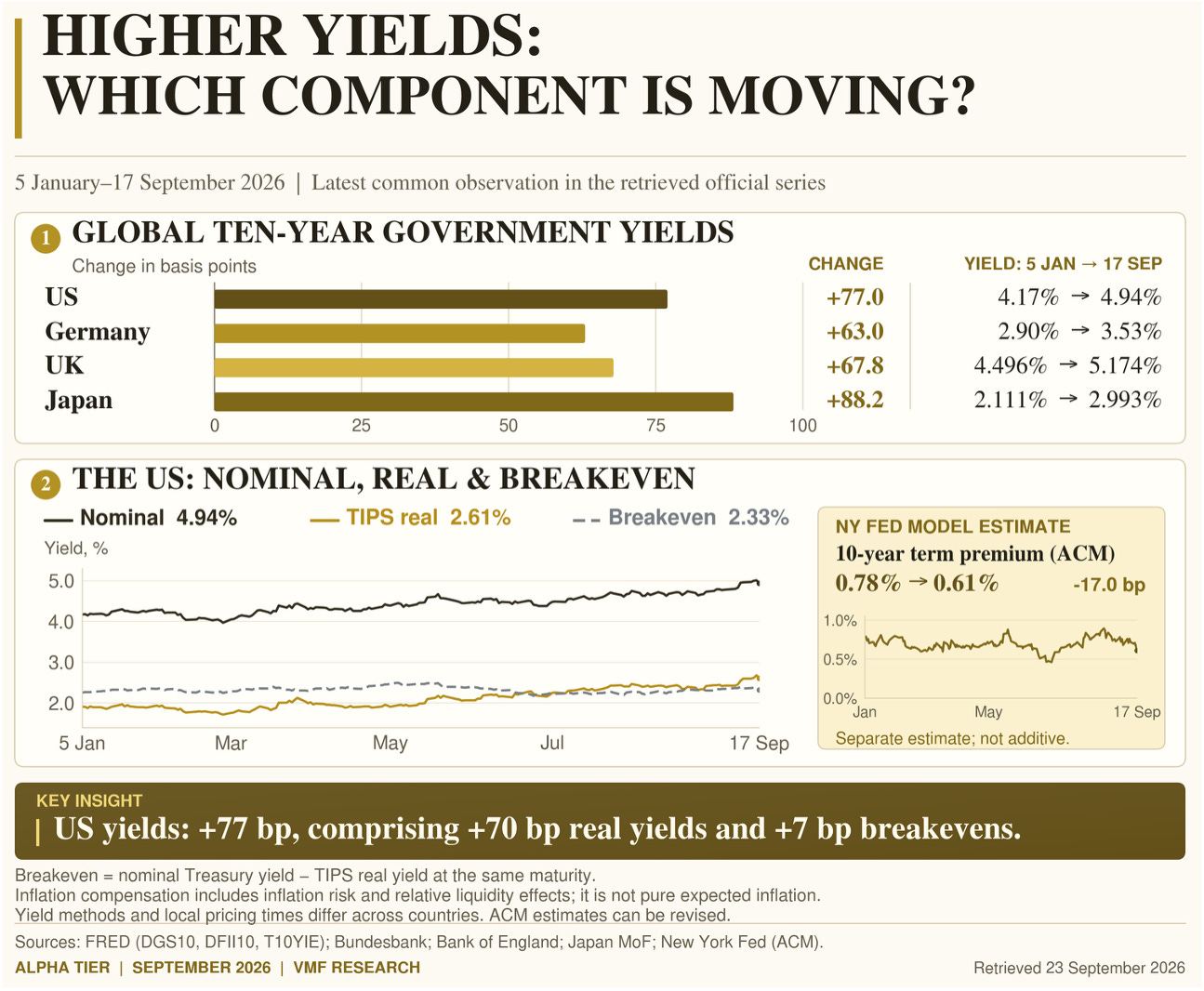
Compare nominal Treasury yields with the real yields on inflation-protected Treasuries, or TIPS, of comparable maturity. The difference is commonly called breakeven inflation. It provides a useful measure of inflation compensation, but includes inflation-risk pricing and differences in liquidity as well as expected inflation. A TIPS yield also contains risk and liquidity effects; it is not a pure measure of expected growth.
If nominal yields rise while breakevens remain broadly unchanged, an explanation based solely on rising inflation expectations is incomplete. Real yields and term-premium estimates deserve attention alongside growth, investment and fiscal developments.
Heavy government borrowing adds another pressure. More debt must find willing owners at a price they accept. If central banks hold less of it, private investors must absorb more exposure to interest-rate changes. They may require higher yields to do so, particularly when their balance sheets are constrained.
Neither a stronger economy nor a larger deficit mechanically sets the yield. The question is how investment demand and debt supply compare with the willingness to save and hold duration at the prevailing price.
There is another source of pressure that begins outside the United States.
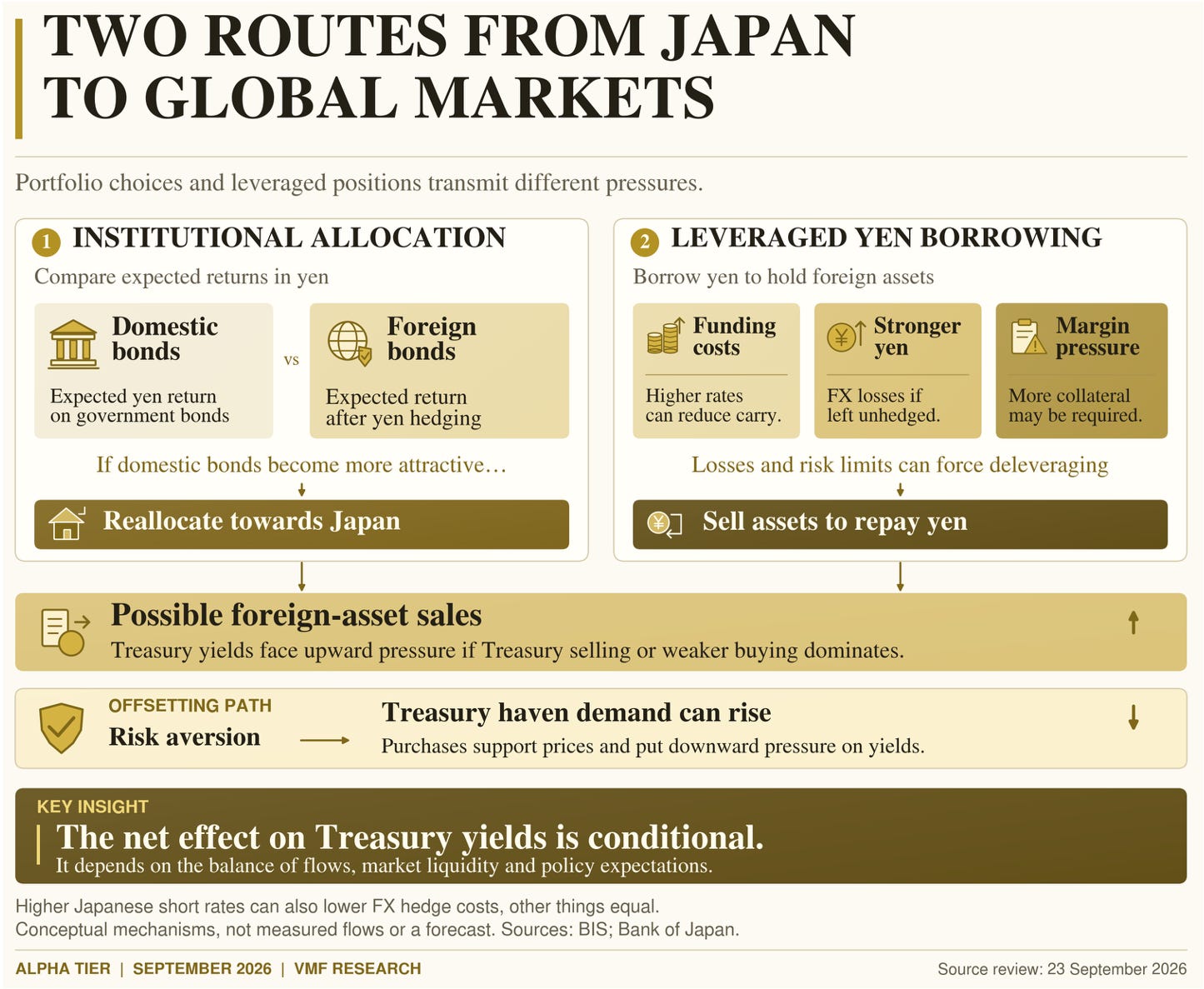
Japan has long offered investors access to relatively cheap yen financing. It is also home to institutions with substantial overseas portfolios. Rising Japanese yields can affect both, through different channels.
For a Japanese insurer or pension fund, more attractive domestic bonds can reduce the need to seek returns abroad. Some capital could return home, while some future investment might remain in Japan. Either could weaken foreign demand for Treasuries at existing prices.
But the comparison is more complicated than putting a JGB yield beside a Treasury yield. An institution hedging its dollar exposure must account for the cost of that hedge. Holding other factors constant, higher Japanese short-term rates narrow the interest-rate differential and can reduce the cost of hedging dollars back into yen. Domestic bonds and hedged foreign bonds can therefore become more attractive simultaneously. This follows from the interest-rate relationship underlying currency forwards.
The leveraged yen carry trade is a separate mechanism. An investor borrows yen and buys an asset expected to earn more elsewhere, while retaining currency exposure. Higher funding costs reduce the attraction. Yen appreciation makes the borrowing more expensive to repay in terms of the foreign asset. Leverage and margin calls can turn an orderly reassessment into forced selling.
That selling could reach government bonds. It could also provoke a flight towards them. During the August 2024 turbulence, the BIS (Bank of International Settlements) documented a carry unwind alongside falling government yields, as growth concerns and expectations of easier policy also influenced markets.
Japan therefore belongs in any serious assessment of what is driving global bond yields.
Establishing that it is driving today’s Treasury sell-off requires evidence from flows, hedged returns and positioning. A particular dollar-yen exchange rate cannot establish that on its own.
Taken together, these forces explain why rising yields can coexist with optimism about technological progress, anxiety about inflation and concern about public finances.
They also explain why the investment opportunity may be changing...
A decade is a long time to own an asset and finish with less than you started with.
Yet a Bank of America chart attributed to Michael Hartnett places the trailing ten-year annualised return on US Treasuries with maturities of fifteen years or more at approximately minus 2% in August 2026. Compounded for ten years, that is a loss of roughly 18%.
The chart presents an exceptionally weak result across the approximately ninety years of history displayed, forming the basis of the argument that long bonds may offer a generational entry point.
The implication deserves serious consideration.
An unusually poor investment record can emerge just as the terms available to a new investor become more attractive.
There are instructive precedents in other assets.
Over the ten calendar years from 2000 through 2009, the S&P 500 lost approximately 9% including dividends. Over the following decade, it gained approximately 253%, equivalent to 13.4% a year. That comparison begins after the substantial recovery during 2009 (it does not require buying the precise March low).
Gold’s dollar price fell approximately 27% during the 1990s, then rose approximately 275% during the 2000s, or 14.1% a year before storage costs. Yet gold had also lost value during the 1980s. One negative decade was followed by another before the powerful recovery.
These selected episodes demonstrate both the opportunity and the limitation of the analogy.
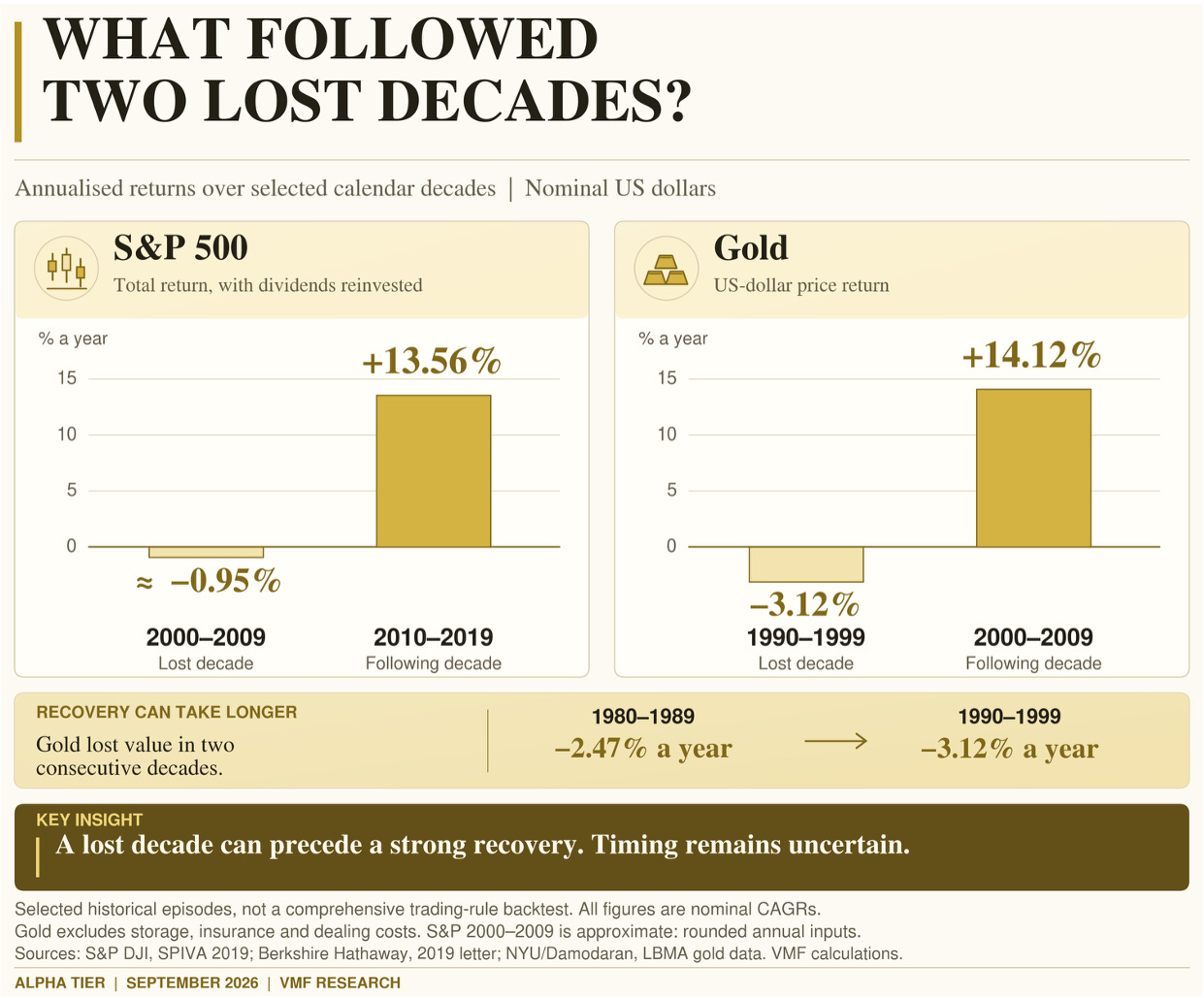
Past disappointment can leave an asset attractively priced. It does not tell us when the economic conditions supporting a recovery will arrive.
Gold is also a particular commodity exposure. A broad commodity-futures investment includes the effects of replacing expiring contracts and earning income on collateral. Its return cannot be inferred from a collection of spot-price charts.
For bonds, however, the improvement in prospective returns has a particularly tangible foundation.
When a bond’s price falls, the same promised payments offer the next buyer a higher yield. Provided those payments are made, today’s investor can acquire a better contractual return than the investor who paid a much higher price.
There is no requirement for the old price to return for that improvement to matter.
But there is also no requirement for today’s price to be the bottom.
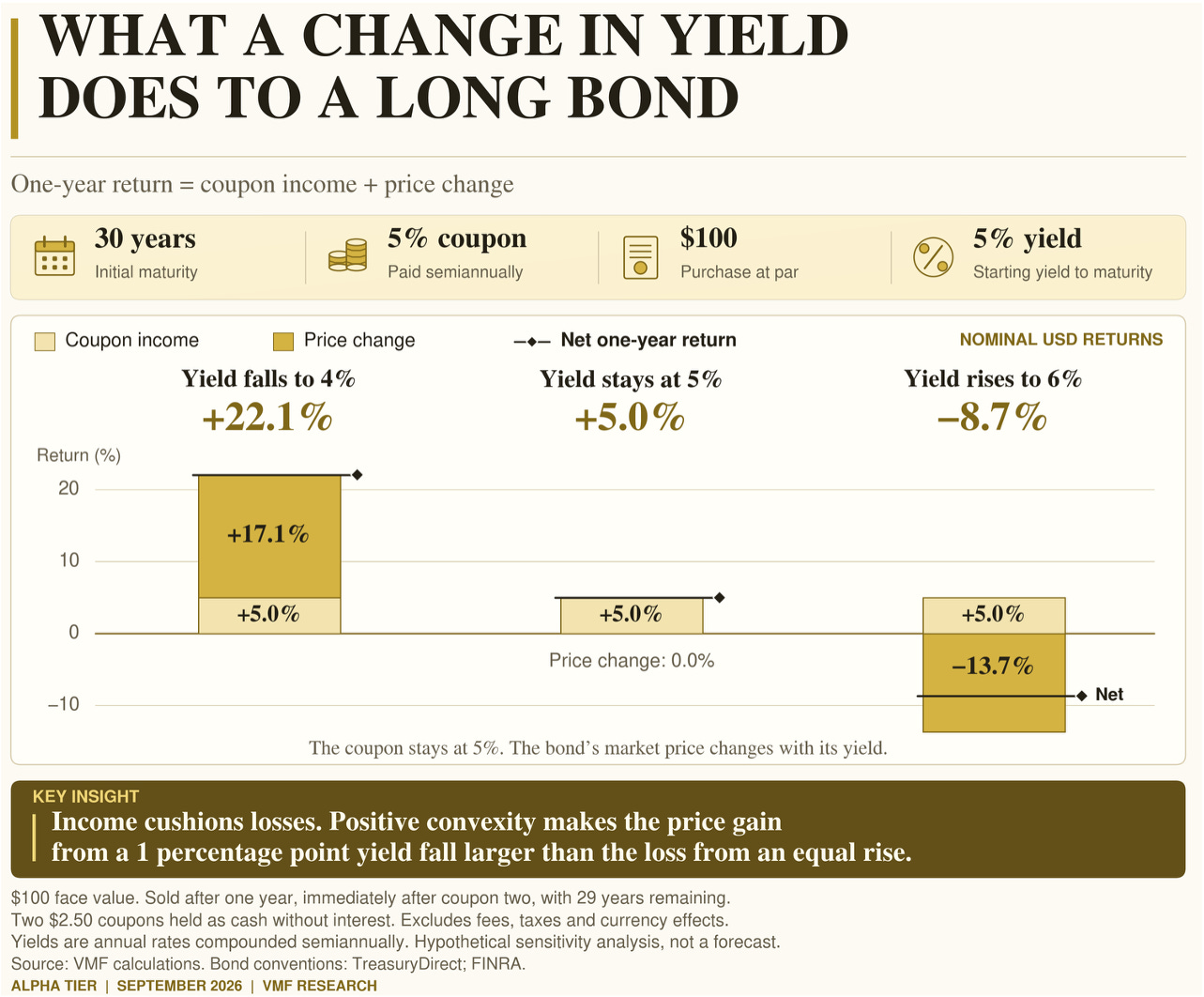
Consider an illustration: a thirty-year Treasury paying a 5% annual coupon in semiannual instalments, bought at par with a 5% yield to maturity. This is a hypothetical bond, not a quotation for a particular security.
After one year, it has paid $5 per $100 invested and has twenty-nine years remaining. If its yield then falls to 4%, its price rises to approximately $117.07, producing a one-year total return of about 22.1%. If its yield stays at 5%, the return is 5%. If its yield rises to 6%, the price falls to approximately $86.33 and the total return is about minus 8.7%.
The income provides a cushion. It does not remove the risk.
A bond’s modified duration measures the approximate sensitivity of its price to a small change in yield. The curvature that makes the gain from a one-point yield fall larger than the loss from an equal rise is positive convexity.
It is a useful property, but it tells us nothing about how likely either outcome is.
Holding an individual bond to maturity fixes its promised dollar cash flows, subject to payment. It does not fix their purchasing power, the return earned on reinvested coupons or their value in an investor’s home currency. A fund that continually replaces ageing bonds to maintain long duration does not gradually approach a single maturity date in the same way.
Those distinctions should shape how any position is implemented and sized.
Where does that leave our conviction?
Our Abundance Shock thesis gives us a coherent reason to question whether the inflation risks embedded in long-term nominal bonds will prove as persistent as investors fear. If productivity gains spread, competition passes savings through and monetary policy preserves credibility, today’s fixed payments could become more valuable than the prevailing narrative suggests.
A growth slowdown or a Dovish Shock that preserves inflation credibility could accelerate that repricing. The stronger structural case would be an economy capable of expanding with less inflation pressure than is currently priced.
We must test that case against the possibility that stronger investment keeps real rates elevated, or that fiscal supply and uncertainty keep term premia high.
Cheaper intelligence alone cannot settle the balance.
For the Model Portfolio, the practical question is whether the yield available today adequately compensates us for those competing outcomes. We would look for broader productivity gains, durable moderation in inflation and evidence that financing pressures are easing. Entrenched inflation, higher real rates or fiscal risk premia that offset disinflation, or a sustained deterioration in policy credibility would challenge the case.
But, Hartnett’s chart brings long Treasuries firmly back onto our investment agenda.
Their future return will depend on the price we pay and the world that follows, rather than the decade already endured.
The opportunity we are investigating is straightforward: investors may be demanding more compensation for long-term inflation risk than a more productive economy ultimately requires.
If that compensation proves excessive, long Treasuries could become one of the less obvious beneficiaries of our Abundance Shock thesis.

Important Disclosure
This article contains general investment research produced by Vasco Marques de Freitas, CFA, CMT, Founder and CEO of VMF Research, Lda. It reproduces “The Cost of Building Abundance” from the September 2026 issue of Alpha Tier. The underlying research was completed on 25 September 2026 at 4:00 p.m. Eastern Daylight Time and first disseminated to paid subscribers on 25 September 2026 at 9:00 p.m. Eastern Daylight Time. Charts, market data and third-party research retain their individually stated reference dates.
The publication contains information recommending or suggesting an investment strategy. It is not personalised investment advice and does not consider any reader’s objectives, financial circumstances, knowledge, experience, liquidity requirements or tolerance for risk. The Alpha Tier Model Portfolio is an illustrative research portfolio and does not represent client assets, transactions executed by VMF Research or the performance of an investable fund or managed account.
The analysis combines macroeconomic, monetary-policy, fixed-income and market research within a medium- to long-term framework. Statements concerning the Abundance Shock, inflation, productivity, real interest rates, term premia, Treasury supply, Japanese capital flows and the prospective attractiveness of long-duration government bonds are analytical judgments and conditional hypotheses rather than assurances of future outcomes.
Neither VMF Research nor the author received compensation from any issuer covered in connection with the preparation of the original research, and no issuer reviewed, approved or amended its investment conclusions before first dissemination.
Past performance, simulated performance, Model Portfolio performance and forward-looking scenarios are not reliable indicators of future results. All investments involve risk, including volatility, liquidity risk and the possible loss of some or all invested capital. Readers should conduct their own analysis and, where appropriate, consult an authorised financial intermediary or adviser before making an investment decision.