Alfred Lee Loomis ran an investment bank in the 1920s. His bank helped finance electrification, the disruptive innovation of that era, much like AI today. His advantage was basic and powerful: measure first, decide second.
He didn’t gamble by holding risky leftovers from deals. He kept cash and safe bonds so he could act when it mattered. He watched three simple things: was supply growing faster than real demand? Were prices running ahead of profits? Was debt making the system fragile? In early 1929, his answers were “yes.” He sold into strength.
After the crash, he waited... and then used his cash to buy quality assets cheap, on his terms. So... he sold at the top and bought at the bottom. Those are the same questions we ask of today’s market... and, in more than a few pockets, the early answers rhyme with Loomis’s.

We’re in the melt-up
We’re not gloom-and-doomers, and we’re certainly not warning from the sidelines. We’ve been positioned for this tape since our inaugural editions in May 2024—when many of today’s winners were still deeply contrarian.
Our Model Portfolios are exposed to the best-performing assets: precious metals (several positions now showing triple-digit gains), China (our early Alibaba call is ~+140%), crypto (an explicit overweight from day one, now north of +70%), and disruptive innovation (positions already above +100%).
These aren’t victory laps... they’re receipts. They show we were early for the right reasons—and that we’re still compounding with a hand on the risk dial. (Educational research only; past performance is not indicative of future results.)
In my paid Alpha Tier, I publish the live dashboards, the exact trims, and the insurance I’m carrying — plus the triggers that would make me flip posture. If you want that level of detail, today’s the best time to join.
Quick context: why this looks like a classic top… and why we’re still long risk
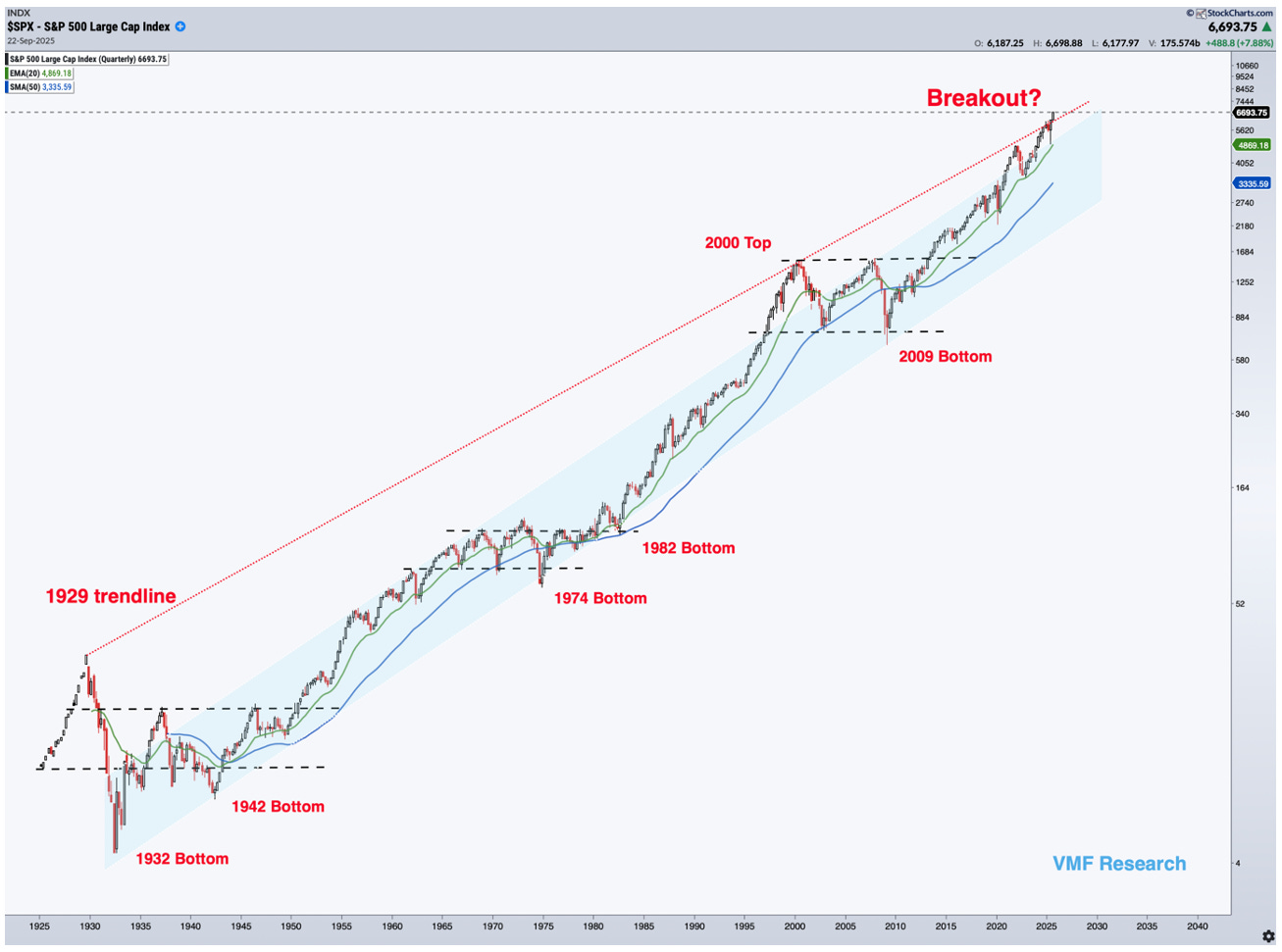
The tape is pushing into a century-scale trendline that connects the 1929 and 2000 peaks, while a composite of core valuation metrics sits at extreme percentiles. That combo—parabolic price pressing historic resistance with valuations at records—rarely ends with a gentle glide path. Still, melt-ups can run longer than anyone’s patience.
Our job isn’t to call the exact top; it’s to manage asymmetry: keep most of the upside while capping the downside regret. In practice, that means harvesting into vertical moves, tightening risk levels as momentum accelerates, and preserving liquidity so we can choose our moment.
We stay long while the market pays us, but we do it with a hand on the brake, not the horn. (we use the two charts from page 4 of the September Alpha Tier issue to illustrate the long-term trendline breakout and the valuation composite).
Cycle analysis—our critical edge from decades to days (and the answer to the “Are we about to pull a Loomis?” question)
Cycle work is the tiebreaker in a melt-up. We use the full toolkit—from long-term to short-term—to decide when to press, when to harvest, and when to step aside. At the long end, the Fourth Turning framework explains why a substantial bear before the next secular “High” is plausible: stressed institutions, heavy debt, geopolitical risk. In the medium term, two clocks dominate outcomes: Liquidity and Debt Refinancing. Liquidity is still supportive but aging, while the U.S. faces a visible maturity wall into 2026—the kind of rollover pressure that can create sudden air pockets. In the near term, seasonality and election rhythms tilt constructive—especially for crypto into the October–December window—so the melt-up can extend even as we keep a hand on the brake.
That’s our answer to the Loomis question: not yet—but we’re acting like we might. We stay long leaders now, take partial profits on triple digit winners, buy insurance (don’t chase it), define exit levels in advance, and keep dry powder for forced-seller moments.
Here’s the thing: you don’t need to pick a day on the calendar. You need rules that survive mood swings. Loomis had them in 1929. We can have them in 2025.
In my paid Alpha Tier, I publish the live dashboards, the exact trims, and the insurance I’m carrying — plus the triggers that would make me flip posture. If you want that level of detail, today’s the best time to join.
Looking for where to start?

Check our Leaderboard updates - Top 10 Positions - February 18th, 2026

You might also like reading: