

This Weekly Update was first published for Tier One subscribers on 25 July 2026.
We argued that long-term Treasury yields had entered what we call the TACO Zone: the point at which tighter financial conditions begin imposing enough political and economic pain to make a Trump retreat increasingly likely.
Two days later, President Trump has paused US strikes on Iran. Oil is falling sharply, Treasury yields are easing and risk assets are rallying.
The TACO may now be unfolding in real time.
Here is what we wrote before the turn.
Long-term yields have pushed into the zone we label the TACO Zone.
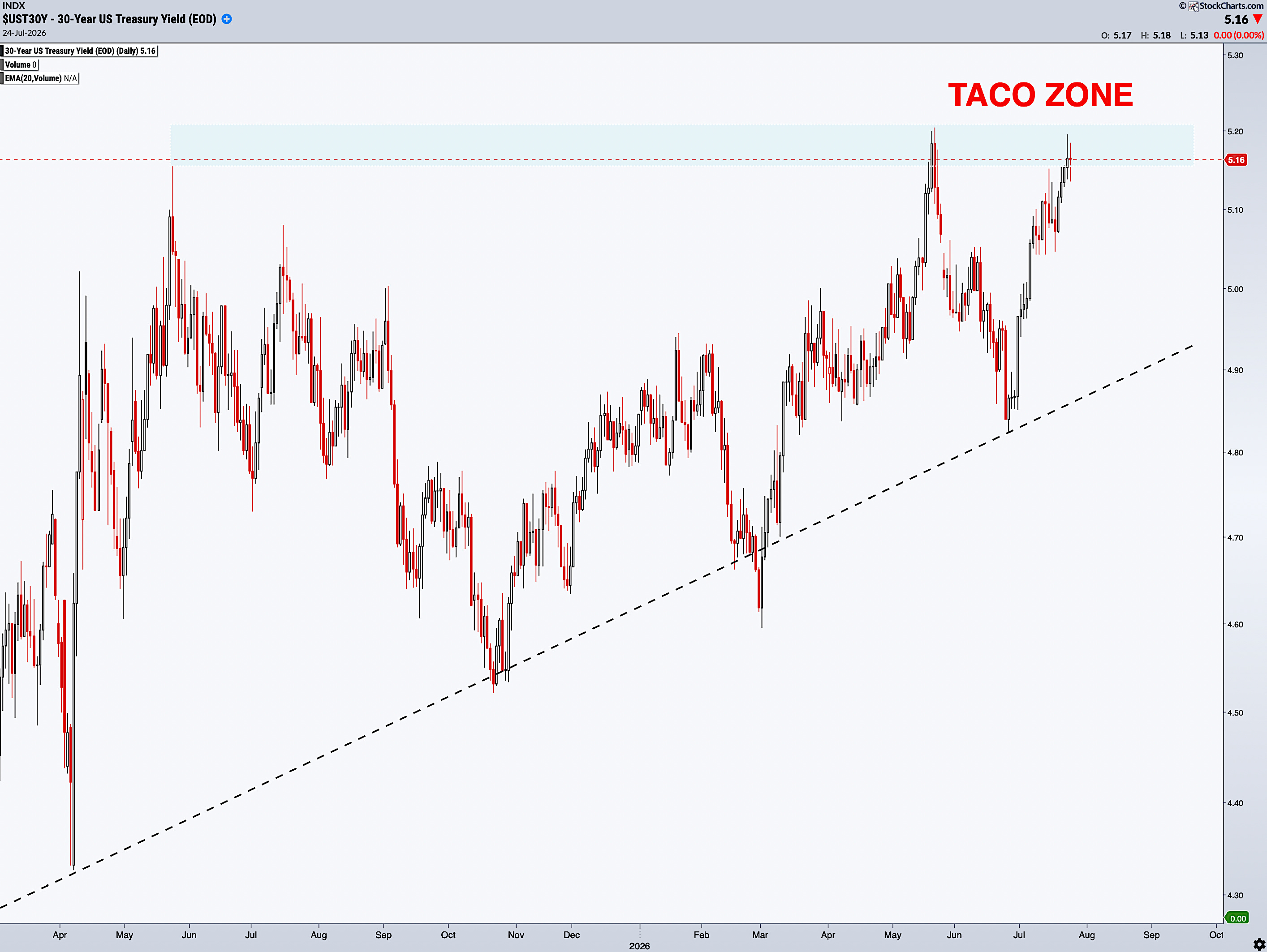
The 30-year Treasury yield is testing and probing the 5.16–5.20 area after a sustained rise along its multi-year uptrend. We call it the TACO Zone for a reason. At these levels, higher long-end yields begin to impose visible political and economic costs: rising mortgage rates, pressure on equity valuations, and tighter financial conditions that become harder to ignore.
History suggests this is precisely the point at which incentives can shift. For an administration focused on growth and market stability, the political calculus of allowing yields to break decisively higher starts to deteriorate.
The temptation to deliver a TACO (Trump Always Chickens Out), to soften rhetoric, adjust policy signals, or create conditions that ease the long end, tends to rise once the pain threshold is reached.
A decisive break above the zone would tighten financial conditions further and raise the bar for our Dovish Shock confirmation ladder.
The market is still priced for a restrictive path; this is the latest reminder that monetary evidence must still improve before the thesis can move from alive to confirmed.
At the same time, the very existence of the TACO Zone highlights the growing tension between market pricing and political incentives.
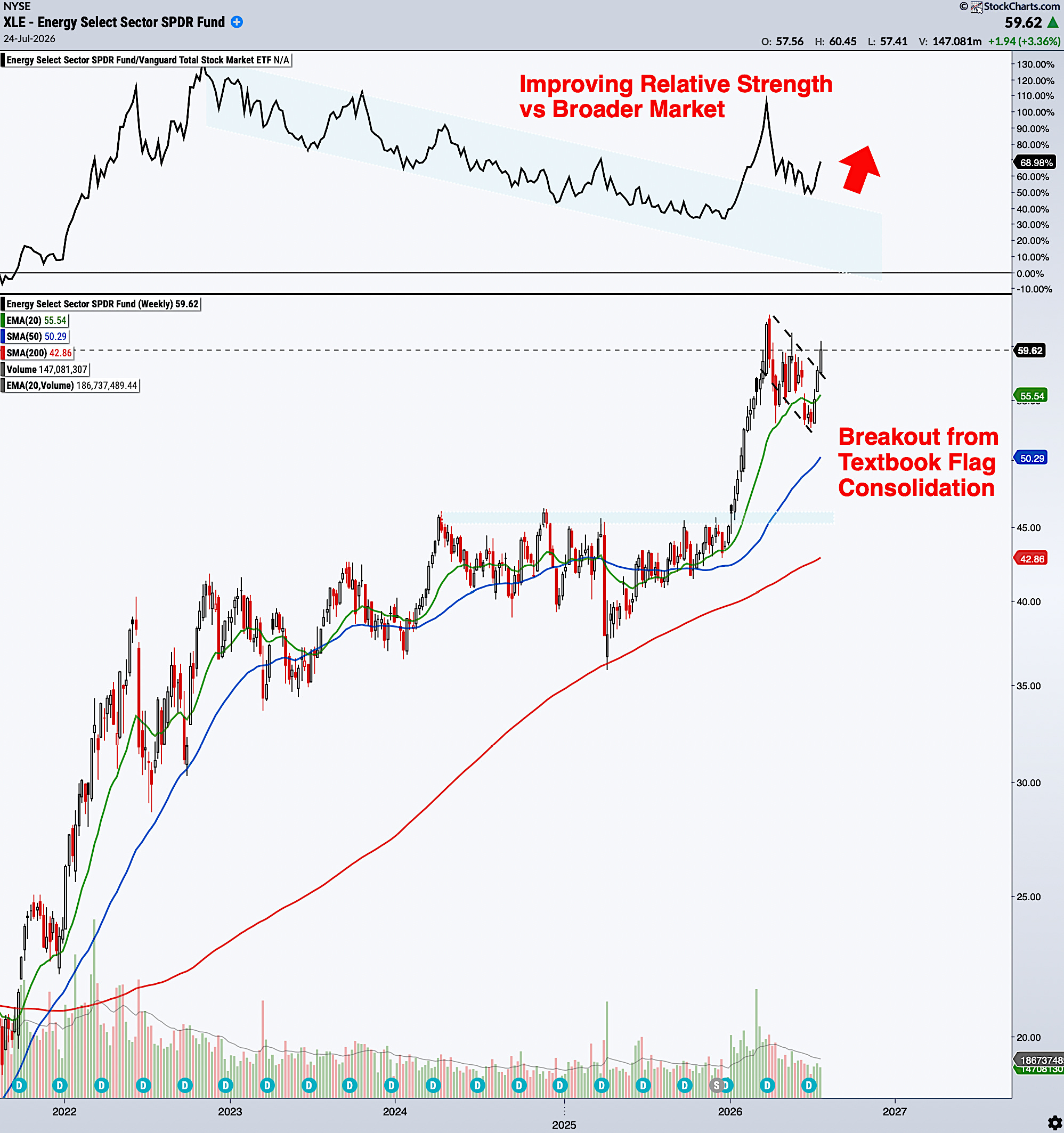
Energy has been the clearest beneficiary of the renewed geopolitical risk premium. XLE has broken higher from a textbook flag consolidation, accompanied by improving relative strength versus the broader US equity market.
The existing allocation is responding exactly as the Iran related supply fears and oil volatility would suggest. Absolute momentum and relative performance are both moving in the same direction for the first time in several months.
At the same time, another important dynamic is gripping markets: growing uncertainty about the ultimate size, speed and profitability of the AI capex boom.
Recent breakthroughs from Chinese laboratories continue to change the calculation, both the size of the overall pie and how the slices may ultimately be distributed. Capability is improving while costs compress.
That combination pressures the scarcity premiums that defined the first phase of the trade.
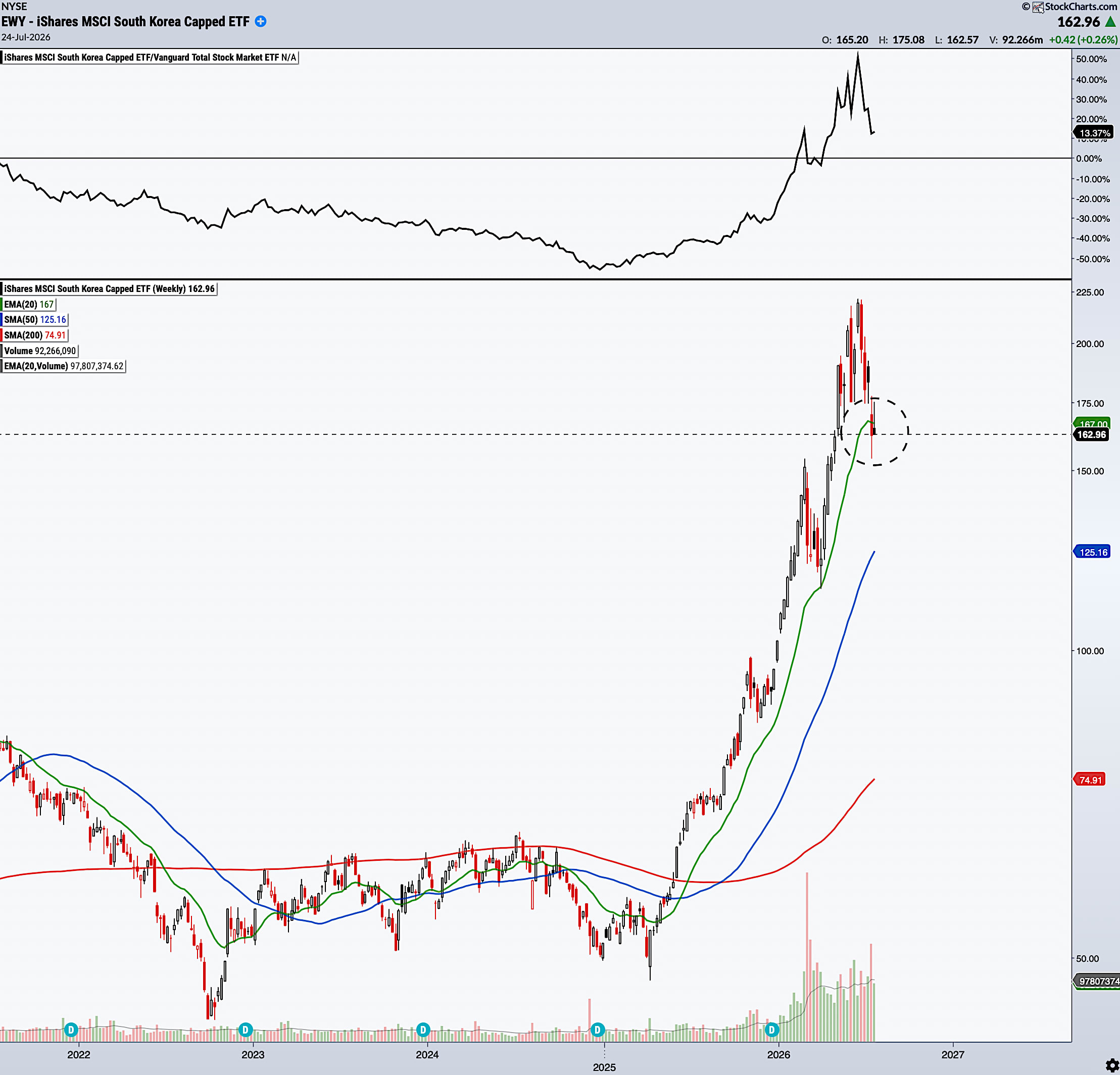
Our recent exit from the remaining EWY position after a 238% total return therefore appears increasingly timely.
We entered when memory was still an underappreciated bottleneck. We left once the market had fully discovered the thesis and price had begun to embed an unusually optimistic future. The subsequent reversal in South Korean equities simply reinforces the value of harvesting when recognition arrives.
No change to the Model Portfolio is required.
The existing exposures already capture the energy risk premium and the downstream application-layer opportunity. Higher long-end yields remain a headwind that the Dovish Shock thesis must still overcome, even as political incentives to deliver a TACO begin to build. We will continue to measure price against process rather than force activity for its own sake.
Good investing!
Vasco Marques de Freitas, CFA, CMT
A quick note on accountability.
We don’t publish these theses to be right on paper. We publish them to express edge in the real economy. Our Leaderboard shows the exact scorecard since inception, tracking every position, our compounding outperformance against the market, and the triple-digit winners we’ve captured along the way.
You can view the exact numbers on our Leaderboard.
Important Disclosure
This article reproduces general investment research first published for Tier One subscribers on 25 July 2026. It was produced by Vasco Marques de Freitas, CFA, CMT, Founder and CEO of VMF Research, Lda. The original analysis, charts and conclusions reflect the information available at the time of publication and have not been revised with hindsight. Any introductory comments concerning subsequent events were added when the article was republished and should be distinguished from the original research.
The publication contains information recommending or suggesting an investment strategy. It is not personalised investment advice and does not consider any reader’s objectives, financial circumstances, knowledge, experience or tolerance for risk. The Tier One Model Portfolio is an illustrative research portfolio and does not represent client assets or transactions executed by VMF Research.
The analysis combines macroeconomic, political, fundamental and technical evidence within a medium- to long-term framework. The “TACO Zone” and “Dovish Shock” are conditional analytical hypotheses, not forecasts or assurances. Subsequent developments may appear consistent with the analysis without confirming its broader conclusions, and market conditions can reverse rapidly. Views are reviewed through VMF Research’s monthly publications and may be updated through weekly or ad hoc research.
Equities, energy-sector instruments, sovereign bonds and interest-rate-sensitive assets involve substantial market, geopolitical, policy, liquidity and valuation risks. Technical signals may fail, political decisions may change without warning and investors may incur material losses.
Disclosure of interests: as of the original publication date, neither VMF Research, Lda. nor Vasco Marques de Freitas personally held any financial instrument mentioned in this article.
Past performance is not indicative of future results. Readers should conduct their own analysis and, where appropriate, consult an authorised financial adviser before making an investment decision.